
In short
The two changes that break most existing advice: tax-free shopping switches on 1 November 2026 from tax deducted at the till to a refund claimed on departure, and JR East raised fares on 14 March 2026, the first rise in 39 years. Almost every English guide online still describes the old versions of both.
Each tip checked against a primary source, August 2026.
Most Japan tips articles are recycled from 2019. They tell you to buy the JR Pass, get a Welcome Suica because tourists cannot buy a normal one, and show your passport at the till for a tax-free discount. All three of those are now wrong.
Here are the tips that actually matter in 2026, with the numbers behind them.
What is in this guide
- 1. Do the JR Pass arithmetic before you buy it
- 2. You can buy a normal Suica again
- 3. Tax-free shopping changes on 1 November 2026
- 4. The departure tax tripled
- 5. Lodging taxes are not in the price you booked
- 6. Forward your luggage instead of dragging it
- 7. Use 7-Eleven ATMs, not airport exchange counters
- 8. Prices moved, quietly
- 9. Book what actually needs booking
- 10. Mt Fuji has real rules now
- 11. Etiquette: the five that matter
- 12. Timing tricks that save real money
- 13. Things that no longer exist
- 14. Practical odds and ends
- Frequently asked questions
- A note on our numbers
- What to pack, and what to leave
- Staying connected and getting around on foot
- Accessibility
- Travelling with children
- Safety and emergencies
- The five-minute pre-flight check
- What is confirmed for 2027
- Kansai: Kyoto and Osaka
Verified: 18 August 2026 · Exchange rate: ¥159.21 = 1 USD
Editor’s note
Fourteen tips, each checked against current rules rather than repeated from older lists. We have deliberately left out several pieces of advice that are still quoted everywhere and are now simply wrong.
1. Do the JR Pass arithmetic before you buy it
This is the most expensive default advice in Japanese travel. The 7-day ordinary Japan Rail Pass costs ¥50,000, rising to ¥53,000 on 1 October 2026. The classic first-timer route does not come close to justifying it.
| Leg | Reserved fare |
|---|---|
| Tokyo to Kyoto | ¥14,170 |
| Kyoto to Osaka | ¥1,450 |
| Osaka to Tokyo | ¥14,720 |
| Point-to-point total | ≈ ¥29,000 |
| 7-day JR Pass | ¥50,000 to ¥53,000 |
| Overspend | ≈ ¥21,000 to ¥24,000 per person ($132 to $151) |
When the pass still wins: 14-day (¥84,000) and 21-day (¥105,000) trips, where the daily cost drops 20 to 33 per cent; itineraries that reach Kyushu or Hokkaido; and schedules with a long-distance leg nearly every day.
Bonus catch: the Japan Rail Pass does not cover Nozomi or Mizuho, the fastest Shinkansen. Pass holders ride Hikari, which is 20 to 40 minutes slower on Tokyo to Osaka, or pay a supplement.
The full comparison, including regional passes, is in How Much Does a Trip to Japan Cost?.
2. You can buy a normal Suica again
The chip shortage that forced JR East to stop selling ordinary Suica cards in 2023 ended. As of 2026 there are four ways to tap in, and the tourist card is no longer the only option.
| Card | Deposit | Validity | Foreign card top-up |
|---|---|---|---|
| Suica / PASMO | ¥500, refundable | No expiry | No, cash only |
| Welcome Suica (physical) | None | 28 days | No |
| Welcome Suica Mobile | None | 180 days | Yes |
| Tourist PASMO | None | 28 days | No |
If you have an iPhone, add Welcome Suica Mobile to Apple Wallet before you fly. No queue, no deposit, six months of validity, tops up with a foreign credit card. Android needs a Japan-issued Felica handset, so a physical card is still the answer there.
3. Tax-free shopping changes on 1 November 2026
Every guide currently online describes the old system. Here is the difference.
| Until 31 Oct 2026 | From 1 Nov 2026 | |
|---|---|---|
| At the till | Tax deducted, you pay less | You pay full price |
| Consumables | Sealed in a bag you must not open | Sealing rule abolished |
| Refund | None needed | Claimed at airport customs, before check-in |
| Categories | Consumables and general goods split, separate thresholds | Simplified |
Three practical consequences: budget 10 per cent more up front; do customs before you drop your bags, not after security; and leave 30 to 45 extra minutes at the airport if you have shopped seriously.
4. The departure tax tripled
¥1,000 became ¥3,000 on 1 July 2026. It is collected inside your airline ticket price, so you will not be asked for it at the airport, but it is ¥12,000 for a family of four that no one budgeted for.
5. Lodging taxes are not in the price you booked
Booking sites almost never include these. They are collected in cash or card at check-out, per person per night.
| City | 2026 rate | Notes |
|---|---|---|
| Kyoto | Up to ¥10,000 per night, five bands | Raised 1 Mar 2026 from a ¥1,000 ceiling. The top band bites hard at luxury ryokan |
| Osaka | ¥0 / ¥200 / ¥400 / ¥500 | Doubled 1 Sep 2025; threshold dropped from ¥7,000 to ¥5,000 |
| Tokyo | ¥100 / ¥200 now | Becomes a flat 3% on 1 Apr 2027, exemption below ¥13,000, minpaku included |
| Kanazawa, Fukuoka, Sapporo and others | ¥100 to ¥500 | Growing list, check your city |
For a couple spending four nights in Kyoto at a mid-range hotel, this is a few thousand yen. At a ¥100,000-a-night ryokan it is ¥10,000 per person per night, which is a genuinely different number.
6. Forward your luggage instead of dragging it
Takkyubin costs roughly ¥2,000 to ¥2,500 per suitcase between cities and delivers next day. Hand it in at your hotel’s front desk before 10am, travel Tokyo to Kyoto with a daypack, collect it at the next hotel.
Shinkansen luggage rules make this practical rather than optional: bags with combined dimensions over 160 cm require a reserved oversized baggage space, booked in advance and free, or you pay ¥1,000 and get assigned wherever there is room. Most large check-in suitcases exceed 160 cm.
This is the single best ¥2,000 you will spend in Japan.
7. Use 7-Eleven ATMs, not airport exchange counters
7-Eleven and Japan Post ATMs reliably accept foreign cards and give a near-interbank rate. Airport exchange counters do not. Withdraw ¥20,000 to ¥30,000 on arrival rather than bringing yen from home.
Japan is more card-friendly than its reputation, but the exceptions are consistent: ramen shops with ticket machines, temple entry booths, rural buses, street food, small izakaya, and coin lockers. Carry ¥15,000 to ¥20,000 in notes.
8. Prices moved, quietly
If your mental model of Japanese prices was formed before 2025, adjust it.
| Item | Old | 2026 | Effective |
|---|---|---|---|
| Vending machine drink | ¥160 to ¥180 | ≈ ¥216 | Oct 2025 |
| 7-Eleven regular coffee | ¥120 | ¥140 | Jul 2026 |
| Tokyo public sento | ¥550 | ¥600 | 1 Aug 2026 |
| Tokyo taxi flagfall | ¥430 | ¥500 for 1.096 km, then ¥100 / 232 m | Apr 2026 |
| JR East fares | — | +7.8% | 14 Mar 2026 |
| Tokyo Wide Pass | ¥15,000 | ¥16,000 | 14 Mar 2026 |
Inflation in Japan is running at 1.7 per cent, which is modest, but the yen at ¥159 to the dollar means foreign visitors are still buying at a discount to 2019 in real terms. National hotel ADR is ¥22,450, up 11.4 per cent year on year, and that increase is concentrated at the top: luxury up 19.3 per cent, economy up 4.2 per cent. Business hotels remain the best value in the country.
9. Book what actually needs booking
| Needs advance booking | Does not |
|---|---|
| Ghibli Museum (lottery, months ahead) | Temples and shrines |
| Shibuya Sky sunset slots | Metropolitan Government observatory (free) |
| teamLab Borderless and Planets | Public parks and gardens |
| Shinkansen reserved seats in peak season | Shinkansen non-reserved cars |
| Mt Fuji climb (mandatory registration) | Most museums |
| Tokyo Disney | Department store food halls |
| Popular sushi counters | Standing soba, ramen, izakaya |
10. Mt Fuji has real rules now
The 2026 season brought the strictest regime in the mountain’s modern history:
- ¥4,000 on all four trails. The old ¥2,000 Yoshida-only fee is gone.
- Mandatory advance registration for every climber.
- Shizuoka Prefecture trails (Fujinomiya, Gotemba, Subashiri) require an e-learning course and a test before registration.
- Gates close 2pm to 3am unless you hold a mountain hut booking, ending overnight “bullet climbing.”
- Season runs roughly early July to early September.
11. Etiquette: the five that matter
Most etiquette lists are anxiety generators. These are the ones people actually notice.
- No eating or drinking while walking. Stand by the vending machine, finish, bin it there.
- Silence on trains. No calls, phone on manner mode.
- Shoes off wherever there is a step up and a shoe rack.
- Wash before the onsen. Sit on the stool, soap, rinse fully, then soak. Tattoos are still an issue at some traditional baths; look for tattoo-friendly listings or book a private family bath.
- Never tip. It causes confusion, occasionally offence.
Things that are fine despite the rumours: slurping noodles, speaking English slowly after “sumimasen,” and pointing at a menu when you cannot pronounce it.
12. Timing tricks that save real money
- Lunch sets at high-end restaurants cost a third of the same kitchen’s dinner. Book your one splurge at midday.
- Department store basements after 7pm discount bento and prepared food by 30 to 50 per cent.
- Avoid Golden Week (29 Apr to 5 May), Obon (mid-August) and New Year. These are domestic travel peaks: trains sell out, hotels double.
- November is the best-value good month: clear, mild, autumn colour, and cheaper than cherry blossom season.
- Temples at opening time. Fushimi Inari before 7am and Arashiyama before 8am are different places from the ones in the photographs.
13. Things that no longer exist
Arriving at a locked door is avoidable.
| Listed in old guides | Reality |
|---|---|
| Robot Restaurant, Shinjuku | Closed. Samurai Restaurant in its place |
| Oedo-Onsen Monogatari, Odaiba | Permanently closed, 5 Sep 2021 |
| Yokohama Landmark Tower Sky Garden | Closed until at least 2028 |
| MariCar street go-karting | Lost the Nintendo lawsuit, now Street Kart, no costumes |
| Tokyo Disney free Priority Pass | Ends 31 Aug 2026, paid Premier Access from 1 Sep |
| DisneySea Fantasy Springs virtual queue | Dropped, normal queueing since 1 Apr 2025 |
| JR East Tohoku / Nagano-Niigata passes | Consolidated into one JR EAST PASS, 14 Mar 2026 |
| Tsukiji inner market | Moved to Toyosu in 2018; outer market still open |
14. Practical odds and ends
- eSIM, not pocket wifi, unless you are a group sharing one connection. ¥2,000 to ¥4,000 for 10 to 20GB over two weeks.
- Bins are rare. Convenience stores and platform bins are your options.
- Tap water is safe everywhere.
- Power is 100V, type A/B. US devices work, UK and EU need an adapter.
- Coin lockers ¥400 to ¥1,000, full by 10am at major stations on weekends. Ecbo Cloak books shop storage instead.
- Google Maps is accurate for Japanese rail down to platform numbers.
- Convenience store food is good. This is not a budget compromise, it is a genuine feature of the country.
Frequently asked questions
Should I buy the Japan Rail Pass in 2026? Only if your trip is 14 or 21 days, or reaches Kyushu or Hokkaido, or has a long-distance leg nearly every day. For a 7 to 10 day Golden Route trip, point-to-point tickets cost about ¥29,000 against ¥53,000 for the pass from 1 October 2026.
Can tourists buy a normal Suica card now? Yes. Ordinary Suica and PASMO sales resumed after the chip shortage ended. Welcome Suica Mobile, valid 180 days and topped up with a foreign card, is the best option for iPhone users.
How much cash should I carry in Japan? ¥15,000 to ¥20,000 in notes, topped up at 7-Eleven or Japan Post ATMs. Cards work in hotels, chains, department stores and trains, but not in small ramen shops, temples, rural buses or street stalls.
What is the Japan departure tax in 2026? ¥3,000 per person from 1 July 2026, tripled from ¥1,000. It is included in your airline ticket price.
How does tax-free shopping work now? Until 31 October 2026 the tax is deducted at the till. From 1 November 2026 you pay full price and claim the refund at airport customs before check-in, and the sealed-bag rule for consumables is abolished.
Do I need to tip in Japan? No, never. There is no tipping culture. Higher-end restaurants add a service charge to the bill instead.
Is it rude to have tattoos in Japan? Not in daily life. Some traditional onsen and public baths still refuse entry. Tattoo-friendly baths are increasingly common, and private family baths are always an option.
How much does a day in Japan cost? About ¥7,800 ($49) as a backpacker, ¥22,200 ($139) mid-range, ¥48,500 ($305) comfortable, excluding intercity transport.
A note on our numbers
Every figure above was checked against operator, city or government sources in August 2026, with the effective date noted for recent and upcoming changes. Japanese fares and taxes move on fixed calendar dates, so items dated 2027 are confirmed but not yet live. Spot something that has moved? Tell us and we will correct it.
Keep reading: Japan Travel Guide 2026 · How Much Does a Trip to Japan Cost? · Tokyo Travel Guide 2026 · Where to Stay in Tokyo
What to pack, and what to leave
Japan punishes over-packing more than most destinations, because you will carry your own bag up station stairs and because hotel rooms are small.
| Bring | Why |
|---|---|
| Shoes you can slip off | You will remove them several times a day |
| Socks without holes | See above. This is not a joke |
| A small towel | Public toilets often have no dryer or paper |
| A packable bag for rubbish | Bins barely exist in public |
| A plug adapter (UK and EU) | Japan is 100V, type A/B |
| One layer more than you expect | Buildings are heated and cooled aggressively |
| A printed allergy card in Japanese | Restaurants take them seriously |
| Leave at home | Why |
|---|---|
| Large suitcases | Forward them, or better, do not bring them |
| Yen bought abroad | 7-Eleven ATMs beat every exchange counter |
| Formal clothes | Almost nowhere requires them |
| Toiletries | Japanese drugstores are excellent and cheap |
| A travel adapter with a bulky transformer | 100V is close enough to 110V for US devices |
Staying connected and getting around on foot
Google Maps is unusually good in Japan: it gives platform numbers, which carriage to board for the fastest exit, and accurate walking times. Trust it over your sense of direction, especially in Shinjuku Station, which has over 200 exits and where taking the wrong one adds fifteen minutes.
Station exits matter more than street addresses. Japanese addresses are block-based rather than street-based, so locals navigate by station exit and landmark. When someone gives you directions, they will start with an exit number.
eSIM at ¥2,000 to ¥4,000 for 10 to 20GB over two weeks is the default. Pocket wifi only makes sense for three or more people sharing.
Accessibility
Japan is better than its reputation for step-free access and worse than its reputation for space.
| Reality | |
|---|---|
| Major stations | Lifts and step-free routes at nearly all JR and metro stations in cities |
| Older and rural stations | Often stairs only |
| Shinkansen | Wheelchair spaces available, book in advance |
| Temples and shrines | Frequently gravel, steps and no ramp |
| Hotel rooms | Standard rooms are small; accessible rooms exist but are limited, book early |
| Staff assistance | Excellent. Station staff will escort you and radio ahead to your destination |
Asking for help at a station gate is the single most effective thing you can do. Staff will physically walk you to the platform and arrange assistance at the other end.
Travelling with children
| Notes | |
|---|---|
| Trains | Free under 6, half fare 6 to 11 |
| Nappy changing | Reliable at department stores, station facilities, convenience stores |
| Baby food and formula | Widely available at drugstores |
| Restaurants | Family restaurants (Saizeriya, Gusto) have kids’ menus and high chairs. Small izakaya rarely do |
| Prams | Hard in rush hour, fine otherwise. Lifts exist but are often at the far end of the platform |
| Attractions | Kyoto Railway Museum, Osaka Aquarium, Ueno Zoo, Tokyo’s Railway Museum in Omiya |
Safety and emergencies
| Police | 110 |
| Fire and ambulance | 119 |
| Japan Visitor Hotline (24h, English) | 050-3816-2787 |
| Earthquake alerts | Automatic on Japanese phones. Install a warning app on foreign ones |
| Lost property | Genuinely effective. Report it at the nearest station or koban |
| Typhoon season | August to October. Trains are pre-emptively suspended, not delayed |
Japan runs a planned suspension system for typhoons: rail operators announce cancellations a day ahead rather than running and failing. If one is forecast, check the operator’s website the night before rather than turning up at the station.
The five-minute pre-flight check
Everything in this article condenses into a list you can run through the week before you fly.
| Do this | Why |
|---|---|
| Add Welcome Suica Mobile to Apple Wallet | 180 days, no deposit, tops up with a foreign card, skips the airport queue |
| Do the rail-pass arithmetic for your specific route | The 7-day pass loses about ¥21,000 on Tokyo, Kyoto, Osaka |
| Buy an eSIM and activate it before departure | ¥2,000 to ¥4,000 for two weeks. Navigating without data is a false economy |
| Book Ghibli Museum, teamLab, Shibuya Sky if you want them | The Ghibli Museum is a lottery months ahead |
| Register for Mt Fuji if you plan to climb | Mandatory, ¥4,000, plus an e-learning test on Shizuoka-side trails |
| Check lodging tax for your cities | Kyoto up to ¥10,000 per person per night since 1 Mar 2026 |
| Budget the ¥3,000 departure tax | Tripled on 1 Jul 2026, inside your ticket price |
| If travelling after 1 Nov 2026, budget 10% more for shopping | Tax-free moves to an airport refund claimed before check-in |
| Plan luggage forwarding between cities | ¥2,000 to ¥2,500 per bag, next day. The best-value spend in Japan |
| Note the last train in each city | Roughly midnight. There is no night service anywhere in Japan |
What is confirmed for 2027
Two changes are legislated or decided but not yet in force. Anything you read that describes these as current is wrong; anything that omits them is out of date if you are travelling next year.
| Change | Detail | Date |
|---|---|---|
| Food consumption tax | Drops from 8% to 1% on food and non-alcoholic drink. Cabinet decision, legislation pending | 1 Apr 2027 |
| Tokyo lodging tax | Replaces ¥100 / ¥200 flat amounts with a flat 3%, exemption below ¥13,000, minpaku included | 1 Apr 2027 |
The Tokyo change is the one to watch: on a ¥40,000 room it means ¥1,200 a night rather than ¥200, so a week in a good Tokyo hotel gains roughly ¥7,000 in tax.
Kansai: Kyoto and Osaka
Tokyo is only half a first trip to Japan. Two hours and fifteen minutes west, the Golden Route continues.
- Kyoto Travel Guide 2026 — the lodging tax that now reaches ¥10,000 a night, and the bus pass that no longer exists
- The Perfect 3-Day Kyoto Itinerary — built around two dawn starts
- Where to Stay in Kyoto — now the most expensive bed in Japan
- How Much Does a Trip to Kyoto Cost?
- The Best Things to Do in Kyoto — including the temples that are closed for restoration
- Osaka Travel Guide 2026 — why the Expo site is shut and the Amazing Pass still wins
- The Perfect 2-Day Osaka Itinerary
- Where to Stay in Osaka — Umeda or Namba, decided
- The Best Things to Do in Osaka
- Best Day Trips from Osaka and Kyoto — Nara, Kobe, Himeji, Koyasan
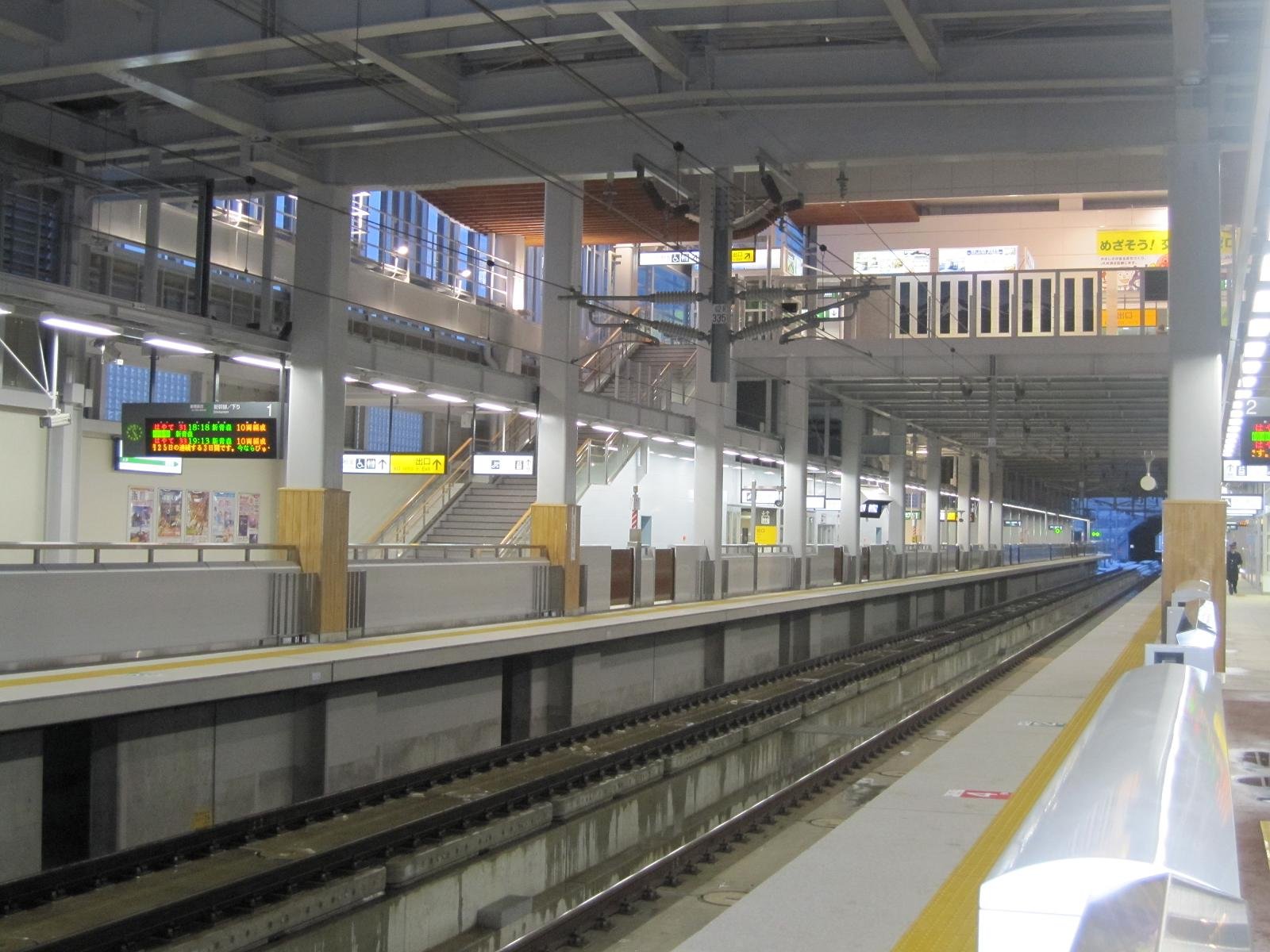
Photo: “Shinkansen platform at Shichinohe-Towada station” by Angaurits, via Wikimedia Commons, licensed CC0.