
In short
The whole itinerary turns on one fact: Todai-ji’s Great Buddha Hall opens at 07:30, roughly two hours before the coaches arrive. Starting there (¥800, cash) and moving to Nigatsu-do, then Kasuga Taisha by 09:00 and the Kofuku-ji National Treasure Museum (¥900) by 10:30 gets the major sites done before the crowds and leaves the afternoon free.
Opening times and fees verified against each temple’s own page, August 2026.
Most one-day Nara itineraries are the same list in the same order, starting at ten. They are not wrong so much as they are indifferent to the one structural fact that makes a day here good or mediocre.
Todai-ji opens at 07:30 from April to October — 08:00 the rest of the year. Nara National Museum opens at 09:30. Kofuku-ji’s halls open at 09:00. Isuien opens at 09:30.
What is in this guide
That is a gap of ninety minutes to two hours in which the most-visited building in Japan’s first permanent capital is open and essentially nothing else is. It is not a secret, it is not a hack, and it costs nothing but an earlier train. Everything below is built on it.
A note on what this itinerary does not do: it does not tell you the coaches arrive at ten. That claim is everywhere in English writing about Nara and we could not source it anywhere. The opening times are published. Plan on those.
Before you go
Take Kintetsu, not JR, unless you hold a rail pass. Kintetsu-Nara station is a few minutes from the park. JR Nara is further west through the town and adds fifteen minutes on foot to everything.
- Kyoto to Kintetsu-Nara: 760 yen, about 51 minutes with one change at Yamato-Saidaiji. The limited express adds 520 yen and saves roughly fifteen minutes.
- Osaka-Namba to Kintetsu-Nara: 680 yen, plus 520 on the limited express.
Bring cash. Todai-ji is cash only, and so are several of the smaller admissions.
Do not buy a bus pass reflexively. A single ride is 250 yen and the 600 yen day pass breaks even on the third boarding. This itinerary uses one bus ride, at most two. If you add Nishinokyo in the afternoon, buy the pass; otherwise skip it.
07:30 — Todai-ji, before anyone else
800 yen for the Great Buddha Hall, 1,200 including the museum. Cash.
Walk in from Kintetsu-Nara through the park. You will meet deer on the way; ignore them for now, because holding food is the single highest-risk thing you can do here and doing it in a crowd is worse. More on that below.
The hall itself takes twenty minutes if you are moving and an hour if you are not. The bronze Buddha is fifteen metres tall and cast in the eighth century, and the building around it — even at two-thirds of its original width — is one of the largest wooden structures on earth. Early, with low light coming through the front opening and perhaps thirty other people in a hall built for thousands, it is a genuinely different experience from the same room at eleven.
When you come out, walk east and uphill to Nigatsu-do. It is free, it opens onto a terrace looking back over the city, and almost nobody who came for the Buddha bothers. Hokke-do and Kaidan-do open at 08:30, 800 yen each, and hold some of the finest eighth-century sculpture in Japan in rooms you will often have to yourself.
09:00 — the Kasuga approach
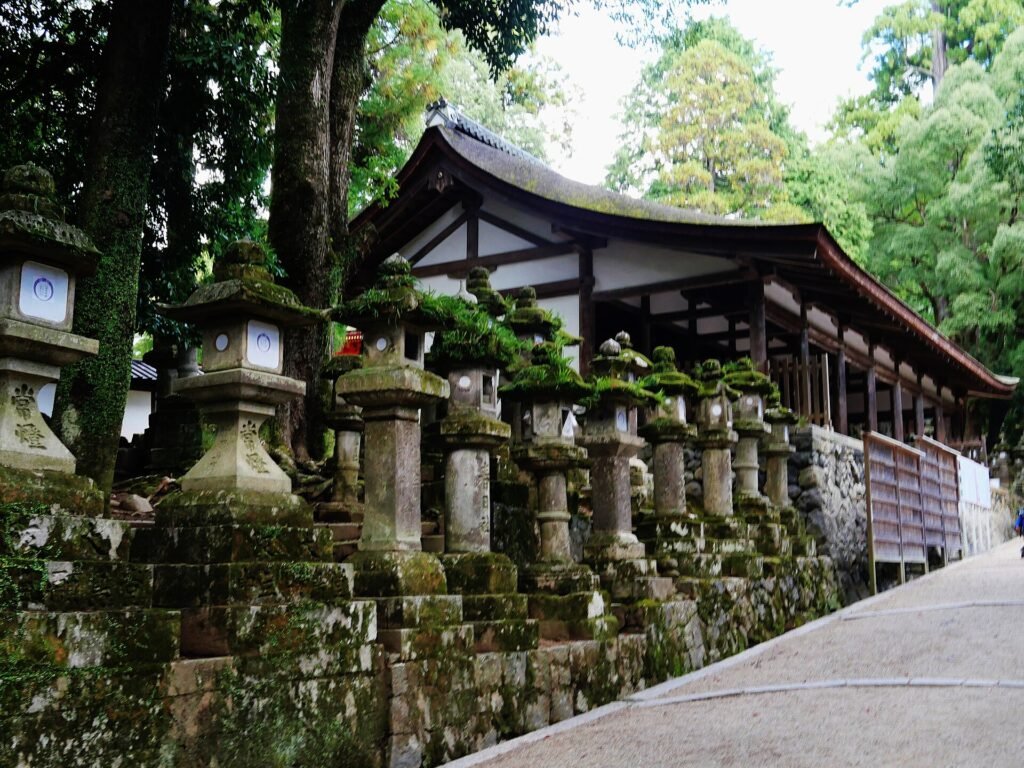
Walk south through the forest to Kasuga Taisha. This is the part of the day that does not photograph and is the best of it: a wide gravel path under old cedars, lined with roughly two thousand stone lanterns, going gently uphill for about twenty minutes.
The grounds are free. The 700 yen special worship takes you inside the middle gate to the corridor of hanging bronze lanterns — that is the image you have seen, and it is worth the money. Two caveats: availability varies by date and certain festival days restrict access, and 2026 is the shrine’s 1250th anniversary year, so fees for special exhibitions at the Kokuhoden museum (normally 700 yen) may differ.
If it is April or May, the Man’yo Botanical Garden (500 yen) is open every day — it closes Tuesdays only from June to March, and April and May are wisteria season, which is the whole point of the place.
10:30 — Kofuku-ji
Back down towards the station and the five-storey pagoda.
The National Treasure Museum is 900 yen and holds the Ashura statue: three faces, six arms, and an expression that has been reproduced on more posters than any other object in Japanese Buddhist art. It is smaller and considerably stranger in person. This is the best-value ticket in Nara.
The three-hall combined ticket is 1,600 yen and adds the Eastern and Central Golden Halls. Worth it if you want the architecture; the museum alone is the one to do if you are choosing.
Prices here rose in April 2025. If you are reading 700 yen anywhere, that page has not been updated in over a year.
12:00 — lunch in Naramachi
South of Sarusawa Pond the monument circuit ends and a town begins. Naramachi is the old merchant quarter: lattice-fronted townhouses, lanes too narrow for a coach, and food aimed at people who live there.
Two restored houses are open and free: Koshi-no-Ie, which closes Mondays, and Nigiwai-no-Ie, which closes Wednesdays. Usefully, that means there is no single day on which both are shut. Both are 09:00 to 17:00 and both take about twenty minutes.
This is also where to eat kakinoha-zushi — pressed sushi of salt-cured mackerel wrapped in persimmon leaves. One thing worth knowing: the leaves are rich in tannins and the whole thing is designed so that overnight the leaf’s aroma and the mackerel’s umami migrate into the rice. It is meant to be eaten the day after it is made, not fresh. Buying some to take back for tomorrow’s breakfast is closer to the intent than eating it on the spot.
14:00 — pick one
The afternoon is where itineraries should stop pretending everyone wants the same thing.
If you want a garden
Isuien, 1,200 yen — and that price includes the Neiraku Museum, which makes it better value than it first appears. Two linked gardens using Todai-ji’s gate and the hills beyond as borrowed scenery. Open 09:30 to 16:30, closed every Tuesday.
Next door, Yoshikien is free. Not free-for-foreigners, which is what almost every English page still says — free for everyone, and has been since April 2020. The concession was not withdrawn; it was extended to everybody. Nobody shows a passport. Nobody pays.
If your Tuesday plans just collapsed: Yoshikien is open, and it is the better bargain anyway.
If you want more temples
Two stops out to Nishinokyo, where almost no day-tripper goes. Yakushi-ji 1,000 yen (covering the Kondo, Daikodo and Toindo, not the Genjo-sanzoin precinct) and Toshodai-ji 1,000 yen, open 08:30 to 17:00 with a 200 yen treasure house. This is the leg that justifies the 600 yen bus pass.
If you want scale rather than detail
Heijo Palace Site Historical Park, and it is free. This was the imperial capital before Kyoto — a vast, flat, windy site with a railway line running straight through the middle of it. What stands is reconstruction: the Suzakumon gate, the Daigokuden hall rebuilt in 2010, and the Daigokumon completed in 2022, which is recent enough that most English guides do not mention it. Open 09:00 to 16:30; most facilities closed Mondays.
Nothing else in Nara gives you the same sense of how large the eighth-century city actually was.
If you want a view
Mount Wakakusa, 150 yen. Open 09:00 to 17:00 from the third Saturday of March to the second Sunday of December. Thirty to forty minutes up a grass hill for the whole basin, the pagoda, and — in late afternoon — the light everyone comes to Nara hoping for.
About the deer, wherever you meet them
They are legally wild, ownerless animals with national natural monument status. Not owned by Kasuga Taisha, not tame, not trained.
Nara Prefecture recorded roughly a hundred incidents in the 2023 financial year. None required hospitalisation and 70.4 per cent needed only basic first aid. And 72.5 per cent happened while buying, giving, or having just given crackers.
So: the park is not dangerous. Holding food is where the risk lives, and you leave it the moment your hands are empty.
Give them nothing except the licensed shika senbei, which contain only rice bran and wheat flour. Not bread, not sweets, not the end of your lunch — other food makes them ill and kills some of them. Secure your bag before you approach: they take paper and plastic out of hands and pockets, and plastic in a deer’s stomach is fatal.
If you are here in September, October or November, that is the rut and the males are short-tempered. Mid-May to July is fawning and the females defend. Those two windows line up almost exactly with the two peaks in the injury data.
The bowing story, incidentally, is unsupported by any official source we could find. Head-lowering is ordinary deer behaviour, and a lowered head just before contact is as likely to precede a butt as a request. The full version is in our Nara travel tips.
Should you stay the night?
If you can, yes, and for a reason nobody mentions: Nara charges no lodging tax. Neither the city nor the prefecture levies one. Kyoto now charges 200 to 10,000 yen per person per night depending on your room rate; Osaka up to 500.
The better argument is that the seven-thirty opening only works if you are already here. Nara empties at five and becomes a small, quiet city with a floodlit pagoda in the middle of it. The day-trip version of Nara is fine. The overnight version is a different place.
The compressed version
| Time | Cost | |
|---|---|---|
| 07:30 | Todai-ji Great Buddha Hall | 800 yen, cash |
| 08:30 | Nigatsu-do, Hokke-do | free / 800 yen |
| 09:00 | Kasuga Taisha via the lantern approach | free, 700 inner |
| 10:30 | Kofuku-ji National Treasure Museum | 900 yen |
| 12:00 | Lunch and the two free houses in Naramachi | free |
| 14:00 | Isuien 1,200 or Nishinokyo 2,000 or Heijo Palace free | |
| 16:00 | Mount Wakakusa | 150 yen |
Done properly and cash in hand, a full day in Nara costs between 2,000 and 5,000 yen in admissions depending on which afternoon you choose, plus about 1,500 yen in trains from Kyoto and back.
For the full price list, the climate table and the rest of the corrections, see our Nara travel guide.
Editor’s note. Every price and opening time above was read off the temple’s, city’s or prefecture’s own page on 20 August 2026, and is printed with that date deliberately. We verify figures on the day we write and then leave them alone rather than editing them quietly later, so you can always tell how old a number is. Nara’s admissions have moved more than most in the last two years — Kōfuku-ji in April 2025, Hōryū-ji in March 2025 — so if you are reading this well after that date, check the two or three that matter to your budget.