
In short
Nara has exactly one protected food — Miwa sōmen, GI No. 12 — and its legal production area is the whole prefecture, not the village. Kakinoha-zushi, narazuke and Yamato-cha hold no protected status at all. The ministry gives two different origin stories for kakinoha-zushi, both hedged. And the wholesale price of Miwa sōmen is set by divination at Ōmiwa Shrine every 5 February.
Checked against MAFF, the GI register, Nara Prefecture and the makers’ own sites, 25 August 2026.
What is in this guide
- Nara has exactly one protected food, and it is not the one you think
- The price of Miwa sōmen is set by divination
- The registered noodle dish is the hot one
- Kakinoha-zushi: two origin stories, both hedged
- Narazuke is a product category, not a place
- The tea industry is shrinking, and the prefecture says so
- Chagayu is breakfast, not a curiosity
- Three more corrections
- Where you can actually eat temple food, with prices
- On “the birthplace of sake”
- What we could not verify
Nara’s food is written about loosely in English, and it does not need to be. Japan’s Ministry of Agriculture runs two separate food registries, the prefecture publishes its own tea statistics, and the geographical-indication register is a public list. Almost everything below can be checked.
Nara has exactly one protected food, and it is not the one you think
The GI register has one entry for Nara Prefecture: Miwa sōmen, GI No. 12, registered 29 March 2016.
Not kakinoha-zushi. Not narazuke. Not Yamato-cha. None of those holds a geographical indication or any other protected designation.
And the Miwa sōmen registration contains a detail that undoes the story most guides tell:
> Production area: the whole of Nara Prefecture.
A noodle made in Gojō or Ikoma can legally be Miwa sōmen. What the registration actually constrains is the method — a ten-stage hand-stretch in which stages five and seven must be done by hand — and the specification: wheat flour of at least 10.0% crude protein, finished noodle at least 9.5% protein, dried to no more than 13.5% moisture. It is a technique standard, not a village one.
Two things worth adding. The producers’ co-operative bands only member-made noodles meeting its own standard, stricter than the national one, with a torii-mark paper. And since 25 March 2026, Miwa sōmen is no longer the only GI-registered sōmen — Nankan and Awajishima hand-stretched sōmen were registered on that date.
The price of Miwa sōmen is set by divination
This is on Ōmiwa Shrine’s own festival page and is absent from English travel writing entirely.
On 5 February each year the shrine holds the Bokujō-sai, and its own description reads:
> “The selling price of the local speciality Miwa sōmen for the new year is divined according to ancient rite. In accordance with the divine will, one of ‘high’, ‘middle’ or ‘low’ is decided as the wholesale price.”
The other thing nobody mentions: sōmen is a winter manufacture. The ministry gives the production window as December to the end of March — the cold, dry season. The drying racks are a designated prefectural landscape asset, and the prefecture notes that most producers now dry indoors, with only some still sun-drying.
The registered noodle dish is the hot one
There is no cold-sōmen entry in the Nara regional-dish register. The registered dish is nyūmen, the hot broth version.
The ministry’s own account of the origin is hedged twice over — “is said to be” — and tells it two different ways in its two registries: a divine revelation at Ōmiwa Shrine in one, and in the other, simply that the son of the shrine’s chief priest planted wheat there. It also records that Miwa spread the craft outward to Banshū, Shōdoshima and Shimabara along the Ise pilgrimage route.
Kakinoha-zushi: two origin stories, both hedged
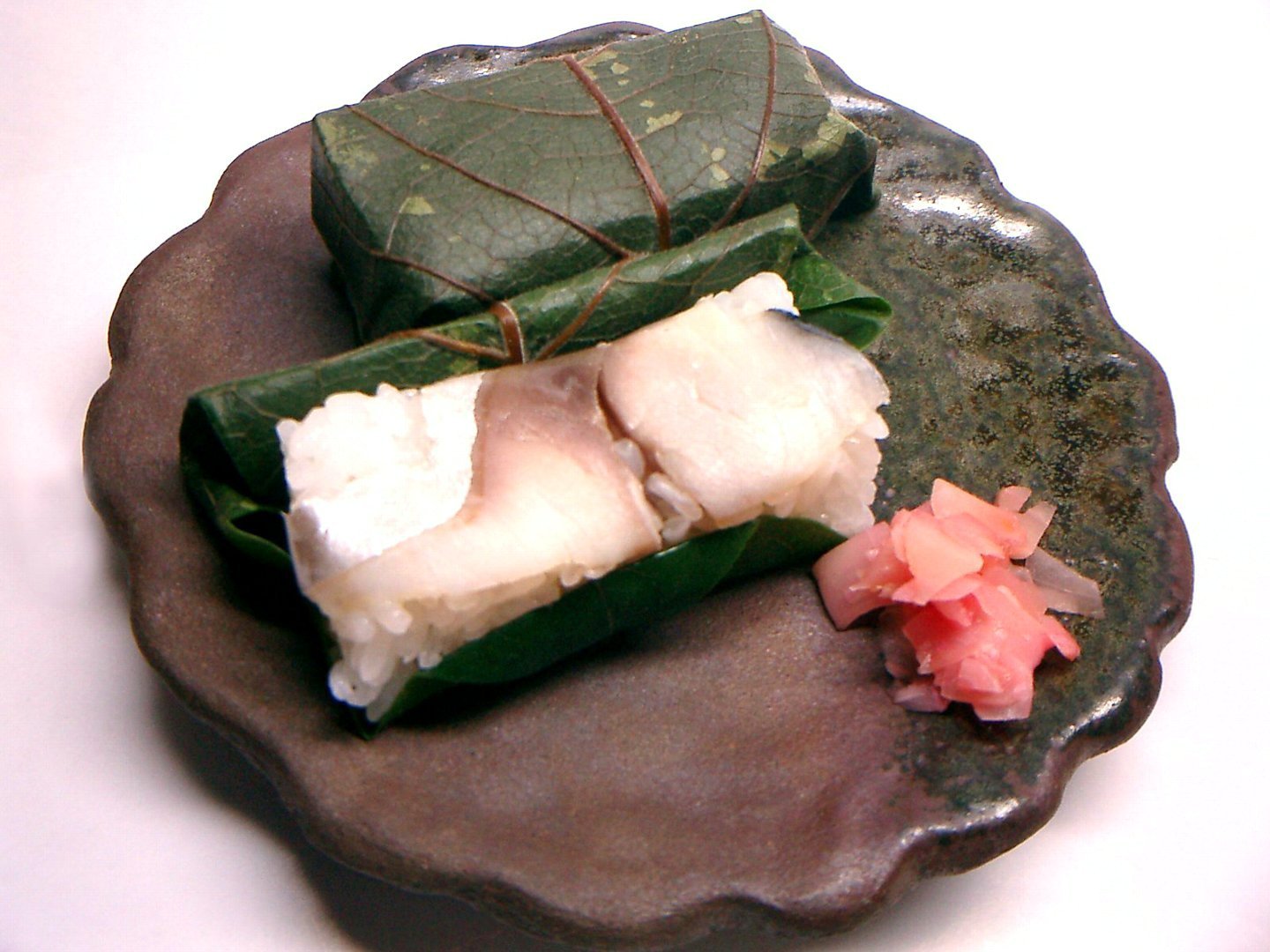
Persimmon-leaf sushi is Nara’s signature food, and the ministry gives two different accounts in its two databases, each explicitly flagged as one theory among several.
Version one: in the mid-Edo period, Kishū fishermen burdened by heavy tax salt-cured summer mackerel from the Kumano Sea and carried it over the passes to the Yoshino River villages, arriving in time for the summer festivals.
Version two: it began as a fermented narezushi, and the date is “either the Nanboku-chō period or the 1800s.” The form you actually eat, this version says, exists because the railway arrived and it was sold at station kiosks.
Any article that gives you one origin as fact is claiming more than the ministry will.
What is not in dispute is the technique. The leaf is from an astringent persimmon, chosen for its tannin. The vinegar and the leaf both preserve. And it is meant to rest overnight under a weight — the aroma of the leaf and the umami of the mackerel move into the rice. The ministry also gives a winter serving suggestion nobody repeats: grill it in its leaf for three or four minutes until the surface just chars.
Prices, from two makers’ own shops, checked 25 August 2026:
| Maker | Product | Price |
|---|---|---|
| Hiraso | Mackerel, 8 pieces | from ¥1,689 |
| Tanaka | Three-fish, 7 pieces | ¥1,479 |
| Tanaka | Mackerel only, 7 pieces | ¥1,285 |
| Hiraso | Mini, 8 kinds, 16 pieces | ¥2,160 |
A plain seven-or-eight-piece box sits between ¥1,285 and ¥1,689 at both.
Narazuke is a product category, not a place
“Narazuke” is defined in a national standard, not by geography. Japan’s agricultural standard for pickled vegetables defines it by process — repeatedly changing the sake lees, then finishing in a final lees bed — and by measurable thresholds: Brix at least 35°, alcohol at least 3.5%, salt no more than 5.0%.
Anyone in Japan meeting that spec may sell narazuke. And one of the oldest and most famous houses, founded in 1789, is in Kyoto, not Nara.
The ministry does place its history in Nara: a wooden tablet excavated at the Heijō palace site carries the name, over 1,300 years ago, and the modern form followed the Muromachi arrival of refined sake brewing. Completion takes three months to a year and a half.
The tea industry is shrinking, and the prefecture says so
Yamato-cha gets written up as a thriving speciality. The prefecture’s own production plan says otherwise:
| Planted area | Growers | |
|---|---|---|
| 2017 | 701 ha | 388 |
| 2020 | 654 ha | — |
| 2022 | 488 ha | 168 |
| 2027 target | 450 ha | 121 |
Planted area fell about 30% and grower numbers about 57% in five years, and the prefecture’s own target is a further decline. Output has held up because production is moving to higher-value shaded teas.
One caveat we will not paper over: the 2017 and 2020 figures are national census and the 2022 figure is a prefectural survey, so it is not a like-for-like series.
The origin story is at least well sourced. Both the ministry and the prefecture trace Yamato-cha to seed brought from Tang China by Kūkai in 806 and sown at Butsuryū-ji in Uda — the same seed the ministry credits for chagayu.
Chagayu is breakfast, not a curiosity
The ministry’s line on it is worth quoting straight: “the Yamato morning breaks with chagayu.” It is a plain rice-and-hōjicha gruel that spread as a way of eating cold leftover rice hot, and it has been on the menu of Tōdai-ji’s Omizutori for over 1,200 years.
Three more corrections
Asuka-nabe is not an ancient dish. The milk-and-chicken backstory is genuinely Asuka-period, but the ministry states plainly that the present form was fixed in the early Shōwa era. It is a twentieth-century hotpot with a seventh-century pedigree — and it is served in school lunches.
Sō, the ancient dairy solid, is a revival not a survival. Production was reconstructed in 1987 by the Asuka Historical Museum, and that reconstruction is what led to the commercial product.
The famous high-speed mochi pounding has no published schedule. The shop’s own site publishes no timetable, no opening hours and no prices — only the address, the phone number, and an explanation of why speed matters. Every “every thirty minutes” you have read is unsourced.
Where you can actually eat temple food, with prices
Taima-dera Oku-no-in, in Katsuragi, publishes shōjin ryōri prices as text on its own site — the Nara equivalent of what Tenryū-ji does in Kyoto:
| Set | Price (before tax) |
|---|---|
| Shōjin shōkadō bentō, Enpō | ¥1,500 |
| Bunki | ¥2,000 |
| Tenpyō Hōji | ¥3,000, five people minimum |
| Oku-no-in shōjin gozen | ¥5,000, five people minimum |
Reservation required; cancellation charges apply within 48 hours. These are the only prices in this guide quoted before tax.
A second temple, Chōkyū-ji Enshō-in in Ikoma, is still listed as serving shōjin ryōri in third-party guides. Its own site says reservations are suspended and it will announce when they resume. Do not turn up.
Elsewhere, on their own sites: warabi-mochi at ¥800 for six pieces, kuzu-mochi at ¥660, and the Yamatokōriyama oshiro-no-kuchi-mochi at ¥800 for six.
On “the birthplace of sake”
Nara is routinely called this, tied to Shōryaku-ji. Here is what the sources actually support.
The temple claims four techniques as founded there: three-stage mashing, morohaku polished-rice brewing, the bodaimoto starter, and pasteurisation. It names two documents — a Muromachi brewing diary and an early-Edo brewing manual — but quotes neither, and connects them to modern brewing with the language of inheritance rather than citation.
The prefecture’s brewers’ association gives the one genuinely quotable line, from the Edo-period manual: “the Nara school is the root of all the schools of sake brewing.”
That is a claim about the transmission of method, not about invention. The technical case is well attested and consistently made; the leap to “sake was invented here” is made by inference. We think it is worth saying which is which.
If you want to see it: Shōryaku-ji holds a bodaimoto sake festival in January — the 2026 date was 10 January — with tasting and sales, both charged. Nara has 26 member breweries in total.
What we could not verify
- Any narazuke price from a Nara maker’s own site. One maker’s site was unreachable, another publishes no prices, and a third loads them by script. So no narazuke price appears here.
- Kasuga Taisha’s tea house menu, including the manyō-gayu price. The shrine’s site was unreachable across four attempts.
- Whether Hiraso’s price revision, notified on 9 August 2026, changed the figures above. We could not read the notice; the prices quoted are what its live shop showed on 25 August 2026.
- Shōryaku-ji’s admission and hours, and the names or number of breweries at the January festival — the temple publishes none of them.
Registry entries, prices and statistics were checked against MAFF, the GI register, Nara Prefecture, Ōmiwa Shrine and the makers’ own sites on 25 August 2026.
More Nara: the travel guide for fares and fees, one day built around the 07:30 opening, and what the guidebooks get wrong about the deer.