
In short
The most-repeated error: Himeji Castle’s ¥2,500 admission is residency-based, not nationality-based. Himeji residents pay ¥1,000, under-18s are free, castle plus Koko-en is ¥2,600 and an annual pass is ¥5,000 — a foreign resident of Himeji pays the ¥1,000, and much of the English coverage mangled this into a “foreigner price”.
Fees verified against the castle’s own page, August 2026.
Kobe changed a lot in 2026, and English-language travel writing has not caught up. This is not a normal tips article. It is a list of the specific things that are now wrong in most guides to Kobe, with the current figure and the date it changed, so you can plan against reality rather than against 2024.
Everything below was checked against the operator’s, the city’s or the prefecture’s own page on 20 August 2026. Where we could not verify something, we say so instead of filling the gap.
What is in this guide
- 1. Himeji Castle costs ¥2,500 now, not ¥1,000
- 2. The Kansai Airport ferry discount for foreign visitors is gone
- 3. Most Kobe tourist passes are app-only now
- 4. Kobe has no lodging tax, but it does have a bathing tax
- 5. The City Loop bus is not running normally
- 6. Tuesday is the wrong day to be in Kobe
- 7. Prices that quietly went up on 1 April 2026
- 8. The Weathercock House is open again
- 9. Two Kobe rail fares that moved
- 10. Kobe Luminarie is not a December event any more
- 11. Verify a Kobe beef restaurant before you book, not after
- 12. Nankinmachi has no closing day, but it does have touts
- 13. When to actually go
- 14. What we could not verify, and why it matters
1. Himeji Castle costs ¥2,500 now, not ¥1,000
Changed 1 March 2026. This is the biggest single price movement in the Kansai region this year.
| Visitor | Admission |
|---|---|
| General, 18 and over | ¥2,500 |
| Himeji residents | ¥1,000 |
| Under 18 | Free |
| Castle plus Koko-en garden | ¥2,600 |
| Annual pass | ¥5,000 |
It is residency-based, not nationality-based, and this distinction got mangled in a lot of the English coverage. A Himeji resident of any nationality pays ¥1,000. A Japanese citizen from Osaka pays ¥2,500, exactly the same as a visitor from Manchester or Melbourne. Residency is proved with a My Number Card, a driving licence, or a government-issued photo ID showing a Himeji address. The paper My Number notification card is not accepted.
The old adult price was ¥1,000, so the general rate is now two and a half times what most guides print.
Also check your hours. The castle runs 09:00 to 17:00 with gates closing at 16:00, closed 29 and 30 December. Older English sources give summer hours of 09:00 to 18:00. The city’s current pages show no seasonal extension, so do not build a late-afternoon arrival around a rumour.
2. The Kansai Airport ferry discount for foreign visitors is gone
Ended 30 June 2026. The Kobe-Kansai Bay Shuttle used to sell a discounted inbound-tourist boarding ticket, and a great many articles still promise it at ¥500 or ¥1,000.
The adult fare is now ¥1,880, child ¥940. The operator withdrew the discount citing growth in inbound passenger numbers. Tickets already purchased remain valid until they expire.
What is still true and still worth knowing:
- The Bay Shuttle plus Portliner set ticket is ¥1,880 — the same price as the ferry alone. The train leg from Kobe Airport into Sannomiya is effectively free. Buy it at the Kansai Airport counter or at Portliner Sannomiya station. This is the actual best-value option and it is not a foreigner discount, so it is not going anywhere.
- A U25 campaign fare of ¥1,000 is still running. It is age-based, not nationality-based.
- Round trip ¥3,060 adult, valid 120 days. Same-day return ¥2,510.
- Crossing time is advertised at 30 minutes; the published timetable shows 31 minutes standard, 36 on two midday sailings. About fifteen departures each way daily. The shuttle bus between the KIX terminal and the pier is included.
3. Most Kobe tourist passes are app-only now
This is the change that will actually strand people at a station window.
The Kobe Sightseeing 1-Day Coupon, the Himeji tickets, the Taiko no Yu coupon and most other Hanshin discount tickets are now digital only, sold through the スルッとQRtto app, which requires membership registration and a credit card. The paper versions that used to be sold at station counters have been discontinued for these products.
If a guide tells you to buy your Kobe pass at the station, it is describing 2024. Set the app up before you land, not on the platform.
The exception worth knowing: the Rokko and Maya Leisure Ticket, ¥3,350 for the 2026 season, is still paper and still cash only, sold at five Hanshin stations — Osaka-Umeda, Amagasaki, Koshien, Mikage and Kobe-Sannomiya — and at the Hanshin Service Center at Kobe-Sannomiya. It is sold and valid 11 April to 30 November 2026.
4. Kobe has no lodging tax, but it does have a bathing tax
Half the point of staying in Kobe rather than Osaka or Kyoto is that Kobe levies no accommodation tax. We confirmed this four separate ways, including the Ministry of Internal Affairs and Communications register of municipalities that levy one, and a Kobe city council discussion on 21 February 2024 that did not lead anywhere. If you have run your trip through our Japan lodging tax calculator, Kobe returns zero.
But Kobe does levy a bathing tax (入湯税), and this is the one that surprises people at checkout.
- ¥150 per person per night for overnight guests at hot-spring accommodation
- ¥75 per person per day for day visitors to bathing facilities
- Day visitors paying under ¥1,200 excluding consumption tax are exempt
- Under-sevens, school trips, ordinary public bathhouses and welfare facilities are exempt
That exemption threshold explains something that otherwise looks arbitrary. Kin no Yu and Gin no Yu in Arima do not add the tax, because their adult fares of ¥800 and ¥700 sit under the threshold. Taiko no Yu does add ¥75, because its weekday adult admission is ¥2,750.
If you are staying overnight at a ryokan in Arima Onsen, expect ¥150 per person per night on top of the room rate. It will not be in the headline price you booked.
5. The City Loop bus is not running normally
Since 11 August 2026 the City Loop has operated a reduced timetable because of a vehicle fault, which the operator describes as lasting “for the time being.”
The operator’s own advice: passengers heading for Meriken Park and the Port Tower should use the Port Loop instead.
Current fares, unchanged: single ride ¥300 adult, ¥150 child; 1-day loop ticket ¥800 adult, ¥400 child; 2-day ¥1,200 adult. Both passes cover City Loop and Port Loop plus several other routes, and carry discounts at participating attractions. Sold at the Kobe City General Information Center south of JR Sannomiya, at Shin-Kobe station information, at the Shinki Bus Sannomiya terminal, on board for the 1-day version, and through the RYDEPASS and PassRu apps. A full circuit takes about 65 minutes.
Check the operator’s page on the morning you plan to use it. This is a live situation, not a permanent one.
6. Tuesday is the wrong day to be in Kobe
More things close on Tuesday in Kobe than on any other day, and this is not something guides flag.
| Closed | What |
|---|---|
| Every Tuesday | Maya View Line cable car and ropeway, Kiku-Masamune Sake Brewery Museum |
| Every Wednesday | Sawanotsuru Museum |
| Every Monday | Kobe Maritime Museum and Kawasaki Good Times World, Disaster Reduction and Human Renovation Institution, Hyogo Prefectural Museum of Art |
| 3rd Tuesday | Weathercock House, Kitano |
| 2nd and 4th Tuesday | Kin no Yu, Arima Onsen |
| 1st and 3rd Tuesday | Gin no Yu, Arima Onsen |
Kiku-Masamune’s Tuesday closure is new from April 2026 and will not be in older guides at all.
The Maya View Line closure matters most, because Mount Maya is where Kobe’s famous night view is actually taken from, not Mount Rokko. Lose Tuesday evening and you lose the picture.
7. Prices that quietly went up on 1 April 2026
Japan’s fiscal year starts on 1 April and a batch of Kobe admissions moved with it.
| Attraction | Old | New from 1 Apr 2026 |
|---|---|---|
| Nunobiki Herb Gardens and Ropeway, return adult | ¥2,000 | ¥2,500 |
| Nunobiki return, child | ¥1,000 | ¥1,250 |
| Nunobiki one way, adult | ¥1,400 | ¥1,900 |
| Kitano two-house ticket, Weathercock plus Moegi | ¥650 | ¥800 |
Still current at Nunobiki: a night ticket at ¥2,000 adult for purchases from 17:00, return only; seniors 65 and over at ¥1,150 return. The mid-slope glasshouse terrace, The Veranda Kobe, was rebuilt and reopened on 1 April 2026 with three new terraces, so this is one of the few places where a rewrite is warranted for something added rather than something withdrawn.
Note the closures: Nunobiki shuts 31 August to 3 September 2026 and 23 January to 12 February 2027 for equipment maintenance, and suspends in high wind or lightning.
8. The Weathercock House is open again
From October 2023 to June 2025 the Weathercock House in Kitano was closed for seismic reinforcement, and visitors were offered a VR substitute at Rhine House instead. It reopened in July 2025, after about one year and nine months.
Pages describing it as closed were still live in August 2026, including on at least one site that presents itself as an official Kitano ijinkan resource. It is open: ¥500, 09:00 to 17:00, last entry 16:45, closed the third Tuesday of the month.
9. Two Kobe rail fares that moved
- Hanshin’s short-hop fares rose on 19 January 2025 when a barrier-free surcharge was added to the Kobe Kosoku Line. Zone 1 went ¥130 to ¥140, zone 2 ¥150 to ¥160, and the Kobe-Sannomiya to Motomachi special fare went from ¥130 to ¥140. Guides still quoting ¥130 are describing a fare that no longer exists.
- JR Osaka to Sannomiya is ¥420, the figure that came in with JR West’s 1 April 2025 Keihanshin restructuring. That revision set the urban rate at ¥15.50 per kilometre, up from ¥15.30, and abolished the separate Osaka Loop Line zone. This is a different event from the JR East fare revision of 14 March 2026, and the two get conflated constantly. Kansai’s change was a year earlier.
- Kobe City Bus ordinary-zone fares went from ¥210 to ¥230 on 1 October 2024.
- Portliner fares have not changed since 1 October 2019. Sannomiya to Kobe Airport ¥340; Sannomiya to Shimin-Hiroba ¥250; Portliner 1-day pass ¥710.
For the wider question of whether a rail pass is worth buying at all, run your route through our Japan Rail Pass calculator.
10. Kobe Luminarie is not a December event any more
This is the one that will ruin a trip if you get it wrong, because people book flights around it.
Kobe Luminarie has moved out of December. The 31st edition ran 30 January to 8 February 2026. The 32nd is confirmed for 29 January to 7 February 2027.
The Meriken Park zone is now ticketed, with timed entry: ¥500 or ¥750 in advance, ¥1,000 or ¥1,500 same day. The Higashi Yuenchi zone and the former Foreign Settlement zone remain free.
The illumination began as a memorial to the 1995 earthquake, which is part of why the move to late January, closer to the 17 January anniversary, makes sense.
11. Verify a Kobe beef restaurant before you book, not after
The supply arithmetic is the honest way to think about this. About 7,500 Tajima cattle are shipped annually and about 7,000 qualify as certified Kobe Beef — under 0.2% of all beef consumed in Japan — and that is distributed across every Japanese prefecture plus the USA, Europe, Asia and Australia. Set that against the number of establishments in Kobe alone advertising Kobe beef to tourists.
The certifying body does not publish a mislabelling estimate and we will not invent one. But it does publish a register, and using it takes a minute. Our full guide to Kobe beef sets out the certification rules in detail.
A designated registered shop displays two things at the storefront: the Kobe Meat Distribution Promotion Council’s certificate, and a bronze statue of a Tajima cow. A restaurant with neither is not certified, whatever its signage says.
The register is public and searchable at kobe-niku.jp and at the official restaurant guide at kobebeef-org.jp, bilingual, filterable by area and by category — dine-in, retail, wholesale, mail order — with a registration number for each entry. Individual cuts carry cattle identification numbers that can be checked through the Council’s bloodline certification and DNA verification systems.
On prices: we could not verify restaurant course prices from primary sources, because the sector publishes prices as images and several of the best-known restaurants block automated access. We are not printing a range we cannot stand behind. One verified retail benchmark: Kobe Motomachi Tatsuya, a designated registered shop, sells a 200 g sirloin pack of two pieces for ¥24,192, about ¥12,100 per 100 g.
Note also that Steakland, the restaurant most often named in English “cheap Kobe beef” articles, did not appear as a designated registered shop in the material we could reach. Check it on the register yourself before assuming.
12. Nankinmachi has no closing day, but it does have touts
Two things the Nankinmachi Shopping Street Promotion Association publishes on its own site that English guides omit.
There is no district-wide closing day. Each shop sets its own hours, so the district is reliably open but any particular stall may not be. The association office is open weekdays 11:00 to 17:00.
The association explicitly warns visitors about aggressive street touting, and asks that street-food waste be returned to the shop it was bought from rather than dropped in the street. There is no dedicated parking.
A useful test: the name “Nankinmachi” is trademarked to the association, and only member shops may use it.
2026 dates: the Mid-Autumn Festival runs 25 to 27 September 2026, with lion and dragon dances at Nankinmachi Plaza.
13. When to actually go
Japan Meteorological Agency normals for Kobe, 1991 to 2020. Annual mean 17.0°C, annual precipitation 1,277.8 mm.
The counter-intuitive part: August is the hottest month but not the wettest. July is wettest at 187.9 mm, June second at 176.7 mm. August gets only 103.4 mm — but averages 28.6°C, 25.9 days at or above 30°C, and 24 tropical nights where the temperature never falls below 25°C.
The best months are late October, November and April. November averages 62.4 mm of rain and zero days above 30°C. September is still summer in Kobe, with 11 days above 30°C, whatever the calendar says. January is the driest month at 38.4 mm and mild at 6.2°C, which makes winter reasonable in a city whose main attractions are indoors, uphill or in hot water.
Our month-by-month guide to the best time to visit Japan puts this in national context.
14. What we could not verify, and why it matters
Publishing this list is the point of the article. If a guide has no such list, it either checked nothing or is guessing.
- Rokko Cable Car standalone fares, and admission to Rokko Garden Terrace and Rokko Shidare Observatory. The operator’s site blocked automated access repeatedly. Confirmed: the Shidare Observatory is a cypress-timber structure by Hiroshi Sambuichi, and free guided tours of about 20 minutes run.
- Kobe Municipal Subway fares and its 1-day pass price.
- The Bridge World tower-top tour price at the Akashi Kaikyo Bridge. Everything else is confirmed: designated days April to November 2026 and March 2027, two sessions daily, about 2 hours 50 minutes, maximum 48 and minimum 12 participants, ages 12 to 15 accompanied, booking online only through a JTB-operated site, free cancellation to 10 days before. The fee table is published as an image.
- Maiko Marine Promenade admission and hours.
- Uroko House, Yamate Hachiban-kan, the Kitano Foreign Club and the tiered ijinkan passes. Weathercock House, Moegi no Yakata, Rhine House and the ¥800 two-house ticket are verified.
- Ikuta Shrine hours and access.
- Nunobiki Falls: whether it is free, and the walking time from Shin-Kobe.
- Kobe Suma Sea World standalone admission. Hanshin’s combined return-travel-plus-admission ticket at ¥4,100 adult is verified.
- Nojima Fault Preservation Museum on Awaji admission and hours. The site itself is confirmed operating, with preserved surface rupture and survivor storyteller sessions.
- The “Kobe eats more bread than anywhere in Japan” claim. The authoritative source is the Statistics Bureau household survey ranking of cities by expenditure per item, covering 2023 to 2025. We located the file and could not open it. Two cautions if you see the claim elsewhere: it concerns household spending on bread, not consumption, and it ranks cities, so it is a claim about Kobe-shi rather than Hyogo. The top city moves between survey years, and Kyoto has topped it recently.
- Akashiyaki versus takoyaki, the technical difference. The Akashi tourism association’s pages are a restaurant directory, not a culinary explainer. What is verified: 明石焼 is Akashi’s signature dish, the market is Uonotana shotengai, and named shops include Akashidama Jusanmi, Yokoi and Yoshikawa, the last described as the oldest in the fish market.
- Sobameshi’s origin story. No official source located. We are not repeating one.
For the whole city in detail, see our Kobe travel guide, and for a plan built around these closing days, the two-day Kobe itinerary.
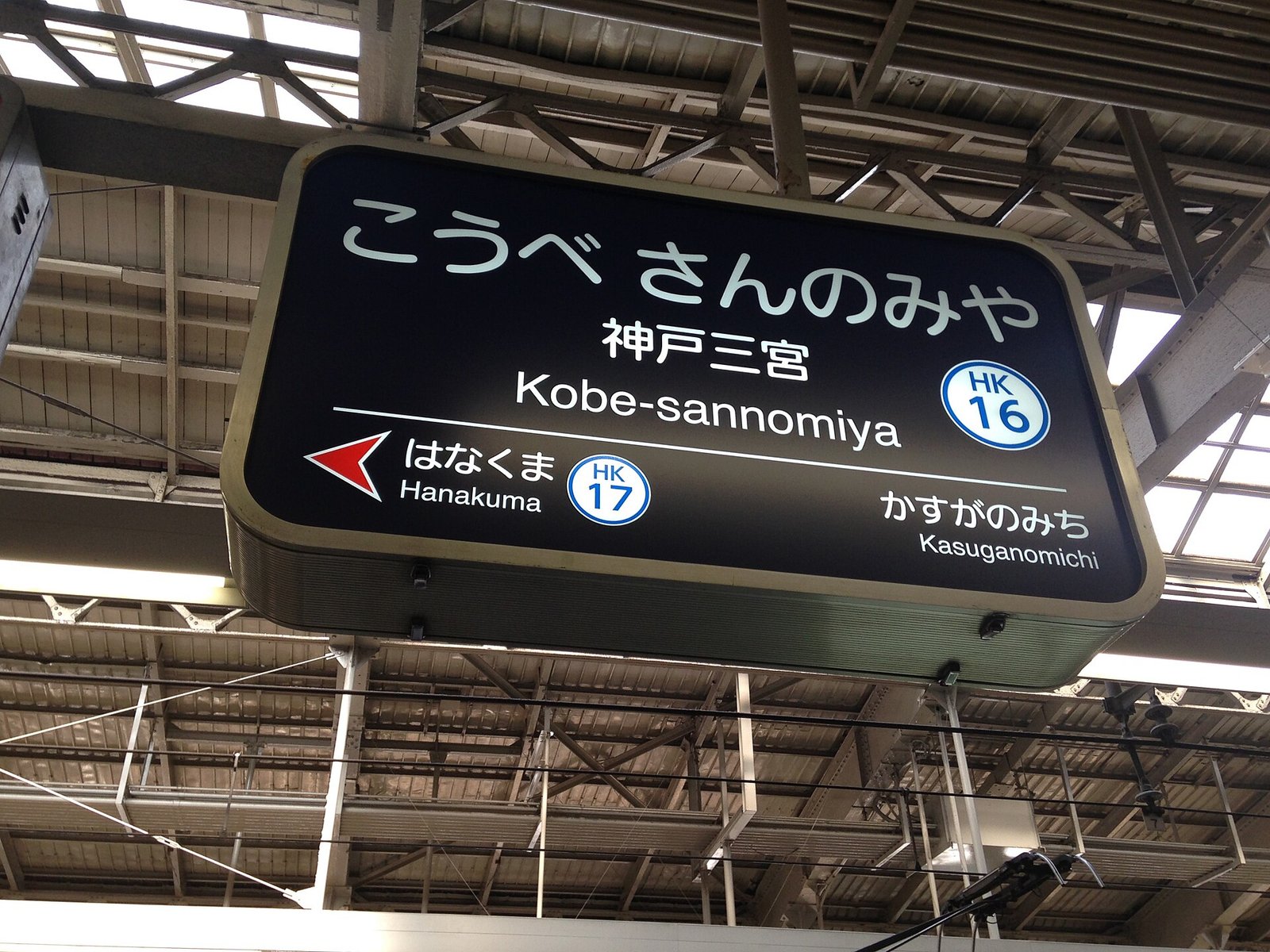
Photo: “Kobe-Sannomiya Station Sign (Hankyu)” by そらみみ This photo was taken with iPhone 5, via Wikimedia Commons, licensed CC BY-SA 3.0.