
In short
Kobe’s museums close on staggered weekdays, so the order of a two-day visit matters more than the route. Mondays close the Maritime Museum, Kawasaki Good Times World, the Disaster Reduction institution and the Hyogo Prefectural Museum of Art. Tuesdays close the Maya View Line cable car and ropeway and the Kiku-Masamune sake museum. This itinerary is built around those closures rather than around a map.
Closing days verified against each venue’s own page, August 2026.
Most two-day Kobe itineraries you will find in English have the same problem: they are built around a list of sights rather than around the days those sights are closed. Kobe is unusually punishing about this. The Maya View Line, which carries you to the city’s best night view, shuts every Tuesday. The Kiku-Masamune sake museum shuts Tuesdays too, new since April 2026. Sawanotsuru shuts Wednesdays. The Maritime Museum and the earthquake museum both shut Mondays. Turn up on the wrong day with the wrong plan and you can lose an afternoon to locked doors.
So this itinerary starts with the closures, then builds two days around them, with the actual 2026 fares and admissions attached. Everything was checked against the operator’s own page on 20 August 2026.
What is in this guide
Read this before you fix your dates
| Day | What is closed |
|---|---|
| Monday | Kobe Maritime Museum and Kawasaki Good Times World, Disaster Reduction and Human Renovation Institution, Hyogo Prefectural Museum of Art |
| Tuesday | Maya View Line (cable car and ropeway), Kiku-Masamune Sake Brewery Museum |
| Wednesday | Sawanotsuru Museum |
| 3rd Tuesday of the month | Weathercock House, Kitano |
| 2nd and 4th Tuesday | Kin no Yu, Arima Onsen |
| 1st and 3rd Tuesday | Gin no Yu, Arima Onsen |
Tuesday is the worst day to be in Kobe. If your dates are flexible, avoid it. If they are not, put Tuesday on the harbour and in Nankinmachi, both of which are open every day, and move the mountain to your other day.
Two further live warnings for 2026. The City Loop bus has run a reduced timetable since 11 August 2026 because of a vehicle fault; the operator advises passengers heading for Meriken Park and the Port Tower to take the Port Loop instead. And the Nunobiki Herb Gardens and Ropeway close 31 August to 3 September 2026 for maintenance, and again 23 January to 12 February 2027.
What this itinerary costs
| Item | Cost |
|---|---|
| City Loop and Port Loop 1-day ticket | ¥800 |
| Kobe Port Tower, with rooftop deck | ¥1,200 |
| Kobe Maritime Museum, includes Kawasaki Good Times World | ¥900 |
| Kitano two-house ticket | ¥800 |
| Maya View Line, full line return | ¥1,560 |
| Nada sake museums | Free |
| Disaster Reduction and Human Renovation Institution | ¥650 |
| Hyogo Prefectural Museum of Art, collection | ¥550 |
Two-day admissions and local transport, excluding food and hotel: roughly ¥6,500 to ¥7,500 per adult. The variable is whether you go up a mountain twice.
If you would rather buy one ticket than eight, the Kobe Sightseeing 1-Day Coupon at ¥1,500 covers the Kobe Kosoku Line, both subway lines and the Portliner, and includes one free entry to a participating attraction priced up to ¥800. Note that it is now digital only, bought through the スルッとQRtto app, which needs membership registration and a credit card. The paper version sold at station windows no longer exists.
Day one: the port city
Morning, from 09:00: Kitano
Start uphill while it is cool. Kitano is the hillside district of Western-style houses built by foreign merchants after the port opened in 1868, and it is a fifteen-minute walk north from Sannomiya or fifteen minutes west from Shin-Kobe.
Two houses are worth paying for and one is free.
- Weathercock House, the brick one with the rooster on the roof, is a nationally designated Important Cultural Property. ¥500, open 09:00 to 17:00 with last entry 16:45, closed the third Tuesday of the month. It reopened in July 2025 after a closure of about one year nine months for seismic reinforcement, so ignore any page that tells you it is shut and offers a VR substitute.
- Moegi no Yakata, the pale green one, is also ¥500. Currently open 09:30 to 18:00 with last entry 17:45, but from 1 October 2026 it moves to 09:00 to 17:00, last entry 16:45.
- The two-house combined ticket is ¥800, raised from ¥650 on 1 April 2026.
- Rhine House, a 1915 wooden residence, is free.
High-school students and under go free at both paid houses, as do Kobe residents aged 65 and over.
On the other Kitano houses: Uroko House, Yamate Hachiban-kan, the Kitano Foreign Club and the tiered multi-house passes are the part of Kitano that older English guides get most wrong, and we could not verify their current prices from a primary source. Check the tier board at the door before you commit to a multi-house ticket.
Late morning: down to Sannomiya and Nankinmachi
Walk back down. Nankinmachi, Kobe’s Chinatown, is one of Japan’s three major Chinatowns alongside Yokohama and Nagasaki, and it grew from the same 1868 port opening that built Kitano.
Two practical things the association itself publishes and English guides omit. First, there is no district-wide closing day — every shop sets its own hours, so the district is reliably open but individual stalls are not. Second, the association warns visitors about aggressive street touting, and asks that street-food waste be taken back to the shop it came from rather than dropped in the street. There is no dedicated parking.
The name Nankinmachi is trademarked to the shopping street association, and only member shops may use it, which gives you a quick test of whether a business is part of the district or simply next to it.
If you are here between 25 and 27 September 2026, that is the Mid-Autumn Festival, with lion and dragon dances at Nankinmachi Plaza.
Afternoon: Meriken Park and the harbour
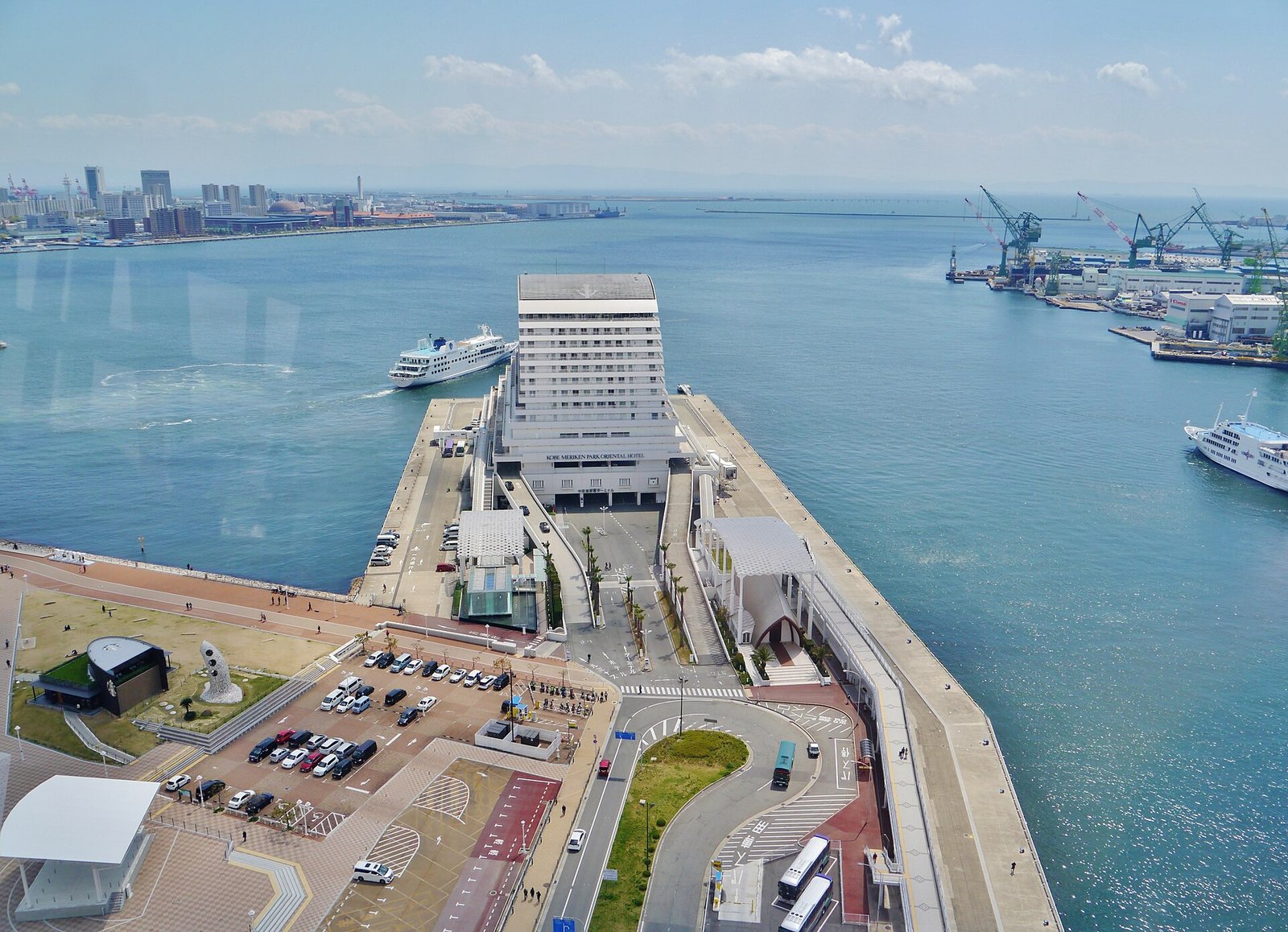
Ten minutes’ walk south from Motomachi. Meriken Park is free and open, and holds the two paid attractions on the waterfront plus the Kobe Port Earthquake Memorial Park, which preserves a collapsed section of quay wall exactly as the 1995 earthquake left it. We could not locate a primary-source page for the memorial’s own details, so we describe only what is uncontroversial about it.
- Kobe Port Tower: ¥1,000 for the observation floors, or ¥1,200 including the rooftop deck. Open 09:00 to 23:00, last entry 22:30, year round — the longest hours of anything in this itinerary. Date-and-time-specified tickets are required for both the observation deck and the rooftop, so book rather than turn up. The ground floor is free to enter without a ticket. The rooftop is stairs-only from the fifth-floor observation level and not wheelchair accessible, and closes without notice in bad weather.
- Kobe Maritime Museum: ¥900, open 10:00 to 18:00 with last entry 17:30, closed Mondays and over New Year. Admission includes Kawasaki Good Times World — they are one ticket, not two, which is worth knowing because a lot of listings present them as separate attractions.
There is no combined Port Tower and Maritime Museum ticket advertised on the museum’s price page.
Evening: Mount Maya, not Mount Rokko
This is the single most useful substitution in this itinerary. Kobe’s famous night view is photographed from Mount Maya, not Mount Rokko, and specifically from the Kikuseidai terrace.
The Maya View Line is a cable car plus a ropeway.
| One way | Return | |
|---|---|---|
| Full line, adult | ¥900 | ¥1,560 |
| Full line, child | ¥450 | ¥780 |
| Either segment alone, adult | ¥450 | ¥780 |
End to end is about ten minutes. Hours are seasonal and long in summer: on 20 August 2026 the cable car ran until 21:00 and the ropeway until 20:50.
It is closed every Tuesday, moving to the following weekday when Tuesday is a public holiday. If your day one is a Tuesday, swap this with the Nada breweries on day two and go up on day two’s evening instead.
If you plan to do both mountains, the Rokko and Maya Leisure Ticket at ¥3,350 covers return Hanshin rail, Kobe City Bus, and either the Rokko Cable Car or the Maya View Line return, plus two mountain bus routes. It is sold 11 April to 30 November 2026. Unusually, it is one of the few Hanshin tickets still sold as paper, cash only, at five stations: Osaka-Umeda, Amagasaki, Koshien, Mikage and Kobe-Sannomiya.
Day two: the mountain, the sake, and the reckoning
Morning, from 09:30: Nada, and three free brewery museums
Kobe’s Nada district produces a large share of Japan’s sake, and three of its breweries run visitor museums that are all free to enter and all within a short walk of a station. Twenty minutes from Sannomiya, and essentially untouristed.
- Hakutsuru Sake Brewery Museum, in a Taisho-era brewery. Free, self-guided, 09:30 to 16:30 with last entry 16:00. Closed 5 to 18 August 2026 for Obon, and 28 December 2026 to 4 January 2027. About five minutes’ walk from Hanshin Sumiyoshi. Groups of ten or more must book online. The shop was refurbished in 2026.
- Kiku-Masamune Sake Brewery Museum. Free, 09:30 to 16:30. Closed Tuesdays from April 2026, which is a change, plus New Year. Take JR to Sumiyoshi, then the Rokko Liner two stops to Minami-Uozaki, then two minutes on foot. The site has full Japanese, English, Chinese and Korean versions.
- Sawanotsuru Museum, in a late-Edo stone warehouse, preserving the underground sake-pressing chamber and the original tools across three hundred years. Free, 10:00 to 16:00, closed every Wednesday except public holidays, plus a summer break, which in 2026 ran 8 to 16 August. About ten minutes’ walk from Hanshin Oishi. The shop offers tastings, including sake sold only at the brewery.
On tasting charges: Sawanotsuru’s own page mentions shop tastings. Whether tastings at Hakutsuru and Kiku-Masamune are free or paid is not stated on their pages, so budget for the possibility rather than assuming.
Two of the three are enough for a morning. Pick by day: on a Tuesday skip Kiku-Masamune, on a Wednesday skip Sawanotsuru, and in the first half of August skip Hakutsuru.
Midday: the beef question
You are in Kobe, so this will come up. The essential thing to understand is that “Kobe Beef” is a Hyogo Prefecture designation, not a Kobe city one, awarded to Tajima-gyu cattle bred and fattened entirely within Hyogo and meeting a specific grade. About 7,500 head are shipped a year and about 7,000 qualify, which is under 0.2% of the beef eaten in Japan, distributed worldwide.
Our full guide to Kobe beef certification goes through this properly. A certified shop displays two things at the door: the Kobe Meat Distribution Promotion Council’s certificate, and a bronze statue of a Tajima cow. The register is public and searchable at kobe-niku.jp and at the official restaurant guide at kobebeef-org.jp, with a registration number for each entry. Look the restaurant up before you book, not after you sit down.
We are not printing a restaurant price range, because we could not verify one. The sector publishes its prices as images, and several of the best-known restaurants block automated access entirely. The one price we can stand behind is retail: Kobe Motomachi Tatsuya, a designated registered shop, sells a 200 g sirloin pack of two pieces for ¥24,192, which is about ¥12,100 per 100 g. Use that as your anchor for what the real thing costs, and check each restaurant’s own current menu.
Afternoon: HAT Kobe, and the two things worth crossing the city for
Take the Hanshin line east to Iwaya or Kasuganomichi, about ten minutes’ walk, or JR to Nada, about twelve. Two major institutions sit five minutes apart on the waterfront here, and almost no English itinerary puts them together.
The Disaster Reduction and Human Renovation Institution is the museum of the 1995 earthquake. ¥650 for both buildings, ¥300 for the east building only, free for high-school students and under, always, and free for everyone on the 17th of every month — the date the earthquake struck. Open 09:30 to 17:30, last entry 16:30, closed Mondays and New Year. A temporary closure is scheduled for 20 and 21 February 2027.
The figures it deals with, from the Fire and Disaster Management Agency’s final report of 19 May 2006: 05:46 on 17 January 1995, magnitude 7.3, 6,434 dead, 3 missing, 43,792 injured, 104,906 buildings completely destroyed, 293 fires. This is the most substantial thing to do in Kobe that has nothing to do with beef or ropeways, and it is what makes a two-day visit feel like more than a shopping trip.
The Hyogo Prefectural Museum of Art is five minutes away, designed by Tadao Ando, holding around ten thousand works. Collection exhibition ¥550 adult, ¥400 university, free for high school and under, ¥250 for over-70s. Open 10:00 to 18:00, last entry 17:30, closed Mondays. The Ando Gallery on the second floor is free, so even on a tight budget you can see the building. Special exhibitions are priced separately.
Evening: back to the harbour, or Arima
If you have the energy, the Port Tower is open until 23:00 and the view at night is the reason to have bought the ¥1,200 rooftop ticket.
If you would rather finish in hot water, Arima Onsen is reachable over the mountain by the Rokko to Arima ropeway, ¥1,400 one way or ¥2,520 return, about twelve minutes, departures every twenty minutes. The two municipal baths are the sensible choice.
| Kin no Yu, the iron-rich brown water | Gin no Yu, the clear carbonated water | |
|---|---|---|
| Adult, weekend or holiday | ¥800 | ¥700 |
| Adult, weekday | ¥650 | ¥550 |
| Hours | 08:00 to 22:00, last entry 21:30 | 09:00 to 21:00, last entry 20:30 |
| Closed | 2nd and 4th Tuesday | 1st and 3rd Tuesday |
The combined two-bath ticket is ¥1,200, adults only, valid one month — a ¥300 saving on the two weekend adult fares.
Note that Kobe levies a bathing tax of ¥75 per person per day for day visitors, but day visitors paying under ¥1,200 excluding consumption tax are exempt, which is why the municipal baths do not add it and why Taiko no Yu, the large bathing complex at ¥2,750 on a weekday and ¥2,970 at weekends, does. Taiko no Yu includes indoor wear, a towel and a bath towel in the price, which is a real difference from the municipal baths.
If you have a third day: Himeji
Himeji Castle changed its pricing on 1 March 2026 and this is now the most important thing to know before you go.
| Visitor | Admission |
|---|---|
| General, 18 and over | ¥2,500 |
| Himeji residents | ¥1,000 |
| Under 18 | Free |
| Castle plus Koko-en garden | ¥2,600 |
The old adult price was ¥1,000, so the general rate is now two and a half times what most guides still print. The lower rate is based on residency in Himeji, not on nationality — a Himeji resident of any passport pays ¥1,000, proved with a My Number Card, driving licence or government photo ID showing a Himeji address, and the paper notification card is not accepted. A Japanese visitor from Osaka pays ¥2,500, the same as anyone else.
Hours are 09:00 to 17:00 with gates closing at 16:00, closed 29 and 30 December. Ignore older English sources that give summer hours to 18:00; the city’s current pages show no seasonal extension.
Between 24 July and 24 October 2026 the Himeji Castle Odekake QR 1-Day Ticket at ¥3,950 bundles admission with rail travel on the Port Island Line, the Kobe Kosoku Line and all of Sanyo. It is roughly the sum of its parts rather than a saving, but it skips the ticket queue.
For a wider view of what else is reachable in a day, see our guide to the best day trips from Osaka and Kyoto, and for the whole city in detail, the Kobe travel guide.
Frequently asked questions
Is two days enough for Kobe?
Yes, for the city and one mountain. It is not enough to add Arima Onsen properly and Himeji as well — that needs a third day.
What is the worst day to visit Kobe?
Tuesday. The Maya View Line, Kiku-Masamune, and depending on the week Kin no Yu, Gin no Yu or the Weathercock House are all closed. Monday is second worst: the Maritime Museum, the earthquake museum and the Hyogo Prefectural Museum of Art all shut.
Do I need the City Loop bus pass?
Only if you are doing the harbour and Kitano in the same day and do not want to walk between them. Central Kobe is genuinely compact. Note that the City Loop has been on a reduced timetable since 11 August 2026, and the operator suggests the Port Loop for Meriken Park.
Can I do Kobe as a day trip from Osaka?
You can, and it costs ¥330 each way on Hankyu or Hanshin. But you will have to choose between the harbour and the mountain, and you will not get the night view, which is the thing worth staying for.
Photo: “Kobe Kobe Port Tower Blick auf das Kobe Meriken Park Oriental Hotel 2” by Zairon, via Wikimedia Commons, licensed CC BY-SA 4.0.