
In short
Kobe is a day trip from Osaka for pocket change: Hankyu or Hanshin, Osaka-Umeda to Kobe-Sannomiya, ¥330 direct (27 and about 35 minutes); JR to Sannomiya is ¥420. Two things old guides get wrong: Kobe charges no accommodation tax but does levy ¥150 per person per night as a hot-spring tax, and the KIX Bay Shuttle foreigner discount ended on 30 June 2026.
Fares checked on operator pages, 20 August 2026.
Kobe is the Japanese city most often described in English as “underrated,” and the description has become so routine that it now hides a real problem: a lot of what English-language guides say about Kobe is out of date. Several of the city’s headline prices changed in 2026. One of them more than doubled. A discount that half the internet still promises to foreign visitors was withdrawn on 30 June 2026. And the ticket you are told to buy at a station window is, for most of Kobe’s tourist passes, no longer sold at a station window at all.
This guide is built the other way round. Every fare, admission price and opening time below was checked against the operator’s or the city’s own page on 20 August 2026, and where we could not verify something we say so rather than repeating what everyone else prints.
What is in this guide
What changed in Kobe in 2026
If you read one section, read this one. These are the changes that make older guides wrong.
- Himeji Castle now charges ¥2,500 for general adult admission, up from ¥1,000, since 1 March 2026. The new lower rate is based on residency in Himeji, not nationality.
- The Kansai Airport Bay Shuttle’s foreign-visitor discount ended on 30 June 2026. The adult fare is ¥1,880. Any article promising a ¥500 or ¥1,000 “foreigner fare” is describing a ticket that is no longer sold.
- Most Kobe tourist passes are now app-only, bought through the スルッとQRtto app with membership registration and a credit card. Paper versions have gone.
- The Nunobiki ropeway went from ¥2,000 to ¥2,500 return on 1 April 2026.
- The two-house Kitano ijinkan ticket went from ¥650 to ¥800 on 1 April 2026.
- Kobe Luminarie has moved out of December. The 2027 edition runs 29 January to 7 February, and the Meriken Park zone is now ticketed.
- The City Loop bus has been on a reduced timetable since 11 August 2026 because of a vehicle fault.
Getting to Kobe
Kobe sits about 30 kilometres west of Osaka, and three separate railway companies compete for the journey. That competition is why the fare is low and why the advice you get depends on who is giving it.
| Route | Adult fare | Journey time |
|---|---|---|
| JR, Osaka to Sannomiya | ¥420 | see note |
| Hankyu, Osaka-Umeda to Kobe-Sannomiya | ¥330 | 27 min, direct |
| Hanshin, Osaka-Umeda to Kobe-Sannomiya | ¥330 | about 35 min, direct |
Fares checked on the operators’ pages and on Ekitan, 20 August 2026. The ¥420 JR fare is the figure that came in after JR West’s 1 April 2025 restructuring of Keihanshin urban fares, which set the urban rate at ¥15.50 per kilometre and abolished the separate Osaka Loop Line zone. It includes the ¥10 barrier-free station charge.
A note on JR journey times. English guides very commonly print “21 minutes” for the Special Rapid from Osaka to Sannomiya. We could not obtain that figure from a JR West primary source. A live Ekitan search on 20 August 2026 returned 28 minutes for the specific departure it happened to show. Treat any single number you see as approximate and check a live timetable on the day.
Which one should you take? Hankyu, if you are simply going from Umeda to central Kobe: it is the same ¥330 as Hanshin and materially faster. Hanshin, if you are continuing west onto the Kobe Kosoku Line towards Motomachi, Kosoku Kobe or Shinkaichi, or onward to Himeji on the Sanyo line. JR, if you already hold a rail pass.
One more correction worth carrying: Hanshin’s short-hop fares rose on 19 January 2025 when a barrier-free surcharge was added to the Kobe Kosoku Line. The Kobe-Sannomiya to Motomachi special fare went from ¥130 to ¥140. Guides still quoting ¥130 are describing a fare that no longer exists.
From Kyoto
JR Kyoto to Sannomiya is ¥1,110 as of the post-April-2025 fares. We could not verify a scheduled journey time from a primary source, so we are not printing one.
From Kansai Airport (KIX)
The interesting option here is the Kobe-Kansai Bay Shuttle, a high-speed ferry across Osaka Bay to Kobe Airport, from which the Portliner runs into Sannomiya.
- Adult one way ¥1,880, child ¥940. Round-trip ticket ¥3,060 adult, valid 120 days. Same-day return ¥2,510.
- The best-value version is the Bay Shuttle plus Portliner set ticket at ¥1,880 — the same price as the ferry alone, with the train leg into Sannomiya effectively thrown in. Buy it at the Kansai Airport counter or at Portliner Sannomiya.
- Crossing time is advertised as 30 minutes; the published timetable shows 31 minutes standard and 36 on two midday sailings. About 15 departures each way daily. The shuttle bus between the KIX terminal and the pier is included in the fare.
- The inbound-tourist discount ended on 30 June 2026. The operator cited growth in inbound passenger numbers. Tickets already bought remain valid until they expire.
- Still running: a U25 campaign fare of ¥1,000, which is age-based rather than nationality-based.
The KIX limousine bus to Sannomiya exists, but we could not verify its current fare or journey time from a primary source, so we are not quoting one.
By shinkansen
Shin-Kobe is on the Sanyo Shinkansen, one subway stop north of Sannomiya. English guides often assert that “only some Nozomi stop at Shin-Kobe.” We could not confirm the current stopping pattern from a JR primary source and would rather you check your specific train than trust a claim we cannot stand behind. If you are travelling on a rail pass, our Japan Rail Pass calculator will tell you whether the pass beats point-to-point tickets for your route.
Getting around Kobe
Central Kobe is small. Sannomiya, Motomachi, Nankinmachi, Kitano and the harbour are all walkable from each other, and a fit visitor can cross the flat part of the city in half an hour. You need transport for three things: the mountains, the airport island, and the sake district.
City Loop and Port Loop buses. Single ride ¥300 adult, ¥150 child. One-day loop ticket ¥800 adult, ¥400 child. Two-day ¥1,200 adult. Both passes cover City Loop and Port Loop plus several other bus routes and carry discounts at participating attractions. Sold at the Kobe City General Information Center south of JR Sannomiya, at Shin-Kobe station information, at the Shinki Bus Sannomiya terminal, on board for the one-day version, and through the RYDEPASS and PassRu apps.
Check before you rely on the City Loop. Since 11 August 2026 it has run a reduced timetable because of a vehicle fault, described by the operator as lasting “for the time being.” The operator’s own advice is that passengers heading for Meriken Park and the Port Tower should use the Port Loop instead. A full City Loop circuit takes about 65 minutes.
Portliner, the automated line out to Port Island and Kobe Airport, has not changed its fares since 1 October 2019.
- Sannomiya to Kobe Airport ¥340 adult, ¥170 child
- Sannomiya to Shimin-Hiroba, for Kobe Animal Kingdom, ¥250 adult
- Portliner one-day pass ¥710 adult. Rokko Liner one-day ¥550. Combined ¥1,220.
Kobe’s official tourism body puts the airport-to-city-centre run at about 18 minutes.
Kobe City Bus ordinary-zone fares rose from ¥210 to ¥230 on 1 October 2024. We could not verify Kobe Municipal Subway fares or the price of its one-day pass from a primary source.
The passes that are actually worth it
| Pass | Price | What it covers |
|---|---|---|
| Kobe Sightseeing 1-Day Coupon, Kobe version | ¥1,500 | Kobe Kosoku Line, both subway lines, Portliner, plus one free entry to a participating attraction priced up to ¥800 |
| Same, Hanshin expanded version | ¥2,150 | The above plus all Hanshin lines, so usable from Osaka |
| Rokko and Maya Leisure Ticket 2026 | ¥3,350 | Return Hanshin rail, Kobe City Bus, and either the Rokko Cable Car or the Maya View Line return, plus two mountain bus routes. Sold 11 April to 30 November 2026 |
| Sannomiya and Himeji QR 1-Day Ticket | ¥1,590 | Kobe Kosoku Line, all Sanyo Electric Railway, the Shin-Kobe to Sannomiya subway hop, plus a return on Sumaura Yuen’s B course |
| Himeji Castle Odekake QR 1-Day Ticket | ¥3,950 | Includes Himeji Castle admission plus Port Island Line, Kobe Kosoku Line and all Sanyo. Sold 24 July to 24 October 2026 |
| Arima Onsen Taiko no Yu Coupon 2026 | ¥3,150 | One-day Hanshin pass, Kobe subway, Kobe Dentetsu to Arima, plus one admission to Taiko no Yu |
All checked on Hanshin Electric Railway’s own discount-ticket pages, 20 August 2026.
The important structural change: the Kobe Sightseeing Coupon, the Himeji tickets, the Taiko no Yu coupon and most other Hanshin discount tickets are now digital only, bought through the スルッとQRtto app, which requires membership registration and a credit card. Paper versions sold at station windows are gone for these products. If a guide tells you to buy your Kobe pass at the station counter, it is describing 2024.
The Rokko and Maya Leisure Ticket is the exception: still paper, still cash only, sold at five Hanshin stations — Osaka-Umeda, Amagasaki, Koshien, Mikage and Kobe-Sannomiya — and at the Hanshin Service Center at Kobe-Sannomiya.
What to see, and what it costs in 2026
| Attraction | Adult admission | Hours and closures |
|---|---|---|
| Kobe Port Tower | ¥1,000 observation, ¥1,200 with rooftop deck | 09:00 to 23:00, last entry 22:30, year round. Timed tickets required |
| Kobe Maritime Museum, including Kawasaki Good Times World | ¥900 | 10:00 to 18:00, last entry 17:30. Closed Mondays and New Year |
| Nunobiki Herb Gardens and Ropeway | ¥2,500 return, ¥1,900 one way | Seasonal. Closed 31 Aug to 3 Sep 2026 and 23 Jan to 12 Feb 2027 for maintenance |
| Weathercock House, Kitano | ¥500 | 09:00 to 17:00, last entry 16:45. Closed 3rd Tuesday |
| Moegi no Yakata, Kitano | ¥500 | 09:30 to 18:00 now; 09:00 to 17:00 from 1 October 2026 |
| Two-house Kitano ticket | ¥800 | Raised from ¥650 on 1 April 2026 |
| Rhine House, Kitano | Free | Free admission |
| Maya View Line, cable car plus ropeway | ¥900 one way, ¥1,560 return | Closed every Tuesday |
| Rokko to Arima Ropeway | ¥1,400 one way, ¥2,520 return | About 12 minutes, departures every 20 minutes |
| Disaster Reduction and Human Renovation Institution | ¥650 both buildings | 09:30 to 17:30, last entry 16:30. Closed Mondays. Free on the 17th of every month |
| Hyogo Prefectural Museum of Art, collection | ¥550 | 10:00 to 18:00. Closed Mondays. Ando Gallery free |
| Kobe Animal Kingdom | ¥2,400 | Hours vary daily, check the park’s operating calendar |
| Kin no Yu, Arima Onsen | ¥800 weekends, ¥650 weekdays | 08:00 to 22:00. Closed 2nd and 4th Tuesday |
| Gin no Yu, Arima Onsen | ¥700 weekends, ¥550 weekdays | 09:00 to 21:00. Closed 1st and 3rd Tuesday |
| Both Arima baths, combined ticket | ¥1,200 | Adults only, valid one month |
All checked 20 August 2026 against the operator’s or the city’s own page.
Three of these deserve a sentence more. The Port Tower reopened after renovation with a rooftop deck that is stairs-only from the fifth-floor observation level and therefore not wheelchair accessible, and which closes without notice in bad weather. The Weathercock House was closed from October 2023 to June 2025 for seismic reinforcement and reopened in July 2025 — several sites, including pages still live in August 2026, describe it as closed with a VR substitute at Rhine House. It is open. And the Maya View Line closes every Tuesday, which catches out more visitors than anything else on this list, because Mount Maya is where Kobe’s famous night view is actually photographed from.
Himeji Castle: the price change that matters
Himeji is not in Kobe. It is about 40 minutes west by rail and it is the single most common day trip from the city, which is why it belongs here.
On 1 March 2026 Himeji Castle introduced differential pricing.
| Visitor | Admission |
|---|---|
| General, 18 and over | ¥2,500 |
| Himeji residents | ¥1,000 |
| Under 18 | Free |
| Castle plus Koko-en garden | ¥2,600 |
| Annual pass | ¥5,000 |
The old adult price was ¥1,000. The general rate has therefore risen by two and a half times.
The distinction is residency, not nationality. This matters, because the change was widely reported in English as a “foreigner price,” which it is not. A Himeji resident of any nationality pays ¥1,000, and proves it with a My Number Card, a driving licence or a government-issued photo ID showing a Himeji address. The paper My Number notification card is not accepted. A Japanese citizen from Osaka pays the same ¥2,500 as a visitor from Chicago.
Opening hours are 09:00 to 17:00 with gates closing at 16:00, closed 29 and 30 December. Older English sources give summer hours of 09:00 to 18:00; the city’s current pages show no seasonal extension, so do not plan around a late entry.
If you are visiting from Kobe between 24 July and 24 October 2026, the Himeji Castle Odekake QR 1-Day Ticket at ¥3,950 bundles admission with the rail travel, which is close to the sum of its parts rather than a big saving, but it removes the ticket queue.
Kobe beef, in one paragraph
The full version has its own guide, because the certification rules are the part everyone gets wrong. The short version: “Kobe Beef” is a Hyogo Prefecture designation, not a Kobe city one, awarded by the Kobe Meat Distribution Promotion Council to Tajima-gyu cattle bred and fattened entirely within Hyogo. About 7,500 head are shipped annually and about 7,000 qualify, under 0.2% of the beef consumed in Japan, distributed across every Japanese prefecture plus the USA, Europe, Asia and Australia. A genuinely certified shop displays the Council’s certificate and a bronze Tajima cow statue at the door, and appears on the public register at kobe-niku.jp. Check before you book.
The 1995 earthquake
You cannot understand what modern Kobe looks like without it. At 05:46 on 17 January 1995, the Hyogo-ken Nanbu Earthquake, magnitude 7.3, struck beneath the strait between Kobe and Awaji Island. The Fire and Disaster Management Agency’s final report, issued 19 May 2006, records 6,434 dead, 3 missing and 43,792 injured, with 104,906 buildings completely destroyed and 293 fires. The magnitude figure was revised from 7.2 to 7.3 in 2001, which is why both numbers circulate.
The event is called the Hyogo-ken Nanbu Earthquake; the disaster it caused is called the Great Hanshin-Awaji Earthquake Disaster.
The Disaster Reduction and Human Renovation Institution at HAT Kobe is the place to engage with it: ¥650 for both buildings, high-school students and under free always, and free for everyone on the 17th of every month. It is closed Mondays and open 09:30 to 17:30 with last entry at 16:30. It is a five-minute walk from the Hyogo Prefectural Museum of Art, and the two make an obvious afternoon that almost no English itinerary puts together.
When to go
Japan Meteorological Agency normals for Kobe, 1991 to 2020. Annual mean 17.0°C, annual precipitation 1,277.8 mm.
| Month | Mean | Daily max | Rainfall | Days 30°C+ | Tropical nights |
|---|---|---|---|---|---|
| January | 6.2°C | 9.4°C | 38.4 mm | 0 | 0 |
| February | 6.5°C | 10.1°C | 55.6 mm | 0 | 0 |
| March | 9.8°C | 13.5°C | 94.2 mm | 0 | 0 |
| April | 15.0°C | 18.9°C | 100.6 mm | 0 | 0 |
| May | 19.8°C | 23.6°C | 134.7 mm | 0.3 | 0 |
| June | 23.4°C | 26.7°C | 176.7 mm | 2.1 | 0.6 |
| July | 27.1°C | 30.4°C | 187.9 mm | 18.4 | 15.6 |
| August | 28.6°C | 32.2°C | 103.4 mm | 25.9 | 24.0 |
| September | 25.4°C | 28.8°C | 157.2 mm | 11.0 | 6.6 |
| October | 19.8°C | 23.2°C | 118.0 mm | 0.2 | 0 |
| November | 14.2°C | 17.5°C | 62.4 mm | 0 | 0 |
| December | 8.8°C | 12.0°C | 48.7 mm | 0 | 0 |
| Year | 17.0°C | 20.5°C | 1,277.8 mm | 57.9 | 46.8 |
The counter-intuitive finding here is worth spelling out: August is Kobe’s hottest month but not its wettest. July is, at 187.9 mm, with June close behind at 176.7 mm. August averages only 103.4 mm, but it also averages 25.9 days at or above 30°C and 24 tropical nights, meaning nights that do not fall below 25°C. Hot and comparatively dry is still hot.
And the normals now understate what you will actually get. At the same JMA station, observed monthly means in 2025 ran well above normal through the summer: July 29.4°C and August 29.8°C, against normals of 27.1°C and 28.6°C, with a July maximum of 37.3°C. If you are planning a summer visit, plan against the recent observations rather than the thirty-year averages.
The best months are late October, November and April. November averages 62.4 mm of rain and zero days above 30°C. September is still hot, with 11 days above 30°C, so treat it as summer rather than autumn. January is the driest month at 38.4 mm and mild by northern-hemisphere standards at 6.2°C, which makes winter a genuinely reasonable time to visit a city whose main attractions are indoors, uphill or in hot water.
For the national picture, see our month-by-month guide to the best time to visit Japan.
Where to stay, and the tax question
Kobe’s centre of gravity for visitors is the strip between Sannomiya and Motomachi, which puts you within walking distance of Nankinmachi, Kitano and the harbour and on top of all three railways. Shin-Kobe suits you if you are arriving and leaving by shinkansen and want one fewer transfer. Arima Onsen, over the mountain, is a different proposition: a hot-spring town rather than a city base, and worth a night rather than a whole trip.
Kobe does not levy a lodging tax. We checked this four separate ways, including the Ministry of Internal Affairs and Communications register of municipalities that levy one, and a Kobe city council discussion on 21 February 2024 that did not proceed. If you have used our Japan lodging tax calculator, Kobe is one of the cities that returns zero.
Kobe does levy a bathing tax, which is different and catches people out. It is ¥150 per person per night for overnight guests at hot-spring accommodation, and ¥75 per person per day for day visitors to bathing facilities. Day visitors paying under ¥1,200 excluding consumption tax are exempt, which is precisely why Kin no Yu and Gin no Yu do not add it to your ¥800 ticket, and why Taiko no Yu, at ¥2,750 on a weekday, does. Under-sevens, school trips and ordinary public bathhouses are exempt.
What we could not verify
We think this section belongs in a travel guide, and almost no one prints it.
- The Rokko Cable Car’s standalone fares, and admission to the Rokko Garden Terrace and Rokko Shidare Observatory. The operator’s site blocked automated access repeatedly. What we can confirm: the Shidare Observatory is a cypress-timber structure by architect Hiroshi Sambuichi, and free guided tours of about 20 minutes are offered.
- Kobe Municipal Subway fares and the price of its one-day pass.
- Maiko Marine Promenade admission and hours.
- The Bridge World tour price for the Akashi Kaikyo Bridge tower-top walk. Everything else about it is confirmed: it runs on designated days from April to November 2026 and in March 2027, two sessions daily, about two hours fifty minutes, maximum 48 people, minimum 12, participants aged 12 to 15 must be accompanied. Booking is online only through a JTB-operated site. The fee table is published as an image, which is why we cannot quote it.
- Uroko House, Yamate Hachiban-kan, the Kitano Foreign Club and the multi-house ijinkan passes. These are exactly what older articles get wrong, and we would rather you check the tier prices yourself than publish a stale one.
- Ikuta Shrine’s hours and access, and whether Nunobiki Falls is free and how long the walk from Shin-Kobe takes.
- Kobe Suma Sea World’s standalone admission. Hanshin’s combined travel-plus-admission ticket at ¥4,100 adult is confirmed.
Frequently asked questions
Is Kobe worth visiting?
Yes, but for reasons that are usually stated badly. It is not a “hidden gem”: it is Japan’s seventh-largest city with a major port and a serious museum sector. It is worth visiting because it puts a hot-spring town, a mountain night view, a Chinatown, a sake district and one of the country’s most substantial disaster memorials within about forty minutes of each other, and because it is cheap to reach from Osaka and Kyoto.
How many days do you need in Kobe?
Two full days covers the city and one of the mountains. Three lets you add Arima Onsen properly or take the Himeji day trip without rushing. One day is enough only if you already know what you want to see.
Is Kobe cheaper than Osaka or Kyoto?
On accommodation, usually. Kobe levies no lodging tax, where Osaka and Kyoto both do. On transport and admissions the difference is marginal.
Do I need a rail pass for Kobe?
Almost certainly not for Kobe itself: the fares involved are ¥330 to ¥420 each way from Osaka. A pass makes sense only if Kobe is one stop on a longer itinerary. Run the numbers on our Japan Rail Pass calculator.
Can you see Himeji Castle as a day trip from Kobe?
Yes, and it is the standard day trip. Budget ¥2,500 for admission at the general rate since 1 March 2026, plus rail, or take the bundled Himeji Castle Odekake QR ticket at ¥3,950 while it is on sale until 24 October 2026.
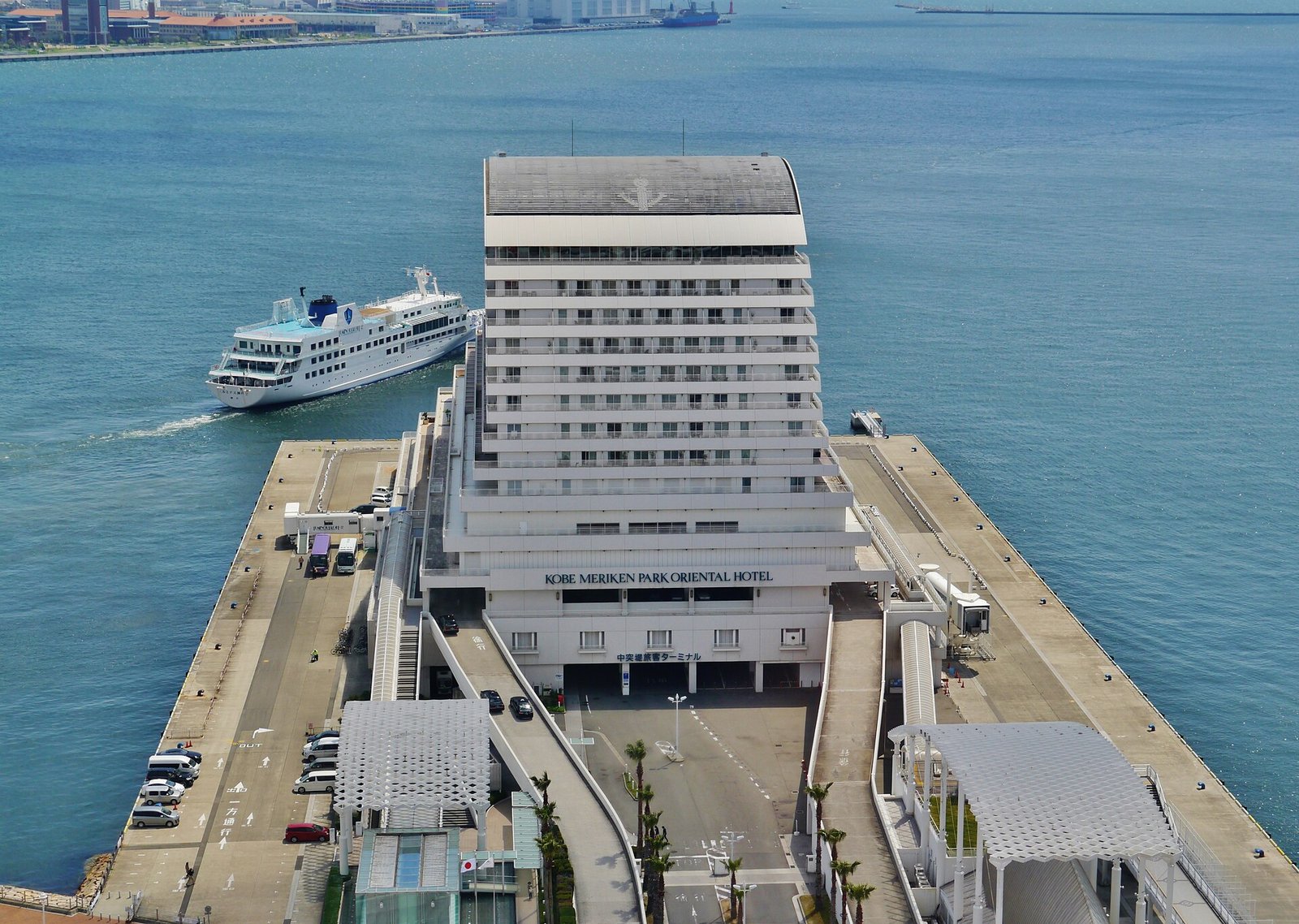
Photo: “Kobe Kobe Port Tower Blick auf das Kobe Meriken Park Oriental Hotel 3” by Zairon, via Wikimedia Commons, licensed CC BY-SA 4.0.