
In short
Only about 7,000 carcasses a year qualify as Kobe Beef anywhere in the world — under 0.2% of Japan’s beef. Certification is a documented scheme with a public register of approved restaurants and shops, so a place either appears on it or does not. Anything sold as “Kobe beef” outside that register is something else.
Verified against the Kobe Beef Marketing and Distribution Promotion Association register, August 2026.
There is a fact about Kobe beef that reframes everything else written about it. About 7,500 Tajima cattle are shipped each year, and about 7,000 of them qualify as certified Kobe Beef. That is under 0.2% of all the beef consumed in Japan — and it is distributed not just across Kobe but across every Japanese prefecture, and exported to the USA, Europe, Asia and Australia.
Now count the establishments in Kobe alone advertising Kobe beef to tourists.
What is in this guide
The certifying body does not publish an estimate of how much mislabelling that implies, and we are not going to invent one. But the supply ceiling is a published figure, and it is the honest way to make the point. It is also why the most useful thing this article can give you is not a restaurant list. It is the certification rules and the register, so you can check for yourself.
Everything below was verified against the certifying body’s, the association’s or the operator’s own page on 20 August 2026.
What legally counts as Kobe Beef
The certifying body is the Kobe Beef Marketing and Distribution Promotion Association (神戸肉流通推進協議会). Its published criteria are specific, and an animal must meet all of them.
- Breed and provenance. The animal must have Tajima-gyu (但馬牛) as its base stock, and must be bred and fattened — from breeding through to shipment — entirely within Hyogo Prefecture, by a producer registered with the Association.
- Sex. Only heifers that have never calved, or castrated males. A cow that has calved cannot be Kobe Beef.
- Grade. Yield grade A or B, meat quality grade 4 or above.
- Marbling. BMS (Beef Marbling Standard) number 6 or above.
- Carcass weight. Heifers 270 to 499.9 kg; steers 300 to 499.9 kg.
- A final defect assessment by authorised receiving companies.
Read criterion one again, because it contains the thing almost every English article gets wrong.
“Kobe Beef” is a Hyogo Prefecture designation, not a Kobe city one. The cattle need never have been near the city of Kobe. Tajima-gyu is a strain of Japanese Black cattle from the Tajima region in the north of Hyogo, a long way from the port. Kobe’s name is attached because Kobe was the port through which the meat was traded, not because the animals were raised in it.
This also explains why you can eat certified Kobe beef in Tokyo, or in Los Angeles, and why eating it in Kobe carries no particular authenticity advantage beyond the density of certified shops.
How to tell a certified restaurant from one that says it is
This takes a minute and it is the single most useful thing in this article.
A designated registered shop (指定登録店) displays two things at the storefront:
- The Association’s membership and designation certificate
- A bronze statue of a Tajima cow
Together these signal qualification to handle Kobe Beef. A restaurant displaying neither is not certified, whatever its signage says.
The register is public, searchable and bilingual. Two entry points: kobe-niku.jp/shop/ and the KOBE Beef Official Restaurant Guide at kobebeef-org.jp. Each listing gives a registration number, shop name, address, telephone and category. You can filter by area — every Japanese prefecture plus overseas listings for the USA, Europe, Asia and Australia — and by category: dine-in, retail over the counter, wholesale, mail order.
Look the restaurant up before you book, not after you sit down.
Beyond the shop level, individual cuts carry cattle identification numbers (牛個体識別番号), displayed at retailers and restaurants and checkable through the Association’s Tajima Cattle Bloodline Certification System and its DNA verification system. The framework covering all breeding farms, fattening farms and traders was established in 2007.
One name to check for yourself: Steakland is the restaurant most frequently named in English “cheap Kobe beef” articles. We found no evidence in the material we could reach that it is a designated registered shop. That is not an accusation, it is a gap in what we could verify — look it up on the register before you go.
What it actually costs
This is where we have to be honest about a limit.
We could not verify restaurant course prices from primary sources. The sector publishes its prices as images rather than text, and several of the best-known restaurants block automated access entirely. Rather than repeat the “lunch from ¥5,000, dinner from ¥15,000” range that circulates without a source, here is exactly what we could and could not confirm.
Verified: Kobe Plaisir (神戸プレジール), Sannomiya. This is the restaurant operated directly by JA Zen-Noh Hyogo, the prefectural agricultural cooperative — about as unimpeachable a provenance as exists. Confirmed from its own site: lunch 11:30 to 15:00, last orders 14:00; dinner 17:00 to 22:00, last orders 21:00, and 17:00 to 21:30 on Sundays; closed Mondays. Three course tiers plus a la carte. Reservations by phone or through TableCheck. The prices are published only as images, and we will not transcribe a number we cannot read.
Verified: one retail benchmark. Kobe Motomachi Tatsuya (神戸元町辰屋) states on its own site that it is a designated registered shop of the Kobe Beef Distribution Promotion Council. It sells a sirloin steak pack of two pieces totalling 200 g for ¥24,192 — approximately ¥12,100 per 100 g at retail. Shop hours 10:00 to 17:30, closed Sundays and public holidays; web and fax orders around the clock.
Use that retail figure as your anchor. A restaurant serving a 150 g certified sirloin has bought roughly ¥18,000 of raw material at that rate, before rent, staff, preparation or margin. Any menu offering “Kobe beef steak” far below that is telling you something, and what it is telling you is worth thinking about before you order.
Not verified: Mouriya, Wakkoqu and Steakland prices. Mouriya blocks automated access. Wakkoqu’s site loads but publishes no prices in text. Steakland’s site had a TLS certificate hostname mismatch on every attempt.
Beyond the beef
Kobe’s food story is genuinely bigger than one animal, and the rest of it is cheaper.
Nankinmachi, the Chinatown
One of Japan’s three major Chinatowns, with Yokohama and Nagasaki, grown from the 1868 opening of Kobe port — the same event that built the Western houses up in Kitano.
Practical things the shopping street association publishes on its own site that English guides tend to omit:
- There is no district-wide closing day. Every shop sets its own hours, so the district is reliably open but any specific stall may not be. The association office runs weekdays 11:00 to 17:00.
- The association explicitly warns visitors about aggressive street touting.
- It asks that street-food waste be taken back to the shop it was bought from rather than dropped in the street.
- There is no dedicated parking.
- The name “Nankinmachi” is trademarked to the association, and only member shops may use it — a quick test of whether a business is part of the district or merely beside it.
2026 dates: the Mid-Autumn Festival runs 25 to 27 September 2026, with lion and dragon dances at Nankinmachi Plaza through the year.
Nada, and three free sake museums
The Nada district east of the centre is one of Japan’s great sake-producing areas, and three of its breweries run visitor museums that are all free to enter, all near a station, and all essentially untouristed. Twenty minutes from Sannomiya.
| Museum | Hours | Closed | Access |
|---|---|---|---|
| Hakutsuru Sake Brewery Museum | 09:30 to 16:30, last entry 16:00 | 5 to 18 Aug 2026 for Obon; 28 Dec 2026 to 4 Jan 2027 | Hanshin Sumiyoshi, about 5 min walk |
| Kiku-Masamune Sake Brewery Museum | 09:30 to 16:30 | Every Tuesday from April 2026; New Year | JR Sumiyoshi, then Rokko Liner 2 stops to Minami-Uozaki, 2 min walk |
| Sawanotsuru Museum | 10:00 to 16:00 | Every Wednesday except public holidays; summer break, 8 to 16 Aug in 2026 | Hanshin Oishi, about 10 min walk |
All three are free. Reservations are not needed for groups under ten at any of them.
Hakutsuru is housed in a Taisho-era brewery and is self-guided; its shop was refurbished in 2026. Kiku-Masamune’s Tuesday closure is new from April 2026 and will not appear in older guides at all; its site runs in Japanese, English, both Chinese scripts and Korean, which is unusual for a brewery museum. Sawanotsuru occupies a late-Edo stone warehouse and preserves the underground sake-pressing chamber and the original brewing tools across three hundred years of the company’s history. Its shop offers tastings, including sake sold only at the brewery.
On tasting charges: Sawanotsuru’s page mentions shop tastings. Whether tastings at Hakutsuru and Kiku-Masamune are free or paid is not stated on their own pages, so budget for the possibility.
A fourth option: Kobe Shushinkan (神戸酒心館), the Fukuju brewery in Higashinada, open year-round except New Year, running brewery tours with strengthened multilingual support, with an in-brewery restaurant, Kura no Ryotei Sakabayashi, and the Tomeigura shop selling the Fukuju served at Nobel Prize banquets. Tour and meal prices are not published on its site, so ask before you commit.
Akashiyaki
Akashi, west of Kobe on the Sanyo Electric Railway, has its own octopus dumpling — 明石焼, known locally as 玉子焼 (tamagoyaki) — treated by the city’s tourism association as its signature dish. The association maintains a directory of shops, in which it names Akashidama Jusanmi, an Akashiyaki Festival award winner; Yokoi, described as the old traditional taste; and Yoshikawa, described as the oldest akashiyaki shop in the fish market. The market is Uonotana shotengai (魚の棚商店街).
A note on the standard explanation. English guides universally describe akashiyaki as differing from takoyaki by having more egg, a softer texture, and being dipped in dashi rather than sauced. We could not verify that from an official Japanese source — the tourism association’s pages are a restaurant directory, not a culinary explainer, and gave no egg proportion, no float-starch detail and no dashi description. The explanation may well be correct. We simply cannot cite it, so we are flagging it rather than presenting it as established.
Getting there: Akashi is on the Sanyo line, and the Sannomiya and Himeji QR 1-Day Ticket at ¥1,590 covers all Sanyo lines, so an Akashi stop en route to Himeji costs nothing extra. Hanshin also sells dedicated Akashi day tickets.
Bread, and a claim to handle carefully
You will read that Kobe consumes more bread than anywhere in Japan. Before repeating it, three things.
The authoritative source is the Statistics Bureau of Japan household survey ranking of prefectural capitals and designated cities by expenditure per item, currently covering 2023 to 2025. We located the correct file and could not open it, so we cannot tell you Kobe’s actual current rank.
What we can tell you is how to read the claim if you see it elsewhere. First, it is a claim about household spending on bread, not consumption by volume. Second, it ranks cities, so it concerns Kobe-shi against other designated cities — not Hyogo, and not Japan as a whole. Third, the top city moves between survey years, and Kyoto has topped the ranking in recent editions.
None of which stops Kobe’s bakery culture from being real and visible. It just is not the same claim.
Sobameshi
The Kobe-origin dish of chopped yakisoba fried with rice. We could not locate any official Kobe City or trade-association source for its origin story, and there are several competing versions in circulation. We are not repeating one we cannot cite.
Frequently asked questions
Is Kobe beef worth the money?
That depends on what you are buying. At the verified retail rate of about ¥12,100 per 100 g, a restaurant portion is a genuinely expensive meal by any standard. Whether the eating experience justifies it is personal. What is not personal is whether you are getting the certified article, and that you can check for free on the register before you book.
Can you eat Kobe beef cheaply in Kobe?
Cheaper than in Tokyo or abroad, plausibly. Cheap, no. Work backwards from the retail cost of the raw material and a low headline price stops looking like a bargain.
Is Kobe beef the same as wagyu?
No. Wagyu is a category covering four Japanese cattle breeds. Kobe Beef is a certification applied to a narrow subset of one strain, Tajima-gyu, raised entirely in Hyogo Prefecture and meeting specific grade, marbling, sex and carcass-weight thresholds. All Kobe Beef is wagyu; almost no wagyu is Kobe Beef.
Where can I check if a restaurant is genuine?
The public register at kobe-niku.jp and the official restaurant guide at kobebeef-org.jp. Both are bilingual and searchable by area and category, and each listing carries a registration number.
What should I eat in Kobe if I skip the beef?
Nankinmachi for Chinese street food, Akashi for akashiyaki on a ¥1,590 Sanyo day ticket, and the Nada breweries for free sake museums. That is a full day of eating and drinking for less than one certified steak.
For the rest of the city, see our Kobe travel guide and the two-day Kobe itinerary.
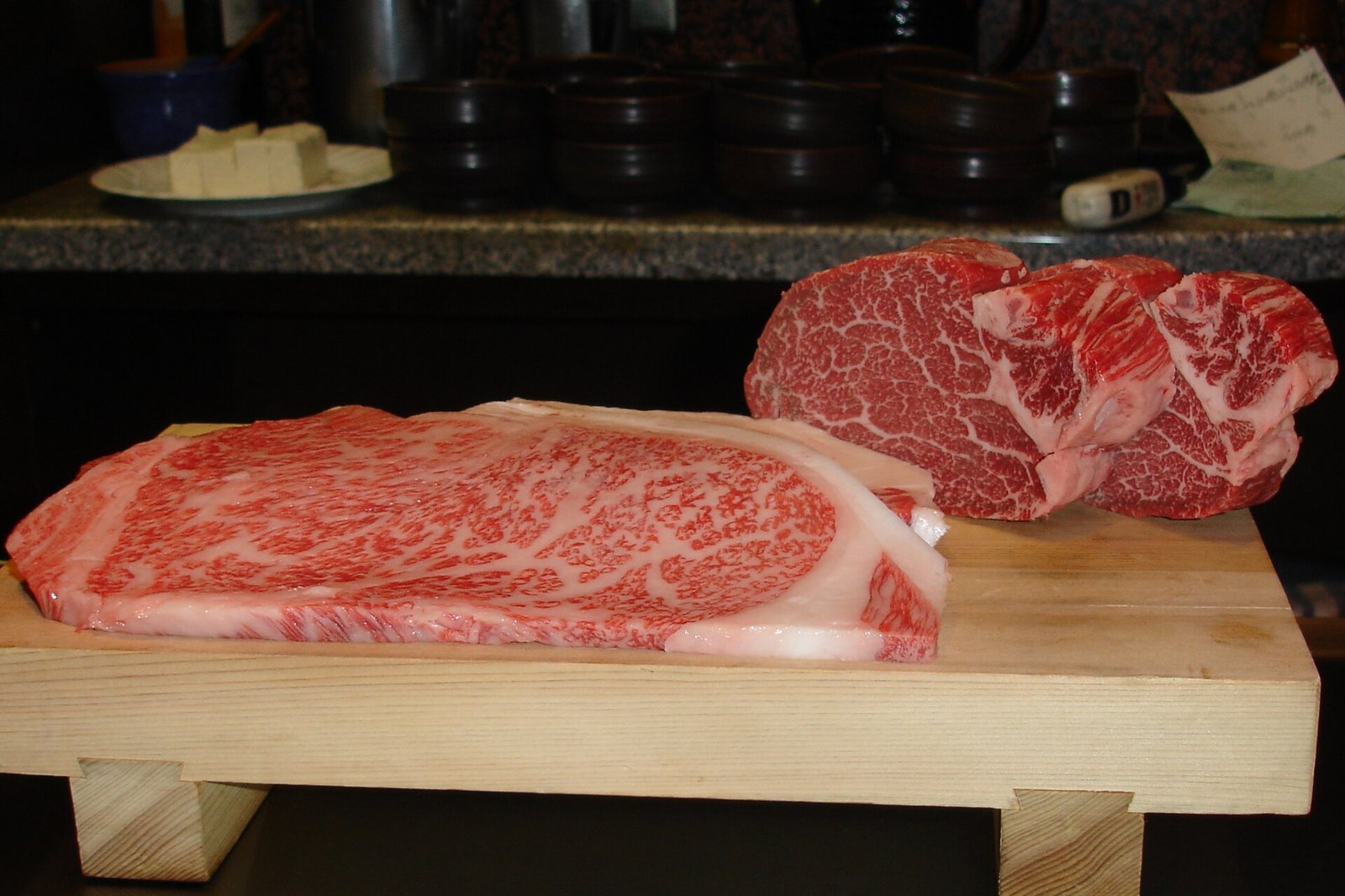
Photo: “Kobe Beef, Kobe Japan” by Orlando G. Calvo, via Wikimedia Commons, licensed CC BY-SA 3.0.