
In short
Since 31 December 2025, US, UK, Canadian, Australian, Irish and EU citizens get 30 visa-free days per 60-day period — not the 60 days still published on Kyrgyzstan’s own MFA site. No registration needed under 30 days. The mountain season is short: roads open around late May, yurt camps run mid-June to late September. Bring cash — locals pay by phone, but visitors cannot use those systems.
Checked 26 August 2026 against UK, Canadian, Irish and US government advice, the National Bank of the Kyrgyz Republic, and CDC and NaTHNaC health guidance.
On this page
- The visa rule changed, and the government’s own website hasn’t caught up
- Money: the cashless country you cannot join
- When to go, and why the season is so short
- Getting around
- Connectivity, and the thing eSIM sellers won’t tell you
- Safety: four governments, four different answers
- What it costs
- A ten-day route
- Why now
- What we could not verify
Kyrgyzstan earned about US$1.1 billion from tourism in 2025 — and more than ninety-five per cent of its foreign visitors came from neighbouring Central Asian countries and Russia. Western travellers are, statistically, a rounding error.
That is the whole argument for going now. This is a country of 7,000-metre peaks, month-long summer pastures and a genuinely functioning homestay network, and almost nobody from Britain or America is there.
Here is the practical guide, with every figure dated and sourced, checked on 26 August 2026.
The visa rule changed, and the government’s own website hasn’t caught up
Since 31 December 2025, citizens of 55 countries — including the US, UK, Canada, Australia, Ireland and most of the EU — may stay visa-free for up to 30 calendar days within each 60-day period.
The previous rule was 60 days, and this is where it gets awkward: Kyrgyzstan’s own Ministry of Foreign Affairs visa page still says 60 days, and so does the US Embassy in Bishkek’s travel page. Wikipedia says 90. All three are out of date.
We are going with 30 because three separate governments — the UK, Canada and Ireland — all state it independently on advisory pages updated in June and August 2026. If you plan a 45-day trip on the strength of the Kyrgyz MFA’s own website, you will overstay.
Passport validity: six months beyond arrival, consistent across every official source.
Registration: not required for a normal tourist trip under 30 days — a real contrast with Uzbekistan next door, where the clock starts on arrival. If you stay longer than 30 days you must register, though sources conflict on the deadline: the UK says within five days of entry, Canada says within 60. Register within five working days and the question does not arise.
Money: the cashless country you cannot join
The National Bank rate on 26 August 2026 was 87.45 som to the US dollar, about 102 to the euro and 119.5 to the pound. The spread at Bishkek exchange counters on the dollar was roughly 0.4 per cent, which is unusually tight.
Now the interesting part. Kyrgyzstan is further into mobile payments than almost anywhere in the region: MBank alone reports more than three million active customers — around eighty per cent of the adult population — and there is a national interoperable QR system, ELQR, supported by sixteen banks and payment services. Locals pay for everything by phone.
You almost certainly cannot use any of it. These services generally require a Kyrgyz mobile number and often a local ID, and we could find no tourist-facing route into them. So the honest position is: Kyrgyzstan is a cashless society that visitors are locked out of, and you will be using cash — particularly outside Bishkek, and universally in the mountains, where there are no machines at all.
One warning about published prices: a widely read Kyrgyzstan money guide updated in March 2026 still converts at 95.68 som to the dollar. The som has strengthened since. Its som figures are fine; its dollar figures understate by about nine per cent.
When to go, and why the season is so short
| Month | Bishkek high | Precip | Verdict |
|---|---|---|---|
| April | 18.7 °C | 75 mm — the wettest month | Mud; passes shut |
| May | 24.1 °C | 63 mm | Roads opening late in the month |
| June | 29.5 °C | 34 mm | Camps arriving; snow still on high passes |
| July | 32.4 °C | 18 mm | Peak season |
| August | 31.4 °C | 12 mm — the driest | Peak season |
| September | 25.6 °C | 17 mm | Excellent, thinning out fast |
| October | 18.5 °C | 43 mm | Camps gone; passes closing |
Bishkek is hot in summer — 32 °C in July — but Bishkek is not why you came.
The mountains are the constraint. Song-Köl, the great yurt-stay lake, sits at 3,016 metres, carries snow for 180 to 200 days a year, and its ice does not fully clear until late May. The Kalmak-Ashuu pass onto it is opened by a snow-blower at the end of May and closes with the first snowfall in late October.
Which produces the real answer: the road opens around late May, herders and yurt camps arrive from about mid-June, and everyone comes down in late September. July and August are certain. June and September are a gamble on the year’s snow.
One honest note: there is no official source for any of that. Every English article states jailoo season dates without attribution, and we could not find a government, meteorological or tourism-board publication that gives them. It is folk knowledge, accurately reported, but folk knowledge.
Getting around
Bishkek to Osh is 670–685 km and takes 10 to 14 hours by road, crossing the Too-Ashuu pass at 3,586 m — the road stays open year-round only because a 2.8 km tunnel bores through at 3,120 m. A shared taxi costs US$30–40 and leaves when full. Or fly: about 45 minutes for US$35–67 on TezJet or Asman, and Osh is by far the busiest route out of Bishkek. Take the plane unless the drive is the point.
Bishkek to Karakol is 400 km and 6–7 hours. Marshrutkas from about 500 som, shared taxis 1,000–1,500 som, and a GoBus night service leaving at 21:00, 22:00 and 23:00 from about 500 som.
There is one genuinely lovely train. The seasonal Bishkek–Balykchy service runs daily from 26 June to 13 September, taking about four hours to the western end of Issyk-Kul, leaving Bishkek at 08:06. Fares run from 180 som to 1,000 som for the panoramic VIP car. Almost nothing in English covers it.
Self-drive is realistic on the paved Bishkek–Issyk-Kul–Kochkor–Naryn circuit and not much else. Read your rental terms: at least one Kyrgyz hire company voids insurance and forfeits your deposit if you drive to Altyn-Arashan, Torugart or Tosor, and quotes breakdown response times of “48+ hours in remote areas.”
Connectivity, and the thing eSIM sellers won’t tell you
Three operators — MEGA, Beeline and O!. Airport bundles run from 500 som (about US$5.70) for 45 GB to 1,195 som for unlimited data and 300 off-net minutes, all for 30 days. A local SIM requires passport registration.
Coverage is the point. One measurement put Bishkek at 37.9 Mbps and Ala-Archa National Park — 40 km away — at 0.57 Mbps. At Song-Köl and on the Ala-Kul trek you should expect nothing at all.
And since eSIMs roam on those same three networks, an eSIM does not improve mountain coverage, whatever the affiliate content implies. Download offline maps.
Safety: four governments, four different answers
| Government | Position | Dated |
|---|---|---|
| United States | Level 1 — normal precautions; Level 2 within 30 km of the Tajik border | 10 Feb 2026 |
| United Kingdom | No areas advised against | 19 Jun 2026 |
| Canada | Exercise a high degree of caution | 17 Aug 2026 |
| Australia | High degree of caution; reconsider travel to the Ferghana Valley and both the Uzbek and Tajik border areas | Date not published |
That spread is itself worth reporting. Australia’s advice would steer you away from Osh and Jalal-Abad, which sit on the standard Bishkek–Osh route and are mainstream destinations. Australia’s page also still frames the 2022 armed conflict as current context and does not reflect what changed in 2025.
What changed: on 13 March 2025 the presidents of Kyrgyzstan and Tajikistan signed a border delimitation treaty settling 487 km of frontier, and the border reopened the same day after nearly four years shut. The clashes of 2021 and 2022 were serious — the September 2022 fighting killed well over a hundred people — but the UK’s advice, updated June 2026, states there have been no further clashes since the agreement. The residual risk it names is unexploded ordnance and mines, particularly in Batken.
Health, and two specifics worth acting on.
Tick-borne encephalitis. The US CDC lists Kyrgyzstan, noting that infected ticks and a possible human case were reported from Ala-Archa National Park — the single most popular day trip from Bishkek. UK health advice names the same park. Peak risk is spring through autumn, which is hiking season. Discuss it with a travel clinic.
Altitude. Standard guidance is to limit gain to about 500 m a day above 2,500 m. Song-Köl is 3,016 m and most people arrive there by car, from roughly 1,800 m, in a single afternoon. Ala-Archa’s hut trail climbs 1,100 m in a day from a trailhead already at 2,200 m. Build in a slow start.
Dogs and rabies. Rabies is present in domestic animals. In Bishkek alone, 2,318 people sought care for animal bites in the first eight months of 2025, up from 1,926 in all of 2024. That is an urban stray problem rather than a trekking one — we specifically looked for documented shepherd-dog attacks on hikers in Kyrgyzstan and found none, despite the claim circulating widely. Pre-exposure rabies vaccination is still worth raising with a travel clinic.
What it costs
| Tier | Per day | What that buys |
|---|---|---|
| Budget | US$30–45 | Dorm US$8–11, chaikhana food, marshrutkas |
| Mid-range | US$60–90 | Guesthouse US$25–45, restaurant meals, shared taxis |
A plate of plov runs US$3–4 and a street samsa 50–100 som. The budget-breakers are specific: yurt camps at US$25–90 a night, hired 4×4 days from US$80, and the Song-Köl transfer at US$80–100 per car.
A ten-day route
Built only on journey times we could verify.
| Days | Where | Getting there |
|---|---|---|
| 1–2 | Bishkek and Ala-Archa | Electric bus line 1 from T. Usubaliyev Square |
| 3 | Burana Tower, on to Issyk-Kul | Marshrutka 353 to Tokmok, 80 som |
| 4–6 | Karakol — Ala-Kul or Altyn-Arashan | 400 km, 6–7 h from Bishkek |
| 7 | Karakol to Kochkor | — |
| 8–9 | Song-Köl, yurt stay | Shared taxi or CBT transfer; allow for 3,016 m |
| 10 | Back to Bishkek | — |
Osh and the south are a separate loop, not a bolt-on — add at least two days and fly at least one leg.
Two legs we could not verify times for: Karakol to Kochkor, and Kochkor to Song-Köl. Distances and costs are documented; durations are not. Ask locally rather than trusting a schedule.
Why now
The sixth World Nomad Games were held in Kyrgyzstan from 31 August to 6 September 2026, with the opening in Bishkek and competition at Issyk-Kul, drawing participants from more than 89 countries. Kyrgyzstan hosted the first four editions and reclaimed the games after Kazakhstan’s turn in 2024. If you are reading this shortly after publication you have just missed them — but the infrastructure built for them is now there.
On the numbers, use the National Statistical Committee’s figure: tourism revenue of US$1.098 billion in 2025, up from $1.016 billion, and 3.8 per cent of GDP. You will also see a claim of 13 million tourists, made by the president in July 2026. Treat it carefully — Kyrgyzstan counts border crossings rather than unique visitors, and the figure is nearly double the country’s population.
What we could not verify
The Kyrgyz primary document behind the 30-day visa rule — we found the rule confirmed by three foreign governments but could not surface Resolution No. 855 itself on a Kyrgyz government domain. Whether a visitor can access any Kyrgyz mobile payment system. Any official source for jailoo season dates. Current Bishkek city transport fares from an official 2026 source. Australia’s advisory review date, which its own page does not display. And which mobile operator genuinely has the best rural coverage — the common claim that one is better in the mountains is unsupported.
For the neighbouring country and the land border between them, see our Uzbekistan travel guide.
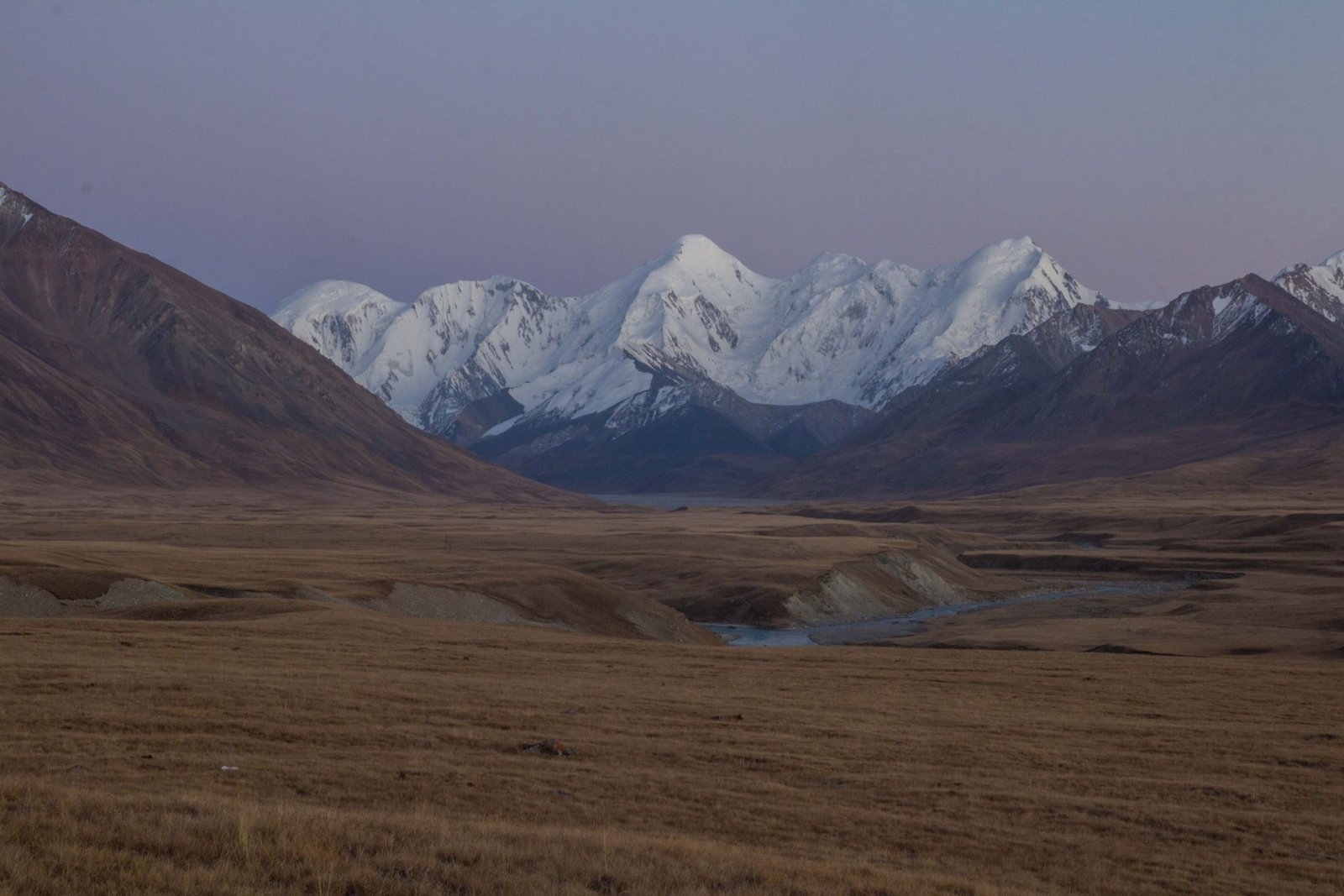
Photo: Sary Jaz. Adyr Tor Peaks by Aidar Em, via Wikimedia Commons, CC BY-SA 4.0.