
In short
Song-Köl sits at 3,016 m and its yurt camps run roughly mid-June to late September — July and August are the only certain months. Expect US$10–20 per person including meals at a herder or CBT camp, against US$60–110 at a commercial one. There is no public transport to the lake, no phone signal, no shop and no ATM.
Checked 26 August 2026. No official register of camps or season dates exists — sourced from CBT Kyrgyzstan, operator listings and dated 2024–26 traveller reports.
On this page
A night in a yurt on Song-Köl costs somewhere between US$10 and US$110, on the same lake, in the same month.
That spread is the most useful fact in this article, and almost nobody writes it down. At one end is a herding family taking guests during a season they would be spending up there anyway. At the other is a purpose-built camp with Starlink and hairdryers. Both are called yurt stays.
Here is how it actually works.
First, the branding trap
CBT Kyrgyzstan is a real thing: the Kyrgyz Community Based Tourism Association, trading as “Hospitality Kyrgyzstan,” registered on 3 January 2003 after an initiative launched in May 2000. It is an umbrella for around seventeen or eighteen local groups, with an office on Gorkiy Street in Bishkek, and its site lists 2026 office hours and departures — so it is demonstrably operating this year.
But there are two nearly identical websites. The association is at cbtkyrgyzstan.kg. There is also a cbtkyrgyzstan.com, with a different phone number, a different email, no legal entity name, no registration number and no physical address anywhere on the site. Its About page recites association-style language about member families and revenue shares, last updated January 2024, without ever claiming to be the association.
We are not accusing anyone of anything. But if you want the association, check the domain ending, and note that Destination Karakol and Destination Jyrgalan — which you will also meet — are something different again: non-profit destination marketing organisations, founded 2016 and donor-funded, with no CBT affiliation.
The local offices worth knowing:
- CBT Kochkor — 22A Pionerskaya St, Kochkor. The main gateway to Song-Köl, specialising in 3–9 day jailoo-hopping.
- CBT Naryn — Lenina St 8, Naryn. Covers Kel-Suu, Song-Köl and Tash Rabat, and arranges border-zone permits, which matters more than it sounds.
- CBT Sary-Mogol — next to the bazaar, for the Alay valley and Peak Lenin.
Song-Köl, and why the season is so short
The lake sits at 3,016 metres, covers 270 km², and is remarkably shallow for its size — a maximum depth of just 13.2 metres across 29 km of water. It is Kyrgyzstan’s largest freshwater lake and a Ramsar wetland of international importance since January 2011.
It also carries snow for 180 to 200 days a year, and its winter ice reaches over a metre thick and does not fully clear until late May.
| Period | Reality |
|---|---|
| Late May | Kalmak-Ashuu pass cleared by snow-blower; road opens |
| Mid-June | Herders and yurt camps begin arriving |
| July–August | Certain. Camps definitely operating |
| September | Thinning out; still likely |
| Late Sept–Oct | Camps come down; first snow closes the passes |
June and September are a gamble on the year’s snow — phone ahead. And be aware that no official source publishes these dates. There is no government season declaration and no register of camps. Every English article, this one included, is reporting folk knowledge accurately rather than citing an authority.
There are roughly fifteen yurt camps around the lake. You can turn up without booking and will find a mattress; book ahead if you want an actual bed or a private yurt.
Getting there
There is no public transport to Song-Köl at all. Not reduced, not seasonal — none.
Three main approaches, all from the Kochkor side or the Naryn highway:
- Kalmak-Ashuu (3,446 m) — the shortest route from Kochkor. Gentle meadow on the lake side, a steep stone road through a scree gorge on the other.
- Teskey-Torpok (3,133 m), which everyone calls “33 Parrots” — off the Bishkek–Naryn highway, passable by an ordinary vehicle in good weather and considerably harder after rain.
- Kyzart — the trekking approach, 55 km from Kochkor to the pass, 77 km to the village.
A 4WD is not strictly necessary; high clearance is. Expect loose rock and stream crossings. The 85 km road from Sary-Bulak is the one most manageable in a normal car.
Costs, none of them official:
| Price | |
|---|---|
| Kochkor → lake, shared taxi seat | About 200 som |
| Kochkor → lake, whole car | Up to 1,000 som |
| CBT-arranged transfer, per car | US$80–100 |
| Kochkor → Kyzart, shared taxi | 200–500 som |
| Bundled tour from Bishkek | From about US$350 |
Driving time from Kochkor is roughly three hours.
What a night actually costs
Herder-direct and CBT-brokered camps, from traveller reports across 2024–2026: 1,000–1,200 som per person, or roughly US$10–20, with dinner and breakfast included. A shower, where one exists, is often 200 som extra.
A commercial camp on the same lake publishes: US$60 per person for bed and breakfast at double occupancy, US$70 with dinner, US$80 full board — and US$95–110 for a single. That buys bedding, hot water, towels, shared bathrooms, Starlink and mobile coverage, across 44 yurts and 90 beds.
We could find no published CBT price list for Song-Köl. Both CBT Kochkor and CBT Naryn quote on request only.
What it is actually like
This is where most articles go soft. The specifics:
Sleeping. A standard yurt has five to nine mattresses laid on the floor around a central stove. Pricier camps have beds and offer private yurts.
The cold — take this seriously. The stove is refuelled in the middle of the night, but the fire goes out towards morning and a yurt cools very fast. Travellers report waking in July to frozen grass outside and ice in the toilet. The stoves burn animal dung. Bring a proper sleeping bag rather than trusting the blankets.
Toilets. A long-drop, usually a hole dug for the season. Some of the commercial camps now have flush.
Washing. Mostly, you don’t. Some camps have a sauna-style heated washing room for around 200 som. On a three-day horse trek, expect to wear the same clothes for three days.
Electricity. Solar, generally reserved for lights. No charging points. Bring a power bank and charge it in Kochkor.
Signal. None, at the community camps. No ATM, no shop, nowhere to buy anything but meals and kumys. The commercial end is changing — some camps now sell Starlink access — but do not count on it.
Horse trekking
Day rates, all from traveller reports rather than any published tariff: a horse runs about 700 som a day and a guide about 1,500 som, though hourly rates of 250 som for a horse also circulate. Negotiation is expected.
The classic route is Kyzart to Song-Köl over two days on horseback:
- Day 1: Kyzart to the Kilemche valley at 2,550 m — about 17 km, roughly +742 m, four to five hours riding
- Day 2: over the Tuz-Ashuu pass at 3,400 m to the lake — about 13 km, +874 m, around four hours
- Day 3: the lakeshore and a drive out, or six hours riding back
On foot it is around 30 km with a high point near 3,330 m, and rates as intermediate-to-hard.
Package prices in 2025–2026 ranged from about US$250 per person for a group of three with a private guide, through 15,000–20,000 som per person for an all-inclusive three-day trip booked locally in Kyzart, up to €250–440 per person through a Western-facing operator depending on group size. All include horse, guide, two nights in yurt camps and meals; transport to the trailhead is usually extra.
You do not need riding experience. Every source agrees the horses are used to beginners and brief instruction is given. What you do need is tolerance for long hours in a wooden saddle at altitude. Helmets are strongly recommended, frequently cost extra, and are frequently declined — take one.
Other places to sleep in a yurt
Tash Rabat — a stone caravanserai at 3,200 m in Naryn province, north of the Torugart pass. Admission 150 som, no formal opening hours; if the gate is shut, knock at the yurt camp next door. Its date and purpose are genuinely disputed: variously dated to the tenth or fifteenth century, and argued over as a Nestorian Christian monastery or a Buddhist one, on the basis of the inscriptions and artefacts found there. Camps beside it run 1,500–2,000 som per person with dinner and breakfast.
Jyrgalan — a village at about 2,500 m, an hour and a half from Karakol, with a marshrutka (#331) for 80 som. A trekking base in summer and ski touring in winter.
Sary-Mogol and the Alay — for Peak Lenin, which is 7,134 m. Marshrutka from Osh is 300 som, guesthouses US$15–20 with breakfast. A border-zone permit is required for the Peak Lenin base camp area — see our guide to Kyrgyz border permits.
Does the money reach the families?
The association’s own published model says 80 to 85 per cent of revenue goes directly to the families and proprietors travellers buy from, with the remainder funding local offices. That figure is self-reported and has never been independently audited, and we could find no study that traces where the money actually lands. The academic work that exists surveys perceptions, not revenue flows.
The best framing we found came from the conservation biologist Marc Foggin, quoted in 2020: “If no benefit is arising for local communities, then it is not ecotourism.”
What can be said honestly is this. Semi-nomadic herding is real and continuing — documented families still run a genuine four-month cycle from June, with children in school in Kochkor over winter. But tourist-oriented camps sit alongside working households on the same shoreline, and even careful travel writers admit they could not tell which sort they had stayed in. The ten-to-one price spread is the clearest evidence available that these are two different businesses wearing the same roof.
If it matters to you, book through a local CBT office rather than a Bishkek agency, and ask directly whose yurt you are sleeping in.
What we could not verify
Any official season dates or register of camps. Any published CBT price list for Song-Köl. Whether the 80–85 per cent revenue-share claim is accurate. And the drive time from Kochkor to the lake beyond a single “about three hours” report.
For the country as a whole, see our Kyrgyzstan travel guide.
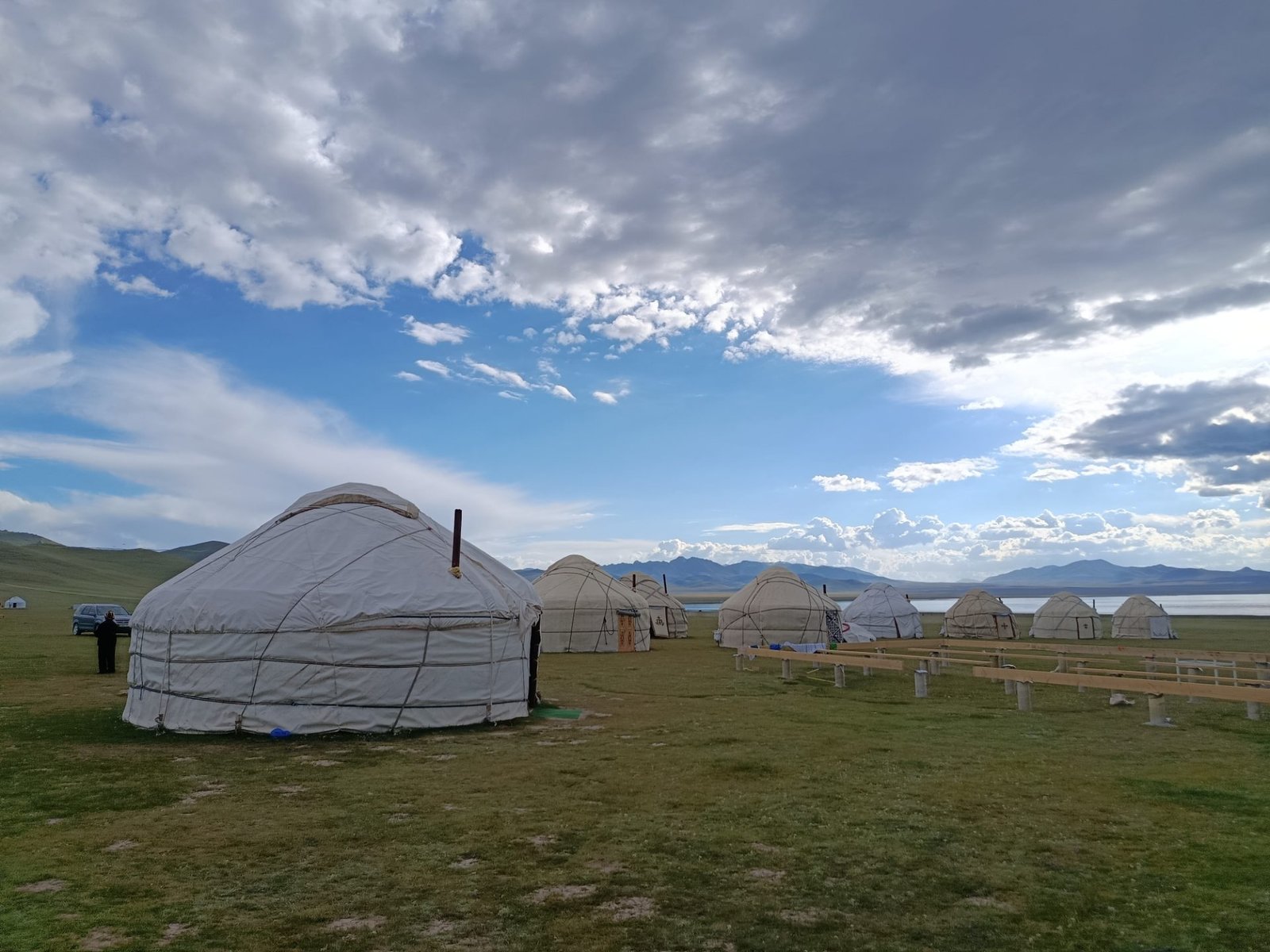
Photo: Yurt camp near Song-Kul lake 2026 01 by AseinMad, via Wikimedia Commons, CC BY-SA 4.0.