
In short
Ala-Archa now costs 250 som for an adult (since 8 June 2026), and petrol and diesel cars have been banned since 1 May 2025 — free electric shuttles take you to any point in the park. It is 40 km from Bishkek by electric bus line 1 from T. Usubaliyev Square. Bishkek itself needs one full day. Note the park is the CDC’s named tick-borne encephalitis locus for Kyrgyzstan.
Fees confirmed by two Kyrgyz news outlets on 11 June 2026; health risk from CDC and UK NaTHNaC guidance current at 26 August 2026.
On this page
Almost every English guide to Ala-Archa National Park is now wrong, because the rules changed twice — on 1 May 2025 and again on 8 June 2026 — and the park does not publish a price list on its own website.
Here is the current position, plus the honest version of what Bishkek is actually worth.
Ala-Archa: you can no longer drive in
Since 1 May 2025, petrol and diesel cars are banned from Ala-Archa National Park. Only electric vehicles may enter. The park runs a fleet of around eighty electric shuttles from behind the checkpoint, and they take you to any point in the park free of charge, serving five stops: Ak-Bata, Saz, Karagai-Bulak, Cher-Zhaz and Ak-Sai.
The reason is straightforward — more than 100,000 cars a year were entering. Open fires and barbecuing were banned at the same time, with designated picnic areas and gas stoves provided instead.
Current fees, in force since 8 June 2026:
| Fee | |
|---|---|
| Adult | 250 som (about US$2.90) |
| Child 7–14 | 180 som |
| Child under 7 | Free |
| Electric vehicle entry | 880 som |
Those replaced 200 / 150 / free / 800 som. There is no longer a car entrance fee for ordinary visitors — the old 500 and 700 som vehicle charges that still appear in most guides are obsolete, because the vehicles themselves are banned.
Note that the park has no citable official web price list. The increase was announced on Instagram, without a formal decree, and the park’s own tariff page could not be reached. If you find a different figure quoted somewhere, that is why.
We also found no evidence of a two-tier price for foreigners — the structure appears to be by age, not nationality.
Getting to Ala-Archa
The park is 40 km from Bishkek, about 50 minutes to an hour. Electric buses on line 1 depart from T. Usubaliyev Square, north of Oak Park, running daily 08:00 to 19:00 with a last return bus at 20:00.
From the park entrance it is a further 12 km to the trailheads at Alplager — this is where the free shuttles matter, and why arriving without a plan for that leg used to be a mistake.
The hikes
| Route | Distance | Time | Altitude |
|---|---|---|---|
| River trail | First 2 km flat, up to 6 km | Easy stroll | Minimal gain |
| Ak-Sai waterfall | 4.7 km from Alplager | 2–3 h up | 2,200 m → about 2,665 m |
| Ratsek hut / Ak-Sai glacier | 6.4 km one way | 4–6 h | 2,200 m → 3,300 m |
| Adygene valley | About 12 km return | 6–8 h | Roughly +900 m |
Two caveats. Sources give the waterfall as either 2,665 m or 2,860 m; the lower figure sits more sensibly between the 2,200 m trailhead and the 3,300 m hut. And the Adygene figures come from a single source, so treat them as indicative.
You can sleep at the Ratsek hut, at 3,300 m, and the prices are published: US$15 a night for a standard bunk, US$25 for the six-bed VIP room, US$15 to pitch a tent, plus a US$3 per person per day campsite fee that applies to everyone. Meals run US$12 for breakfast, US$20 for lunch and US$15 for dinner. It sleeps up to 35, has solar power, and is open year-round. It is the base for Uchitel Peak at 4,540 m.
Two risks worth taking seriously
Altitude. Alplager to Ratsek is +1,100 m in a day, from a trailhead already at 2,200 m. Standard guidance is to limit gain above 2,500 m to about 500 m daily. A day-hiker coming up from Bishkek at 800 m gains roughly 2,500 m in a morning. People get headaches and worse on this trail and assume it is fitness.
Tick-borne encephalitis. This is the specific and under-reported one. Ala-Archa is the exact location the US CDC names for Kyrgyzstan — infected ticks and a possible human case were reported here — and UK health guidance names the same park. Virus circulation was confirmed in studies between 2007 and 2009. Peak risk is spring through autumn. Cover up, check yourself, and raise it with a travel clinic before you travel.
Also: there is effectively no phone signal. One measurement recorded 0.57 Mbps in the park against 37.9 in Bishkek. Weather turns fast, and above 3,000 m it gets cold even in June.
Bishkek: one good day
Bishkek is a base rather than a destination, and the honest answer is that one full day covers it comfortably, two if you want a slower bazaar morning and a couple more museums.
Ala-Too Square takes about thirty minutes. The changing of the guard happens hourly in summer and every two hours in winter, with the guards marching to the flagpole. The Manas statue went up in 2011.
The State Historical Museum is the one thing that genuinely earns two hours. It reopened on 19 November 2021 after a renovation that was supposed to take under a year and took roughly five, during which more than 307 million som — about US$3.8 million — was stolen from the project, with prosecutions following. The building itself is Soviet modernist, from 1984.
Its official hours are Tuesday to Sunday 09:00–18:00, closed Monday, with the ticket office shutting at 17:30 and the last Friday of each month a maintenance day. Admission is reported at 200 som in 2026; the museum does not publish a price list online, so ring ahead if it matters.
One warning that guidebooks have not caught up with: the renovation removed the famous Soviet-era ceiling murals, statues and displays. What is there now is a well-made modern museum with good English signage across three floors — nomadic culture and Russian settler material downstairs, the Soviet period above. If you are going for the murals, they are gone.
Osh Bazaar runs daily 08:00–20:00, about forty minutes’ walk from the centre or US$2 by taxi. Go early. Pickpocketing is a genuine and officially noted risk here.
The Soviet city, if that’s your thing
Bishkek’s real distinction is its intact Soviet modernist fabric, and a two-hour walk covers most of it.
The mosaics: “Labour” (1966) on Chuy Avenue, in pebble and ceramic; “The Path of Enlightenment” (1978) in smalt tile on the National University campus; “Flourish, Kyrgyzstan!” (1978) covering an entire apartment block opposite the VEFA centre and now fading; “Song” (1966), the only interior one, inside the Shubin Music School. There are cosmonaut mosaics on the Ala-Too Cinema.
The buildings: the State Circus (1976), which genuinely does look like a flying saucer; the Palace of Sports (1974); the Wedding Palace (1987) with Kyrgyz-motif stained glass; the National Library (1983) and the Museum of Fine Arts (1974).
Panfilov Park was founded in 1924 as Zvezda — “Star” — park, laid out in a star shape, and renamed in 1942 for Ivan Panfilov. Its 1944 monument was the first in the entire Soviet Union to him. The Soviet fairground rides are widely photographed and almost entirely undocumented; we could find no installation dates, operating status or prices for them.
The Frunze House-Museum on Frunze Street is a replica built around the birth house of Mikhail Frunze — the reason the city was called Frunze until 1991, and the reason Bishkek’s airport code is still FRU. We could not verify its hours or admission, so do not plan around it.
Day trips
Burana Tower, 70–80 km east near Tokmok, open 09:00–19:00 daily, is the best of them. The minaret stands 25 m today, cut down from an original 44 m or so by earthquakes and Soviet-era dismantling, and restored in the 1970s; the interior spiral staircase is climbable and is steep, narrow and dark. Around it are mausoleums, an archaeological site, a small museum in a yurt, and a field of balbals — sixth-century Turkic carved stone figures, originally raised to commemorate enemies killed in battle and later reused as grave markers.
Allow 1.5–2 hours. Getting there: marshrutka 353 from Bishkek’s Eastern Bus Station to Tokmok, 80 som, about 1.5 hours, then a taxi from Tokmok for 500–600 som return including an hour’s wait. Bring cash, and sort your return before 17:00. On admission, sources give either 60 som for the tower plus 50 for the museum, or a single 100 som fee — neither is official.
Chunkurchak, 45 km south and about an hour away on a paved road open year-round, is the quieter alternative to Ala-Archa: entrance under US$1, a 125-metre suspension bridge at 2,400 m, a waterfall 20–30 minutes’ walk from the base, and a yurt lunch at the Supara complex for US$10–18. Wild Greig’s tulips in late April and May; a small ski area with 10 km of runs in winter.
Issyk-Ata, 60 km east and under two hours, is a Soviet-era hot-springs sanatorium reachable by marshrutka from the Eastern Bus Station between 08:30 and 18:00 for US$1–2. We could verify a 200 som pool price and nothing else — not its hours, not its entry fee, and not whether it is still properly operating.
What we could not verify
The park’s official price list, which exists only on Instagram. Whether the ICE-vehicle ban applies to taxis and tour vehicles or only private cars. Whether the Ak-Sai trailhead is affected by construction — one source says it was closed in 2025 and no other mentions it. Official admission for the Historical Museum and for Burana. The Frunze Museum’s hours and price. And anything at all about Panfilov Park’s fairground rides.
For the country as a whole, start with our Kyrgyzstan travel guide.
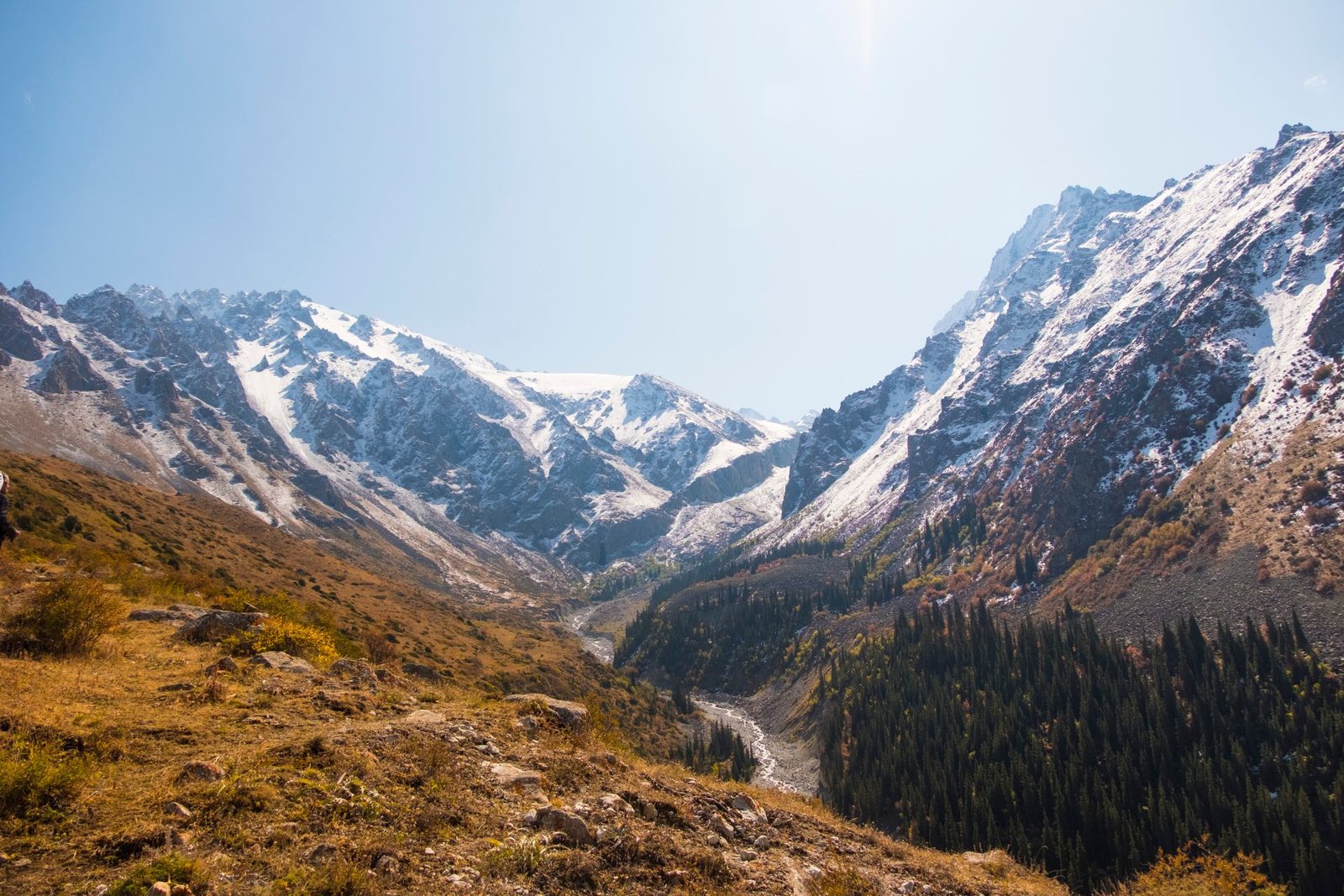
Photo: Ala Archa panorama 02 by Davide Mauro, via Wikimedia Commons, CC BY-SA 4.0.