
In short
Plov varies sharply by city — Samarkand’s is layered, not mixed, while Fergana’s is fried hard and has no sweet element. At Tashkent’s Besh Qozon a 0.7 kg portion costs 60,000 som (about US$5). Everywhere else, eat plov at lunch: it is cooked in the morning and when the pot is empty the place closes.
Prices and opening hours checked 26 August 2026; bread customs sourced to published ethnography rather than travel blogs.
On this page
- Plov is a family of dishes, not one recipe
- The Plov Centre, and what it really costs
- “Gone by lunch” is true, except where it isn’t
- Bread, and the rules that come with it
- What else you will meet
- Tea, and the ritual you will get wrong
- Wine, if you are curious
- Vegetarians: the honest version
- Alcohol and Ramadan
- Where we would actually send you
- What we could not verify
UNESCO inscribed “Palov culture and tradition” on its intangible heritage list in 2016. Uzbeks themselves count as many as 150 variations of the dish, and the differences are not trivial — in one city the rice and carrots are stirred together, and in another doing that would be a mistake.
Here is what to eat, where, and what things actually cost, checked in August 2026.
Plov is a family of dishes, not one recipe
The single most useful thing to understand: Samarkand plov is layered, not mixed. Uzbek recipe sources are explicit — the rice and the carrots are not stirred together but placed one on top of the other. Served on the platter, rice goes down first, then carrot, then meat on top. The carrots are stewed rather than fried, so they keep their own flavour, and you may be handed a small wooden block and a knife to cut your own meat.
Fergana plov is the opposite in almost every respect.
| Style | Rice | Character |
|---|---|---|
| Tashkent | Long-grain | Rich; kazy horse sausage, egg, chickpeas, raisins; yellow and red carrots together |
| Fergana | Devzira only | Everything fried hard first, hence the brown colour; no sweet elements — garlic and chilli instead. The heaviest, and the most canonical |
| Samarkand | Layered, not mixed | Carrots stewed not fried; lighter; you control the fat ratio yourself |
| Bukhara | — | Dried fruit — raisins, apricots, sometimes nuts; minimal oil; sweet red carrots |
| Khorezm | Soft local rice | The most laconic: meat, onion, carrot, little spice, carrots sliced rather than shredded |
Teahouse plov, the Fergana and Tashkent-province style, fries the onions before the meat, which is where its deeper colour comes from, and traditionally uses cottonseed oil.
One thing not to conflate: Uzbekistan’s UNESCO element is “Palov culture and tradition.” Tajikistan has a separate listing, “Oshi Palav,” inscribed the same year. They are two entries, not one.
The Plov Centre, and what it really costs
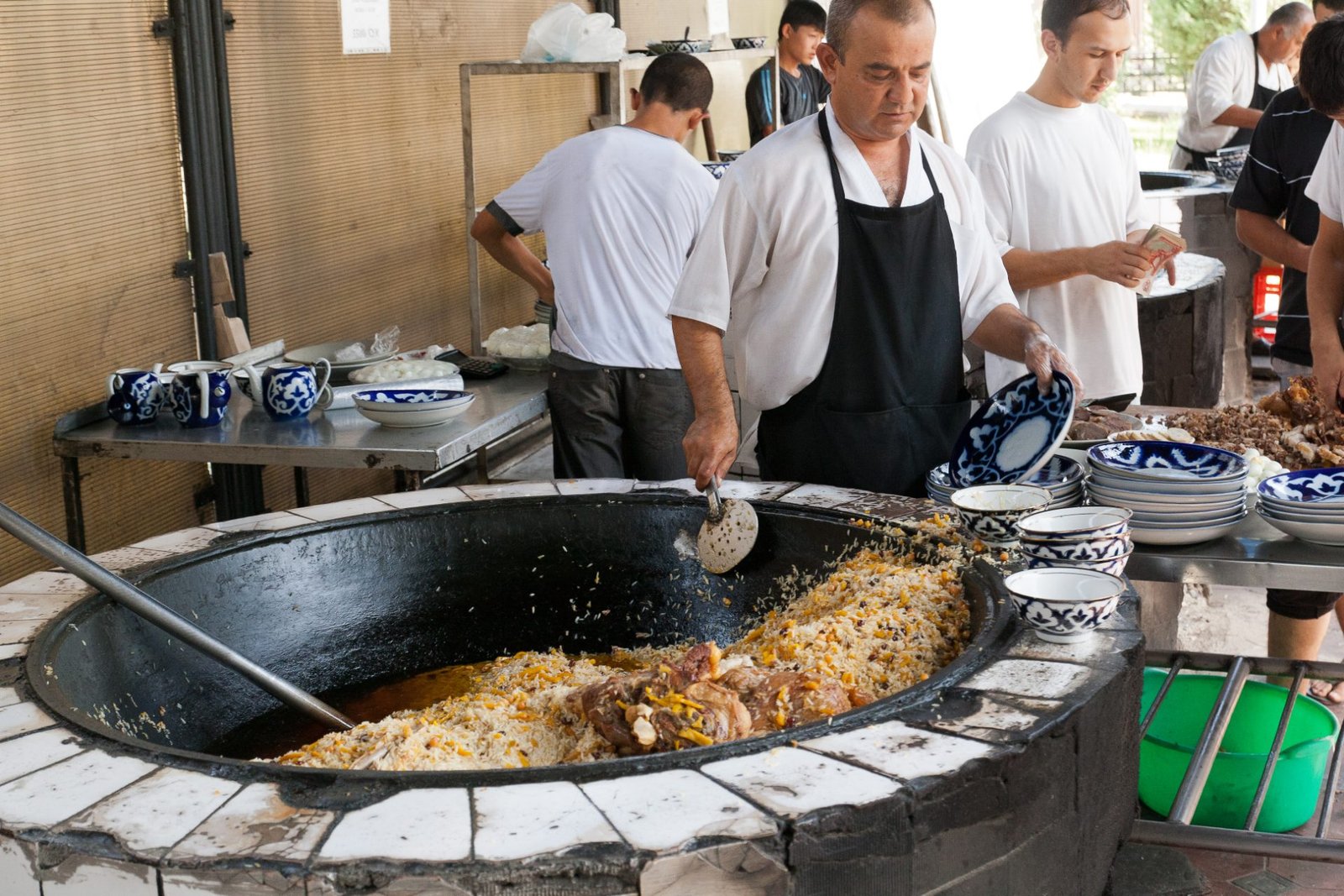
Besh Qozon, the Central Asian Plov Centre by the TV Tower in Tashkent, opened in 1999 with fifteen staff and now employs more than seven hundred, serving something like fifteen thousand people a day.
Every plov dish is 0.7 kg and costs 60,000 som — about US$5.10. The menu distinguishes toy osh (wedding), choyxona osh (teahouse), zigir osh made with flaxseed oil, devzira osh, and a house special.
It is on Iftikhor Street, nearest metro Shahriston, open 09:00–23:00.
For a sense of how fast Uzbek prices move: a portion here cost 34,000 som in January 2024. That is a rise of about seventy-six per cent in two and a half years, and it is why you should distrust any price in a travel article that isn’t dated — including ours, in a year’s time.
“Gone by lunch” is true, except where it isn’t
You will read everywhere that plov sells out by early afternoon. That rule is real, and it is wrong about the one place it is most often applied to.
The general rule holds because plov is genuinely made in the morning — preparation starts around six — and when the qozon is empty, the place shuts. The clearest proof is Samarqand Osh Markazi N1 in Samarkand, which opens 11:00 to 15:00, Tuesday to Saturday, and serves plov and nothing else. Turn up at four and you have missed it.
Besh Qozon is the exception: it cooks all day, and the branch at Nurafshon runs to three in the morning. So the correct advice is: eat plov at lunch everywhere in Uzbekistan, except at the Tashkent Plov Centre, where you can turn up at nine in the evening.
Bread, and the rules that come with it
Uzbek non is baked stuck to the wall of a tandoor at around 315 °C. The baker — the nonvoy — prepares a sourdough overnight, then stamps each round with a chekich, a perforated metal stamp often made from arranged nails, and presses the centre with a bosma, a spoked press frequently cut from a bicycle wheel. A single baker turns out something like fifty large loaves and four hundred small ones a day.
The regional differences are real. Samarkand non is darker, heavier and denser, coated with oil. Tashkent non is lighter and chewier and peaks in quality for only a few hours. Bukhara bread sits between the two and is scattered with blackened nigella. Khorezm non is flatter, almost a cracker, stamped over most of its surface. Patyr is the festive one, its dough layered with mutton fat and butter until it goes flaky.
The customs around it are documented ethnography, not travel-blog invention:
- Tear bread by hand. Never cut it with a knife.
- Never place a loaf face-down — it is a real discourtesy.
- Dropped pieces are picked up and left on a wall or a branch for the birds.
- Engagement bread is bought in pairs, broken and shared to formalise the engagement.
- At weddings, the couple bite from two loaves placed face to face; the dried loaves are kept until their first breakfast together.
- A son leaving for military service bites from one of a pair, and the family hangs the other until he comes home.
There is a proverb: respect for non is respect for country.
One correction on a story you will hear. Samarkand non is said to keep for years — that is legend, and we could not source it. What is documented is narrower and more useful: it freezes well, and thawed, sprayed with water and reheated, tastes freshly baked. Tashkent bread does not survive the day.
What else you will meet
Somsa is baked on the wall of a tandoor until the pastry turns golden — it is not deep-fried, whatever you may have had elsewhere. Minced lamb or beef with onion and fat is the classic.
Lagman is hand-pulled wheat noodles of Uyghur origin, arriving via Xinjiang. Two forms: the soup, and kovurma lagman, fried and tossed in sauce with no broth. Manti are big steamed dumplings, lamb and onion or pumpkin, cooked in a tiered steamer called a kaskan, and descended from Chinese mantou.
Shashlik at its best has dumba — sheep’s-tail fat — threaded between the meat. Shurpa is a brothy lamb soup with large chunks of meat and vegetables. Chuchvara are small dumplings, boiled in broth or fried. Mastava is sometimes called liquid plov, and that is a fair description.
Tea, and the ritual you will get wrong
Green tea, kok choy, is the default across most of the country, drunk plain — no milk, no sugar. Black tea is more common among Russian-speakers and in Tashkent, Samarkand and Urgench; in Karakalpakstan both are taken with milk.
The pouring custom is real and specific. Tea is poured from the fresh pot into a bowl and returned to the pot three times before anyone drinks — the three returns even have names, loy, moy and choy.
Then the counter-intuitive part: the honoured guest gets the least tea. The bowl is filled maybe half way. This is not meanness. The logic is that the more often a guest has to ask the host for something, and the more often the host obliges, the better the hospitality — so a small pour is an invitation to keep asking.
Alongside tea you will meet katyk (sour milk), suzma (strained curd), kurt (salted dried balls that are much saltier than they look), ayran and chalop.
There is also a folk rule, offered here without endorsement: never drink vodka after plov.
Wine, if you are curious
Hovrenko in Samarkand still runs tastings — ten wines in a standard flight — but operates on a tour-group basis rather than walk-ins, and 2026 reviews are genuinely split between “professionally presented” and “a ten-minute run-through.”
Bagizagan, 15 km east of Samarkand, also has a tasting hall near the railway station, open 11:00–18:00 and closed Sunday. Six wines plus three brandies and chacha, served with cheese, fruit and nuts. The whites are Rkatsiteli, the reds Saperavi and Cabernet.
Vegetarians: the honest version
Uzbekistan is difficult, and most guides soften this. Here is the real picture.
Genuinely meat-free: non; achichuk, the tomato and onion salad; tuxum barak, egg-filled ravioli in yoghurt sauce from Khorezm; and shivit oshi, Khiva’s dill noodles, where the meat sauce is served separately and can simply be declined.
Traps. Vegetarian lagman frequently still has small pieces of meat in the broth. Vegetable somsa and manti often taste strongly of mutton fat. Vegetarian plov exists and is usually bland — rice with vegetables rather than a dish in its own right.
Assume most soups are made with meat stock. Shurpa, mastava, chuchvara in broth and lagman are all defined by a lamb or beef base.
What works: ask for egg dishes, order garnir (vegetable sides) and salads, use the self-service diet cafés, buy from bazaars, and stay in family guesthouses where someone will cook to order. Afsona in Tashkent and Minzifa in Bukhara both flag vegetarian and vegan options.
Alcohol and Ramadan
Alcohol is legal and the country is officially secular. It is sold in licensed restaurants and bars, in dedicated Sharob shops open 09:00–23:00, and in supermarkets like Korzinka. Public drinking is illegal — streets, parks, public transport — and forbidden near mosques and pilgrimage sites. The drink-driving limit is zero.
Rough prices: local beer US$1–2.50 in a venue, Uzbek wine US$2–4 a glass or US$5–8 a bottle.
Ramadan in 2026 ran from 18 February to 19 March, ending days before Navruz. Most restaurants and cafés stayed open through the day in the main cities. Expect iftar crowds around 18:00–19:30, and simply avoid eating or smoking conspicuously in front of people who are fasting.
Where we would actually send you
Only places we could confirm are currently operating, with recent reviews.
Tashkent — Besh Qozon for plov, 60,000 som. Afsona on T. Shevchenko for modern Uzbek, 11:00–23:00, with vegetarian options. Caravan on Abdulla Kahhar, open till two in the morning; listed dishes run from about 49,000 som for tuxum barak to 174,000 for its signature jiz.
Samarkand — Platan is the long-established choice. Samarqand Osh Markazi N1 on Ibn Sino does plov and nothing else, 11:00–15:00, Tuesday to Saturday, and two people can eat for around 130,000 som.
Bukhara — Minzifa for the terrace over the old town, and Old Bukhara near Hotel Asia. Both are solid rather than remarkable, and reviews are mixed on value.
Khiva — Terrassa, on the rooftop over Itchan Kala, open 07:00 to nearly midnight. Mastava about 57,000 som, lagman 58,000, manti 69,000.
One we are deliberately not recommending: a famous-name restaurant in Samarkand that trades on its location beside the monument it is named for rates only 3.4 out of 5 across more than 240 reviews. Reputation is not the same as a good dinner.
What we could not verify
Whether the Rishtan and regional craft-town restaurants are still operating — coverage out there is too thin to check. Precise 2027 Ramadan dates, which will be confirmed locally by moon sighting. And whether a couple of the Bukhara listings above have changed hands; the most recent reviews we could reach for one of them date from spring 2025.
For the trip around the food, see our Uzbekistan travel guide, and for where the plov styles come from, our guides to Samarkand and Bukhara.
Photo: Plov Tashkent by Ekrem Canli, via Wikimedia Commons, CC BY-SA 3.0.