
In short
UNESCO inscribed ten modernist buildings in and around Tashkent on 26 July 2026. Most are free or cheap to see: Chorsu Market and Kosmonavtlar metro station cost nothing beyond a 1,700 som metro fare, and the State Museum of History reopened two days before the vote. The tenth, a Soviet solar furnace at Parkent, is a separate day trip by arranged tour.
Checked 26 August 2026 against UNESCO’s inscription record and Uzbek reporting of the 48th session in Busan.
On this page
On 26 July 2026, at its session in Busan, the UNESCO World Heritage Committee inscribed ten buildings in and around Tashkent as “Tashkent Modernist Architecture: Modernity and Tradition in Central Asia.” It is the first time a body of Soviet-era modernism in Central Asia has been given that status.
It is also, quietly, a vindication. Nine years earlier a bulldozer took down one of the finest buildings of the same generation, and the outrage that followed is the reason this list exists at all.
The earthquake that built the city
At 05:23 on 26 April 1966, an earthquake of magnitude 5.2 struck directly beneath central Tashkent at a depth of only three to eight kilometres. The magnitude is unremarkable. The depth is the whole story.
Between 78,000 and 95,000 homes were destroyed, most of them adobe. More than eighty per cent of the city was affected, and somewhere between 200,000 and 300,000 people out of a population of about 1.1 million were left homeless. The official death toll was fifteen — a figure that is officially recorded rather than independently established, and should be read that way.
What followed was one of the largest reconstruction efforts the Soviet Union ever mounted. Building brigades arrived from across the republics, and roughly 100,000 new homes went up by 1970. The architects working in that window were handed something almost no generation gets: a major capital to rebuild, in a hurry, with state backing.
The idea they reached for is what UNESCO actually inscribed. Not the buildings as objects, but a method — industrialised, seismically engineered construction adapted to Central Asian materials, climate and decorative tradition. In practice that means concrete panjara: the pierced lattice screen of Uzbek architecture, reproduced at building scale as solar shading. The State Museum of History sits as a marble box floating on a podium behind exactly such screens. The Palace of Peoples’ Friendship wears them across its façade. The Circus lines a turquoise dome with ganch stucco, carved walnut and stained glass.
The ten inscribed components
| Building | Dates | Architects | Can you go in? |
|---|---|---|---|
| Pearl (Zhemchug) residential building | 1975–85 | Ofeliya Aydinova | No — private flats, exterior only |
| State Museum of the History of Uzbekistan | 1968–70 | Yevgeny Rozanov, Vsevolod Shestopalov | Yes — reopened 24 July 2026 |
| Palace of Peoples’ Friendship | late 1970s–81 | Yevgeny Rozanov | Ticketed events only |
| State Museum of Arts of Uzbekistan | 1967–74 | Iskander Abdulov, Anatoly Nikiforov | Status unclear — see below |
| Tashkent State Circus | 1965–75 | Genrikh Aleksandrovich, Gennady Masyagin | Yes, for performances |
| Central Exhibition Hall, Academy of Arts | 1972–74 | Rafael Khayrutdinov, F. Tursunov | Yes, 10:00–17:00 |
| Palace of Arts / Panoramic Cinema | 1962–64 | Sergo Sutyagin | Reported closed |
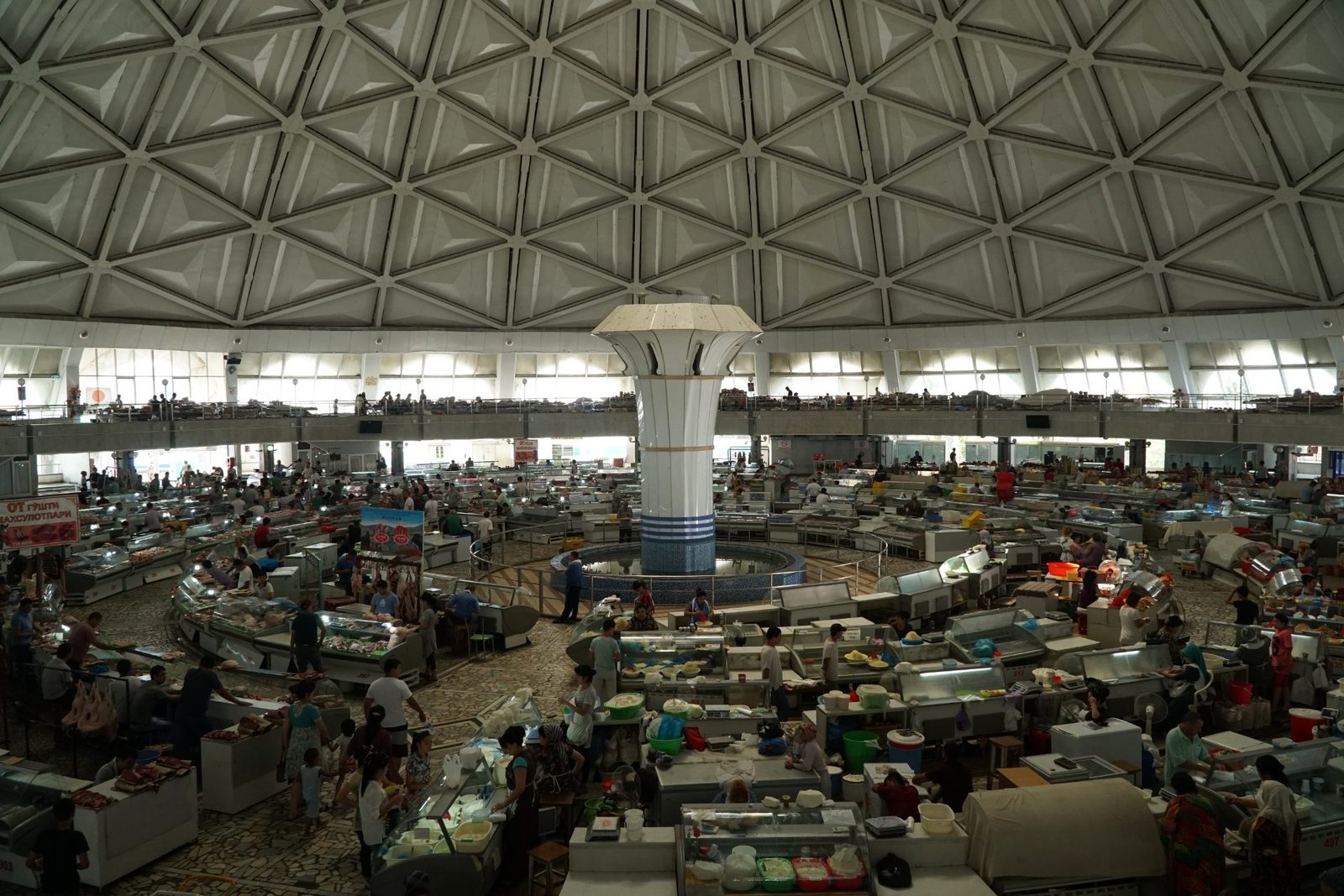
| Chorsu Market | 1983–90 | Vladimir Azimov, Sabir Adylov | Yes, free, daily |
| Kosmonavtlar metro station | 1982–84 | Sergo Sutyagin, S. Sokolov | Yes — it is a metro station |
| Sun Heliocomplex, Parkent | 1981–87 | Not established | By arranged tour |
Two honest caveats. The authorship of Kosmonavtlar is contested: Uzbek sources and Sutyagin’s own biography credit him, while one major architecture outlet credits Spartak Ziganshin. And no source we checked names an architect for the Sun Heliocomplex at all — which, for a structure of that scale, is remarkable in itself.
The building that had to die first
Rafael Khayrutdinov appears on the list above as co-architect of the Central Exhibition Hall. He also designed the Dom Kino, the House of Cinema — built in five months, opened in 1982 to coincide with the Tashkent Film Festival, clad in Gazgan marble and granite, its auditorium projecting on four columns.
It was demolished in December 2017 to clear ground for the Tashkent City business district.
More than seventy architects, filmmakers and artists signed a letter to the president asking that it be kept and worked into the new development. The letter was stopped at the state construction and architecture committee and, by one detailed Uzbek account, never reached him. Months later the Dom Lesovoda, the Forestry House of 1974, went the same way, replaced by a tower.
So the same architect has one building on the World Heritage list and one in a landfill. That is not an ironic coincidence — it is a causal chain. The demolition provoked the campaign; the campaign produced the documentation; the documentation produced the nomination.
That campaign has a name: Tashkent Modernism XX/XXI, run by the Art and Culture Development Foundation with the Milan studio Grace, the Politecnico di Milano and the historian Boris Chukhovich. It produced an exhibition shown in Tashkent in 2023 and later at Triennale Milano, a series of books, and a guide app cataloguing twenty-one landmarks. In April 2024 it helped secure national heritage listing for ten further buildings — including the Hotel Uzbekistan, the TV Centre and the Palace of Aircraft Builders.
Those are a different ten from the UNESCO ten. It is the easiest mistake to make about this subject, and plenty of coverage makes it.
Kosmonavtlar, and what is on the walls
The station opened on 8 December 1984 and won the Soviet architects’ union prize for best building of the year. Its columns are bottle-green glass, narrowed from 60 cm to 39 cm so as not to interrupt the ceiling; ceramic plates along the track walls stand in for infinite space, mirrors having been rejected as unsafe.
The ceramic medallions portray Ulugh Beg, Icarus, Valentina Tereshkova, Yuri Gagarin, Volkov, and Vladimir Dzhanibekov — the last being the cosmonaut born in the Uzbek SSR, which is why he is there. Putting the fifteenth-century astronomer of Samarkand in the same sequence as Gagarin is the entire argument of Tashkent modernism compressed into a corridor.
Photography is fine. The long-standing ban was lifted years ago and everyone shoots the stations now, though we could not find the formal decree, and UK travel advice still lists metro stations among places not to photograph — it has not caught up. Shoot the architecture, not the staff or the security posts. The fare is 1,700 som by card or 3,000 som for a cash ticket, flat, with no distance bands.
The strangest thing on the list
The Sun Heliocomplex at Parkent, about an hour and a half east of Tashkent at around 1,100 m in the Tien Shan foothills, is a solar furnace: a concentrator 54 m high and 47 m wide, fed by 62 heliostats, rated at one megawatt and capable of 3,000 °C. Built between 1981 and 1987, it was the second such facility in the world after Odeillo in France, and remains the only one in Central Asia.
It still belongs to the Institute of Materials Science of the Uzbek Academy of Sciences, which advertises tourist services but publishes no price and no booking form — the honest advice is to phone or email the institute directly. A commercial operator sells it as a nine-hour day trip at roughly US$85 to US$340 per person depending on group size, three hours of that on site.
Two practical warnings from that operator’s own page: the melting demonstrations do not run at weekends and not on every weekday, and as of April 2025 the lift was out of service, so reaching the observation deck meant climbing external stairs. Check before committing a day to it.
Seeing the central group in a day
The museums and the exhibition hall sit on Sharaf Rashidov Avenue, walkable from Mustaqillik Maydoni station. A workable spine: Chorsu from early morning — the bread rows trade from three in the morning and the market is free and open daily — then the metro to Mustaqillik Maydoni for the History Museum and the Central Exhibition Hall, with Kosmonavtlar taken as a station stop on the way, then the Palace of Peoples’ Friendship and the Circus.
The Heliocomplex cannot be folded into that. It is a separate day.
We verified street addresses for only two of the ten components, so treat the sequence as a suggestion and check locations before you set out.
Timing, if you are going
The State Museum of History reopened on 24 July 2026 after two years closed for reconstruction of both the building and its displays — two days before the UNESCO vote. It was founded in 1876 and marks its 150th anniversary this year, with holdings above 350,000 items. Post-reconstruction admission prices had not been published when we checked.
The Central Exhibition Hall opens 10:00 to 17:00 and holds 2,500 m² of exhibition space; it publishes no admission price either.
One framing to avoid: this is being reported as Uzbekistan’s first UNESCO inscription in twenty-five years. That is true only of cultural sites — the country gained the natural Western Tien-Shan property in 2016 as part of a transnational listing.
What we could not verify
The architect of the Sun Heliocomplex, and any standing tour price or timetable for it. Current admission prices for the reopened History Museum, and whether the Central Exhibition Hall charges at all. The current status of the State Museum of Arts of Uzbekistan, which closed for reconstruction in 2019 and had certainly reopened by 2023, but for which we found no reopening announcement, hours or ticket price. The formal act and date lifting the metro photography ban. And a complete inventory of what has been demolished — only the Dom Kino and the Dom Lesovoda are firmly documented, though general commentary implies more.
We also could not reconcile the mirror counts published for the Heliocomplex, which appear in the same sources as both 10,700 and 12,090 and probably describe two different mirror populations. We are not printing a single figure.
For everything else about the city and the country, start with our Uzbekistan travel guide, and for why the restoration debate matters here, see what UNESCO actually decided about Uzbekistan’s older monuments.
Photo: Chorsu Bazaar in Tashkent 2 by Adam Harangozó, via Wikimedia Commons, CC BY-SA 4.0.