
In short
Samarkand has never been proposed for the List of World Heritage in Danger; a 2020 mission said Danger listing would not be appropriate. The Uzbek property that really faced deletion is Shakhrisabz, on the Danger List since 2016 after some 70 hectares of its historic centre were cleared. UNESCO’s recurring complaint everywhere else is procedural — work begun before impact assessments are submitted — not aesthetic.
Read against World Heritage Committee decisions and advisory mission reports on whc.unesco.org, 26 August 2026. Decision language is paraphrased, not quoted.
On this page
- Shakhrisabz is the property that nearly went
- Ten years on the Danger List, with no defined way off
- Samarkand was never proposed for the Danger List
- What UNESCO actually says about the Registan
- Bukhara has the sharpest technical criticism in the whole record
- The real complaint is procedural
- UNESCO also praises Uzbekistan, and that is in the record too
- The part that is not about buildings
- What we could not verify
You will hear it in Samarkand, usually from another visitor: the restorations here are so heavy-handed that UNESCO nearly stripped the city of its World Heritage status.
It is a good story and it is not true. We read the World Heritage Committee’s decisions on every Uzbek property, and Samarkand has never been proposed for the List of World Heritage in Danger. The city where deletion really was on the table is ninety kilometres south, and almost nobody visits it.
Everything below is paraphrased from the Committee’s published decisions and advisory mission reports rather than quoted, so that nothing here depends on wording we could not check letter by letter.
Shakhrisabz is the property that nearly went
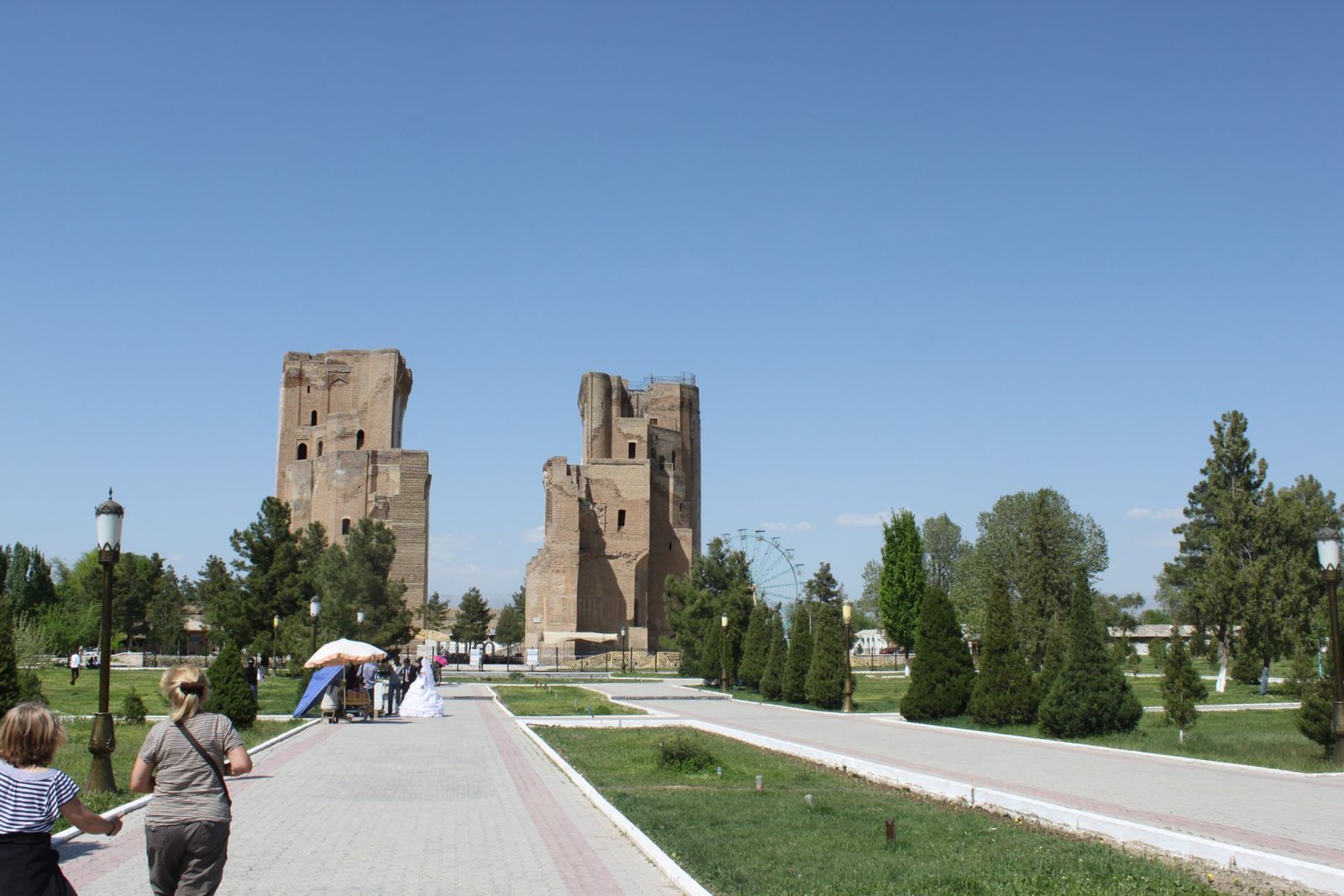
The Historic Centre of Shakhrisyabz — UNESCO’s spelling — was inscribed in 2000. Timur was born nearby, and the ruined gatehouse of his Ak-Saray palace is the largest thing he built.
From 2014, under a presidential decree, a state redevelopment programme cleared roughly seventy hectares of the historic centre, running from the Ak-Saray to the Dorus-Tilovat complex. Around two thousand residents were moved about four kilometres away. A monitoring mission in December 2016 found one historic quarter almost entirely destroyed, including the core of the earliest, seventh-century part of town, with archaeological layers stripped to a depth of two metres and more.
That mission reached a conclusion the Committee has been quoting back ever since: recovering enough of the property’s attributes to justify the value it was inscribed for looked impossible.
Shakhrisabz went onto the Danger List in 2016, by decision 40 COM 7B.48. In 2018, decision 42 COM 7A.4 asked the question directly — whether the property had lost the values it was listed for and should be deleted outright under Paragraph 192 of the Operational Guidelines. It concluded that the heart of Timurid town planning had been lost, and retained the property anyway. In 2019, decision 43 COM 7A.44 gave Uzbekistan two years to propose either a major boundary change or an entirely new nomination, failing which the option on the table was deletion.
Ten years on the Danger List, with no defined way off
Here is the detail that struck us hardest. A property on the Danger List normally has a Desired State of Conservation for Removal — a written definition of what recovery would look like — and a set of corrective measures. Shakhrisabz has been listed for ten years and, as of the 2025 record, neither has ever been drafted.
That is not administrative drift. It is because the Committee and Uzbekistan spent the decade arguing about something more fundamental: whether the property should continue to exist in the form it was inscribed.
The answer now on the table is that it should not. Uzbekistan submitted a draft in April 2025 proposing to shrink the property to four Timurid monuments and rename it accordingly, with the rest of the city becoming buffer zone. The Committee welcomed the approach in 2025 and confirmed it in 2026 with decision 48 COM 7A.26. The full boundary-modification dossier is due by 1 February 2029, with an interim report due 1 February 2027.
The route out of the Danger List, in other words, is not repair. It is redefinition.
Two live technical disputes are worth knowing. The Committee asked Uzbekistan not to proceed with a proposed silicone treatment of the Ak-Saray’s cracked walls, on the grounds it could stiffen the masonry and reduce earthquake resistance. And rising groundwater is now the dominant threat, made worse because the traditional water-management channels were largely demolished during the redevelopment. A 2019 mission put tile loss on the Ak-Saray at roughly three per cent a decade.
Samarkand was never proposed for the Danger List
We checked every Committee decision on Samarkand we could open, from 2005 to 2025. None of them mentions the Danger List, ascertained danger or potential danger.
The evidence is stronger than mere absence. A joint monitoring mission in January 2020 concluded that the property is not subject to ascertained or potential danger and that Danger listing would not be appropriate to consider. A 2024 advisory mission found that the physical characteristics carrying the property’s value remain evident and tangible.
What did happen is a different mechanism, and it is almost certainly where the rumour comes from. In 2008 the Committee applied Reinforced Monitoring to Samarkand, a heightened-scrutiny procedure. A mission followed in March 2009, and later that year the Committee discontinued it. Samarkand was under the mechanism for about a year and was released.
Reinforced Monitoring is not the Danger List and is not a step towards deletion. The 2008 trigger was not restoration quality at all — it was development pressure, specifically proposals to re-create the Timurid city walls and build a hotel with historic-style facades near them.
There is also a case where UNESCO pressure plainly worked. A 2004 traffic plan had approved a new road through the historic centre; by 2019 the Committee was noting with satisfaction a revised scheme that would replace it and prevent further roads, and by 2023 a scheme with no expansion of main transport routes inside the property or its buffer zone.
What UNESCO actually says about the Registan
This is where the record is most often misreported, including in our own working notes before we checked.
The Registan is not discussed in the 2025 Samarkand decision, 47 COM 7B.91, despite that decision being widely cited for it. That decision names the Silk Road Museum, the Third Renaissance programme, the Chorsu Trade Dome, Koshhovuz, the Ulugbek Observatory, the Imari building, Bibi Khanoum, the Samarkand Hotel and the Imam Maturidi complex. It does not mention the Registan at all.
The Registan appears in the 2023 decision, 45 COM 7B.50, in a list of projects for which documentation must be submitted for advisory-body review. The substantive assessment sits somewhere else entirely: a joint UNESCO and ICOMOS advisory mission of November 2024. That is an advisory document, not a Committee decision, and the distinction matters.
What the mission found at the Registan is more specific and far less lurid than the rumour. It recorded extensive twentieth-century, Soviet-era reconstruction supported by limited documentary evidence, and almost no interpretive material explaining to visitors how the complex actually evolved. It asked for historical analysis before any further work, and for detailed structural analysis by international specialists — particularly at the south-west corner of the Tilla-Kori madrasah, where there is localised deformation.
So the complaint about the Registan is substantially about interpretation. Nobody tells you what is original and what was rebuilt. That is a fair criticism, and one you can act on as a visitor: assume more of what you are looking at is twentieth-century than the signage implies.
The same mission was blunter about the wider Third Renaissance programme — new visitor centres, level changes, excavations and parking schemes across Shah-i-Zinda, Gur-i-Amir, the Observatory, the Registan and Bibi Khanoum — noting that no heritage impact assessments were included in the documentation. And it rejected the proposed site for a new Silk Road Museum, which would have required demolishing sixty-one buildings and sat on significant eleventh- and twelfth-century Karakhanid remains.
Bukhara has the sharpest technical criticism in the whole record
If you want a documented complaint about the quality of Uzbek restoration, it is not in Samarkand. It is in the November 2024 advisory mission to Bukhara, which found reconstruction using sometimes non-original materials and inappropriately designed new work — and, specifically, that earlier interventions at the Kalon Mosque using reinforced concrete had made structural problems worse.
The 2025 decision on Bukhara, 47 COM 7B.90, also records that a new plaza on the south side was created without the World Heritage Centre being notified, and that work at one site was completed without incorporating the revisions ICOMOS had asked for. A development moratorium remains in force pending finalised master plans.
At Khiva, the 2026 decision found the draft development plan for the centre inadequate as a planning document, because it does not connect the changes it proposes to the values the site was inscribed for. We covered that, and the termites and salt underneath it, in our guide to Khiva.
The real complaint is procedural
Read all four properties together and the pattern is unmistakable. The Committee’s recurring objection is not that Uzbek restorations look wrong. It is that work is designed, approved or begun before impact assessments and documentation reach UNESCO’s advisory bodies — a requirement under Paragraph 172 of the Operational Guidelines.
The same finding appears at Shakhrisabz in 2016, at Samarkand in 2024, at Bukhara in 2025, at Khiva in 2026, and even at the newly inscribed Zarafshan-Karakum Silk Roads corridor, where the Committee regretted in 2025 that impact assessments for two archaeological park projects had not been submitted and asked for them urgently.
UNESCO also praises Uzbekistan, and that is in the record too
An honest account has to include this. The Committee has welcomed a 2018 presidential decree protecting all Uzbek World Heritage properties and the withdrawal of the Shakhrisabz rebuilding decree; the cancellation of demolition and development schemes and a standing moratorium at Samarkand; the relocation of a major tourist complex away from the property; the abandoned road scheme; and an International Advisory Committee for Uzbek World Heritage properties described by UNESCO as the only body of its kind in the region.
At Khiva in 2026 it welcomed a new management plan, a monitoring and documentation campaign including 3D scanning of the entire walled ensemble, and commended local conservation training.
And in July 2026 UNESCO inscribed a new Uzbek property: Tashkent Modernist Architecture, ten Soviet-era buildings including Chorsu Market and Kosmonavtlar metro station. A body on the point of expelling Uzbekistan’s heritage does not add to it.
The part that is not about buildings
The sharpest current controversy is not restoration aesthetics. In October 2025, three UN Special Rapporteurs — on adequate housing, on cultural rights, and on the independence of judges and lawyers — stated that an entire neighbourhood in a protected zone near the al-Maturidi mausoleum in Samarkand was demolished in May 2025, and that more than 1,200 people lost their homes within weeks, many of them members of the Multoni minority. They alleged an absence of consent, no resettlement plan and insufficient compensation.
The World Heritage Committee touched the same events from a heritage angle in its 2025 Samarkand decision, requesting clarification about third-party concerns regarding expansion of the Imam Maturidi complex. The Committee had already been told, in the 2024 mission, that a considerable number of complaints about demolitions had reached the World Heritage Centre.
We found no published Uzbek government response to the October 2025 statement. That is not the same as saying none exists.
What we could not verify
We could not open every pre-2013 Samarkand decision in full, so our finding on the Danger List should be read as “no decision we could find” rather than “no decision ever”. We could not confirm the inscription decision number for Tashkent Modernist Architecture, and we could not find any Uzbek official on-record defence of the Shakhrisabz demolitions — the fullest counter-argument available is that without heavy twentieth-century intervention, after earthquakes and material-raiding, some of these monuments might not have survived at all.
For what any of this means at the ticket office, see our guides to Samarkand’s contradictory entry prices and Bukhara’s published tariff.
Photo: Ak Sarai in Shahrisabz 1 by Faqscl, via Wikimedia Commons, CC BY-SA 3.0.