
In short
No official price for Itchan Kala’s combined ticket has been published since 2019. Two figures circulate — 150,000 som (traceable to 2019) and 250,000 som (2026 sources). Budget 250,000 som, about US$21. What every source agrees on: three tiers, valid two full days, sold in cash at the West Gate, with the Pahlavan Mahmud mausoleum and the Islam Khoja minaret charged separately.
Checked 26 August 2026 against the Ichan-Qala museum-reserve site, Uzbekistan’s legal database, the Internet Archive and UNESCO’s state of conservation record for property 543.
On this page
- The official page that publishes nothing
- Two prices are in circulation, and only one can be right
- What is consistent across every source
- Termites, salt, and the slow problem under the walls
- The restoration UNESCO’s advisers called preoccupying
- The hotel that earned Khiva a formal rebuke
- Where Khiva stands with UNESCO now
- Getting there in 2026
- What we could not verify
Khiva’s walled inner town, Itchan Kala, was the first site in Central Asia inscribed on the UNESCO World Heritage list, in 1990. It is also the only major Uzbek destination where we could not establish the price of a ticket from any source you could check yourself.
That is not for want of trying. There is an official ticket page. It simply does not publish anything a reader can read.
The official page that publishes nothing
The Ichan-Qala State Museum-Reserve runs a proper website with a tickets section in three languages, and an online ticketing portal that has existed since September 2019. Neither serves any price to anyone outside the site’s own interface — the ticket page is a JavaScript application that returns nothing but metadata, and the ticketing portal did not respond at all when we checked.
We then looked in every other place a price could reasonably live. Uzbekistan’s legal database has a 2024 presidential resolution on developing Khorezm’s tourism potential; it mentions Itchan Kala only in connection with staged performances and contains no ticketing clause whatsoever. The state heritage portal’s Itchan Kala page carries history and nothing else. The Internet Archive holds no snapshot of the ticket page at all, so there is not even a historical figure to anchor to.
The one genuinely official number we found is from 2019, and it is for Uzbek citizens only. A report on the launch of online sales gives the tiers as Standard at 2,000 to 4,000 som, Economy at 10,000 and VIP at 50,000 for adults. That is useless for pricing a visit today, but it is useful for one thing: it confirms that the Economy, Standard and VIP structure is the museum-reserve’s own official scheme, not something invented at the gate.
Two prices are in circulation, and only one can be right
Everything else is unofficial, and it splits cleanly into two camps that do not overlap.
| Figure | Reported by | Traces back to |
|---|---|---|
| 50,000 / 100,000 / 150,000 som by tier | Multiple blogs and a wiki, including pages stamped 2026 | Visitor accounts from 2019 |
| 250,000 som for the full ticket | Two 2026 sources, one dated July 2026 and marked as checked that month | 2026 only |
At the Central Bank of Uzbekistan’s rate for 26 August 2026 — 11,778.52 som to the dollar — 150,000 som is US$12.74 and 250,000 som is US$21.23.
The problem with the lower cluster is that we could trace almost every instance of it back to the same 2019 source material, including on pages carrying a 2026 date in the title. One widely-read guide updated in July 2026 quotes the 150,000 figure while also stating an exchange rate of roughly 8,450 som to the dollar — a rate from around 2019 or 2020. That is a strong sign the page’s prices were never re-checked either.
The higher cluster is thinner but fresher, and one of the two sources states plainly that it was last checked in July 2026 and that Uzbek prices have been rising steadily. Given that Samarkand’s Registan went from 40,000 to 100,000 som in five years, and Bukhara reset its whole tariff in January 2025, a 2026 increase in Khiva is entirely plausible.
We are not going to tell you which one is correct. Budget 250,000 som, be pleased if it is less, and treat any single figure you read online — including both of ours — as a starting point.
What is consistent across every source
The numbers disagree. The structure does not. Every account from 2019 to 2026, official and otherwise, agrees on this much:
- There are three tiers, rising from the walled town alone to the town plus its museums to a top tier adding the city walls, the Kunya-Ark watchtower and the Islam Khoja minaret climb.
- The ticket is valid for two full days, not one.
- It is sold at booths by the city gates, principally the West Gate, Ota Darvoza — not online in practice, and not at individual buildings.
- The Pahlavan Mahmud mausoleum is excluded and charged separately. Reported figures for it range from 10,000 to 30,000 som.
- The Islam Khoja minaret climb and the Kunya-Ark watchtower are either extra or top-tier only. One 2026 source puts the minaret climb at 100,000 som on its own.
Plan on cash, two days, and the west gate. The walled town itself has no barrier — you can walk in and wander at any hour; the ticket is for the buildings.
Termites, salt, and the slow problem under the walls
Khiva looks immaculate. It is not, and UNESCO’s own state of conservation reports are unusually blunt about why.
Termites are eating the timber. The 2021 report records that traditional houses inside Itchan Kala have collapsed from severe infestation or been demolished as unsafe. The 2023 report names attacks on wooden beams in the Friday Mosque and the Khan’s Palace specifically. The 2024 report documents damage at Tash Khauli Palace and the Juma Mosque and describes a research programme being developed to investigate it, along with new guidance on termite-resistant timber and chemical treatment. The World Heritage Committee’s 2026 decision still asks Uzbekistan to report on termite control as an open issue.
Salt is the quieter problem. Much of Itchan Kala still lacks proper water and sanitation infrastructure, and inadequate drainage is drawing groundwater up into the walls. As it evaporates it leaves salt behind, and the 2024 report warns that the decorative ceramic tilework faces irreversible damage as a result. Erosion of the mud walls is described as persistent across the whole site, requiring continuous maintenance that current staffing cannot deliver. The World Heritage Centre called the lack of expertise to maintain mud walls a fundamental issue for the property.
None of this makes Khiva a bad place to visit. It does mean that what you are looking at is a monument under active repair, and that some of what looks ancient is recent.
The restoration UNESCO’s advisers called preoccupying
That last point has a specific case attached to it. Reviewing the Juma Mosque restoration, ICOMOS — the World Heritage Committee’s advisory body on cultural sites — — the hypostyle hall with its forest of carved wooden columns, which is the single most photographed interior in Khiva — found that a high proportion of the timberwork had been replaced, and described the material choices in one word: preoccupying.
The 2026 decision requires Uzbekistan to produce a dedicated five-year management plan for the Juma Mosque alone and submit it for review. If you visit, it is worth knowing which columns are which; not all of them are old.
The hotel that earned Khiva a formal rebuke
In 2021 the World Heritage Committee took the unusual step of naming a single hotel in a formal decision. It recorded regret that the Mevaston Hotel had been built before revised plans were approved, and stated that while the project might be acceptable with revisions, it could not be treated as a model for development in areas of demolished neighbourhoods.
Two details are usually got wrong when this is retold. The hotel is not inside Itchan Kala. It is in Dishan Kala, the outer town — the traditional residential area that is the proposed buffer zone. And the phrase about demolished neighbourhoods is the real substance: the same decision expressed regret at the demolition of large areas of Dishan Kala and urged Uzbekistan to maintain a moratorium on demolition and reconstruction, finding the property extremely vulnerable. By 2023 the Committee had accepted revised plans subject to conditions while repeating that the project remained no kind of precedent.
Where Khiva stands with UNESCO now
The current position, from the Committee’s 2026 decision, is mixed and worth reading straight.
On the positive side, the Committee welcomed a new Management Plan for 2026 to 2031, a comprehensive monitoring and documentation campaign, and a database including a 3D scan of the whole Itchan Kala ensemble. It commended increased international expert involvement and local conservation training.
On the negative side, it found the draft development plan for central Khiva inadequate as a planning document, because it fails to connect the changes it proposes to the values that got the site inscribed in the first place. It asked for the plan to be rewritten and recommended a heritage impact assessment. And it repeated, once again, a request first made in 2016: Itchan Kala still has no approved buffer zone, thirty-six years after inscription.
Two things it did not do: Itchan Kala is not on the List of World Heritage in Danger, and no reactive monitoring mission was requested. Uzbekistan’s next report is due by 1 December 2027.
Getting there in 2026
Khiva has had its own railway station since 2018, when the line was extended the last 35 km from Urgench. It is roughly a thirty-minute walk from the old town.
Since early May 2026 a new South Korean-built high-speed train, the Jaloliddin Manguberdi, runs Tashkent to Samarkand to Bukhara to Urgench to Khiva in about seven and a half hours, against roughly fourteen before. Reported fares are 780,000 som (US$66) in economy and 1,815,000 som (US$154) in VIP, with a Tashkent departure around 07:00 and arrival mid-afternoon.
Two Uzbek outlets reporting the launch within a day of each other give different operating days of the week, so check eticket.railway.uz rather than trusting any published schedule, ours included. Conventional overnight and morning services from Bukhara to Urgench take about five hours and cost a fraction as much.
Worth noting: UNESCO’s own 2021 assessment flagged the tourism pressure created by connecting Khiva to the high-speed network. The train that makes your trip easy is part of what the conservation reports are worried about.
What we could not verify
The current ticket price, in any currency, at any date after 2019. The official validity period — two days is consistent across unofficial sources only. Official opening hours or any closing day. And whether the mausoleum, minaret and watchtower exclusions are official policy or simply gate practice.
We could not determine the Mevaston Hotel’s size, developer or exact location, or whether its second phase was ultimately built; the UNESCO documents give no architectural detail and we found no news coverage that did.
Before you go, our guide to Uzbekistan’s registration rules covers the one piece of Uzbek bureaucracy that is genuinely well documented. For the other two Silk Road cities, see Samarkand’s contradictory entry prices and Bukhara’s published tariff.
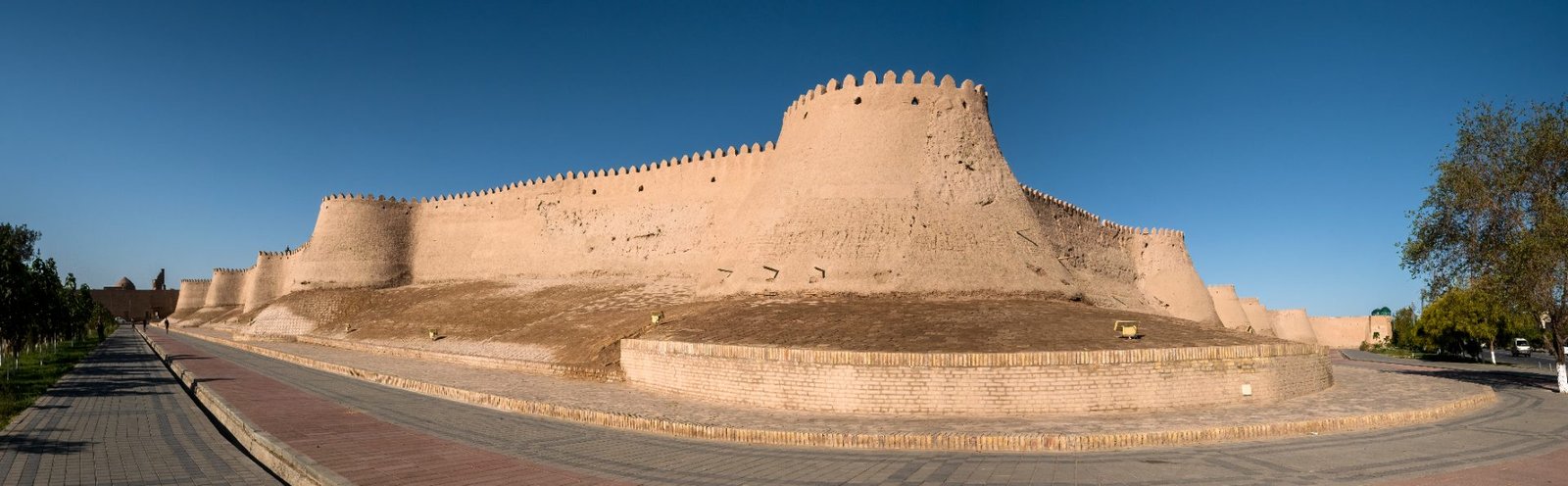
Photo: Стена Ичан-Калы (Ichan-kal’a devori, Itchan Kala walls) by Petar Milošević, via Wikimedia Commons, CC BY-SA 4.0.