
In short
Shakhrisabz is 92 km from Samarkand, about two hours over the Takhtakaracha Pass, and needs three to four hours on site. There is no published entry tariff — budget 20,000–40,000 som per monument in cash and ask for a ticket. Expect four or five fine Timurid monuments standing in a large modern park: the historic city around them was cleared in 2014–16.
Checked 26 August 2026 against UNESCO decision 48 COM 7A.26, the Shakhrisabz museum-reserve, and 2025–26 visitor accounts.
On this page
Ninety kilometres south of Samarkand, over a mountain pass, is the town where Timur was born. It has been on UNESCO’s List of World Heritage in Danger since 2016, and in 2018 and 2019 the World Heritage Committee formally considered deleting it from the list altogether.
It is still worth the day trip. But you need to know what you are going to see, because the thing most visitors expect — a historic city — was demolished a decade ago.
What was cleared
From 2014, under a presidential decree, a redevelopment programme razed a strip roughly two kilometres long and seventy hectares in area straight through the medieval centre. It took two UNESCO-protected residential quarters with it, along with ancient water-management channels. Around two thousand residents were relocated.
What replaced them is a broad boulevard, a parking area and a plaza. UNESCO’s own description of the result was a modern theme park with tourist kiosks. The head of the organisation’s Asia-Pacific heritage unit at the time put the process failure simply: the project happened without a proper heritage impact assessment.
A monitoring mission in December 2016 found one historic quarter almost entirely destroyed, including the core of the earliest, seventh-century part of town, with archaeological layers stripped to a depth of two metres and more. The property went onto the Danger List that year.
So when you arrive, the monuments stand as isolated objects in a large modern park. Recent visitors describe it as well kept but short of shade, with electric carts available to cross it. That is precisely why Uzbekistan is now proposing to shrink the inscription down to the monuments alone.
Where it stands in 2026
The Committee retained Shakhrisabz on the Danger List at its 2026 session in Busan and welcomed progress on a boundary change that would reduce the property to a selection of Timurid monuments under the working title “Ak Sarai and the Timurid Monuments of Shakhrisyabz.” The rest of the historic centre would become buffer zone rather than inscribed property.
An updated conservation report is due by 1 February 2027 and the full dossier by 1 February 2029.
Two technical points from the same decision. The Committee welcomed Uzbekistan’s decision not to proceed with a silicone treatment of the Ak-Saray walls — heritage advisers had warned that injecting silicone into cracked masonry could compromise its earthquake resistance. And it noted work carried out at Ak-Saray in 2025 and further work planned through 2027 at Ak-Saray, Kok Gumbaz and the city walls, requiring Uzbekistan to submit its overall restoration approach for expert review before going further.
Rising groundwater is now named as the primary threat to the site.
We could not establish which four monuments the reduced property would contain. Neither the decision text nor Uzbek reporting names them, and we are not going to guess.
Ak-Saray
Timur began his palace here in 1380. What stands today is two enormous brick pylons with surviving mosaic and majolica facing, and a gap of sky where the arch between them used to be. It came down roughly three hundred years ago.
The dimensions depend on who you ask. The state museum-reserve gives the gateway as 22.5 m wide and 40 m high, with total height above 50 m. Other reference sources give the surviving pylons as 38 m with an original arch span of 22 m. The courtyard was something like 120 m by 240 m.
Here is the thing worth knowing: Ak-Saray has not been prettified. It is a genuine ruin, and several recent visitors single that out as the reason to come, given how thoroughly so much else in Uzbekistan has been rebuilt. A modern statue of Timur stands on the axis in front of it.
The rest of what survives
Dorus-Saodat, begun around 1379, was the dynastic memorial complex. Within it is the mausoleum of Jahangir, Timur’s eldest son, who died in 1376; the complex was completed in 1392.
Dorut Tilovat, dated 1370–71, holds the mausoleum of Sheikh Shamsuddin Kulol — the spiritual mentor of Timur’s father — along with the Gumbazi Sayidon mausoleum and the Kok Gumbaz mosque.
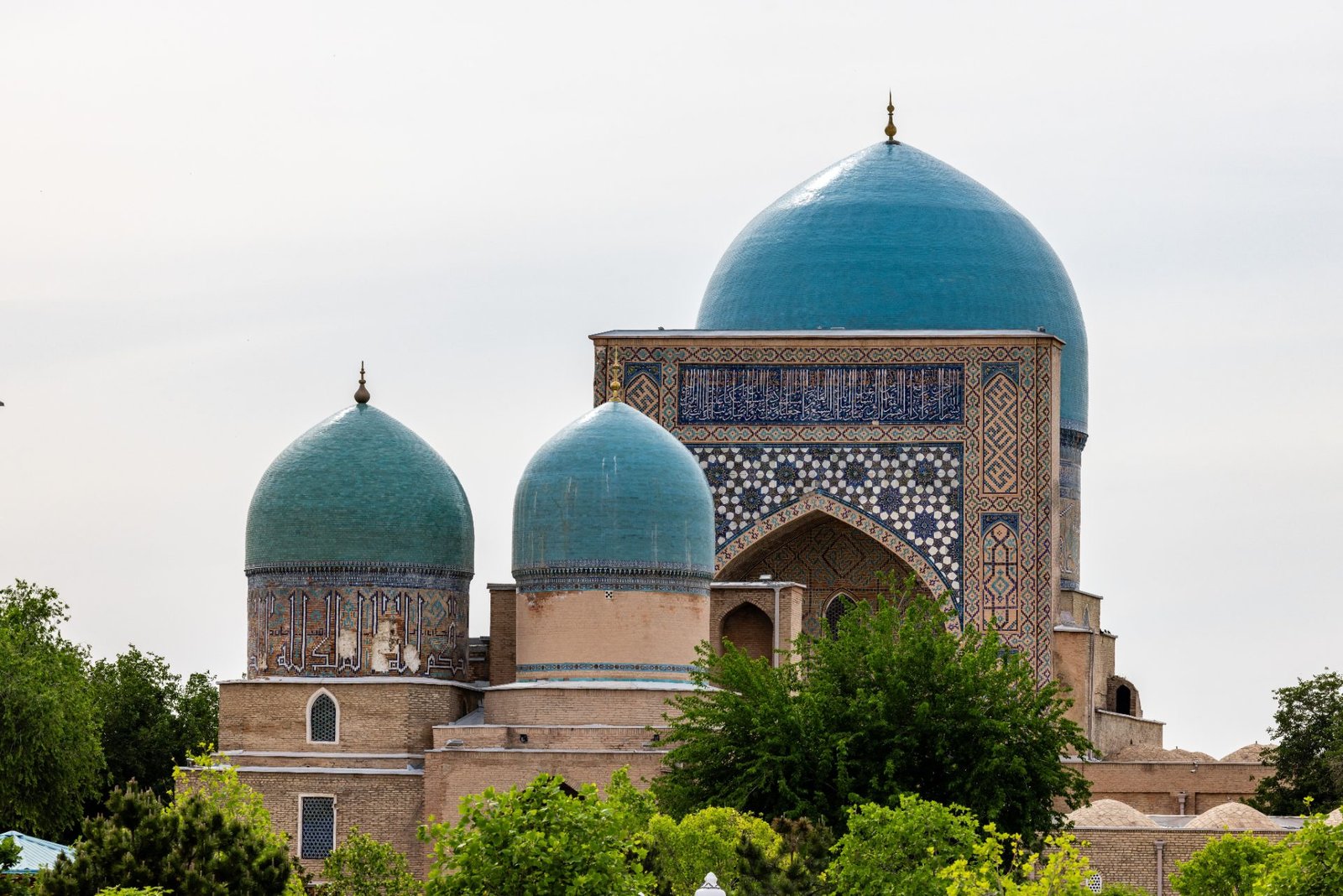
Kok Gumbaz was built in 1434–35 by Ulugh Beg, dedicated to his father Shah Rukh — so the astronomer-prince of Samarkand built the largest mosque in his great-grandfather’s home town. Be prepared for its condition: columns on both sides of the façade are damaged, and poor-quality repairs are widely held to have cost the building its original appearance. It is one of the sites scheduled for work through 2027.
Chorsu, the domed trading structure, is a working market rather than a museum. Stalls inside and around it.
The crypt Timur never used
In 1943 a child playing football fell through the ground near Dorus-Saodat and landed in a burial chamber.
Inside is a marble sarcophagus beneath a single slab about eleven centimetres thick, fitted with five iron rings, with Quranic inscriptions on the arches. The engravings relate to Timur’s life, and it appears to have been built as his own tomb.
He is not in it. Timur died at Farab in February 1405 and was buried in the Gur-e-Amir in Samarkand. The story you will be told — that the mountain passes were snowed in, so they buried him where he lay — is tradition rather than documented history, and we could not source it to a contemporary chronicle. Enjoy it as a story, not a fact.
The crypt is enterable and appears on day tours as a fifteen-minute stop.
While you are at it, the birth date is shaky too. Later Timurid dynastic histories give 8 April 1336, but most sources from Timur’s own lifetime imply a birth in the late 1320s, and there is a reasonable suspicion the date was tidied up afterwards for dynastic reasons. Uzbekistan officially marks 9 April.
What it costs, which nobody will tell you
There is no published official tariff. We checked the state museum-reserve’s own site, the regional tourism portal, the national tourism portal and Uzbekistan’s legal database. Nothing.
The unofficial figures conflict, and so do the systems they describe:
- A visitor in May 2025 reports paying 40,000 som at a single gate, choosing which monuments to visit
- An Uzbek operator in June 2026 lists separate tickets: Ak-Saray around 30,000 som, Dorus-Saodat around 25,000, Dorut Tilovat around 20,000, Kok Gumbaz free
- Another 2025 visitor reports multiple separate tickets and, more awkwardly, that some gates took the money and issued no ticket at all
Budget roughly 20,000–40,000 som per monument, carry small notes, and ask for a ticket. The museum-reserve lists hours of 08:00–17:00 daily for at least some objects, with no seasonal variation published — treat that as indicative.
Getting there from Samarkand
The scenic route is the Takhtakaracha Pass on the M-39: about 92 km and just under two hours. Larger vehicles use a longer bypass of about 155 km and nearly three hours. The pass is a genuine part of the appeal — tour reviews mention it as often as the monuments.
- Shared taxi: leaves from near the Registan at the Suzangaron Street intersection, roughly US$6–10 per seat, departing when full. Getting a ride back is the weak point of the plan.
- Private car: about US$45–65 one way, US$90–130 round trip.
- Organised day trip: from about US$59 per person for a nine-hour tour, or from US$80 per person for a small group. Check whether entrance fees are included — commonly they are not.
Three to four hours on site is enough for the monuments. A half day works if you leave at eight and are back by mid-afternoon.
The new train, and its limits
Since 27 March 2026 the Afrosiyob has run from Tashkent to Shakhrisabz three days a week — Friday, Saturday and Sunday — leaving Tashkent at 06:33 and returning from Shakhrisabz at 16:24. Neither the journey time nor the fare was published with the announcement, and we could not find them.
Two catches. The station is not in town — it is at or near Kitab, with one source putting it about 5.8 km out. And from Samarkand the rail option is close to useless: a single service on selected dates only, taking well over two hours, when the road over the pass takes less. Go by road from Samarkand.
Our guide to booking Uzbek trains covers the 60-day window that applies here too.
Is it worth the day?
Two of the biggest Western operators say no. Neither Intrepid’s ten-day Uzbekistan itinerary nor Wild Frontiers’ fourteen-day one includes Shakhrisabz at all. Meanwhile local operators sell it hard as a day trip — marketed on Timur’s birthplace and the mountain pass, notably not on the UNESCO city.
Our honest answer: yes, with corrected expectations. You get four or five Timurid monuments of real quality, an un-restored ruin of genuine power in Ak-Saray, a burial chamber found by accident, and one of the best short drives in the country. You do not get a historic town, because there isn’t one.
If you are choosing between a day here and another day in Bukhara, take Bukhara. If you have already got your fill of Bukhara and Samarkand, this is the most interesting thing within two hours of either.
Uzbekistan received about 11.7 million foreign visitors in 2025, up roughly 47 per cent, and 6.5 million in the first half of 2026 alone. Places like this will not stay quiet indefinitely.
What we could not verify
Any official entrance price, and whether the single-gate or per-monument system is currently in force. Whether the crypt has its own hours. The identity of the four monuments in the proposed reduced property. The Afrosiyob journey time and fare from Tashkent. And Ak-Saray’s dimensions, where two authoritative sources give irreconcilable figures.
The relocation figure of around two thousand residents comes from UNESCO’s record rather than press reporting, which documents the seventy hectares and the two quarters without giving a number.
For the wider argument about Uzbek restoration, see what UNESCO actually decided; for the trip as a whole, our Uzbekistan travel guide.
Photo: Koʻk Gumbaz 1 by Marat Nadjibaev, via Wikimedia Commons, CC BY-SA 4.0.