
In short
Two days in Osaka: accommodation runs ¥7,000 budget, ¥30,000 mid-range, ¥90,000 comfortable for two nights, and the lodging tax is ¥0 below ¥5,000 a night — the exemption threshold dropped from ¥7,000 to ¥5,000 on 1 September 2025, so budget rooms that used to be exempt now are not. At the mid tier the Amazing Pass (¥3,500) covers transport and entries together.
Rates and tax bands verified against city sources, August 2026.
Disclosure: some links in this guide are affiliate links. If you book through one, we earn a small commission and you pay exactly the same price. We only link to services we would use ourselves, no brand pays for placement or for a favourable write-up, and every price in this article was researched independently.
Two days is the right amount of time for Osaka. Not because the city is small — it is Japan’s third largest — but because it is concentrated. Almost everything you came for sits on one subway line, and the rest is a canal you walk along twice.
What is in this guide
- What two days cost
- Buy this before you start
- Day 1 — Castle, Umeda, Dotonbori
- Day 2 — Market, temple, Shinsekai, bay
- If you have a third day
- Eating: a two-day plan
- Adjusting the plan
- Where to stay for this plan
- Frequently asked questions
- A note on our numbers
- Osaka in one line: the Midosuji
- What to eat, in order
- Practical notes for these two days
- Osaka in one line: the Midosuji
- Eating across two days
- Practical notes for these two days
- What to lock in before this itinerary works
This plan does the city properly in two days, eats extremely well, and leaves you a third day for Nara or Universal Studios if you have one.
Verified: August 2026 · Exchange rate: ¥159.21 = 1 USD
Editor’s note
Two days works in Osaka in a way it does not in Kyoto, because almost everything sits on one subway line. The Midosuji line links Umeda, Shinsaibashi, Namba and Tennoji end to end in about fifteen minutes. If a plan sends you off that line more than twice in a day, it is a worse plan.
What two days cost
| Line | Budget | Mid-range | Comfortable |
|---|---|---|---|
| Accommodation, 2 nights | ¥7,000 | ¥30,000 | ¥90,000 |
| Lodging tax | ¥0 (under ¥5,000 exempt) | ¥400 | ¥1,000 |
| Transport | ¥1,600 | ¥3,500 (Amazing Pass) | ¥7,000 |
| Food | ¥5,000 | ¥11,000 | ¥26,000 |
| Entries | ¥2,000 | Included in pass | ¥6,000 |
| Total, per person | ≈ ¥15,600 ($98) | ≈ ¥44,900 ($282) | ≈ ¥130,000 ($817) |
Note the budget line’s lodging tax: anything under ¥5,000 per person per night is exempt entirely in Osaka. Compare with Kyoto, where the top band is ¥10,000 a night.
Buy this before you start
The Osaka Amazing Pass, 2-day version, ¥5,000. Day 1 below alone uses ¥6,100 of paid attractions.
| Day 1 attractions | Normal |
|---|---|
| Osaka Castle keep | ¥1,200 |
| Nishinomaru Garden | ¥300 |
| Umeda Sky Building | ¥2,000 |
| Tombori River Cruise | ¥2,000 |
| Tsutenkaku deck | ¥900 |
| Total | ¥6,400 |
Plus all your Metro and city bus travel across both days. It is not a close call.
One caveat: the pass covers Osaka Metro including Yumeshima, but the cheaper Enjoy Eco Card (¥620 at weekends) does not cover Yumeshima at all. Since there is nothing at Yumeshima to visit in 2026, this matters less than it sounds.
Day 1 — Castle, Umeda, Dotonbori
| Time | Where | Cost |
|---|---|---|
| 09:00 | Osaka Castle park, then the keep at opening | ¥1,200 / pass |
| 10:30 | Nishinomaru Garden — best cherry blossom view in the city | ¥300 / pass |
| 11:30 | Osaka Museum of History across the road, for the excavated Naniwa palace foundations | ¥600 |
| 13:00 | Lunch, Umeda — a department store basement or Kita-Shinchi set lunch | ¥1,300 |
| 14:30 | Umeda Sky Building — go up the escalator that crosses the void | ¥2,000 / pass |
| 16:30 | HEP FIVE Ferris Wheel — reopened 22 April 2026 after six months of maintenance | ¥1,000 / pass |
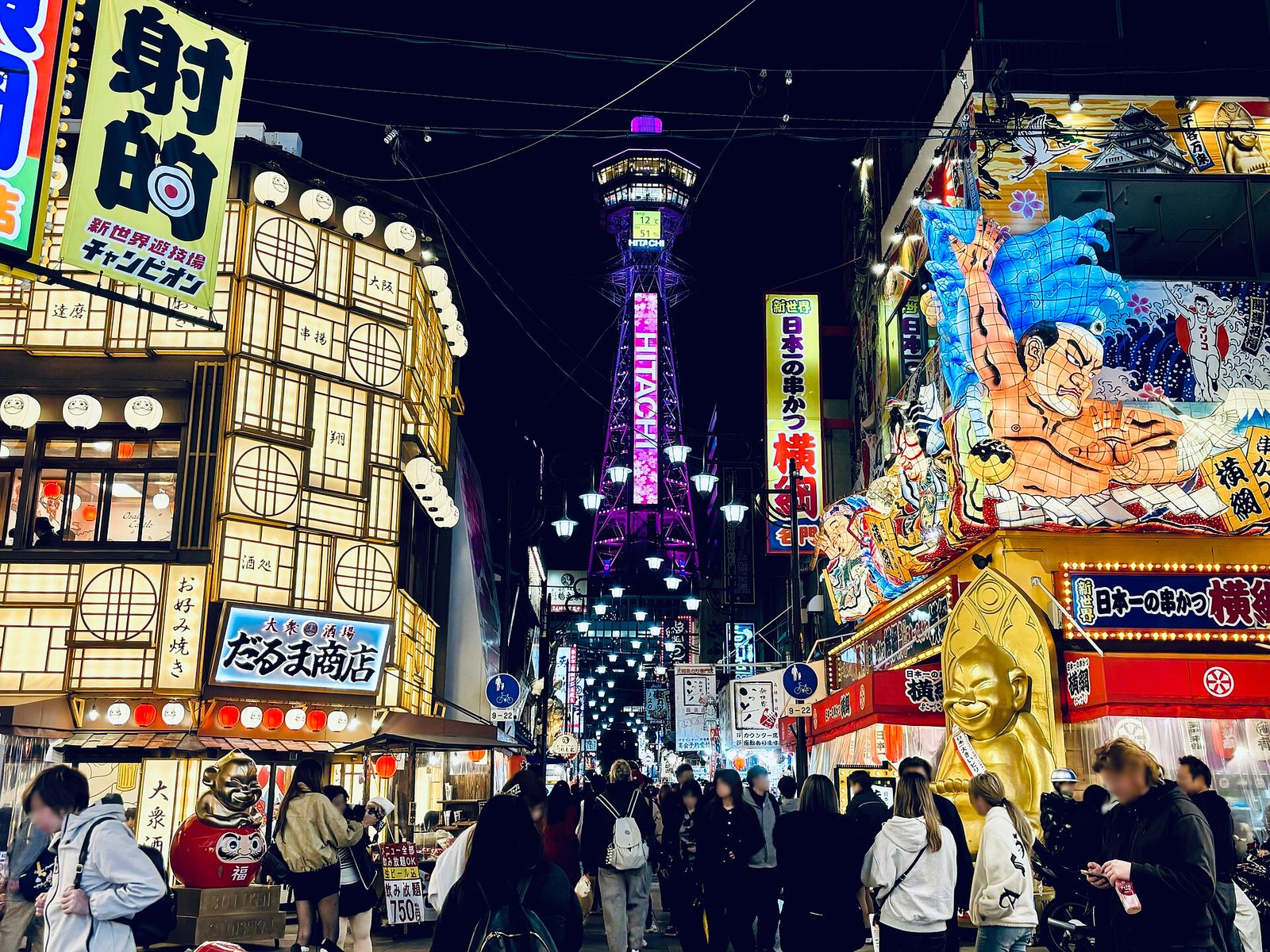
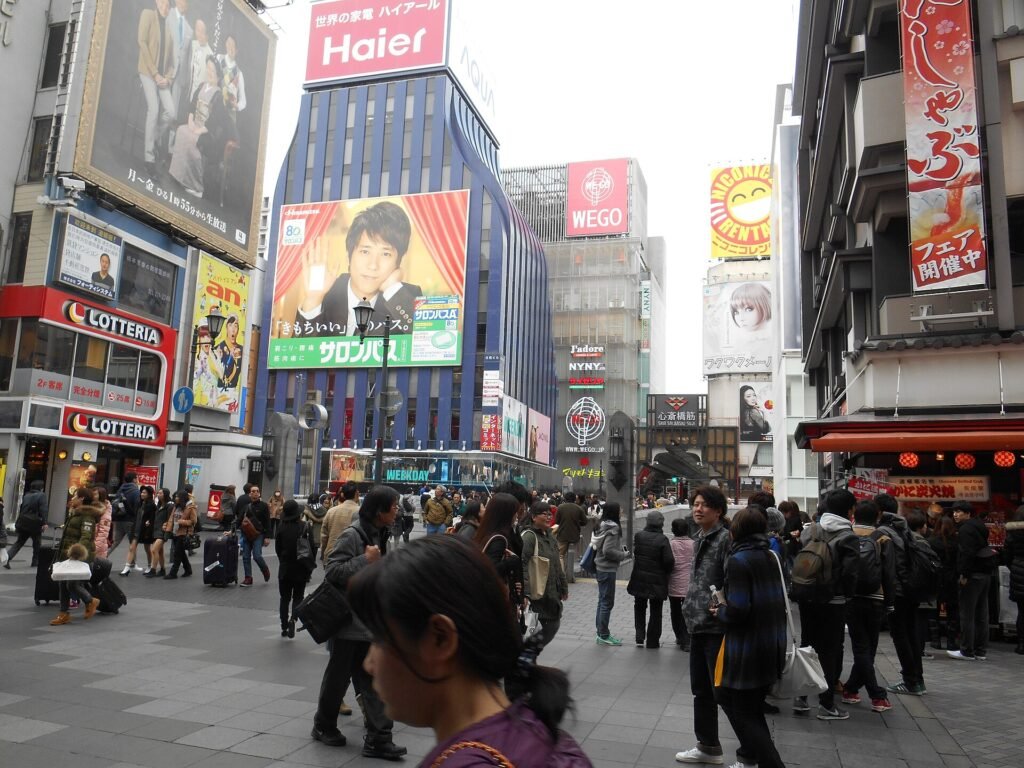
| 18:00 | Dotonbori at dusk. Glico sign, the moving crab, the canal | Free |
| 19:00 | Tombori River Cruise, 20 minutes, best at night | ¥2,000 / pass |
| 20:00 | Dinner: okonomiyaki at Mizuno (Dotonbori, since 1945) or takoyaki from Wanaka | ¥2,500 |
| 21:30 | Walk Shinsaibashi-suji arcade north, or Amerikamura for a drink | ¥1,500 |
Day total with the pass: about ¥7,400 including food.
Umeda Station warning: it is four separate stations with four different names — JR Osaka, Hankyu Umeda, Hanshin Umeda and three subway Umedas — connected by tunnels. Add fifteen minutes the first time and do not trust your sense of direction.
Day 2 — Market, temple, Shinsekai, bay
| Time | Where | Cost |
|---|---|---|
| 07:30 | Kuromon Ichiba Market — the working market, before the crowd | ¥1,200 grazing breakfast |
| 09:30 | Shitennoji — founded 593, Japan’s oldest state-administered temple | ¥500 / pass |
| 11:00 | Abeno Harukas or skip it — see note | ¥1,980 online |
| 12:30 | Lunch: kushikatsu at Daruma, Shinsekai | ¥2,000 |
| 14:00 | Tsutenkaku and the Shinsekai streets | ¥900 / pass |
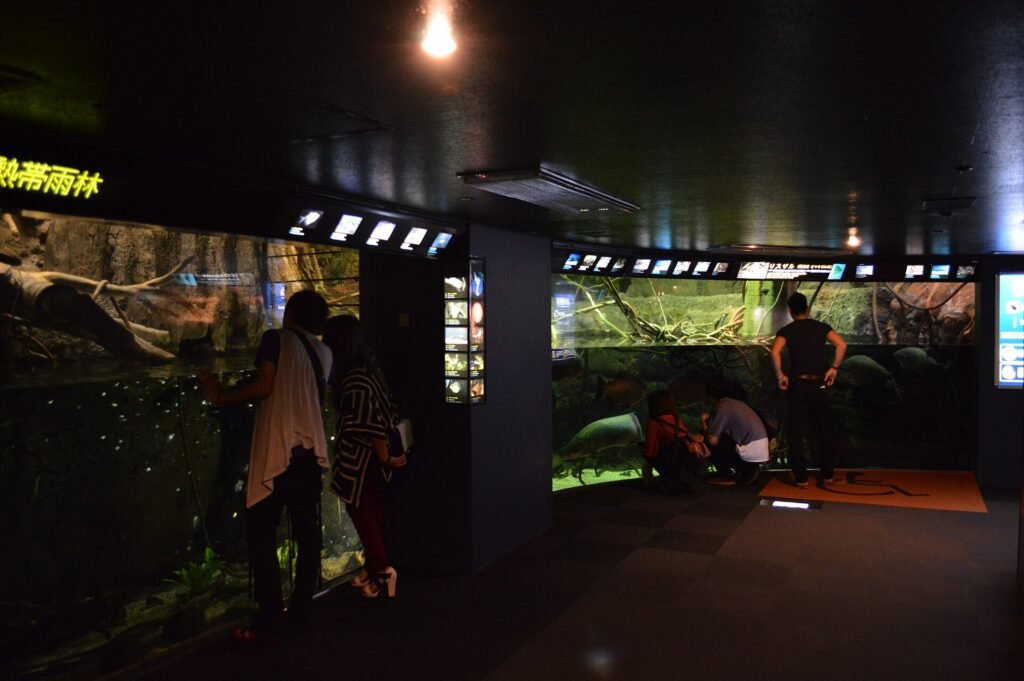
| 15:30 | Metro to the bay: Kaiyukan aquarium | ¥3,200–3,500 |
| 17:30 | Tempozan Ferris Wheel at sunset | ¥800 / pass |
| 19:30 | Back to Namba. Dinner at an izakaya, or crab at Kani Doraku | ¥3,500 |
Day total with the pass: about ¥12,000 including Kaiyukan, which is not covered by the pass.
On Abeno Harukas: it is Japan’s tallest building and its observatory now costs ¥2,200 at the door or ¥1,980 online since 23 July 2026. If you did Umeda Sky yesterday, skip it. Two paid high views in two days is one too many.
The kushikatsu rule: one dip in the communal sauce, never a second. Cabbage leaves are provided as a spoon if you want more. This is the most seriously enforced etiquette in Osaka.
If you have a third day
| Option | Cost | Time each way |
|---|---|---|
| Nara | ¥680 Kintetsu + ¥800 Todaiji | 35–40 min |
| Kobe | ¥330 Hankyu | 27–31 min |
| Himeji Castle | ¥1,460 JR + ¥2,500 entry | 63 min |
| Kyoto | ¥410 Hankyu | 43 min |
| Universal Studios Japan | ¥8,400–11,900 + ¥200 transport | 12 min |
| Koyasan | Nankai from Namba | ~2 hr |
Nara is the best of these and the cheapest: 35 minutes on the Kintetsu line puts you in central Nara, walking distance from the deer park and Todaiji. Full comparisons in Best Day Trips from Osaka and Kyoto.
If it is USJ, book the date as early as you can — from 1 September 2026 the price of a given date rises as it sells rather than staying fixed.
Eating: a two-day plan
Osaka’s nickname is *kuidaore*, roughly “eat until you go bankrupt.” Here is how to do it without going bankrupt.
| Meal | Where | Rough cost |
|---|---|---|
| Breakfast day 1 | Convenience store or hotel | ¥500 |
| Lunch day 1 | Umeda department store basement | ¥1,300 |
| Dinner day 1 | Okonomiyaki, Dotonbori | ¥2,500 |
| Breakfast day 2 | Kuromon Ichiba, grazing | ¥1,200 |
| Lunch day 2 | Kushikatsu, Shinsekai | ¥2,000 |
| Dinner day 2 | Izakaya, Namba | ¥3,500 |
| Street food throughout | Takoyaki, ¥500 to ¥700 a portion | ¥1,500 |
The places that have been doing it longest: Aizuya invented takoyaki in 1933 and still runs eleven shops. Mizuno has made okonomiyaki in Dotonbori since 1945 and does not close on any regular day. Daruma brought kushikatsu out of Shinsekai and now has sixteen Osaka branches. Kani Doraku is the crab.
One rule with a real fine: smoking on the street has been banned across the whole city since 27 January 2025, ¥1,000 penalty, and more than 122,000 have been issued. Use the marked smoking areas.
Adjusting the plan
| If | Change |
|---|---|
| Cherry blossom, late Mar to mid-Apr | Osaka Castle park and Nishinomaru Garden are the city’s best spots. Garden entry rises to ¥350 |
| Summer, Jul to Aug | Start at 07:30 both days, move Kaiyukan and the museums to the middle of the afternoon. Tenjin Matsuri is 24–25 July |
| With children | Swap Shitennoji for Kids Plaza Osaka (¥1,500 adult, ¥800 child) and add the Cup Noodles Museum in Ikeda, where admission is free |
| Rain | Kaiyukan, the History Museum, the Umeda underground malls, Shinsaibashi’s covered arcade. Osaka is unusually good in the wet |
| On a tight budget | Skip the Amazing Pass, use the Enjoy Eco Card at ¥620 on a weekend, and stick to free sights: the castle park, Sumiyoshi Taisha, Shinsekai’s streets, Dotonbori, Kuromon |
| One day only | Do day 1, and add Kuromon Market at 07:30 before you start |
Where to stay for this plan
Namba or Shinsaibashi. Both days above start and end within walking distance, and the Midosuji Line handles everything else. Umeda works too and is calmer at night. Full breakdown in Where to Stay in Osaka.
Frequently asked questions
Is 2 days enough for Osaka? Yes, for the city itself. Osaka is concentrated and most of it sits on one subway line. Add a third day for Universal Studios or Nara, and a fourth if you want Kobe or Himeji.
How much does 2 days in Osaka cost? About ¥15,600 ($98) on a hostel budget, ¥44,900 ($282) mid-range with the Amazing Pass, ¥130,000 ($817) comfortable, per person including accommodation.
Should I buy the Osaka Amazing Pass for two days? At ¥5,000 for the 2-day version, yes — day 1 of this plan alone contains ¥6,400 of covered attractions, and transport is included on top.
What is the best area to stay in Osaka? Namba or Shinsaibashi for food and nightlife on your doorstep, Umeda for a calmer base with better rail links to Kyoto, Kobe and Nara.
Is Osaka worth visiting, or should I just do Kyoto? Do both. They are 29 minutes apart. Osaka is cheaper, the food is better and it is far more relaxed; Kyoto has the temples. Splitting your nights between them is the standard experienced-traveller move.
What is the one thing I should eat in Osaka? Takoyaki, from a stall, standing up, burning your mouth slightly. Then okonomiyaki for dinner.
Can I do Universal Studios and the city in two days? Only badly. USJ takes a full day and often more with queues. Give it its own day.
What time should I go to Kuromon Market? Between 07:30 and 09:30. The fishmongers are open from around 05:00, the crowds arrive at eleven, and prepared food gets discounted after 15:00.
A note on our numbers
Fares, admissions, pass contents and opening hours were verified against operator and city sources in August 2026, with effective dates noted where something changed recently. Kaiyukan uses date-based dynamic pricing, so its figure is a range. Osaka Castle’s admission is quoted differently by different sources and we have flagged that rather than pick one.
Keep reading: Osaka Travel Guide 2026 · Best Things to Do in Osaka · Where to Stay in Osaka · Best Day Trips from Osaka and Kyoto · The Perfect 3-Day Kyoto Itinerary
Osaka in one line: the Midosuji
Almost everything in this itinerary sits on a single red subway line, which is the reason two days works here and would not work in Tokyo.
| Station | What is there |
|---|---|
| Shin-Osaka | Shinkansen. Nothing else |
| Umeda | Sky Building, HEP FIVE, department stores, Kita-Shinchi dining |
| Yodoyabashi | Keihan line to Kyoto. Nakanoshima museums |
| Honmachi | Chuo Line interchange for the bay and Kaiyukan |
| Shinsaibashi | Shopping arcade, Amerikamura |
| Namba | Dotonbori, Kuromon Market, Nankai to the airport, Kintetsu to Nara |
| Tennoji | Abeno Harukas, Shitennoji, the zoo, JR to Kansai Airport |
| Dobutsuen-mae | Shinsekai and Tsutenkaku |
End to end is about 25 minutes. If you get lost, get back on the Midosuji and you are never more than half an hour from where you meant to be.
What to eat, in order
If you did nothing in Osaka but eat, the trip would still work. A sensible two-day sequence:
| When | What | Where | Cost |
|---|---|---|---|
| Day 1, afternoon | Takoyaki, standing up, from a stall | Dotonbori or Namba | ¥500–700 |
| Day 1, dinner | Okonomiyaki, Osaka style, everything mixed into the batter | Mizuno, Dotonbori, since 1945 | ¥1,200–2,000 |
| Day 1, late | Kushiage and a beer | Anywhere off Dotonbori | ¥2,500 |
| Day 2, breakfast | Grazing at Kuromon — scallops, wagyu skewer, fruit | Kuromon Ichiba, 07:30 | ¥1,200 |
| Day 2, lunch | Kushikatsu, one dip only | Daruma, Shinsekai | ¥1,500–2,500 |
| Day 2, afternoon | Kitsune udon — Osaka invented it | Any noodle shop | ¥600–900 |
| Day 2, dinner | Crab, or a proper izakaya | Kani Doraku, or Namba backstreets | ¥3,500–6,000 |
A note on the queues. Some Dotonbori takoyaki stands have forty-minute lines. The difference between them and the stand round the corner is smaller than the queue implies. Aizuya, who literally invented the dish in 1933, generally has no queue at all.
Practical notes for these two days
- Smoking on the street is banned city-wide since 27 January 2025, ¥1,000 fine, actively enforced. Use the marked areas.
- Stand on the right on escalators in Osaka — the opposite of Tokyo. Nobody will say anything, but you will notice you are the only one.
- Coin lockers at Namba and Umeda run ¥400 to ¥800 and fill by mid-morning at weekends.
- Kuromon and Dotonbori both expect you to eat where you bought it. No fine, just the local norm.
- Osaka Metro does not cover Yumeshima on the Enjoy Eco Card, and there is nothing at Yumeshima to see in 2026 anyway.
- Last trains run around midnight. Taxis from Namba to Umeda run ¥1,500 to ¥2,500.
Osaka in one line: the Midosuji
Almost everything in this itinerary sits on a single red subway line, which is why two days works here and would not work in Tokyo.
| Station | What is there |
|---|---|
| Shin-Osaka | Shinkansen. Nothing else |
| Umeda | Sky Building, HEP FIVE, department stores, Kita-Shinchi dining |
| Yodoyabashi | Keihan line to Kyoto, Nakanoshima museums |
| Honmachi | Chuo Line interchange for the bay and Kaiyukan |
| Shinsaibashi | Shopping arcade, Amerikamura |
| Namba | Dotonbori, Kuromon Market, Nankai to the airport, Kintetsu to Nara |
| Tennoji | Abeno Harukas, Shitennoji, the zoo |
| Dobutsuen-mae | Shinsekai and Tsutenkaku |
End to end is about 25 minutes. Get lost, get back on the Midosuji, and you are never more than half an hour from where you meant to be.
Eating across two days
Osaka’s nickname is *kuidaore* — eat yourself bankrupt. A sensible sequence:
| When | What | Where | Cost |
|---|---|---|---|
| Day 1 afternoon | Takoyaki, standing up | Dotonbori or Namba | ¥500–700 |
| Day 1 dinner | Okonomiyaki, everything mixed into the batter | Mizuno, Dotonbori, since 1945 | ¥1,200–2,000 |
| Day 1 late | Kushiage and a beer | Off Dotonbori | ¥2,500 |
| Day 2, 07:30 | Grazing at Kuromon — scallops, wagyu skewer, fruit | Kuromon Ichiba | ¥1,200 |
| Day 2 lunch | Kushikatsu, one dip only | Daruma, Shinsekai | ¥1,500–2,500 |
| Day 2 dinner | Crab, or a proper izakaya | Kani Doraku or Namba backstreets | ¥3,500–6,000 |
On the queues: some Dotonbori takoyaki stands have forty-minute lines. The difference between them and the stand round the corner is smaller than the queue implies. Aizuya, who invented the dish in 1933, generally has none.
Practical notes for these two days
- Street smoking is banned city-wide since 27 January 2025. ¥1,000 fine, actively enforced, over 122,000 issued. Use the marked areas.
- Stand on the right on escalators — the opposite of Tokyo. Nobody will say anything; you will just notice you are the only one.
- Coin lockers at Namba and Umeda are ¥400–800 and fill by mid-morning at weekends.
- Umeda Station is four stations with four different names joined by tunnels. Add fifteen minutes the first time.
- Last trains run around midnight. Namba to Umeda by taxi is ¥1,500–2,500.
- Eat where you bought it at Kuromon and Dotonbori. No fine, just the local norm.
What to lock in before this itinerary works
Two days in Osaka is short, and the good news is that almost none of it needs planning. Dotonbori, Shinsekai, Kuromon Market, the castle grounds and every kushikatsu counter on this plan are walk-up.
Two exceptions.
Universal Studios Japan, if it is on your day one. Super Nintendo World runs timed entry and the free in-park passes are gone before noon on busy days. Express Passes disappear weeks ahead in July, August and over New Year. Check availability on Klook and on KKday before you commit the day to it, because a USJ day without an Express Pass in August is four hours of queueing for three rides.
Anything with a start time on day two. Okonomiyaki classes, Nada sake brewery tours and small-group bar crawls cap at around a dozen people.
Getting in from Kansai needs no booking at all. The Nankai Rapi:t reaches Namba in 38 minutes for 1,490 yen and the Haruka reaches Shin-Osaka in 50. Both run often enough that you can walk out of arrivals and onto one. This is the rare Japanese city where a pre-booked transfer is hard to justify unless you land after 23:00.
Skip the Osaka Amazing Pass unless you have counted four or more included attractions into a single day. Most two-day itineraries, including this one, do not reach that number.
An eSIM earns its keep on the metro, which is the one part of Osaka that confuses everyone on day one.