
In short
Three additions worth the extra days, with the ferry fares that decide them. To Gökçeada: foot passenger ₺200 walk-up or ₺180 with a GestCard; a car ₺2,485 walk-up against ₺995 with the card — the card more than halves the car fare, and it is billed as a return. Sailings run roughly 07:00 to 23:00, about every one to two hours.
Fares from the operator’s own tariff; checked 20 August 2026.
Most visitors to Çanakkale come for Troy and Gallipoli, do both in two days, and leave. That is a reasonable trip. It also means skipping a Doric temple on a volcanic hill where Aristotle taught, and two islands — one of them the largest in Türkiye and the world’s first Cittaslow island — that almost no English itinerary mentions.
Here are the three, with the verified 2026 fares, admissions and hours, checked on 20 August 2026.
What is in this guide
Assos (Behramkale)
Admission €11. Open 08:30 to 21:00, ticket sales closing 20:30, daily. An audio guide is available.
Assos was founded in the 6th century BC and built of andesite on an extinct volcanic hill above the Gulf of Edremit. Two things make it worth the drive.
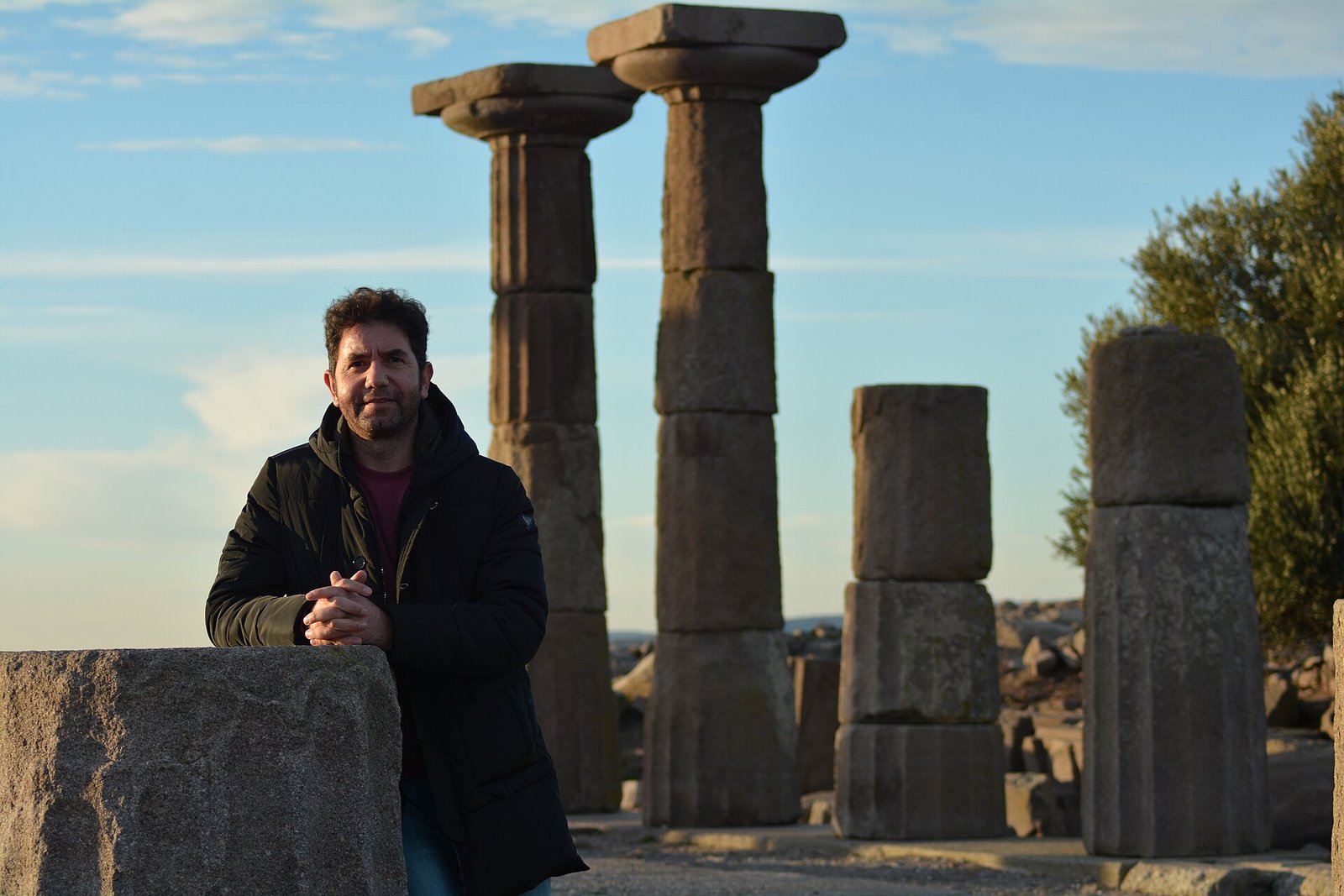
The Temple of Athena crowns the summit, and the Ministry of Culture and Tourism describes it as “the first and only Doric temple built in Anatolia.” That is a genuine superlative from the authority that manages the site, not a travel-writing flourish.
Aristotle lived here and founded a school. He spent roughly three years at Assos in the 340s BC under the patronage of the ruler Hermias, before moving on to Lesbos and then to Macedon to tutor Alexander.
The city was also famous for its sarcophagi — exported across Anatolia and known as “man-eating sarcophagi” for the local stone’s reputation for consuming remains quickly. A Roman-period theatre, agora, necropolis and city walls survive.
Practically: Assos is south of Çanakkale on the road toward Ayvalık and İzmir, so it works well as a stop when you are moving on rather than as an out-and-back day trip. The modern village of Behramkale sits on the hill; the harbour below is a separate settlement reached by a steep road.
Two other ministry sites in the province, for completeness: Apollon Smintheion at €3, and Alexandria Troas, which is free.
Note the pass trap: the MuseumPass The Aegean at €95 does not cover Assos, or Troy, or anything in Çanakkale. Its inclusion list is İzmir, Aydın, Muğla and Denizli only.
Bozcaada (Tenedos)
The wine island, and the easier of the two to reach.
Getting there
Ferry: Geyikli to Bozcaada, operated by GESTAŞ.
| Walk-up | GestCard | |
|---|---|---|
| Foot passenger | 200.00 ₺ | 180.00 ₺ |
| Car | 2,485.00 ₺ | 995.00 ₺ |
The car fare is billed as a return. Multiple sailings run daily, roughly 07:00 to 23:00, about every one to two hours at peak with afternoon gaps on some weekdays.
Book ahead if you are taking a car. Online booking is offered at online.gdu.com.tr, and it uses dynamic pricing: standard until 11 days before sailing, then +30% in the final five days. Be at the pier at least ten minutes before departure. Cancelling more than 24 hours ahead refunds 70%; if GESTAŞ cancels, you get 100%.
We could not verify the crossing duration — GESTAŞ publishes departure times and fares but no journey times, for any of its routes.
A note on the operator’s website: it is gdu.com.tr. The gestasdenizulasim.com.tr address given in older articles no longer resolves.
What is there
Bozcaada is the ancient Tenedos, about 42 km², with its highest point at Göztepe, 192 m.
- Bozcaada Castle, used through the Venetian, Genoese and Byzantine periods and substantially rebuilt in 1816, now with an exhibition space
- The Kimisis Teodoku Greek Orthodox church with its bell tower
- The historic Alaybey and Yalı mosques
- The Bozcaada Museum, described by the governorship as “the memory of Bozcaada”
- A serious wine and vineyard culture — this is the island’s real identity, and the reason to stay a night rather than day-trip it
- Ayazma, the best-known beach, with eleven other bays
The Greek and Turkish layers sit side by side here in a way that is unusual and very legible — a castle, a church and a mosque within a few hundred metres.
Gökçeada (Imbros)
The bigger, wilder, more complicated one — and note the logistics carefully, because they are not what you would assume.
Getting there
The ferry leaves from Kabatepe, on the Gallipoli peninsula — not from Çanakkale town. That single fact changes the planning considerably: you have to get onto the peninsula first, and Kabatepe is in the Anzac sector.
| Walk-up | GestCard | |
|---|---|---|
| Foot passenger | 250.00 ₺ | 225.00 ₺ |
| Car | 1,400.00 ₺ | 560.00 ₺ |
The car fare is billed as a return. The timetable dated 3 July 2026 runs two-hourly from 07:00 to 21:00, with extra 05:00 and 23:00 sailings marked Friday to Sunday. Cars can be taken, and online booking is offered — with the same +30% dynamic pricing in the final five days.
A practical consequence worth planning around: because the ferry goes from Kabatepe, Gökçeada pairs naturally with a Gallipoli day rather than with Troy. You can walk the Anzac sector and sail from the same corner of the peninsula.
What is there
Gökçeada is the ancient İmbros, and it is Türkiye’s largest island — coastline about 95 km, with five lakes, ranked fourth in the world for fresh-water availability.
It has been the world’s first and only Cittaslow island since 2011, which is a formal designation rather than a marketing line, and it shapes the place: organic farming and traditional viticulture are policy here, not nostalgia.
- Yıldızkoy, Türkiye’s first underwater national park
- The Marmaros waterfall
- A salt lake with therapeutic mud
- The Uğurlu-Zeytinlik site, 8,500 years old, and Yeni Bademli Höyük; rock tombs
- Aydıncık beach, a windsurfing and kitesurfing centre
- The coves of Laz, Gizli Liman and Yuvalı
- Five Greek villages with protected architecture — Dereköy, Kaleköy, Tepeköy, Zeytinli and Eski Bademli
Those villages are the heart of it. Gökçeada had a substantial Greek population for centuries, and the stone villages in the interior — several now very sparsely inhabited — are the most atmospheric thing in the province.
Give it two nights if you can. It is too big and too far from the pier to do justice in a day trip, and the ferry timetable is not generous.
Çanakkale town itself
If you have an evening rather than a day, the town rewards a walk.
The Çanakkale Naval Museum, run by the Turkish Naval Forces, opens Tuesday to Sunday, 09:00 to 12:00 and 13:30 to 17:00, ticket office closing 11:30 and 16:30. Closed Mondays, New Year’s Day and the first days of religious holidays. Published admission is 13.00 ₺ with students free, plus charges for photography.
Treat that price with caution. 13.00 ₺ is implausibly low for 2026 and the operator’s page may simply not have been updated. It is the published figure as at August 2026; expect to pay more and do not budget on it.
Çimenlik Castle (Kale-i Sultaniye) is the Asian-shore partner to Kilitbahir across the water. The pair were built to cover the narrows so that no ship could pass without being under fire from at least one of them — which is the whole strategic logic of the 1915 campaign in one sentence, and much clearer standing between them than on a map.
The kordon, the waterfront promenade, is where the town actually lives in the evening, and it holds the large wooden horse that everyone photographs.
Two honest notes about that horse. It is a different horse from the one at the Troy archaeological site — there are two, and conflating them is the commonest Troy error in English guides. And the claim that it is the prop from the 2004 film Troy is not confirmed by any government source we could reach; the municipality, the governorship and the official destination site all confirm the horse is there, and none states where it came from.
The clock tower on Saat Kulesi Meydanı is a central landmark, and we could not find any official source giving its date, builder or history — so we are not going to give you one.
Planning the extra days
| Trip | Getting there | Cost | Time needed |
|---|---|---|---|
| Assos | Road, south toward Ayvalık | €11 admission | Half a day, or a stop en route |
| Bozcaada | Ferry from Geyikli | 200 ₺ foot, 2,485 ₺ car return | A long day, better as an overnight |
| Gökçeada | Ferry from Kabatepe on the peninsula | 250 ₺ foot, 1,400 ₺ car return | Two nights |
| Çanakkale town | You are already there | Naval Museum 13.00 ₺ as published | An evening |
Book the island ferries if you are taking a car — both are billed as returns and both rise 30% in the final five days. Do not book the strait shuttles; Çanakkale to Eceabat runs roughly hourly around the clock at 40.00 ₺ and is turn-up-and-go.
Türkiye’s accommodation tax is currently 1%, on the room rate before VAT, shown separately on your bill, and Çanakkale levies no additional local tax. Presidential Decision 11263, published 1 May 2026, cut the statutory 2% to 1% until 31 December 2026 inclusive; it reverts to 2% on 1 January 2027 unless extended.
For the rest of the province, see our Çanakkale and Gallipoli travel guide, our guide to visiting Troy, and the site-by-site guide to the Gallipoli battlefields.
Frequently asked questions
Is Assos worth visiting?
If you have any interest in classical archaeology, yes. It holds the only Doric temple built in Anatolia, on a volcanic summit above the sea, and Aristotle founded a school there. It is €11 and open until 21:00 in the warm season.
How do you get to Bozcaada?
Ferry from Geyikli, multiple sailings daily roughly 07:00 to 23:00. 200 ₺ as a foot passenger, 2,485 ₺ for a car billed as a return. Book online if you are driving — prices rise 30% in the final five days.
Can you visit Gökçeada as a day trip from Çanakkale?
Not comfortably. The ferry leaves from Kabatepe on the Gallipoli peninsula, not from Çanakkale town, and it runs two-hourly. The island is Türkiye’s largest, with a 95 km coastline. Give it two nights.
Which island is better, Bozcaada or Gökçeada?
Bozcaada for wine, beaches and a compact, walkable town — the easier trip. Gökçeada for scale, the Greek villages, and the Cittaslow character — the more rewarding one if you have the time.
Do I need a car for these trips?
For Assos, effectively yes. For the islands, a car is optional but changes the fare substantially — and on both islands the interesting parts are spread out.