
In short
One €27 ticket covers both the Troy Museum and the archaeological site. There are nine cities stacked on the mound, not one, and the layer usually sold as “Homer’s Troy” is not the one most visitors picture. As for Priam’s Treasure: the gold is in Moscow, at the Pushkin Museum, not in Türkiye and not in Berlin.
Checked 20 August 2026 against the Ministry, UNESCO, the University of Cincinnati Troy project and the museums holding the gold.
Troy has a reputation problem. It is widely described as a disappointment — a low mound of broken walls with a fake wooden horse outside — and visitors arrive expecting Homer and leave having photographed a replica.
That reputation survives partly because most English-language writing about Troy gets the substance wrong. It repeats a treasure attribution that Schliemann’s own successor disproved, credits the wrong man with finding the site, states as settled a question that is still argued, and sends readers to buy the wrong museum pass.
What is in this guide
Here is the accurate version, checked on 20 August 2026 against the Ministry of Culture and Tourism, UNESCO, the University of Cincinnati’s Troy project, and the two museums that actually hold the gold.
Admission: one ticket, €27
€27 buys the Troy Museum and the archaeological site together. The Ministry of Culture and Tourism’s fee annex lists the two as a single line with the note “Tek biletle gezilebilir” — visitable on one ticket.
There is no separate museum-only or site-only price for foreign visitors. Guides that describe two tickets, or that quote one price for the ruins and another for the museum, are wrong.
Fees at ministry sites are set in euro and charged in lira, converted at the previous day’s Turkish Central Bank effective selling rate.
Hours, with a caveat
The ministry’s live ticketing portal gives both the site and the museum as 08:30 to 20:00, ticket office closing 19:30, open every day.
But the ministry’s own cultural portal gives the museum as 08:30 to 17:30. The two government properties disagree, and the governing directive says hours are set case-by-case by the directorate or the provincial authority, with no universal seasonal timetable. Read 08:30–20:00 as the summer figure and 08:30–17:30 as the likely winter one — and note that the switch date is not published anywhere. If you are visiting in the shoulder season, arrive early rather than late.
The museum pass trap
The MuseumPass The Aegean, at €95, does not include Troy. Its own official inclusion list covers İzmir, Aydın, Muğla and Denizli only. Çanakkale, Troy and Assos are not on it. This is an expensive and common mistake — people buy the regional pass precisely for a Troy trip.
The broader MuseumPass Türkiye at €165 is valid 15 days across 350-plus ministry sites. We could not confirm whether it admits foreign visitors to Troy, because unlike the Aegean pass it publishes no inclusion list. The fee annex marks Troy “enterable with the Museum Card,” but the Müzekart is a different product, valid for Turkish citizens. We would rather flag the gap than guess.
Getting there
Troy is about 30 km south of Çanakkale town, and 4.5 km inland from the coast, at Tevfikiye village. The Kültür Portalı describes it as 5 km off the Çanakkale–İzmir road at the 25 km mark.
We could not verify any public dolmuş service or timetable. The municipal transport directorate publishes its schedules only as PDF downloads and through the KentKart app, and lists no line serving Tevfikiye in its page text. If you are not driving, budget for a taxi or a tour, and do not plan around a departure time you read somewhere.
Nine cities, or ten
The convention is nine numbered cities, Troy I to Troy IX, in Roman numerals, with sub-phases. That scheme is Wilhelm Dörpfeld’s, not Schliemann’s, and it is still the working framework.
The ministry’s own Troy page says “9 layers of Troy show more than 3000 years of uninterrupted occupation.” The Çanakkale Governorship’s page says ten — “10 farklı kent katmanı” — spanning 3000 BC to around AD 500. UNESCO’s inscription refers to “an uninterrupted settlement sequence over more than 3,000 years” and names Troy I, II and VI.
We are reporting the disagreement rather than choosing, because two Turkish government sources genuinely differ. Say nine, with sub-phases, and note that some official sources count ten.
UNESCO inscribed Troy in 1998 under criteria (ii), (iii) and (vi), and records 24 excavation campaigns over the past 140 years.
Which layer is Homer’s? Nobody knows
Do not accept a confident answer to this, from us or anyone.
Dörpfeld favoured Troy VI. Carl Blegen, of the University of Cincinnati, who kept full scientific records and used pottery for closer dating, identified Troy VIIa as the most probable war layer, on evidence of burning and siege. Both positions are still argued. UNESCO’s own text dates the siege Homer describes to the 13th century BC.
Troy VIIa is the leading candidate. It is not a settled fact, and articles that present it as one are overclaiming.
Who actually found Troy
Frank Calvert, an English resident at the site, first proposed that the mound of Hisarlık was Troy. It was his tip that brought Schliemann there in 1868. He is routinely written out of popular accounts, and he should not be.
Heinrich Schliemann began excavating — UNESCO dates his first campaign to 1870. The University of Cincinnati’s own account of the site says plainly that “Schliemann made mistakes,” archaeology then being a new discipline. His methods destroyed a great deal.
Wilhelm Dörpfeld succeeded him, established the nine-layer sequence still in use, and demonstrated that Schliemann’s “treasure” came from Troy II — a city many centuries older than any war Homer could have been describing.
Carl Blegen and the University of Cincinnati excavated in the 1930s. Manfred Korfmann directed renewed excavation from 1988, with Cincinnati partnering the University of Tübingen from 1989 and C. Brian Rose leading the Cincinnati team’s work on the Greek, Roman and later phases.
Where Priam’s Treasure actually is
This is the thing readers most need and almost never get.
It is not at Troy. It is not in the Troy Museum. None of it is in Türkiye.
The Staatliche Museen zu Berlin, which holds part of it, gives the sequence:
- Found on 31 May 1873, during Schliemann’s third campaign.
- Schliemann illegally smuggled it out to Greece, avoiding the Ottoman partage rules. The Ottoman Empire sued him in Athens; a settlement let him keep the collection on payment of 10,000 gold francs.
- He named it for Homer’s Priam. Modern scholarship rejects the attribution — Berlin’s own museum states that the treasure predates the Homeric Troy by centuries.
Where the objects are today:
- The silver and ceramic pieces are in Berlin, at the Museum für Vor- und Frühgeschichte.
- The gold is in Moscow, at the Pushkin State Museum of Fine Arts. It was taken to the Soviet Union by the Red Army after the Second World War, was not publicly known to survive until 1994, and was declared Russian state property in 1998.
The Pushkin’s own statement: it holds 259 objects from Schliemann’s Troy excavations, has held them since 1945, and says objects from 13 of the 17 hoards held in Berlin after 1881 ended up in Moscow. Treasure A alone originally contained 183 objects, of which 101 are in the Pushkin collection.
So: a treasure dug out of Turkish soil, smuggled to Greece, litigated in Athens, split between Berlin and Moscow, and named after a king who — if the attribution is wrong by centuries, and it is — had nothing to do with it.
The two wooden horses
There are two, and neither is ancient.
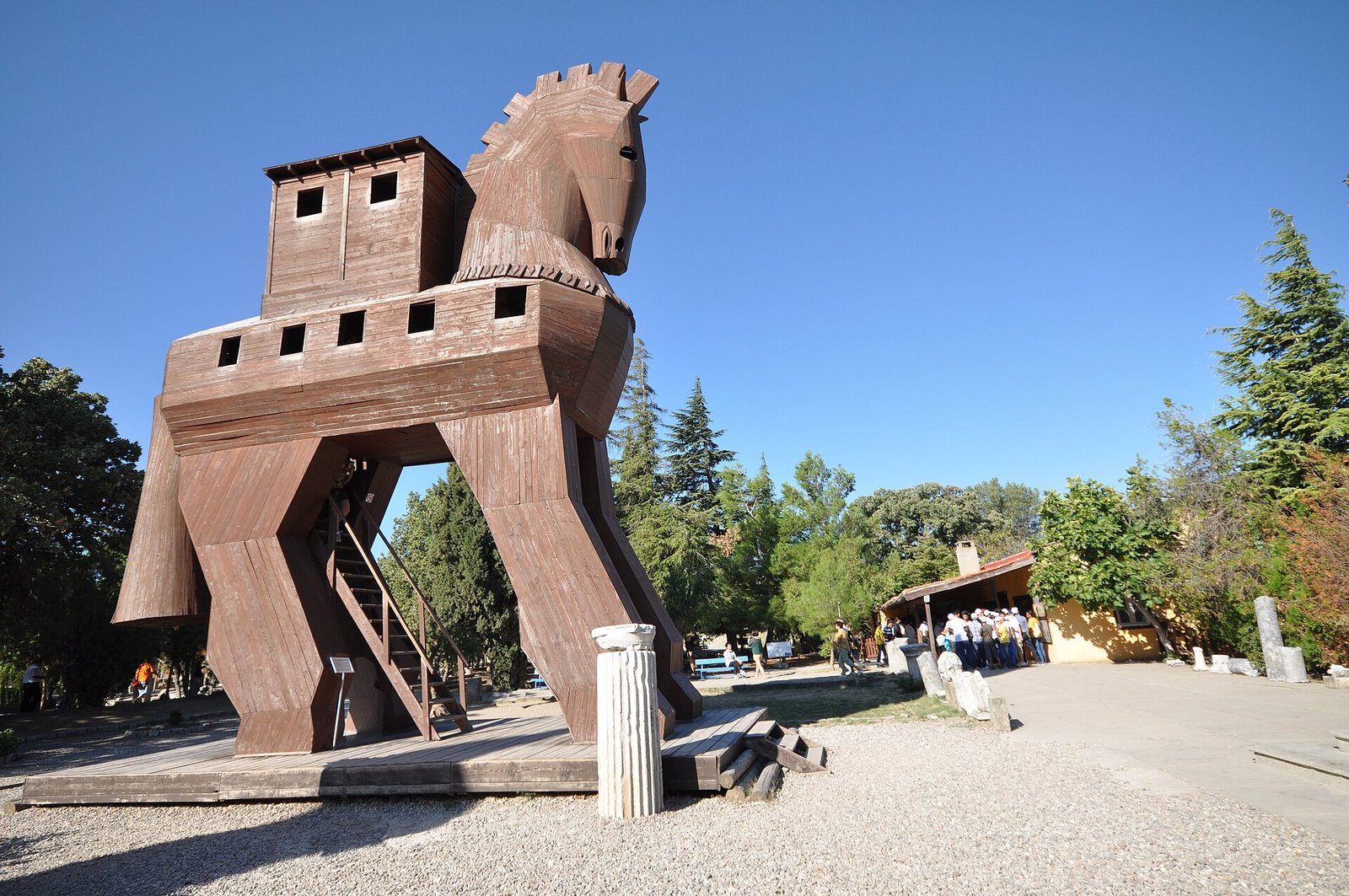
- At the archaeological site, near the entrance, there is a modern wooden horse. It is a visitor attraction, not an artefact. No ancient horse has ever been excavated, and none ever will be.
- In Çanakkale town, on the waterfront kordon, there is a separate, larger wooden horse. The Governorship confirms it stands there, and Türkiye’s official destination site tells visitors to photograph it.
Conflating the two is the single most common Troy error in English guides.
The claim that the waterfront horse is the prop from the 2004 Warner Bros. film Troy is not confirmed by any government source we could reach. The city, the governorship, the cultural portal and the official destination site all confirm a horse stands on the kordon; none states its provenance. Treat that story as widely repeated rather than established.
The Troy Museum
The museum is the reason the visit works, and it is why the “disappointing ruins” verdict is out of date — the finds that make sense of the mound are indoors now.
- Construction began in 2013. The complex covers 90,000 m², with three floors reached by approximately 480 m of ramps, and the ministry describes a 3,000 m² exhibition hall.
- It displays pottery, sculpture, tablets and coins, and has won European museum recognition.
- The Çanakkale Governorship states it opened on 18 March 2019 at a ceremony attended by the President. We could not corroborate that date from a second official source, so we attribute it rather than assert it.
What to expect on the ground
Be realistic. Troy is a stratified mound, not a standing city. What you see is walls, gates, foundations and cut sections through nine or ten superimposed settlements — which is precisely what makes it important, and precisely what does not photograph well.
Go to the museum first, then the site. The sequence matters: the museum gives you the layers, and the site then reads as a section drawing rather than a heap of stones. Allow two to three hours for both on the single ticket, and go early in the shoulder season given the unresolved closing time.
Frequently asked questions
How much does it cost to visit Troy?
€27, covering the Troy Museum and the archaeological site on one ticket. The fee is set in euro and charged in lira at the previous day’s central bank effective selling rate.
Is Troy worth visiting?
If you go expecting Homer’s city, no. If you go expecting the type-site of modern stratigraphic archaeology, with an excellent museum explaining nine superimposed cities, yes. Do the museum first.
Is the Museum Pass valid at Troy?
The Aegean pass at €95 definitely is not — it covers İzmir, Aydın, Muğla and Denizli only. Whether the €165 MuseumPass Türkiye admits foreign visitors to Troy is not published, so do not buy it on that assumption alone.
Is the wooden horse at Troy real?
No, and no ancient horse has ever been found. The one at the site is a modern attraction. There is a second, separate horse on the Çanakkale waterfront — the two are frequently confused.
Where is Priam’s Treasure?
The gold is in Moscow, at the Pushkin Museum, taken by the Red Army in 1945 and declared Russian state property in 1998. The silver and ceramics are in Berlin. None of it is in Türkiye, and it is not Priam’s — it comes from Troy II, centuries too early.
Which layer was the Trojan War?
Unsettled. Troy VIIa is the leading candidate, following Blegen’s evidence of burning and siege; Dörpfeld favoured Troy VI. Anyone stating it flatly is overclaiming.
How do I get to Troy from Çanakkale?
It is about 30 km south, at Tevfikiye. We could not verify a public dolmuş timetable from any official source, so plan on a taxi, a hire car or a tour. Our Çanakkale and Gallipoli travel guide covers transport across the province, and the Gallipoli battlefields guide covers the other side of the strait.