
In short
A site-by-site guide with the names, the geography and the casualty figures attributed to their sources. Commonwealth: about 205,000 casualties, including 43,000 dead, captured or missing, from roughly 410,000 who served. French: about 47,000 from a force of 79,000. Ottoman: an estimated 250,000–350,000 — an estimate, and labelled as one. Entry to the battlefields is free.
Figures attributed to the CWGC; checked 20 August 2026.
The Gallipoli peninsula is free to enter, permanently open, and much larger than most visitors expect. It is also routinely described in English with the wrong place names, the wrong geography, and a set of stories that the Australian government’s own historians have quietly rejected.
This is a site-by-site guide with the names and the locations right, checked on 20 August 2026 against the Commonwealth War Graves Commission, the Australian Department of Veterans’ Affairs, the New Zealand Ministry for Culture and Heritage, and the Çanakkale Governorship.
What is in this guide
First: there is no entrance fee
You do not pay to enter the Gallipoli battlefields. Three independent lines confirm it.
- The enabling statute charges nothing. Law No. 6546, which created the Gallipoli Historical Area Presidency, sets out its purpose, powers and revenue sources — contributions from the provincial administration, the municipality and the chamber of commerce, plus income from authorised activities. It contains no entrance-fee provision.
- The ministry’s fee annex contains no Gallipoli entry at all. Searching its 363 lines for Gelibolu, Gallipoli, Kilitbahir, Seddülbahir, Eceabat or Tarihi Alan returns nothing. The only four Çanakkale entries are Alexandria Troas, Apollon Smintheion, Assos and Troy.
- The Commonwealth cemeteries are open ground. Each CWGC record states the cemetery “is permanently open and may be visited at any time” — with no register kept on site, so look up any grave references you want before you travel.
Individual indoor attractions are a separate matter. We could not verify admission, hours or closing days for the Kabatepe simulation centre (Çanakkale Destanı Tanıtım Merkezi) — the Presidency’s own site would not serve content to us across many attempts. Do not carry a figure over from an English article.
The scale of it, and whether you need a car
The Gallipoli Historical Area covers 33,444 hectares. The Çanakkale Governorship’s inventory lists more than 50 Turkish cemeteries and monuments, and there are 31 Allied cemeteries, strung along ridge roads with no scheduled public transport between them.
The Anzac sector can be walked. The Australian government’s signposted Anzac Walk is about 2 km with 14 stops, beginning and ending at North Beach: North Beach, Ari Burnu, Anzac Cove, Hell Spit, Shrapnel Valley, Brighton Beach, Artillery Road, Lone Pine, Johnston’s Jolly, Quinn’s Post, the Turkish Memorial, The Nek Cemetery, Walker’s Ridge Cemetery, and back to a North Beach overview.
Everything else cannot. Helles, Seddülbahir, Morto Bay and Conkbayırı are 25 to 35 km away over the ridge. For the full peninsula you need a car or a guided tour out of Eceabat or Çanakkale.
About 20 km of original trench lines survive, overgrown, and DVA notes a very high correlation between the positions Şevki Paşa mapped in 1916 and the surviving system today.
The Anzac sector
Anzac Cove (Anzak Koyu / Arıburnu)
Officially named Anzac Cove by the Turkish Government in 1985, and marked by a memorial carrying the Turkish “Anzak Koyu.” Australia reciprocated by naming a reach of Lake Burley Griffin Gallipoli Reach, and Western Australia named the Atatürk Entrance at Princess Royal Harbour.
Between 25 April and 1 May 1915, about 27,000 troops landed here. A Turkish battery nicknamed “Beachy Bill” killed or wounded over a thousand men at the cove.
Two corrections belong here.
The Anzacs did not land at the wrong beach because a current swept the boats north. The Australian government’s own account rejects both standard explanations. Naval logs show only about 1 knot of current on the day. Navigators had detailed shore reconnaissance and held precise bearings, and midshipmen’s accounts record two deliberate course changes totalling 45 degrees during the approach — which suggests intentional deviation, not error. The intended beach was Brighton Beach, to the south.
And nobody can tell you the landing was at 4.30 a.m. The same source records corps headquarters at 4.32, Vice-Admiral de Robeck at 4.20, the 3rd Brigade war diary at 4.15, and Charles Bean at 4.53 — because watches across the fleet were not synchronised, a practice not standardised until 1917.
Ari Burnu Cemetery
Between the beach and the cliff under Plugge’s Plateau, about 1,000 m north-north-west of Lone Pine, 10.7 km along the Eceabat–Bigalı coast road.
252 Commonwealth servicemen buried or commemorated, 42 unidentified, with special memorials to five. Made in 1915 and enlarged in 1926–27 by concentration from two other burial grounds. Permanently open, with wheelchair access at the main entrance.
Lone Pine
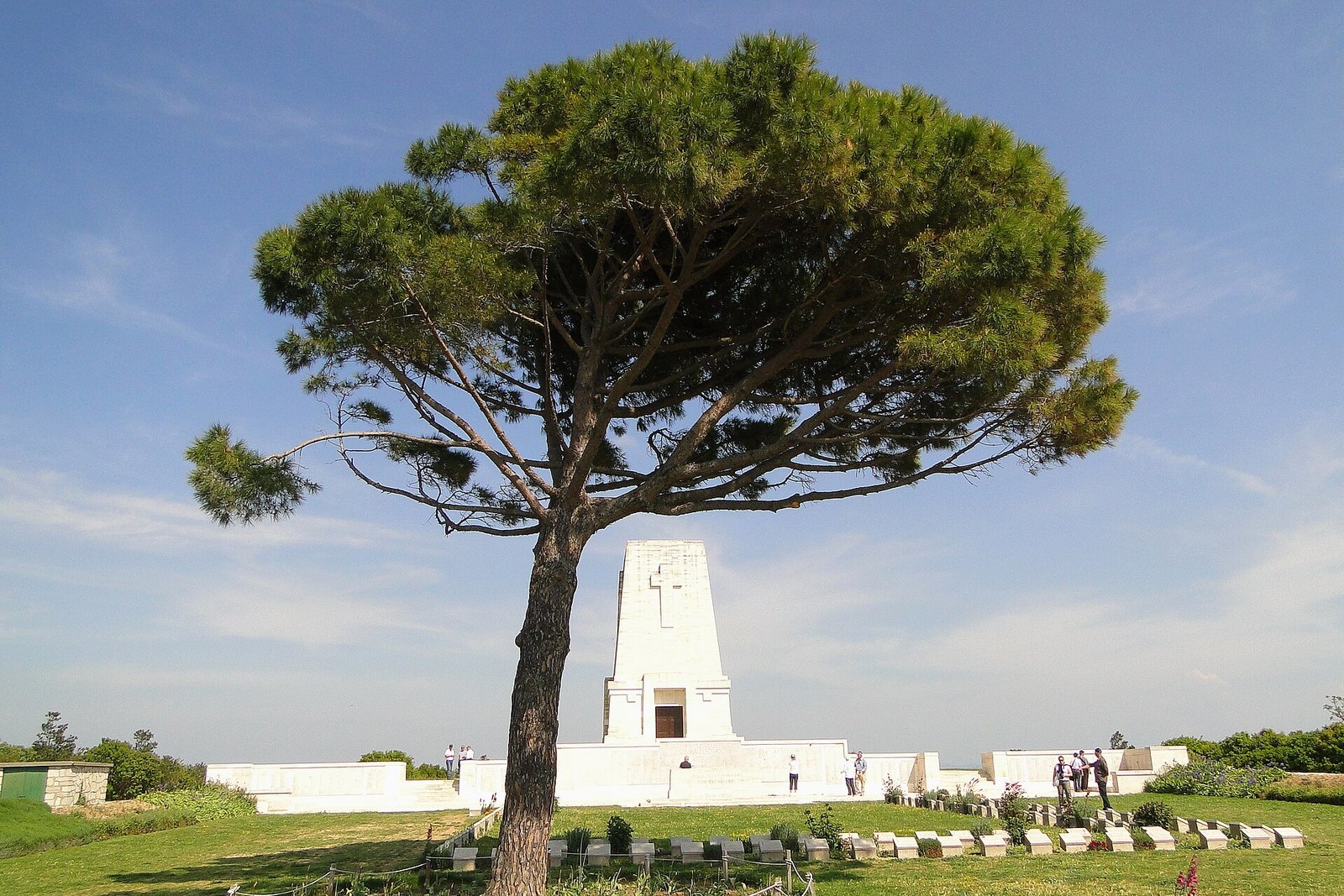
Australia’s principal memorial at Anzac, plus a cemetery, on high ground with views to Helles and Achi Baba. The Turkish name for the ground is Kanlısırt, and the Governorship lists a Kanlısırt Kitabesi as a separate monument.
The Lone Pine Memorial commemorates more than 4,930 servicemen of the British Empire with no known grave, of whom about 4,220 are Australian and more than 700 New Zealanders.
The Battle of Lone Pine, 6 to 9 August 1915, began as a diversion and became one of the campaign’s bloodiest actions: over 2,000 Australian casualties and approximately 7,000 Turkish casualties, and seven Victoria Crosses, among them Lieutenant Frederick Tubb and Corporals William Dunstan and Alexander Burton.
Quinn’s Post
On the Eceabat–Bigalı road, about 11.4 km into the main Anzac area. 473 Commonwealth servicemen buried or commemorated, 294 unidentified, with special memorials to 64 believed buried there.
Named after Major Hugh Quinn of the 15th Battalion, Australian Infantry, killed there during an attack on 29 May. The cemetery was made after the Armistice by concentrating 225 isolated graves, plus burials brought in from Pope’s Hill Cemetery and elsewhere.
The Nek
A cemetery on the narrow spur running from Russell’s Top to Baby 700, north of Quinn’s Post. 326 Commonwealth servicemen, of whom 316 are unidentified — a ratio that tells you what happened here — with special memorials to five Australians.
The cemetery was made after the Armistice, in what had been No Man’s Land. Australians passed through early on 25 April 1915 without holding it; an assault on 2 May and the 3rd Australian Light Horse Brigade attack of 7 August 1915 both failed.
Johnston’s Jolly
A stop on the official Anzac Walk, described by DVA as the defensive position held against the Ottoman attack of 18 May 1915, when 42,000 Ottoman soldiers were committed. We could not retrieve its burial numbers — CWGC’s records blocked repeated requests.
Chunuk Bair (Conkbayırı)
The high ground, and the place where the New Zealand and the Turkish accounts of the campaign meet.
The Chunuk Bair New Zealand Memorial commemorates nearly 850 New Zealand servicemen who died in the north of the Anzac sector and have no known grave.
On the same ground stands the Turkish Conkbayırı Atatürk Zafer Anıtı, a bronze monument commissioned by the Ministry of Culture and Tourism in 1993 and restored in 2015, commemorating the attack of 10 August 1915 led by Colonel Mustafa Kemal as Anafartalar Group commander. It is the newest of the monuments here. The Governorship also lists Conkbayırı Mehmetçik Kitabeleri as separate inscriptions.
The 57th Infantry Regiment Martyrs’ Cemetery
Read this one carefully, because it is widely misdescribed.
The 57. Piyade Alayı Şehitliği stands on the Kabatepe–Conkbayırı road at the southern end of Kılıçbayır, ground the Allies nicknamed “Chessboard.”
It is a memorial complex built on 12 December 1992, designed by the architect Nejat Dinçel in Kevser stone of the kind used in Seljuk and Ottoman caravanserais. Its graves are symbolic. It is not a 1915 burial ground, and describing it as one is wrong.
It comprises a şadırvan fountain, an open prayer area, the cemetery section and a monument carrying a relief of roughly 45 m² showing the regiment’s counter-attack of 25 April 1915, with marble plaques naming the fallen along the north wall. At the entrance stands a bronze statue of Hüseyin Kaçmaz, Türkiye’s oldest surviving veteran, who died in 1994 aged 108.
The regiment, commanded by Major Hüseyin Avni Bey and part of the 19th Division, was the first Ottoman unit to meet and check the Anzac landing at Arıburnu — the action in which Mustafa Kemal came to prominence. It is one of the most affecting places on the peninsula, and it is a modern construction.
The southern end: Helles and Morto Bay
This is the part itineraries get geographically wrong, by slotting southern sites between Anzac ones.
Cape Helles Memorial
At the southernmost point of the peninsula. Commemorates more than 20,000 servicemen of the British Empire who died in the campaign and have no known grave.
Çanakkale Şehitler Abidesi (Çanakkale Martyrs’ Memorial)
It is not at Anzac. It stands on Eskihisarlık Burnu, near Morto Bay at the far southern tip — roughly the opposite end of the peninsula from Anzac Cove. Itineraries that place it between Lone Pine and Chunuk Bair are simply wrong about where it is.
Chosen from 37 competition entries, by the architects Doğan Erginbaş, İsmail Utkular and Feridun Kip. Foundation laid 17 April 1954; opened to visitors 21 August 1960. A 45 m relief frieze precedes a symbolic cemetery section, whose symbolic graves opened to the public in 2007.
It records the names of 59,408 identified Turkish martyrs of the Çanakkale battles, and contains a tomb of the unknown soldier and a marble plaque carrying the words attributed to Atatürk. Remains of a Turkish soldier returned to Türkiye on 10 March 2003 were interred here on 18 March 2003.
V Beach and Seddülbahir
The British landing beaches. We could not retrieve CWGC burial figures for V Beach Cemetery. The Governorship lists the Seddülbahir Cephanelik Şehitliği among its monuments.
Kilitbahir Castle
On the European shore at the narrowest point of the Dardanelles, paired with Çimenlik Castle on the Asian shore so that no vessel could pass without being under fire from at least one.
Built for Fatih Sultan Mehmet in 1462–63; restored under Süleyman the Magnificent in 1541, Abdülaziz in 1870, Abdülhamid II in 1893–94, and again in 2011–13. Seen from above it resembles a clover leaf; the name means “the lock of the sea.”
It now operates as the Kilitbahir Kale Müzesi: 09:00 to 19:00, ticket window closing 18:15, closed Mondays, with seven floors covering defence, daily life, trade, worship and archaeology, including the Yellow Tower, the Inner Tower and a Piri Reis section.
Its admission price is genuinely unpublished. It appears on the ministry’s museum portal but is absent from the ministry’s fee annex, presumably because it is administered by the Gallipoli Historical Area Presidency instead.
The casualty figures, and why you should distrust a single number
Present the disagreement. Do not pick a number.
Commonwealth, per CWGC: of some 410,000 Commonwealth servicemen who served on the peninsula, around 205,000 became casualties, including 43,000 dead, captured or missing.
French, per CWGC: some 47,000 casualties out of a force of 79,000.
Ottoman, per CWGC: estimated between 250,000 and 350,000.
Australian, per the Australian War Memorial: 8,709 Australian deaths — 5,482 killed in action, 2,012 died of wounds, 665 died of disease. A revised estimate in January 1919 raised an earlier count of 8,159 to 8,709. Additionally about 664 officers and 17,260 men wounded, and 70 taken prisoner.
New Zealand, per NZ History: 2,779 New Zealanders killed, “about a sixth of those who fought on the peninsula.”
But a different New Zealand government page gives a different set again, and openly flags the problem: “it is difficult to determine exact casualty figures for the Gallipoli campaign as numbers vary in different publications.”
Turkish official: the Çanakkale Martyrs’ Memorial names 59,408 identified Turkish martyrs. That is a count of the identified dead — a different category from the 250,000–350,000 casualty estimate, and the two are frequently muddled.
| Force | Figure | Source | What it counts |
|---|---|---|---|
| Commonwealth | ~205,000 casualties, incl. 43,000 dead, captured or missing, from ~410,000 who served | CWGC | Casualties |
| French | ~47,000 casualties from a force of 79,000 | CWGC | Casualties |
| Ottoman | 250,000–350,000 (estimate) | CWGC | Casualties, not established |
| Australian | 8,709 deaths; ~17,924 wounded; 70 taken prisoner | Australian War Memorial | Deaths |
| New Zealand | 2,779 killed, about a sixth of those who fought | NZ History | Deaths |
| Turkish, identified | 59,408 names recorded at the Martyrs’ Memorial | Çanakkale Governorship | Identified dead only |
The honest framing: Commonwealth casualties are firmly established at around 205,000, of whom 43,000 died, were captured or went missing. Ottoman losses are not established. Any single confident Turkish figure you read is a choice among competing estimates, not a fact.
The campaign, by date
- 18 March 1915 — the naval attack on the narrows. This is the Turkish national commemoration, Çanakkale Zaferi ve Şehitleri Anma Günü, observed on the peninsula every 18 March.
- 25 April 1915 — the landings. CWGC’s Ari Burnu record specifies the Allies landed on 25 and 26 April.
- 18 May 1915 — the Ottoman attack at Johnston’s Jolly, 42,000 men committed.
- 6–9 August 1915 — Lone Pine.
- 7 August 1915 — The Nek.
- 10 August 1915 — Mustafa Kemal’s attack at Conkbayırı.
- 15–20 December 1915 — the evacuation of Anzac. The last Australians left from North Beach on 20 December 1915.
- 8–9 January 1916 — the evacuation of Helles.
About Atatürk’s words
The text carved at Anzac Cove and on the plaque at the Martyrs’ Memorial — “Those heroes that shed their blood… there is no difference between the Johnnies and the Mehmets to us where they lie side by side” — is universally attributed to Atatürk in 1934.
Its documented trail begins in 1953, not 1934. It first appears in a newspaper interview with the former Turkish minister Şükrü Kaya, published in Dünya, later reproduced by Uluğ İğdemir in Atatürk ve Anzaklar (1978). The “Johnnies and Mehmets” phrase appears only in the English translation, not in the Turkish.
Australian and Turkish historians have questioned the attribution for two decades — Adrian Jones in History Australia (2004), George Frederick Davis in a 2008 Otago doctoral thesis noting the words’ absence from 1934 newspapers, Cengiz Özakıncı in Bütün Dünya (2015), and Paul Daley in Guardian Australia.
The words are no less moving. They are just not securely attributable. We think readers standing in front of them deserve to know that.
Practicalities
There is no ticket and no gate. The cemeteries are open ground at any hour, with no register kept on site.
Base yourself in Eceabat for early starts on the battlefields, or in Çanakkale town for the ferry connections and Troy. Not Gelibolu — it is at the northern end, far from the battlefields, which are at the southern end.
The Çanakkale to Eceabat ferry runs roughly hourly around the clock, 40.00 ₺ on foot, and is turn-up-and-go.
Avoid 25 April and 18 March unless the commemoration is specifically why you are coming. Our Anzac Day guide explains what that day actually involves, and our Çanakkale and Gallipoli travel guide covers transport, costs and where to stay.
Frequently asked questions
Is there an entrance fee for the Gallipoli battlefields?
No. The enabling law provides for none, the ministry’s fee annex contains no Gallipoli entry, and the CWGC cemeteries are permanently open ground.
How long do you need at Gallipoli?
A full day for the Anzac sector and Chunuk Bair. Add half a day for Helles and Morto Bay, which are 25 to 35 km further south. Two days if you want to walk rather than drive between stops.
Can you walk the Gallipoli battlefields?
The Anzac sector, yes — the official Anzac Walk is about 2 km with 14 stops from North Beach. The southern sites, no; they are far too far.
Is the Çanakkale Martyrs’ Memorial near Anzac Cove?
No. It is at Eskihisarlık Burnu near Morto Bay, at the far southern tip of the peninsula, roughly the opposite end from Anzac Cove.
How many died at Gallipoli?
Commonwealth: around 205,000 casualties including 43,000 dead, captured or missing. Ottoman: estimated at 250,000 to 350,000 casualties, with no established figure. The Turkish memorial names 59,408 identified dead, which is a different measure again.