
In short
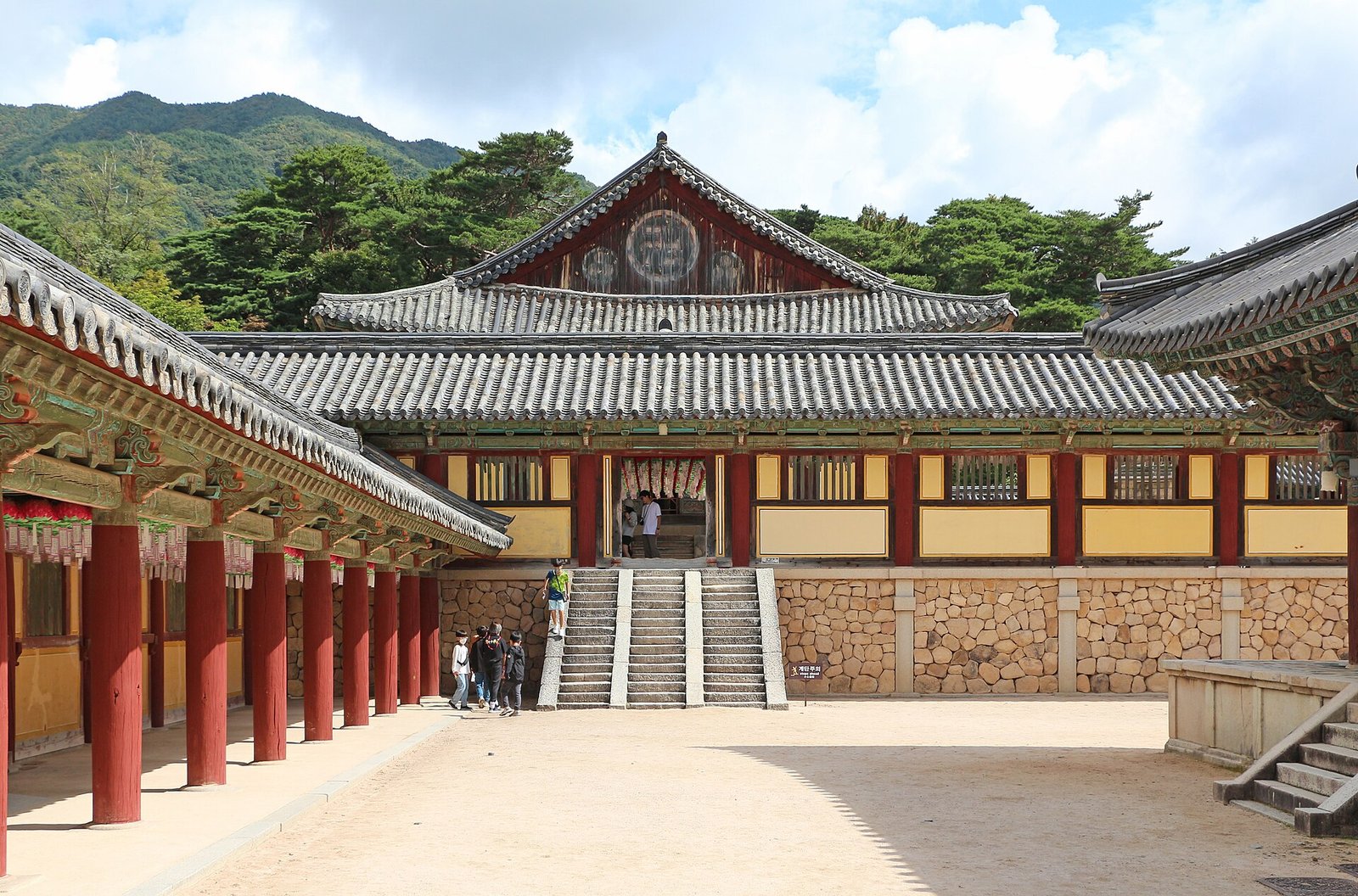
Bulguksa and Seokguram are free — 65 Korean temples stopped charging admission on 4 May 2023, and English guides still quote 6,000 won for Bulguksa. Hours run 09:00–18:00 from March to September, shortening to 17:00 in winter, with no closing day. In Gyeongju the ticketed sites are the smaller ones: Daereungwon 3,000 won.
Verified against temple and municipal sources, August 2026.
In May 2023 South Korea did something almost no other country has done: it abolished admission charges at 65 of its most important Buddhist temples, and paid the temples to make up the difference.
Three years later, English-language travel guides still tell you Bulguksa costs 6,000 won.
What is in this guide
It does not. It is free, and so are Seokguram, Beomeosa, Haeinsa, Hwaeomsa, Songgwangsa, Woljeongsa and dozens more. That is the single biggest correction in Korean travel writing, and it is a good illustration of the general problem: the country changed and the guides did not.
Here is what is actually outside Seoul, with the current figures, checked 20 August 2026.
The temples that stopped charging
Since 4 May 2023, the 65 Jogye Order temples holding nationally designated heritage have charged no admission. The mechanism was an amendment to the Cultural Heritage Protection Act: the state now compensates temple owners for waiving the fee, and budgeted 41.9 billion won for it in 2023.
Now free, among others: Bulguksa, Seokguram, Beomeosa, Haeinsa, Hwaeomsa, Baekyangsa, Songgwangsa, Naejangsa, Donghwasa, Sudeoksa, Woljeongsa, Jeondeungsa and Baekdamsa.
Five temples still charge, because they hold provincially rather than nationally designated heritage and so fall outside the subsidy: Bomunsa on Ganghwa, Goransa at Buyeo, Boriam at Namhae, Baengnyeonsa at Muju, and Huibangsa at Yeongju.
If you are budgeting a temple-heavy trip through Gyeongju, Busan and the southern mountains, the admission line is now close to zero. That is a materially different trip from the one most guides describe.
Gyeongju
The capital of the Silla kingdom for very nearly a thousand years, and the reason to leave Seoul if you only leave once.
| Site | Admission | Hours |
|---|---|---|
| Bulguksa | Free | Mar–Sep 09:00–18:00; Feb and Oct 09:00–17:30; Nov–Jan 09:00–17:00. No closing day |
| Seokguram | Free | May–Sep 09:00–18:00; Oct 09:00–17:30; Nov–Apr 09:00–17:00 |
| Daereungwon (Cheonmachong tumuli) | 3,000 won | — |
| Donggung Palace and Wolji (Anapji) | 3,000 won | — |
| Cheomseongdae observatory | Free | — |
| Gyeongju National Museum | Free | — |
| Yangdong Village | 4,000 won | — |
Parking at Bulguksa is 2,000 won, which for many visitors is now the entire cost of the visit.
Bulguksa and Seokguram are a pair and sit on the same mountain, Tohamsan — the temple below, the grotto above. Both are UNESCO-listed and both are now free.
Donggung and Wolji are worth the 3,000 won after dark, when the pavilions are lit and reflected in the pond. It is the most photographed thing in Gyeongju for a reason.
Busan
Beomeosa is free — it is on the 2023 list.
Busan Metro fares are 1,600 won for zone 1 and 1,800 won for zone 2, unchanged since 3 May 2024. That is higher than Seoul’s base fare, which surprises people.
We could not verify current details for Gamcheon Culture Village, Haeundae or Jagalchi market, so we are not printing figures for them. Gamcheon in particular is a residential neighbourhood that has introduced various visitor-management measures over the years — check locally rather than trusting an old article.
Suwon: a fortress you can walk for nothing
An hour from Seoul, and the best-value half-day in the country.
- The Hwaseong fortress wall itself is free and open year-round, including at night. This is the main event — a 5.7 km circuit of 18th-century military architecture that you can simply walk onto.
- Hwaseong Haenggung, the temporary palace, is 2,000 won. A combined ticket covering three sites is 4,000 won.
- Open 09:00 to 18:00, last entry 17:00, no closing day.
- Night opening runs 1 May to 1 November 2026, Friday to Sunday, 18:00 to 21:30.
- Entry is free if you are wearing hanbok — and the modernised gaeryang hanbok counts, which is the version most rental shops actually stock. Over-65s and under-6s are also free.
That hanbok rule is genuinely useful and almost never mentioned in English.
Jeonju
There is no admission charge for the Hanok Village itself. It is a living neighbourhood of some 700 traditional houses, and you walk in. Individual sites within it charge separately — Gyeonggijeon shrine has its own fee, which we could not verify.
Free guided walking tours run hourly from 10:00 to 16:00, and groups under 20 need no reservation. That is an unusually good free service and it is worth building the day around.
Jeju
Two things matter here, and only one of them is money.
Seongsan Ilchulbong, the tuff cone rising out of the sea at the island’s eastern tip: the summit path is ticketed, the coastal section is free. We could not verify the current summit fee. The climb takes 30 to 40 minutes.
Opening hours shift substantially with the season: November to February 06:00–18:00; March–April and September–October 05:00–19:00; May to August 04:30–20:00. It closes on the first Monday of every month — the detail most likely to ruin a plan.
Hallasan is the one to plan properly, and the constraint is not price. Advance reservation is mandatory for the Seongpanak and Gwaneumsa trails. You cannot turn up. Book before you fly.
What things cost
South Korea publishes official consumer price statistics for restaurant dishes, which is unusual and useful. These are Seoul averages from the Korea Consumer Agency, April 2026.
| Dish | Seoul average | Year on year |
|---|---|---|
| Samgyeopsal (200 g) | 21,321 won | +4.27% |
| Samgyetang (ginseng chicken soup) | 18,154 won | +3.74% |
| Naengmyeon (cold noodles) | 12,615 won | +4.13% |
| Kalguksu (knife-cut noodles) | 10,038 won | +4.40% |
| Kimchi jjigae baekban | 8,654 won | +1.81% |
| Jjajangmyeon | 7,731 won | +3.08% |
| Kimbap | 3,800 won | +4.89% |
Kalguksu crossed 10,000 won for the first time in 2026, moving from 9,923. By the June update kimbap had reached 3,838 won, up 5.9% year on year — the fastest riser of the eight tracked dishes, driven by rice up 13.2% and eggs up 9.0%.
The Korean barbecue portion problem
This is worth knowing before you sit down, because it changes the arithmetic.
Meat is sold per person (1인분), nominally 200 g, and everyone at the table is expected to order at least one portion. Banchan — the little side dishes — are free and unlimited. Rice, stews and noodles are charged separately.
But the portion is no longer 200 g. A survey of 20 grill restaurants in Jongno found only two serving a full 200 g. Most served 150 to 160 g, some 120 to 130 g — at the same price. It is openly discussed in Korea as shrinkflation.
Practical maths: two people, two portions at the official 21,321 won average, is about 42,600 won before rice, stew or drinks. Budget more than the headline number suggests, and expect less meat than the menu implies.
Soju, and the markup
Restaurants buy a bottle for 1,530 to 1,560 won and sell it for 4,000 to 5,000 — 6,000 in smarter places. 7,000 to 10,000 is considered gouging. The pre-pandemic norm was 3,000 won, so the restaurant price has roughly doubled in three years. The markup is three to four times.
We could not verify supermarket shelf prices or beer prices.
Tipping is not just uncustomary — it is structurally unnecessary
Most guides say tipping is not customary in Korea. The stronger and more accurate statement is that all-in pricing is a legal requirement.
Under the final payment price display rule (최종지불가격 표시제), food and drink businesses may not show VAT or a service charge separately. The price on the menu must be the final price the customer pays. Non-compliance draws an order, then a 7-day closure, then a 15-day closure.
So the number on the menu is the number you pay. There is nothing to add.
And there is no lodging tax
South Korea levies no tourism tax and no accommodation tax, at national or municipal level — we found none anywhere, including Seoul.
The opposite is true: Korea refunds hotel VAT to foreign tourists. That is a genuine and quotable advantage over Japan, where Tokyo, Kyoto and Osaka all charge a lodging tax, and it is worth factoring into a two-country trip.
When to go, honestly
Seoul’s climate is continental, not temperate maritime, and the numbers make the point better than adjectives.
- Annual mean 12.8°C
- Coldest month January, −1.9°C. Hottest month August, 26.1°C. That is an annual range of 28.0°C.
- Annual rainfall 1,417.9 mm
- Wettest month July at 414.4 mm. Driest month January at 16.8 mm — a 25-fold difference
- Summer, June to August, brings 892.1 mm — about 63% of the year’s rain
We could not verify the full 12-month table or the count of days above 30°C, because the meteorological administration’s tables load through JavaScript.
The monsoon is a defined window, not a season
Jangma (장마) is not “summer.” It is a specific, normal-dated window:
| Region | Normal dates | Duration | Average rainfall |
|---|---|---|---|
| Central, including Seoul | 25 June – 26 July | 31.5 days | 378.3 mm |
| Southern | 23 June – 24 July | 31.4 days | 341.1 mm |
| Jeju | 19 June – 20 July | 32.4 days | 348.7 mm |
And note what that implies: Seoul’s summer rainfall is 892.1 mm while the central jangma normal is 378.3 mm. Most of the summer’s rain falls outside the monsoon window. Avoiding jangma does not avoid the wet.
(The 378.3 mm figure is a regional value, not the Seoul station’s own.)
Cherry blossom, and the thing guides omit
Seoul’s normal flowering date is 8 April. In 2026 it flowered on 3 April with full bloom around 10 April — five days early.
Here is what almost no English guide tells you. Korea operates a legally mandated Fine Dust Seasonal Management System (미세먼지 계절관리제) from 1 December to 31 March, adopted in November 2019. The government’s own justification figure: PM2.5 averages 29 µg/m³ inside that window against 20 µg/m³ in other seasons — roughly 45% higher.
So the worst fine-dust months overlap the run-up to cherry blossom season. March sits inside the management period; the blossom arrives in early April, just after it ends. If air quality matters to you — and it should if you have asthma or are travelling with children — check airkorea.or.kr, or cleanair.seoul.go.kr for Seoul, on the days around your trip rather than assuming spring is clean.
The most comfortable months are late April to early June, and late September to early November.
Frequently asked questions
Is Bulguksa still 6,000 won?
No. Bulguksa is free, and has been since 4 May 2023, along with 64 other Jogye Order temples holding nationally designated heritage. The state compensates the temples instead. Guides still quoting a fee are three years out of date.
Which Korean temples still charge admission?
Five: Bomunsa on Ganghwa, Goransa at Buyeo, Boriam at Namhae, Baengnyeonsa at Muju, and Huibangsa at Yeongju. They hold provincially rather than nationally designated heritage and fall outside the subsidy.
Is there a tourist tax in South Korea?
No. There is no national or municipal lodging tax. Korea instead refunds hotel VAT to foreign visitors — the opposite arrangement to Japan’s.
Do you tip in South Korea?
No, and the pricing system makes it unnecessary. Restaurants are legally barred from displaying VAT or service charges separately: the menu price must be the final price. There is nothing to add.
How much does food cost in Seoul?
Official April 2026 Seoul averages: kimbap 3,800 won, jjajangmyeon 7,731, kimchi jjigae set 8,654, kalguksu 10,038, naengmyeon 12,615, samgyetang 18,154, and samgyeopsal 21,321 won per 200 g portion. Expect the barbecue portion to be smaller than 200 g in practice.
What is the best time to visit South Korea?
Late April to early June, and late September to early November. Avoid the jangma window of roughly 25 June to 26 July in the centre, and be aware that December to March is the official fine-dust management season, when PM2.5 runs about 45% higher.
Is Gyeongju worth visiting?
Yes, and more so now that its two headline sites cost nothing. Bulguksa and Seokguram are both free, the national museum is free, Cheomseongdae is free, and the two ticketed sites are 3,000 won each. See our Seoul travel guide for the capital, and check whether you need a K-ETA before you fly.