
In short
Yokohama’s museums close on staggered weekdays, so a two-day plan is really a closing-day puzzle. Mondays close Nippon Maru and the Port Museum, the Kirin factory tour, the Archives of History and the Silk Museum. Tuesdays close the CUPNOODLES Museum, Zoorasia and the Hara Model Railway Museum. And the Landmark Tower Sky Garden has been closed since 31 December 2025, so it is not in this itinerary at all.
Closing days verified against each venue’s own page, August 2026.
Yokohama is compact enough that two days is genuinely generous, which means you can afford to slow down — provided you do not lose half a day to a closed door. And Yokohama closes a lot of doors: the Cup Noodles Museum and Zoorasia shut Tuesdays, the Yokohama Museum of Art and Cosmo Clock 21 shut Thursdays, Nippon Maru and the Kirin brewery shut Mondays, and the Hara Model Railway Museum shuts Tuesdays and Wednesdays.
There is also one thing you cannot do at all any more. The Landmark Tower Sky Garden closed on 31 December 2025 and is not expected to reopen before 2028. Most itineraries you will find still open with it.
What is in this guide
This one is built around what is open, at the fares and admissions that applied on 20 August 2026, all checked against the operator’s or the city’s own page.
Before you fix your dates
| Day | What is closed |
|---|---|
| Monday | Nippon Maru and Yokohama Port Museum, Kirin Beer factory tour, Foreign General Cemetery museum, Yokohama Archives of History, Silk Museum |
| Tuesday | CUPNOODLES Museum, Zoorasia, Hara Model Railway Museum, Foreign General Cemetery museum |
| Wednesday | Hara Model Railway Museum. Also 2nd Wednesday: Yamate 111, Ehrismann, Berrick Hall, Bluff 18. 4th Wednesday: British House, Yamate 234, Diplomat’s House |
| Thursday | Yokohama Museum of Art, Cosmo Clock 21 |
No single day is safe, so pick your two days to cover what you actually care about. If you want both the art museum and the Cup Noodles Museum, avoid a Tuesday–Thursday pairing.
Two dated closures to know: the Yokohama Museum of Art closes entirely from 24 November to 10 December 2026. And the Shin-Yokohama Ramen Museum closes only on 31 December and 1 January, which makes it the most reliable wet-weather option in the city.
What to buy first
The Yokohama Minatomirai Pass, ¥560 adult and ¥280 child. It covers the JR Keihin-Tohoku and Negishi Line between Yokohama and Shin-Sugita plus the entire Minatomirai Line — which means Sakuragicho for Minato Mirai, Kannai, and Ishikawacho for Chinatown and Yamate, all on one ticket.
Buy it at designated JR machines inside the free area, or on Mobile Suica for same-day use. It is not sold at the Midori-no-Madoguchi ticket office.
The alternatives, for completeness: the Minatomirai Line One-Day Pass at ¥460 covers only that line and, with a ¥230 maximum single fare, only breaks even on your third ride. The Minato Burari Ticket at ¥700 covers the city subway and municipal buses including the Akai Kutsu loop bus and BAYSIDE BLUE, which is the one to take if you plan to lean on buses rather than trains.
Coming from Tokyo? JR Tokyo to Yokohama is ¥528 with an IC card since the 14 March 2026 fare revision. Tokyu from Shibuya is ¥310 and Keikyu from Shinagawa is ¥320 — both cheaper than JR, and the Tokyu Line Minatomirai Pass from Shibuya at ¥920 bundles the return with unlimited Minatomirai Line travel, saving ¥160 over buying separately.
Day one: the harbour
Morning, from 10:00: Minato Mirai
Start at Sakuragicho. The obvious first move is the one most guides do not mention, because it did not exist when they were written.
YOKOHAMA AIR CABIN, the urban gondola, opened on 22 April 2021 and runs from Sakuragicho Station across to Unga Park. ¥1,000 one way, ¥1,800 return; children ¥500 and ¥900. About 630 m and five minutes, at a maximum height of around 40 m, in eight-person cabins. Open 10:00 to 22:00, weather permitting.
Take it one way. At ¥1,000 it is a pleasant crossing with a good view of the waterfront, and you want to be on the far side anyway. The return leg is walkable in fifteen minutes.
Do not plan on the Landmark Tower Sky Garden. It is closed. If you want height, your options now are the Cosmo Clock 21 ferris wheel at ¥1,000 — 112.5 m, about fifteen minutes for a revolution, but closed Thursdays — or Marine Tower over by Yamashita Park at ¥1,000 on a weekday and ¥1,200 at weekends. Cosmo World itself is free to enter; you pay per ride.
Nippon Maru and the Yokohama Port Museum sit right by the Air Cabin’s lower station. ¥800 for the combined ticket, or ¥400 for the sailing ship alone and ¥500 for the museum. 10:00 to 17:00, last admission 16:30, closed Mondays. On Saturdays school students pay a flat ¥100 for any ticket.
Late morning: the Cup Noodles Museum, if you book it
CUPNOODLES MUSEUM YOKOHAMA is a ten-minute walk on towards the harbour, and its pricing is the single most misreported thing in Yokohama. Admission does not include any of the noodle activities.
| Item | Price |
|---|---|
| Museum admission | ¥500, university age and above; high school age and under free |
| Chicken Ramen Factory, making noodles from scratch | ¥1,200 junior high and above, ¥600 elementary — advance booking required |
| My CUPNOODLES Factory, designing your own cup | ¥500 per cup |
| CUPNOODLES Park, the play attraction | ¥500 per 30-minute session |
| NOODLES BAZAAR food hall | ¥500 regular, ¥250 mini per dish |
The Chicken Ramen Factory rose from ¥1,000 to ¥1,200 on 31 January 2026, while admission stayed at ¥500. Sessions run 90 minutes and must be reserved in advance, online or by phone — this is the one thing here you cannot decide on the day.
Open 10:00 to 18:00, last admission 17:00. Closed Tuesdays.
If you have not booked the Chicken Ramen Factory, the honest advice is that My CUPNOODLES Factory at ¥500 a cup is the better-value activity anyway and needs no reservation. The NOODLES BAZAAR is a reasonable lunch at ¥500 a dish.
Afternoon: Red Brick, Osanbashi and the free view
The Red Brick Warehouse is free, Building 1 open 10:00 to 19:00 and Building 2 from 11:00 to 20:00. It is shops and restaurants in handsome 1910s customs warehouses; treat it as a pleasant twenty minutes rather than a destination.
One correction: the Christmas Market held here is no longer free. Recent editions have been ticketed at ¥500 to ¥1,000 or more depending on the date and ticket type. The 2026 dates had not been published as of 20 August 2026.
Walk on to Osanbashi, the international passenger terminal, which is free and is the best thing on this half of the itinerary. The rooftop plaza — known as the whale’s back — is open 24 hours. It is a broad deck of timber and lawn looking straight back at the Minato Mirai skyline, and with the Sky Garden closed it is now the best free view in Yokohama. The interior hall runs 09:00 to 21:30.
Evening: Chinatown
Yokohama Chinatown is a public street district — the gates, the streets and the shops cost nothing, and there is no district-wide closing day, though individual shops set their own hours.
It formed after the port opened in 1859, when Chinese merchants arrived alongside Western traders. Yokohama City’s official site records over 600 establishments and describes it as “of world-class scale.”
A wording note, since you will see the claim everywhere: neither the city’s official page nor the Chinatown association describes it as “the largest Chinatown in Asia.” What they publish is the 600-plus figure. It is comfortably the largest of Japan’s three historic Chinatowns by shop count, and that is the claim that survives checking. For the comparison, see our Kobe travel guide.
Kanteibyo, the temple to Guan Yu, is worth ten minutes. The grounds are free; entering the main hall costs ¥500, which buys the five incense sticks for the five altars. Open 09:00 to 19:00. It was founded in 1862 by a Chinese resident who brought a wooden image of Guan Yu shortly after the port opened; the present building is the fourth, rebuilt in 1990.
Day two: the Bluff, the history, and the ramen
Morning, from 09:30: Yamate
Take the train to Ishikawacho and climb the Bluff. This is where the foreign community lived, and the surviving houses are the best free thing in the city.
All seven Yamate Western houses are free. Open 09:30 to 17:00, grouped in three parks:
- Minato-no-Mieru-Oka Park: Yokohama British House, Yamate No. 111
- Motomachi Park: Yamate No. 234, the Ehrismann Residence, Berrick Hall
- Yamate Italian Garden: the Diplomat’s House, Bluff No. 18
Watch the split closure pattern, which is the thing that catches people out. Yamate 111, Ehrismann, Berrick Hall and Bluff 18 close on the second Wednesday of the month. British House, Yamate 234 and the Diplomat’s House close on the fourth. All seven close 29 December to 3 January.
Three or four houses is a comfortable morning. Berrick Hall is the largest, the Ehrismann Residence is by Antonin Raymond, and Minato-no-Mieru-Oka Park has the view its name promises.
The Foreign General Cemetery is on the same hill and has awkward opening hours worth planning around. The grounds open only Saturdays, Sundays and public holidays, 12:00 to 16:00 — and not in rain, and not at all in January, August or over the New Year, with a ¥200 donation requested toward maintenance. The attached museum is free and open 09:00 to 17:00, closed Mondays and Tuesdays. Around 5,000 people from more than 40 countries are buried there, and the cemetery traces its origin to the burial of a US Navy sailor from Perry’s 1853 expedition.
Midday: Nihon-odori, and the history that explains the city
Walk down to Nihon-odori for the two small museums that make sense of everything else you have seen. Both are cheap and both are closed Mondays.
The Yokohama Archives of History costs ¥200 for general admission, ¥100 for students and Yokohama seniors, and is free for all school students on Saturdays. Open 09:30 to 17:00, last admission 16:30. It stands on the site where the treaty with the United States was concluded, and holds over 270,000 items.
The Silk Museum is ¥500 general, ¥300 for over-65s and university students, ¥100 for school students. Same hours, also closed Mondays, plus 28 December to 4 January. Raw silk was the port’s dominant export, and this is the museum of the trade that actually built Yokohama.
The history in brief, since it is genuinely short: Perry arrived at Uraga in 1853. The 1858 Treaty of Amity and Commerce designated Kanagawa as an open port — but the shogunate opened Yokohama, then a fishing village across the bay, instead. The port opened on 1 July 1859. Yokohama’s own commemoration is held on 2 June, following a city council resolution in 1928, which is why English sources give conflicting dates.
Lunch nearby: the Hotel New Grand, a minute from Motomachi-Chukagai, opened in 1927 and you can walk into it. Its ground-floor Cafe serves the dishes the hotel claims to have invented: Spaghetti Napolitan ¥2,340, Seafood Doria ¥3,289, Pudding a la mode ¥2,024, all tax and service included.
On that claim, honestly: the hotel’s own account is that during the 1945 to 1952 occupation, when it was requisitioned, its second head chef Shigetada Irie took the ketchup-and-spaghetti the American soldiers were eating and rebuilt it as a proper tomato sauce with garlic and onion. That is the hotel’s claim, and it is the best-documented one — but it is contested in Japan, where ketchup pasta appears elsewhere in the same period. Treat it as the hotel’s story rather than settled fact.
Afternoon: pick one
Sankeien Garden if you want the quiet option. ¥700 adult, ¥200 for school students, 09:00 to 17:00 with last entry 16:30, closed 29 to 31 December. Advance tickets are ¥600. It is a large landscape garden of relocated historic buildings, and it is a bus or train ride out from the centre — budget half the afternoon. Note that the ¥900 price you may have seen is wrong; the garden’s own pages say ¥700.
The Shin-Yokohama Ramen Museum if you want the memorable one. ¥450 admission, weekdays 11:00 to 21:00 and weekends from 10:30, closed only 31 December and 1 January. It is a gallery of ramen history above a recreated 1958 Shitamachi streetscape on two basement levels, housing shops from around Japan. Its annual pass costs ¥500 digital or ¥800 analogue, which is a curious ¥50 more than a day ticket.
Yokohama matters to ramen for a specific reason. Iekei ramen (家系) was invented here — at Yoshimura-ya, founded in 1974 by Minoru Yoshimura in the Shin-Sugita area. The style is thick tonkotsu-shoyu broth with chicken fat, notably thick straight flat noodles of around 160 g, and toppings of spring onion, chashu, large rectangular sheets of nori and spinach, with the customer specifying flavour strength, fat level and noodle firmness. The successor shops all took “-ya” names, which is where “house lineage” comes from. The museum’s own ramen encyclopaedia puts the count at 200 to 250 shops nationwide.
Inside the museum, Rokkakuya 1994+ is a revival of one of the iekei “big three.” Ramen ¥950, medium ¥1,050, large ¥1,150, mini ¥750; ajitama ¥200, nori ¥150, beer ¥500 — on top of the ¥450 admission.
Yoshimura-ya itself still trades near Yokohama Station West, 11:00 to 20:00, closed Mondays. We are not quoting a bowl price, because its own site blocks automated access and no official page publishes a menu.
Evening: shumai, and the train home
Kiyoken has been making its shumai since 1928 — pork and dried scallop, deliberately formulated to taste good cold, because it was designed to be eaten on a train. ¥740 for 15, ¥370 for a six-piece pocket pack. The Shiumai Bento is ¥1,180, introduced in 1954, and its price rose by ¥110 in February 2026.
Outlets are throughout Yokohama Station. Buy it for the journey back — that is what it is for.
If you have a spare half-day and book three months ahead: the Kiyoken factory tour is free, runs about 90 minutes including a tasting, on Tuesdays, Wednesdays, Fridays and Saturdays at 09:00, 10:30, 12:30 and 14:00. Online reservation is required and booking opens three months ahead. It is in Tsuzuki-ku in northern Yokohama, nowhere near the waterfront, so treat it as its own outing.
Two things worth a third day
The Kirin Beer Yokohama factory tour, about 90 minutes with a tasting of three beers, ¥500 per adult rising to ¥1,000 from 1 October, booking required, closed Mondays. Under-20s are free but must be accompanied, and adults pay whether or not they drink. It is at Namamugi on the Keikyu Main Line. We could not confirm the year of that price change — the brewery’s pages say “through September” and “from 1 October” without stating one — so check when you book.
The Hara Model Railway Museum, by Yokohama Station East, ¥1,500 adult. Timed-entry advance tickets must be bought before you go, and it is closed Tuesdays and Wednesdays. This is not a walk-in.
Skip Zoorasia unless you specifically want it. It is ¥800 and good, but it is in Asahi Ward, well inland, and it is not a Minato Mirai add-on. It is also closed Tuesdays, though it is free on Saturdays for students with ID.
Frequently asked questions
Is two days enough for Yokohama?
Comfortably. One day covers Minato Mirai, Chinatown and Yamate at a brisk pace; two lets you add the history museums and either Sankeien or the Ramen Museum without rushing.
What is the worst day to visit Yokohama?
There is no single worst day, which is the problem. Tuesday costs you the Cup Noodles Museum, Thursday costs you the art museum and the ferris wheel, and Monday costs you Nippon Maru and the history museums. Choose by what you care about most.
Can you still go up the Landmark Tower?
No. The Sky Garden closed on 31 December 2025 and the operator does not expect to resume before 2028. Use the Air Cabin, Cosmo Clock 21, Marine Tower, or the free 24-hour rooftop at Osanbashi.
How much does a two-day Yokohama trip cost?
Transport is about ¥560 a day on the Minatomirai Pass. Admissions across both days as described come to roughly ¥4,000 to ¥5,000 per adult — and a determined visitor could halve that, since Yamate, Chinatown, Red Brick and Osanbashi are all free.
Should I stay in Yokohama or Tokyo?
There is a real financial argument for Yokohama: it levies no lodging tax, and neither does Kanagawa Prefecture, while Tokyo does. Tokyo is thirty minutes and ¥528 away. See our Yokohama travel guide for the detail, and our Japan lodging tax calculator for what the taxed cities charge.
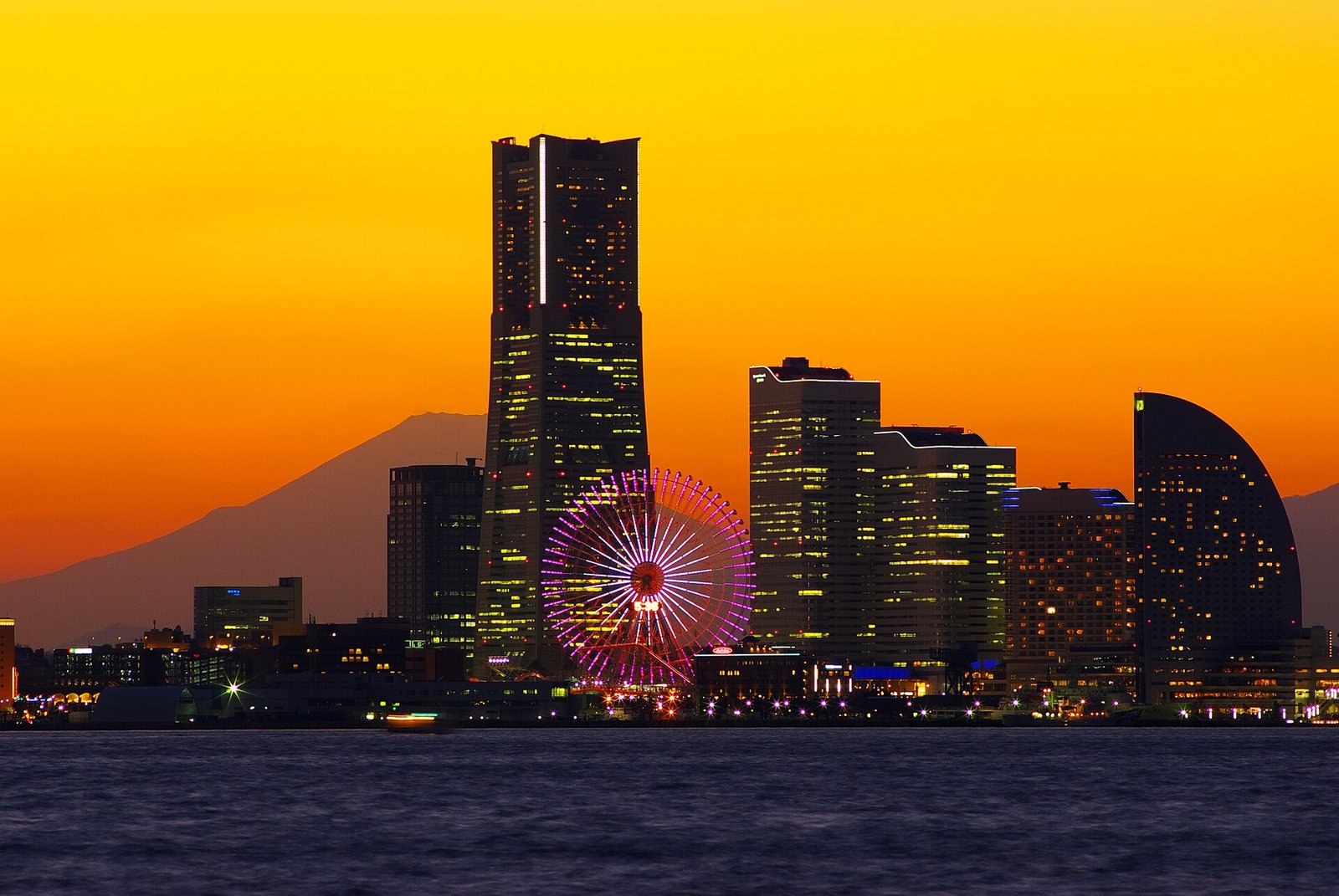
Photo: “MM21&FUJI” by 名古屋太郎, via Wikimedia Commons, licensed CC BY-SA 3.0.