
In short
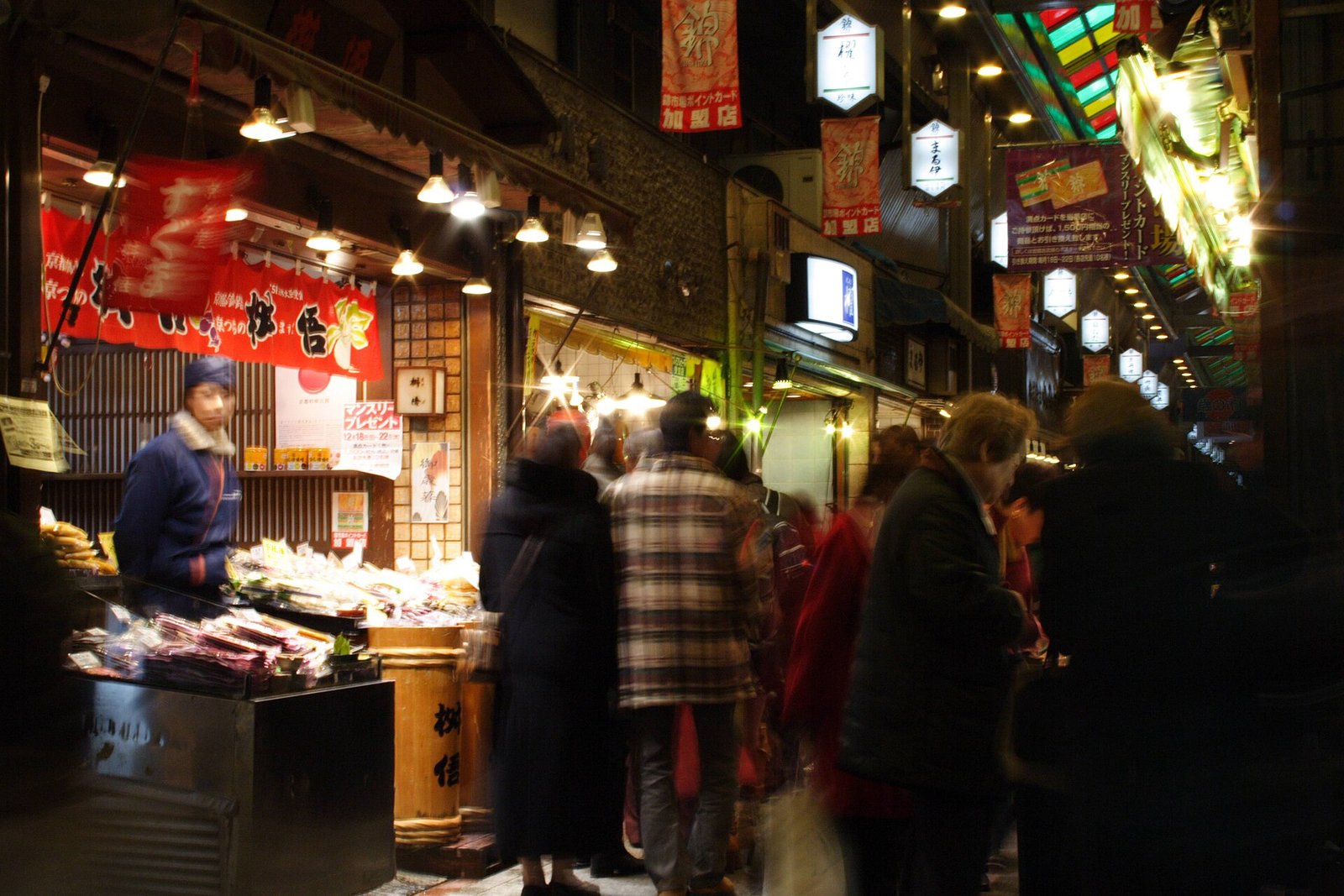
Nishiki Market asks you not to eat while walking — the exact opposite of Osaka’s Kuromon, and in the association’s own English words. It also has no market-wide opening hours; each shop sets its own, and many close Wednesdays. On price: temple shōjin ryōri starts at ¥3,800 against ¥31,625 for a Hyotei kaiseki lunch. And “Uji tea” is not a protected designation — it may be grown in four prefectures.
Checked against MAFF, the Agency for Cultural Affairs and the restaurants’ own sites, 25 August 2026.
What is in this guide
- Nishiki asks you not to eat while walking
- Nishiki has no opening hours
- What Kyoto’s registered food actually is
- “Kyō-ryōri” is a registered craft, not a menu
- Shōjin ryōri, and what it costs
- The kaiseki number, and the cheaper door into the same house
- Uji tea is not what you think it is
- Kyoto’s tea did not start in Uji
- What we could not verify
Ask the internet about Kyoto food and you get kaiseki, and a photograph of someone eating a skewer while walking down Nishiki Market. Both are misleading, and both can be checked against a source rather than argued about.
Nishiki asks you not to eat while walking
This is the correction most worth carrying, because it is the exact opposite of what almost every English guide says — and it is on the market association’s own English page:
> “Please refrain from walking in the market while eating. In a crowded market, there is a risk of staining other customers’ clothes or causing other problems.”
The same page asks you to eat in front of or inside the shop where you bought it. The Japanese homepage says the same thing.
If you have also read our Osaka food guide, this will look odd, because Kuromon Ichiba in Osaka encourages exactly the behaviour Nishiki asks you to avoid. Two covered market streets, two hours apart by train, with opposite house rules. Neither is a general Japanese rule; each is that market’s own position.
Nishiki has no opening hours
Not “roughly 9:00 to 18:00” — none at all. The association states it plainly:
> “Nishiki Market does not have a designated closing day as a whole. It consists of individual shops, each with its own closing day.”
It adds that many shops close on Wednesdays, that most stay open at year-end, and that a good number close 1–3 January. Any guide printing a single market-wide opening time made it up.
For the record, from the association: 123 stores as of May 2023, about 390 m long, and 3.3 m wide for most of its length — widening past 5 m in places. It traces its founding to 1615, when the Edo shogunate recognised three fish wholesalers in Kyoto.
What Kyoto’s registered food actually is
Japan’s Ministry of Agriculture, Forestry and Fisheries maintains a national registry of regional dishes, and thirty are listed for Kyoto Prefecture. What is striking is how few of them are restaurant dishes.
The list includes 千枚漬け, しば漬け and すぐき漬け — three pickles — alongside 水無月 and 宇治金時 and おはぎ, which are sweets. There is 黒豆煮, 松茸ごはん, 栗ごはん, 納豆餅. Kaiseki does not appear, because kaiseki is not a dish.
Two entries repay reading in full.
さばずし (mackerel sushi). MAFF gives the transmission area as the whole prefecture and the ingredients as mackerel, rice, vinegar and salt. It dates the dish to the Edo period and ties it to the Saba Kaidō, the “mackerel road” from the Sea of Japan: salted fish reached landlocked Kyoto after two or three days, by which point the curing had arrived at the right point. And on when it was eaten — “it was eaten as a feast on special days, such as seasonal festivals.” Not everyday food.
にしん茄子 (herring and aubergine). MAFF presents this as the textbook case of であいもん — two ingredients that come into season together and improve each other. Dried herring reached Kyoto by the Kitamaebune coastal trade in the Edo and Meiji periods; the aubergines are 山科なす, which supplied 60–70% of city production from late Meiji into early Shōwa, and 賀茂なす. Both are certified Kyoto heritage vegetables.
That is a more honest picture of Kyoto’s food identity than the kaiseki-first framing: preserved fish from a long way away, pickles, and vegetables with named varieties.
“Kyō-ryōri” is a registered craft, not a menu
京料理 was registered as a Registered Intangible Cultural Property on 17 November 2022. The Agency for Cultural Affairs defines it, verbatim, as:
> “the craft of expressing Kyoto-ness through food, by unifying cooking, setting and hospitality.”
Note what that is not. It is not a list of dishes, and it is not a number of courses. The registration describes three roles — the proprietor overseeing the whole, the cooks, and the hospitality staff — which is why the room and the service are part of what you are paying for, not an add-on to it.
We looked for an official source distinguishing 懐石 from 会席 and could not find one. Neither MAFF nor the Agency for Cultural Affairs defines either term. Anyone who tells you the difference confidently is telling you a convention, not a rule.
Shōjin ryōri, and what it costs
MAFF’s definition is simple: food using no meat or fish, grounded in the Buddhist precept against taking life, typically structured as one soup and three dishes, built on seasonal vegetables and seaweed.
Two temple restaurants publish their prices as text on their own sites:
| Set | Price | |
|---|---|---|
| Shigetsu, run by Tenryū-ji itself | 雪, one soup five dishes | ¥3,800 |
| 月, one soup six dishes | ¥6,500 | |
| 花, one soup seven dishes | ¥9,000 | |
| Izusen, at Daiji-in, Daitoku-ji | あやめ | ¥3,800 |
| ゆり | ¥4,800 | |
| ぼたん | ¥6,200 |
Shigetsu adds ¥500 garden admission on top of every menu and is closed Thursdays; 雪 needs two days’ notice, and 月 and 花 need three days and at least two people. Izusen opens 11:00 to 16:00 and closes only 28–31 December.
The kaiseki number, and the cheaper door into the same house
Hyotei publishes its prices as text, tax and service included:
| Price | |
|---|---|
| Main house, kaiseki lunch | from ¥31,625 |
| Main house, dinner | from ¥37,950 |
| Main house, morning rice porridge, July and August only | ¥7,590 |
| Annex, morning porridge, 16 March – 30 November | ¥5,445 |
| Annex, Shōkadō bentō | ¥7,260 |
The annex morning porridge is roughly one-sixth of the main-house lunch, at the same address. And temple shōjin ryōri at ¥3,800 is about one-eighth of it. “Kyoto is unaffordable” stops being true the moment you look at published prices instead of the headline one.
Minimum party at Hyotei is two. The main house closes Wednesdays, the annex Thursdays, plus irregular days.
Uji tea is not what you think it is
“Uji tea” is not a protected geographical indication. It does not appear on Japan’s GI register. What is registered is something much narrower: Traditional Uji Tencha, GI No. 271, applied for on 10 April 2023, with a production area of Uji City only.
And MAFF’s own definition of Uji tea is far looser than the name suggests:
> green tea made from leaf grown in four prefectures — Kyoto, Nara, Shiga and Mie — finished by a processor based in Kyoto Prefecture using a method originating in the Uji area.
Uji tea is a processing designation, not a growing-area one. Leaf from three other prefectures qualifies.
Kyoto’s tea did not start in Uji
Both MAFF and the temple itself say it started at Kōsan-ji, in Toganoo, in the mountains north-west of the city. Eisai brought seeds back from Song China and passed them to Myōe, who planted them there; the temple records that he recommended tea to the monks because it kept them awake in practice. It was transplanted to Uji later.
Kōsan-ji’s own page carries the sharper line:
> “since medieval times, the tea of Toganoo has been called hon-cha — true tea — and everything else hi-cha.”
Everything else included Uji. The temple still holds a tea offering ceremony on 8 November, attended by Uji tea association officers, and keeps what it describes as Japan’s oldest tea garden. It is a 55-minute bus ride from Kyoto Station, which is why almost nobody goes.
What we could not verify
- Any government definition of 懐石 versus 会席. Searched MAFF and the Agency for Cultural Affairs; nothing.
- Ippodo’s tearoom and matcha prices. The shop’s own pages were unreachable on the day of writing, so no figure appears here rather than a figure from a third party.
- Standing prices for anything not listed above. Every price in this guide comes from the restaurant’s own domain, published as text.
Prices, hours and registry entries were checked against MAFF, the Agency for Cultural Affairs, the Nishiki Market association and the restaurants’ own sites on 25 August 2026.
More Kyoto: the travel guide for what changed this year, the practical tips for fares and rules, and what a trip costs.