
In short
Hiroshima’s prefectural accommodation tax is simple and widely missed: ¥0 under ¥6,000 and ¥200 at ¥6,000 and over, per person per night, on the room charge excluding meals and consumption tax. It applies across the whole prefecture — Hiroshima city, Hatsukaichi and Miyajima — to hotels, ryokan, simple lodgings and licensed minpaku alike.
Verified against prefectural tax pages, August 2026.
Disclosure: some links in this guide are affiliate links. If you book through one, we earn a small commission and you pay exactly the same price. We only link to services we would use ourselves, no brand pays for placement or for a favourable write-up, and every price in this article was researched independently.
Where you sleep in Hiroshima matters less than in most Japanese cities, because the place is compact and the trams are flat-fare. It matters more than you would think for two specific reasons: whether you can be at the Peace Memorial Museum for its 7:30 opening, and whether you spend a night on Miyajima after the day-trippers have gone.
What is in this guide
This guide takes the five realistic bases in turn, says what each is actually for, and is honest about the one thing we could not establish. There is no credible official or primary source for 2026 hotel price bands in Hiroshima city — Japan’s tourism agency publishes guest-nights and occupancy by prefecture, not average daily rates — so we are not going to print invented numbers. Where published rates exist, as they do for Miyajima’s ryokan through their trade association, we use them and say where they come from.
There is also a tax that started four and a half months ago and that almost no English guide mentions. That is in the section below, because it will appear on your bill.
Editor’s note
What is sourced here and what is not: the accommodation tax comes from Hiroshima Prefecture directly and from operator notices; the Miyajima ryokan rates are the properties published rates via the Miyajima Ryokan Association, checked 19 August 2026 — they are asking rates, not transaction prices, so expect peak and weekend nights at the top of each band; the transport figures are from Hiroden and JR. The neighbourhood judgements are ours. We did not find publishable price data for Hiroshima city hotels and have not substituted a guess.
The tax that appears at checkout
Hiroshima Prefecture introduced an accommodation tax on 1 April 2026.
| Room charge per person per night, excluding meals and consumption tax | Tax |
|---|---|
| Under ¥6,000 | ¥0 |
| ¥6,000 and over | ¥200 |
It applies across the whole prefecture — Hiroshima city, Hatsukaichi and Miyajima included — to hotels, ryokan, simple lodgings and licensed *minpaku*. It is collected by the operator, usually at check-in or check-out, and it is often not included in the rate you booked online. Pupils and teachers on school-sanctioned trips are exempt with documentation, universities excluded.
It is small money. It is also four and a half months old, and it surprises people at the desk because nothing in English mentions it. Two hundred yen a night, per person, is the whole story — but budget it rather than be annoyed by it.
The five bases, and what each is for
Hondōri, Kamiyachō and Hatchōbori — the default
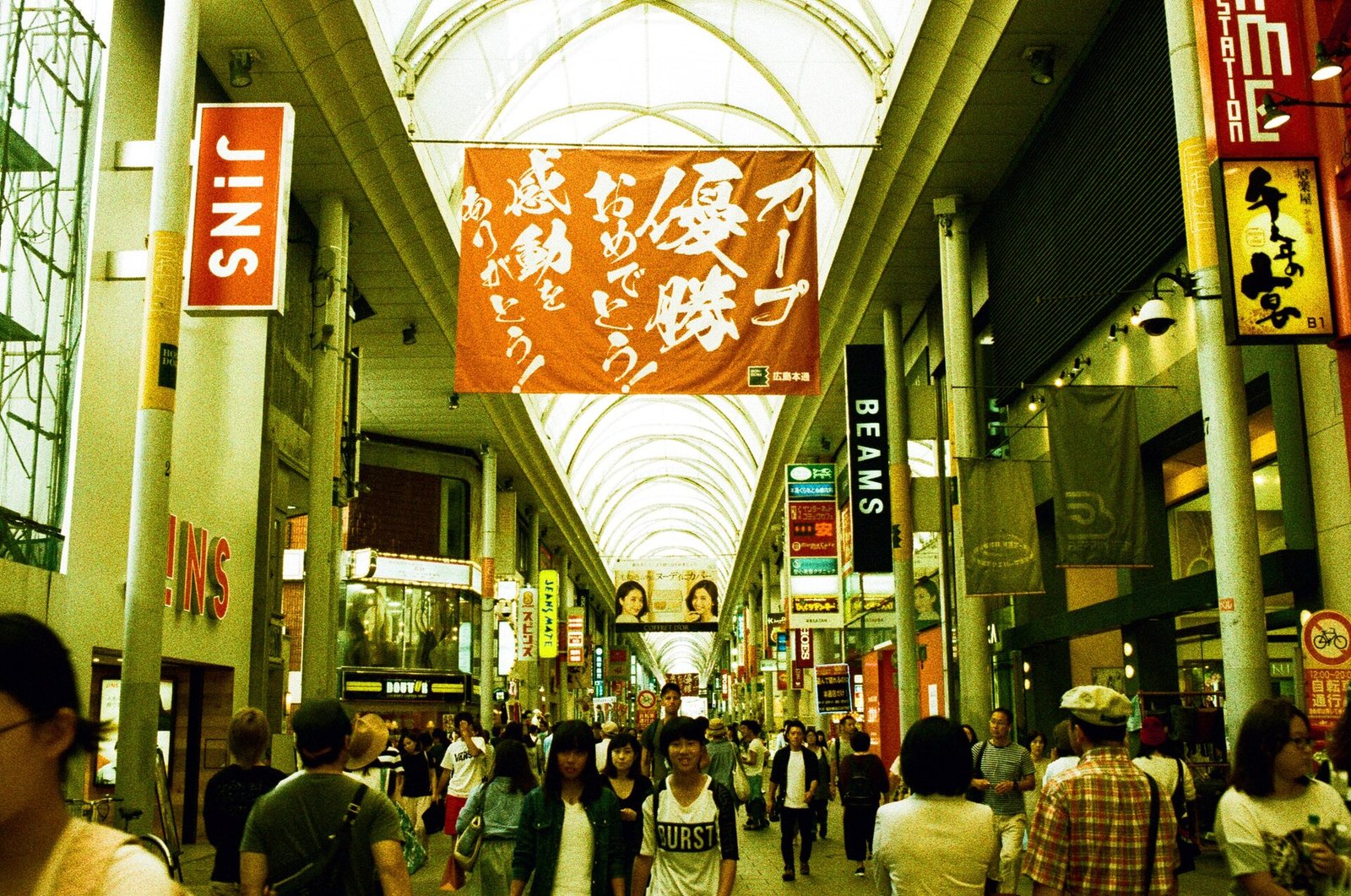
This is the commercial and eating heart of the city: covered arcades, department stores, Okonomimura, and the greatest density of okonomiyaki counters and izakaya anywhere in Hiroshima. It is about ten minutes on foot to the Peace Park and it sits on every tram line.
Choose it if you are staying two nights and want the park within walking distance and dinner on your doorstep. For most visitors this is the right answer, and it is the one we would pick without further information.
Against it: nothing much, beyond the ordinary city-centre trade-off of noise for convenience.
Near the Peace Park — Nakajima, Ōtemachi, Peace Boulevard
Fewer hotels, quieter evenings, and one decisive advantage: you can be at the museum for the 7:30 web-ticket slot without a journey, and walk the park at dawn or after dark when it is genuinely empty. Genbaku Dome-mae is on tram lines 2 and 6.
There is a second, less obvious reason to be here. Motoyasu Pier, 150 metres south of the A-Bomb Dome, is where Aqua Net’s high-speed boat leaves for Miyajima — 45 minutes, ¥2,400 one way, 17 sailings a day each way, first out at 08:30. If you plan to take that boat rather than the tram-and-ferry, this is the base that makes it easy.
Choose it if the museum and the park are the point of your trip, or if you want the direct boat.
Against it: dinner options thin out early, and you will walk into Hondōri most evenings anyway.
Near Hiroshima Station
The largest concentration of business hotels, and the base for anyone arriving and leaving by shinkansen or doing day trips to Onomichi, Iwakuni or Miyajima.
This area is materially better connected than pre-2025 guides suggest. Since 3 August 2025 trams run into the second floor of the station building — the first arrangement of its kind in Japan — and journey times into Hatchōbori and Kamiyachō fell by about four minutes. Any description of hunting for the tram stop outside the station is out of date.
Choose it if you have an early shinkansen, heavy bags, or a day-trip-heavy itinerary.
Against it: it is a transport node, not a night out. After 21:00 the *ekie* complex inside the station is the main eating option, and it is fine rather than good.
Miyajima island
The premium option, and the one worth thinking about hardest, because the case for it is specific rather than general.
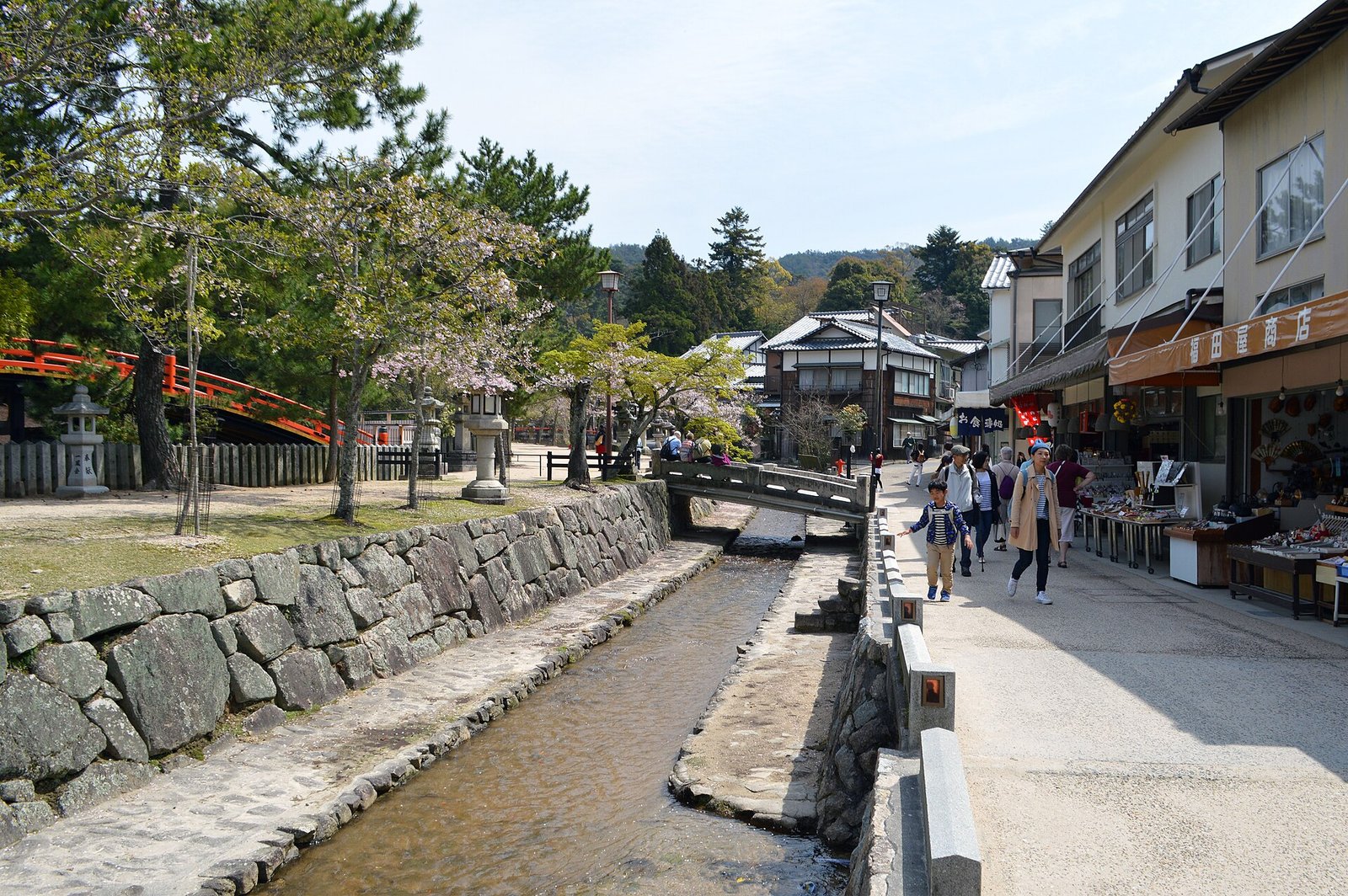
The case for. The day-trip crowd leaves on the late-afternoon ferries and the island empties. Itsukushima Shrine is illuminated from sunset until 23:00. The early morning, before the first mainland ferries arrive, is the other reward — the Omotesandō empty, the deer unbothered, the torii to yourself if the tide is right.
The case against. The ropeway shuts at 16:30, so Mount Misen is a daytime activity regardless. Most Omotesandō shops close in the late afternoon. Dinner outside your ryokan is thin, which is why almost every island property quotes rates with two meals included. And you are cut off from Hiroshima’s food scene on the evening you would otherwise be eating okonomiyaki.
What it costs. These are published rates from the Miyajima Ryokan Association’s own member list, quoted per person per night with two meals, before tax, checked 19 August 2026. They are asking rates rather than transaction prices, so expect weekends and peak season at the top of each band, and add the ¥200 prefectural tax.
| Band | Example properties | Published rate, pp, two meals |
|---|---|---|
| Budget | Miyajima Guesthouse Mikuniya | from ¥8,000 |
| Sakuraya (room only) | ¥6,000–¥10,500 | |
| Kokumin Shukusha Morinoyado | ¥9,000–¥30,000 | |
| Mid | Hotel Makoto | ¥10,000–¥28,000 |
| Yamaichi Bekkan | ¥15,000–¥21,819 | |
| Upper | Hotel Miyajima Bessō | ¥21,000–¥42,000 |
| Iwasō | ¥29,000–¥71,000 | |
| Kinsuikan | ¥32,000–¥80,000 | |
| Itsukushima Iroha | ¥35,750–¥71,500 |
Our verdict: one night, not two, and only if the after-hours island is what you want rather than a base. The efficient pattern for a two-day trip is both nights in central Hiroshima. The atmospheric pattern is one night in the city, one on the island. Both are defensible; the island is not a saving.
Note also that the ¥100 Miyajima visitor tax is charged per visit on the island-bound leg, so staying overnight and returning the next day costs you it once, not twice.
Miyajimaguchi, the mainland ferry terminal
The compromise. Cheaper than the island, first-ferry access, and home to Anagomeshi Ueno, the century-old originator of the local eel-over-rice dish, which does not take table reservations and has a long queue.
Choose it if you want to be on the first boat and the island rates put you off.
Against it: it is a small strip with little else, and you are 26 minutes from Hiroshima by JR or forty by tram. As a base for anything other than Miyajima, it does not work.
How the transport shapes the decision
The reason neighbourhood choice matters less here than in Tokyo or Kyoto is the fare structure. Hiroden trams have charged a flat ¥240 adult and ¥120 child across the entire network since 1 February 2025 — including the Miyajima Line. Hiroshima Station all the way to Hiroden Miyajimaguchi is ¥240. You board through any door and pay on exit.
So the cost of being in the “wrong” neighbourhood is ¥240 and ten minutes, which is not much. What you cannot buy back with ¥240 is being at the museum at 7:30 without setting an alarm, or being on Miyajima after the last day-tripper has left.
On your Miyajima day, buy the ¥1,000 Hiroden tram-and-ferry pass. Tram out ¥240, ferry ¥200, visitor tax ¥100, ferry back ¥200, tram back ¥240 comes to ¥980 on its own. The pass covers all of it, wins the moment you make one extra hop, and cuts the Misen ropeway return from ¥2,000 to ¥1,500. The ¥700 tram-only pass is not worth it — at a flat ¥240 you need three rides to break even and most visitors walk between the park, Hondōri and the castle.
When rooms are hardest to get
Three periods, and they are not the ones people expect.
6 August. The anniversary of the bombing. City hotels sell out and, anecdotally, rates rise sharply — we found no credible published data on how much, and we are not going to invent a percentage. It also falls in the run-up to Obon. If you intend to be in Hiroshima on 6 August, book months out.
The second half of November. Momijidani Park’s maples on Miyajima peak from mid to late November, and the ropeway sits at the bottom of the valley, so the colour and the ropeway coincide. This is the island’s heaviest crowding of the year, and it spills onto the mainland.
Golden Week and Obon. The Peace Memorial Museum itself names Golden Week as a congestion peak. Obon in mid-August is the other, and the Mazda Museum shuts for it — 8 to 17 August 2026.
Conversely, January to March is quiet, cheap and the heart of the oyster season, with the caveat that the Miyajima ropeway took a full closure from 16 January to 6 March 2026 and that pattern recurs.
What to look for when you book
Check whether the accommodation tax is included. Most online rates do not include it. Two hundred yen per person per night on rooms of ¥6,000 or more.
Check the tram stop, not the walking distance. A hotel listed as “15 minutes from the Peace Park” is fine if it is 30 seconds from a Line 2 or Line 6 stop and awkward if it is not.
If the museum’s 7:30 slot is your plan, check your breakfast time. Japanese business hotels typically start breakfast at 6:30 or 7:00, which works — but some start at 7:00 and you will be choosing between them.
On Miyajima, check the meal arrangement. Almost all island rates include dinner and breakfast, at fixed times, and that is the point rather than a restriction. If you would rather eat out, the island is the wrong choice.
For families: junior high and below enter the Peace Memorial Museum free, elementary, junior high and high school students enter Shukkeien free, and Japanese business hotels are unusually good at small twin rooms. The island ryokan are less flexible on room configuration.
Common questions
Where should I stay for one night? Hondōri, Kamiyachō or Hatchōbori. Central, on every tram line, walking distance to the park, and dinner on your doorstep.
Where should I stay for two nights? The same, both nights — that is the efficient answer. The atmospheric answer is one night central and one on Miyajima. Neither is wrong.
Is it cheaper to stay on Miyajima? No. Island ryokan publish rates from about ¥8,000 to ¥80,000 per person per night with two meals. You are paying for the empty evening and morning, not saving on anything.
Is Miyajimaguchi a good base? Only if your priority is the first ferry. It is 26 minutes from Hiroshima by JR and there is little there beyond the ferry terminal and one very good eel restaurant.
Does the Japan Rail Pass affect where I should stay? Slightly. The pass covers JR trains and the JR West ferry to Miyajima, so a station-side base plus the JR Sanyō Line to Miyajimaguchi is 26 minutes and free to you. It does not cover the ¥100 visitor tax, and it does not cover the trams.
How far ahead should I book? Six weeks is comfortable most of the year. For 6 August, the second half of November, Golden Week or Obon, book months ahead.
Is Hiroshima a good base for western Japan? For Onomichi, Iwakuni and the Shimanami Kaidō, yes — all are day trips. For a broader western-Japan tour, JR West’s Okayama–Hiroshima–Yamaguchi Area Pass from ¥15,000 for five days is worth pricing against the nationwide JR Pass, which rises to ¥53,000 for seven days on 1 October 2026.
Before you book
Decide first whether you want a night on Miyajima, because it is the only decision here that changes the shape of the trip — everything else is ¥240 and ten minutes on a tram. Check the accommodation tax is budgeted. And if Hiroshima is one leg of a longer trip, compare fares and check the regional rail pass against the nationwide one before booking anything. If you are arriving early and cannot check in until three, Radical Storage has drop points near the station and the centre — the museum’s 7:30 slot is much better with your hands free.
What the accommodation types actually mean
English booking sites flatten several quite different things into the word “hotel”, and in Hiroshima you will meet at least four of them.
Business hotels are the backbone of the city and of the station area. Small, efficient rooms — often 12 to 16 square metres — with a unit bathroom, a desk, good soundproofing and a breakfast buffet from around 6:30. They are not glamorous and they are not trying to be. For a two-night stay built around a museum and an island, they are close to ideal, and they are where the value is.
City hotels are the larger, full-service properties, mostly near the station and along Peace Boulevard, with restaurants, larger rooms and a concierge. Worth the premium if you want space or are travelling with children who need a twin plus a sofa bed.
Ryokan are the traditional inns, and on Miyajima they are the dominant form. Tatami rooms, futon laid out while you are at dinner, *yukata* provided, and — this is the part that matters — dinner and breakfast included at fixed times, usually a multi-course kaiseki. You are booking an evening, not just a bed. Arrive by the stated check-in time, which is often earlier than a hotel’s, and do not plan to eat out.
Minpaku are licensed private lodgings under the Residential Lodging Business Act. They are legal, they are covered by the accommodation tax like everything else, and they are worth checking for family-sized space. Verify the licence number is displayed, which legitimate operators do as a matter of course.
One practical note that applies across all four: Japanese check-in is typically 15:00 and check-out 10:00 or 11:00, both earlier and stricter than European norms. Luggage can normally be left at the desk on either side of that, and if you are arriving on the shinkansen at nine in the morning with two days to fill, that is worth confirming when you book rather than discovering at the desk.