
In short
Getting to Hiroshima, with the fares as displayed in August 2026: Tokyo 3 h 50 by Nozomi, ¥18,380 non-reserved; Kyoto 1 h 36, ¥10,770; Shin-Osaka 1 h 20 by Mizuho, ¥9,890. The rule that bites here is that the Japan Rail Pass is not valid on Nozomi or Mizuho — the two fastest services on this exact route — so a pass holder takes a slower train or pays separately.
Fares checked on operator sources, August 2026.
Disclosure: some links in this guide are affiliate links. If you book through one, we earn a small commission and you pay exactly the same price. We only link to services we would use ourselves, no brand pays for placement or for a favourable write-up, and every price in this article was researched independently.
Almost everything written in English about Hiroshima and Miyajima is out of date, and not in small ways. Hiroshima Castle’s keep closed permanently in March 2026 and guides still tell you to pay to climb it. The trams went to a flat fare in February 2025 and guides still quote distance-based ones. There is a ¥100 tax to set foot on Miyajima that has existed since October 2023 and that the Japan Rail Pass does not cover, and most English guides do not mention it at all. The Peace Memorial Museum opens at 7:30, not 8:30 — but that slot is web-ticket-only, so turning up gets you nowhere.
What is in this guide
- Getting there
- Getting around: the flat fare nobody has updated
- The Peace Memorial Park and Museum
- 6 August
- Miyajima
- The tide, which decides what your Miyajima day looks like
- Mount Misen
- The deer are not Nara’s deer
- What else is worth your time in the city
- What to eat
- When to go
- Where to stay, and the tax that surprises people
- A two-day plan that works
- Common questions
- Before you book
This guide was rebuilt from official Japanese-language sources in August 2026: the museum’s own booking system, Hatsukaichi City’s tax page, Hiroden’s fare notice, Hiroshima Prefecture’s accommodation tax page, the Miyajima Tourist Association’s tide tables, and the Japan Meteorological Agency’s climate normals. Where we could not verify something — Itsukushima Shrine’s opening hours, which the shrine’s own site blocks automated access to — we say so instead of copying a figure from another blog.
Two days is the right length: one for the city, one for the island. This page covers both, plus what it costs, when to go, and the fourteen things older guides get wrong.
Editor’s note
One note on tone before the practicalities. The Peace Memorial Museum and the park around it are a memorial to the people killed by the atomic bombing of 6 August 1945, and roughly half of this guide is logistics about visiting them. We have tried to keep the logistics useful and the framing plain. The museum permits non-flash personal photography and prohibits tripods and lighting during opening hours; it asks that nothing you do interferes with anyone else being there. That is the right standard, and it is not a photo opportunity.
Getting there
By shinkansen, which is how most visitors arrive. Hiroshima is a major stop served by Nozomi, Mizuho, Sakura, Hikari and Kodama, so the choice of train is about your rail pass, not about access.
| From | Fastest | Non-reserved | Reserved |
|---|---|---|---|
| Tokyo | 3 h 50 (Nozomi) | ¥18,380 | ¥19,760 |
| Kyoto | 1 h 36 (Nozomi) | ¥10,770 | ¥11,940 |
| Shin-Osaka | 1 h 20 (Mizuho) | ¥9,890 | ¥10,950 |
Fares as displayed in August 2026.
The Japan Rail Pass, and two rules that bite here. The pass is not valid on Nozomi or Mizuho without a supplement, so pass holders take Sakura or Hikari — on Shin-Osaka–Hiroshima that costs only a few minutes. And the nationwide pass rises on 1 October 2026: the 7-day ordinary goes from ¥50,000 to ¥53,000, 14-day from ¥80,000 to ¥84,000, 21-day from ¥100,000 to ¥105,000. Any guide quoting ¥50,000 for travel after that date is wrong.
Is the pass worth buying for Hiroshima? On its own, no. A Tokyo–Hiroshima round trip reserved is about ¥39,520 against ¥53,000 for the pass. It only works if Hiroshima is one leg of a wider itinerary. JR West’s regional Okayama–Hiroshima–Yamaguchi Area Pass starts at ¥15,000 for five days and is the better buy for a western-Japan trip.
By air. Hiroshima Airport is not near the city — it is out towards Mihara, with no rail link. The limousine bus to Hiroshima Station takes about 50 minutes and costs ¥1,500 (child ¥750), running roughly 05:55 to 21:55. This is why most people take the train.
Getting around: the flat fare nobody has updated
Since 1 February 2025, Hiroden trams charge a flat ¥240 for adults and ¥120 for children across the entire network — and that includes the Miyajima Line. Before that, the Miyajima Line was zonal and stacked on top of the city fare. Hiroshima Station all the way to Hiroden Miyajimaguchi, a forty-minute run, is now ¥240. English guides still quote ¥270 or “about ¥280.”
Boarding changed too: you board through any door and pay on exit. Cash and paper day passes must exit past a staffed door; IC cards and MOBIRY DAYS can exit anywhere.
And since 3 August 2025, trams run into the second floor of the JR Hiroshima Station building — the first arrangement of its kind in Japan. Journey times into Hatchōbori and Kamiyachō fell by about four minutes. A further circular route opened on 28 March 2026. No English guide written before mid-2025 describes finding the tram at Hiroshima Station correctly.
The lines that matter: Line 2 runs Hiroshima Station to Hiroden Miyajimaguchi direct with no change, every 8 to 15 minutes from roughly 06:44 to 23:09. Lines 2 and 6 serve Genbaku Dome-mae for the Peace Park.
Tram or JR to the ferry?
| Fare | Time | |
|---|---|---|
| Hiroden Line 2 to Hiroden Miyajimaguchi | ¥240 | ~40 min |
| JR Sanyō Line to Miyajimaguchi Station | ¥420 | 26 min |
JR is faster and covered by a rail pass; the tram is cheaper and stops closer to the ferry berths.
The one pass worth buying. Hiroden’s ¥1,000 tram-and-ferry one-day pass (child ¥550) covers every tram line plus the Matsudai ferry to Miyajima and includes the ¥100 visitor tax. Do the arithmetic on a Miyajima day: tram out ¥240 + ferry ¥200 + tax ¥100 + ferry back ¥200 + tram back ¥240 = ¥980. The pass is ¥1,000, breaks even instantly, wins the moment you make one extra hop, and cuts the Misen ropeway round trip from ¥2,000 to ¥1,500.
The ¥700 tram-only pass is a different matter — at a flat ¥240 you need three rides to break even, and most visitors walk between the Peace Park, Hondōri and the castle. Skip it.
The Peace Memorial Park and Museum
Four things sit in and around the park and people routinely confuse which are ticketed. Only one is.
| Site | Cost |
|---|---|
| Peace Memorial Park | Free, open, no gates |
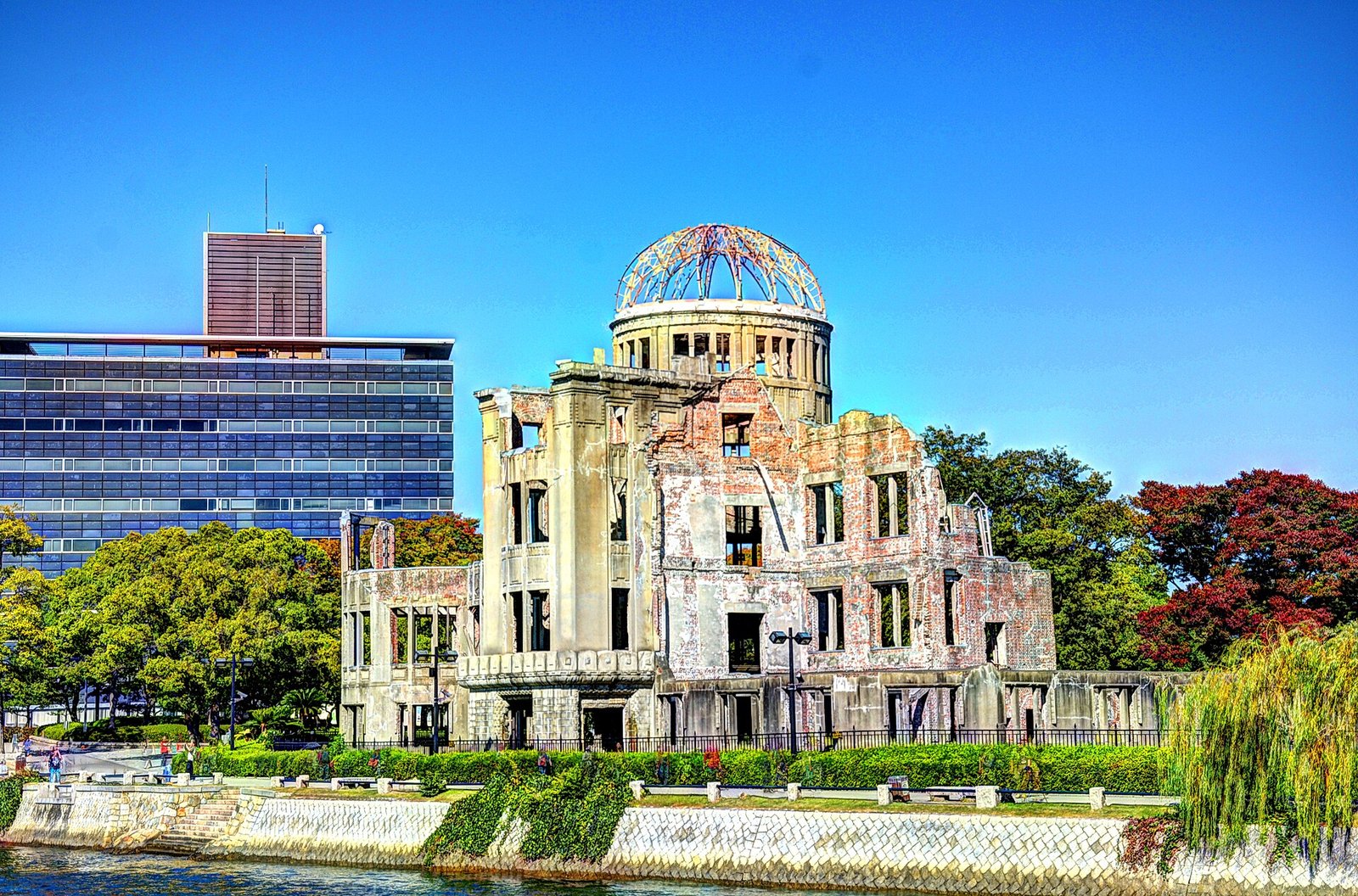
| A-Bomb Dome (Genbaku Dome) | Free, exterior only — you cannot go inside |
| Peace Memorial Museum | ¥200 adult, ¥100 high school, free below |
| National Peace Memorial Hall for the Atomic Bomb Victims | Free |
¥200. That is not a typo, and it is under public discussion following the surge in visitors after Nihon Hidankyo’s Nobel Peace Prize — a rise has been debated but not decided.
Opening hours, which most guides get wrong:
- March–July and September–November: 7:30–19:00
- August: 7:30–20:00, extended to 7:30–21:00 on 5 August. On 6 August itself the museum opens at 09:45 and closes at 21:00, last admission 20:30, because of the ceremony.
- December–February: 7:30–18:00
- Closed: 30–31 December, and for several days in mid-February each year for exhibition changes. The museum publishes only “mid-February” in advance, so check its notices before booking a February trip.
The booking system is the part that matters. The museum runs timed entry through a web ticket system, bookable from 90 days ahead. The 7:30–8:30 slot and the evening slots are reserved-only, capped at 300 people for the block as a whole, with no ticket-machine or counter sales at all during those windows (entry inside the block is issued in 30-minute increments). From 8:30 you still choose an entry time online but arrival is flexible. The museum’s own advice is to buy in advance and it warns that tickets can sell out before last entry.
Practically: book the 7:30 slot. It is the difference between walking through the exhibition and shuffling through it. Allow 90 minutes to two hours — the museum publishes no official figure, so that is our estimate rather than theirs.
The National Peace Memorial Hall next door is free and is not a museum. It holds the names, photographs and testimonies of the dead, and people sometimes wander in expecting exhibits. It opens 8:30–18:00 for most of the year, 8:30–17:00 from December to February, 8:30–19:00 through August, 8:30–20:00 on 5 August and 9:00–20:00 on 6 August.
6 August
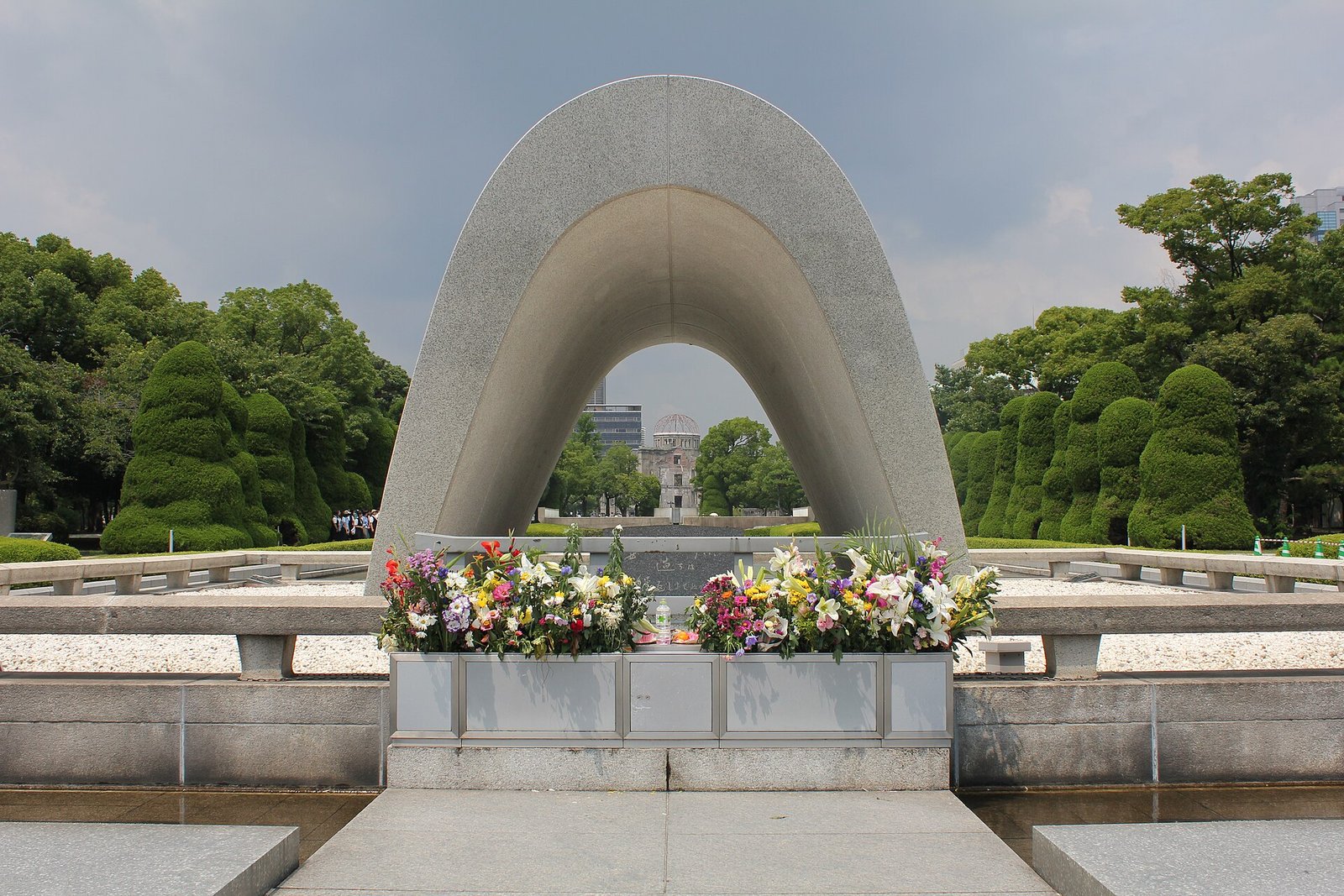
The Peace Memorial Ceremony runs from 08:00 to about 08:50 in the park, with a moment of silence at 08:15, the time of detonation. There are around 7,000 seats at the venue and 2,200 more indoors with a broadcast.
If you are in Hiroshima on that date, know what it involves. The park is under access control from 05:00 to 09:00 — the third consecutive year of park-wide restriction. Attendee entry begins at 06:00 with hand-luggage inspection and metal-detector screening. Flammables, blades, drones, amplifiers, instruments, placards, armbands and helmets are all prohibited, and disruptive conduct can get you removed. Traffic restrictions operate around the park and the city asks people to use public transport.
There is one route in for a visitor without a seat allocation: those wishing only to pay respects at the memorials between 05:00 and 07:00 may use a dedicated entrance without screening.
Whether to be there at all is a genuine question. It is the most significant day in the city’s calendar and the only day on which the park’s meaning is fully legible; the Tōrō Nagashi lantern floating on the Motoyasu River in the evening is what most visitors find affecting. But it is not a sightseeing day — the park is fenced and screened, the city averages 32.8 °C in August, and accommodation is at its tightest. If you go, dress soberly, arrive before 07:00, carry as little as possible through screening, and be silent at 08:15.
Miyajima
The visitor tax nobody tells you about. Since 1 October 2023, Hatsukaichi City levies a ¥100 per person per visit Miyajima Visitor Tax, or ¥500 for a year. It is collected with your ferry fare on the island-bound leg only. Exemptions cover residents, regular commuters and students, pre-school children, sanctioned school groups and disability certificate holders.
The Japan Rail Pass does not cover it. The official JR Pass site says so explicitly. The pass covers the JR West ferry crossing itself; the tax is extra, every time.
Ferries. Two operators share the terminal at Miyajimaguchi with identical fares and near-identical service: ¥200 one way, ¥400 return, about ten minutes, every fifteen minutes in the daytime and every ten on busy days. JR West’s ferry is covered by a rail pass; Matsudai’s is not — and Matsudai’s is the one included in the ¥1,000 Hiroden day pass. Fares rose from ¥180 on the same day the tax started, so a one-way crossing that guides still print as ¥180 is now ¥300 all-in.
The direct boat from the Peace Park. Aqua Net Hiroshima runs a high-speed service from Motoyasu Pier, 150 metres south of the A-Bomb Dome, straight to Miyajima in about 45 minutes: ¥2,400 one way, ¥4,400 return, 17 sailings a day each way, first out at 08:30 and last back at 17:30. The visitor tax is extra. Against roughly ¥640 for tram-plus-ferry, it is a real premium — but it buys you the Ōta River delta and an arrival by water, and it saves a transfer. Worth it one way, not both.
Itsukushima Shrine costs ¥300 for the shrine hall, ¥300 for the Treasure Hall, or ¥500 combined; Senjōkaku is ¥100. Those fees are from the Miyajima Tourist Association’s own price sheet. We could not verify the shrine’s opening hours — its official site blocks automated access and Hiroshima Prefecture’s tourism site declines to publish them, saying only that they vary by season. Check the shrine’s own site before you plan a late arrival.
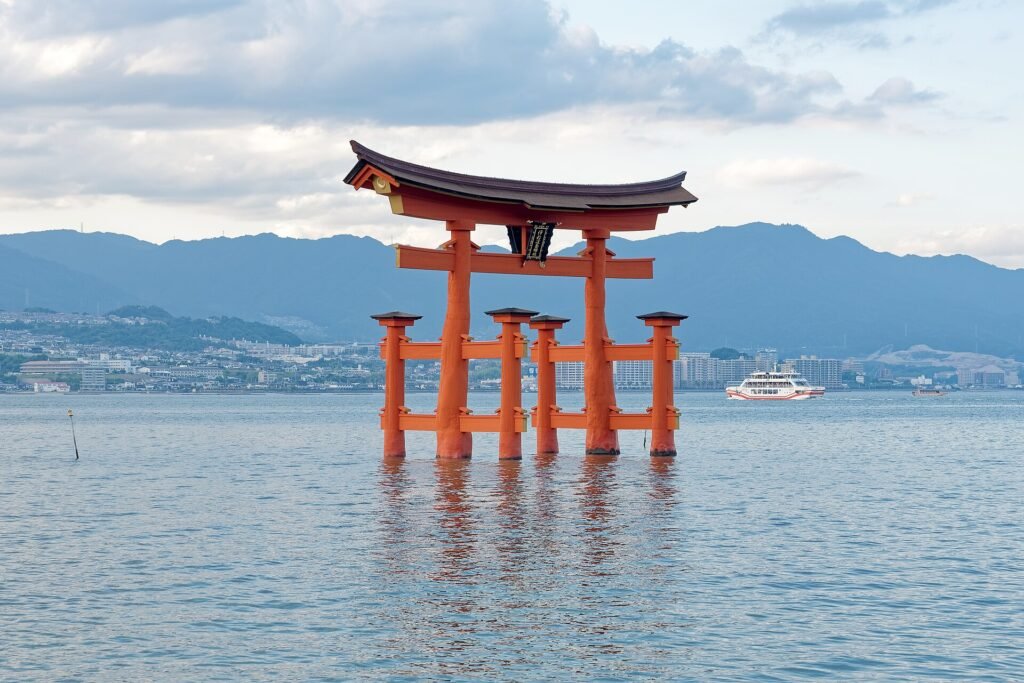
The torii is not under scaffolding. The Reiwa restoration — the first in roughly seventy years — finished on 18 December 2022, and the vermilion was fully renewed. Guides and stock photos still showing a shrouded gate are three and a half years behind.
The tide, which decides what your Miyajima day looks like
This is the single most useful thing on this page. The Miyajima Tourist Association publishes a full year of tide tables and, crucially, the two thresholds that matter:
- Tide 100 cm or below — you can walk out across the sand to the base of the great torii.
- Tide 250 cm or above — the shrine and the torii appear to float.
Arrive at 130 cm and you get neither. Miyajima’s tidal range is large enough that both often occur within a single visiting window, and the Association’s own advice — pick a date where both happen while you are there — is the right advice. If you must choose: high tide for the classic photograph, low tide for the walk-out and for seeing the barnacled base of a gate that is usually in the sea.
Check the table before you fix the date. It is the difference between the two photographs everyone has seen and neither of them.
Mount Misen
The ropeway costs ¥2,000 return for adults, ¥1,000 for children, or ¥1,100 one way. It runs up from 9:00 to 16:00 with the last descent at 16:30, and the ride takes about fourteen minutes across two linked lines. The ¥1,000 Hiroden day pass cuts the return to ¥1,500.
The ropeway does not reach the summit, and this catches people out. It terminates at Shishiiwa Station. From there it is roughly twenty minutes on foot to the Misen Hondō and Reikadō temple complex, and the actual summit at 535 m is beyond that. The Tourist Association’s own guidance is that adding the summit to a ropeway trip adds about an hour. It is a real walk on stone steps, not a stroll.
Walking up takes 1 h 30 to 2 hours on the Momijidani route, which is the standard beginner-friendly one; the Daishō-in route is a similar time, about 2.6 km, dominated by stone steps and with the best views; the Ōmoto route runs 2 to 2.5 hours through primeval forest and has the most junctions to get lost at.
Check for closures before you go. The ropeway took a full closure from 16 January to 6 March 2026 for its first gondola renewal in eighteen years, and another from 22 June to 16 July 2026 for inspection. That pattern — a long winter closure and a shorter early-summer one — recurs, and guides present the ropeway as year-round. It is also running special night operations from 19 to 23 October 2026 to mark the 30th anniversary of Itsukushima Shrine’s World Heritage inscription.
The deer are not Nara’s deer
Write this one down, because the two islands are routinely described as the same situation and they are not.
Hatsukaichi City manages the Miyajima deer under a formal protection and management plan, and its stated position is that they are wild animals, not pets or an attraction. Human feeding has driven population growth, damage to residents and visitors, and — the city’s own phrasing — harm to the deer through accumulated foreign objects in their stomachs. The goal is a coexistence in which people and deer keep a certain distance.
So there are no deer crackers on Miyajima. No licensed *shika senbei*, no equivalent product, and feeding is prohibited by the authority that manages them. The deer will take paper — maps, tickets, ferry stubs — straight out of your hand or bag, which is precisely the foreign-object problem the city cites. Keep paper and food in a closed bag, and do not pose food for photographs.
What else is worth your time in the city
Hiroshima Castle — the keep is closed. This is the most important 2026 correction we can give you. The main keep closed permanently to visitors on 22 March 2026, after about 68 years as a museum, because the 1958 reinforced-concrete reconstruction has deteriorated. You cannot go inside or up; there is no top-floor view. The exterior remains fully viewable, the restored Ninomaru buildings are still open and free (9:00–17:30 April–September, 9:00–16:30 October–March), and the city says the keep is not scheduled for demolition — it is at the basic-investigation stage on restoration options, so reports of demolition or a timber rebuild are premature. A new Ninomaru history museum is targeted for the end of FY2026.
What that means practically: the castle drops from a 60–90 minute stop to a 25-minute walk through free grounds. The moat, the reconstructed gate and yagura, and the surviving A-bombed eucalyptus and willow are still worth the detour if you are walking between the Peace Park and Shukkeien. It is no longer a headline attraction, and every guide telling you to pay to climb the keep is wrong.
Shukkeien is the best-value paid site in the city: ¥350 for adults, ¥150 for university students, free for elementary, junior high and high school students since April 2025. Open 9:00–18:00 from 16 March to 15 September and 9:00–17:00 the rest of the year, closed 29–31 December. It is a genuine 17th-century daimyo stroll garden, compact enough for 45 to 60 minutes, and it sits beside the Prefectural Art Museum. Best in late November for maples.
The Mazda Museum is free, runs 120-minute tours, and is online-booking-only — no telephone, no email. English tours run in the afternoon; mornings are in Japanese. Weekdays only. Watch the company shutdowns: 8–17 August 2026, which straddles Obon, then 26 December 2026 to 5 January 2027, and 8–26 February 2027. Book weeks ahead.
Onward: Onomichi for the Shimanami Kaidō cycling route — the city gives it as roughly 70 km, one to two days for most riders — the 70 m figure many guides quote is the bridges’ height above the sea, not the cumulative climb — is about 1 h 35 by JR local for ¥1,520. Iwakuni’s Kintaikyō bridge is about 40 minutes away; the bridge toll is ¥310, or ¥970 combined with the ropeway and castle.
What to eat
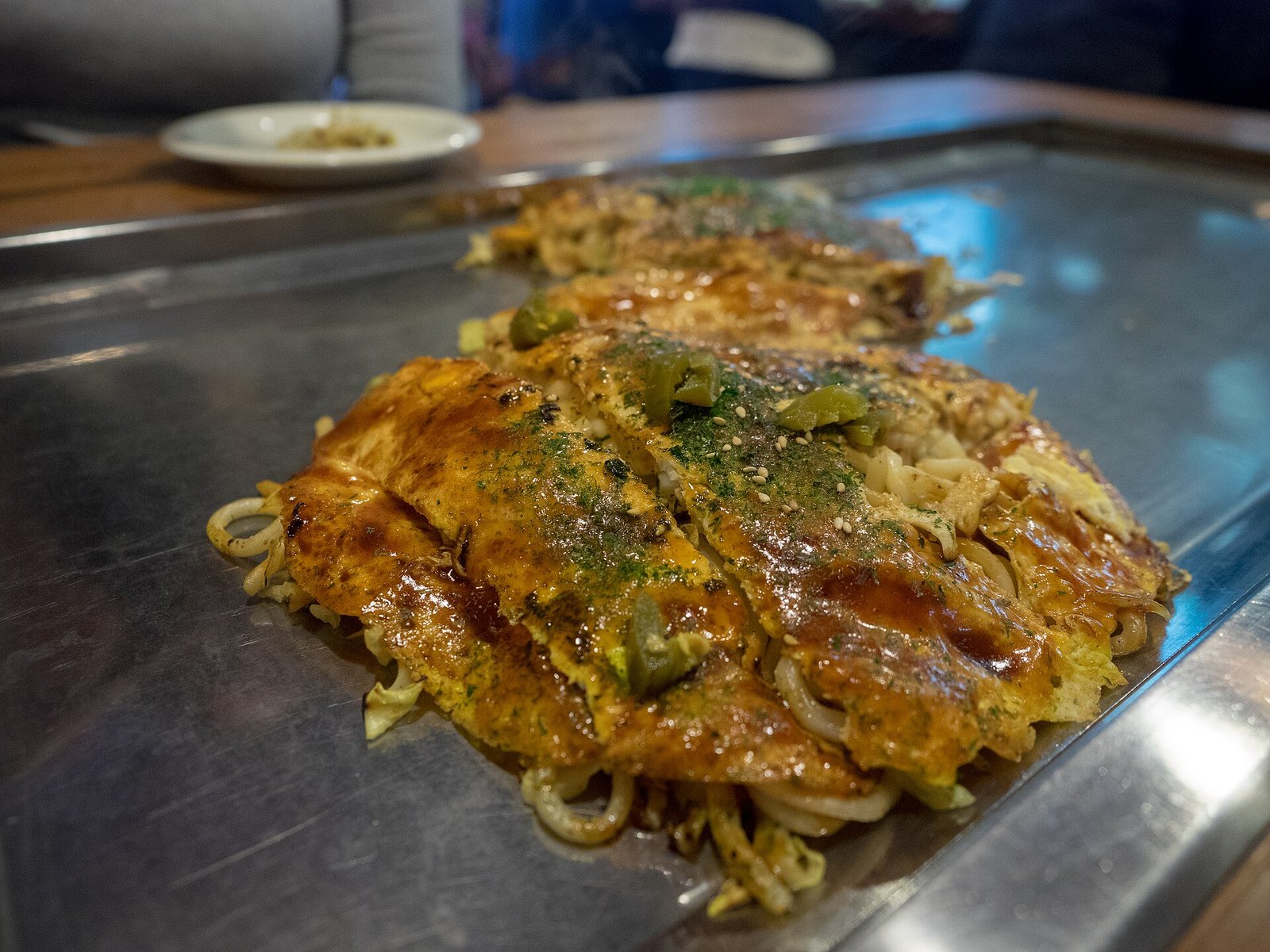
Okonomiyaki, and the difference is structural. Osaka’s is mixed in a bowl and poured onto the griddle as one batter-bound disc. Hiroshima’s is layered, not mixed: a thin crêpe of batter, then a mound of shredded cabbage, bean sprouts and pork belly, more batter, then the whole thing flipped and set on a separately griddled nest of fried noodles, with an egg. It comes out taller, steam-cooked inside rather than batter-heavy, and you eat it off the griddle with a metal spatula.
Two things locals will appreciate you knowing: they call it simply *okonomiyaki*, and 「広島焼き」 — “Hiroshima-yaki” — is a term used elsewhere and is mildly resented here. Noodles are standard, not an extra.
Okonomimura, the multi-floor building of stalls in Shintenchi, is the famous recommendation and also the most touristed. Mitchan Sōhonten carries the founding-family lineage and has branches including Hatchōbori and one inside ekie at Hiroshima Station. Hassho in Yokogawa has its own following. Kamiyachō and Hondōri are dense with independent counters that are as good.
Prices, from Mitchan Hatchōbori’s menu as published: the standard soba-with-meat-and-egg is ¥960; oyster version ¥1,840; deluxe ¥2,030. Budget ¥900–¥1,300 at a well-known city-centre shop, less at a neighbourhood counter.
Oysters. Hiroshima produced, in 2023, 62.9 per cent of Japan’s total oyster output. The eating season runs roughly October to March and the local material treats midwinter as the best of it, after glycogen has accumulated through the autumn cooling. Grilled oysters at the stalls along Miyajima’s Omotesandō are the classic; *kaki-goya* oyster huts operate around the prefecture in winter. Note that oysters served on Miyajima in high summer are outside the local season.
Anago meshi, grilled saltwater eel over rice, is the Miyajima dish — distinct from the freshwater *unagi* served nationally, and originally a Miyajimaguchi railway bento. Anagomeshi Ueno at Miyajimaguchi is the century-old originator: ¥2,530 small, ¥2,800 regular, ¥3,340 large. It does not take table reservations and the queue is long; its boxed bento is sold separately and can be eaten on the ferry.
When to go
Japan Meteorological Agency normals for Hiroshima, 1991–2020:
| Month | Mean max °C | Rain mm |
|---|---|---|
| January | 9.9 | 46.2 |
| February | 10.9 | 64.0 |
| March | 14.5 | 118.3 |
| April | 19.8 | 141.0 |
| May | 24.4 | 169.8 |
| June | 27.2 | 226.5 |
| July | 30.9 | 279.8 |
| August | 32.8 | 131.4 |
| September | 29.1 | 162.7 |
| October | 23.7 | 109.2 |
| November | 17.7 | 69.3 |
| December | 12.1 | 54.0 |
November is the best single month: 17.7 °C, only 69.3 mm of rain, and Miyajima’s maples in Momijidani at peak in the second half. Expect the island’s heaviest crowds of the year with it. Late March and April are the other window — the JMA’s normal flowering date for Hiroshima is 25 March with full bloom on 3 April, though four of the last six years flowered earlier, so target 28 March to 6 April for 2027 planning.
Avoid June and July, the *tsuyu* rainy season, at 226.5 and 279.8 mm — July is the wettest month and also hot. August is the hottest by a clear margin at 32.8 °C with high humidity, and August and September are peak typhoon-landfall months. Also avoid Golden Week, which the museum itself names as a congestion peak, and Obon in mid-August.
Where to stay, and the tax that surprises people
Hiroshima Prefecture introduced an accommodation tax on 1 April 2026: ¥200 per person per night on rooms of ¥6,000 or more (excluding meals and consumption tax), nothing below that. It applies across the whole prefecture including Hiroshima city, Hatsukaichi and Miyajima, and it covers hotels, ryokan, simple lodgings and *minpaku*. It is collected by the operator at check-in or check-out and is often not included in the rate you booked online. School trips are exempt with documentation. It is small money and it is four months old, and almost no English guide mentions it.
Where to base yourself. Hondōri, Kamiyachō and Hatchōbori is the best default for most two-night visits: covered arcades, the greatest density of okonomiyaki and izakaya, about ten minutes’ walk to the Peace Park, and every tram line. Near Hiroshima Station is best if you are moving on by shinkansen or doing day trips, and it is better connected than pre-2025 guides suggest now that trams run into the station building. Near the Peace Park suits anyone who wants the 7:30 museum slot and the park at dawn, and it is the base for the Motoyasu Pier boat.
Miyajima itself is worth one night for one specific reason: the day-trip crowd leaves on the late-afternoon ferries and the island empties, the shrine is illuminated until 23:00, and the early morning before the first mainland ferry is the other reward. Against it: the ropeway shuts at 16:30, the Omotesandō shops close in the late afternoon, and dinner outside your ryokan is thin. The island’s ryokan publish rates from about ¥8,000 to ¥80,000 per person per night with two meals, before tax, through their trade association — so it is a premium, not a saving.
A two-day plan that works
Day 1 — the city. Museum at 7:30 on a pre-booked web ticket, then the park, the Cenotaph and the Dome on foot, then the National Peace Memorial Hall, which is free and takes half an hour. Lunch in Hondōri. Shukkeien in the afternoon, ¥350, forty-five minutes, with the castle grounds on the walk between if you want them. Okonomiyaki in the evening.
Day 2 — Miyajima. Buy the ¥1,000 Hiroden day pass. Tram out on Line 2, ferry across, and time your day against the tide table. Shrine, Omotesandō and grilled oysters, ropeway up Misen with the pass discount, and the twenty-minute walk on to the temple complex if the legs are willing. Back on an evening ferry — or stay, and have the island to yourself after five.
If you have a third day: Onomichi and the Shimanami Kaidō, or Iwakuni’s Kintaikyō.
Common questions
How long do I need in Hiroshima? Two days: one for the city, one for the island. One day is possible and means choosing between them, which is a bad choice to have to make. Three lets you add Onomichi or Iwakuni.
Do I have to book the museum in advance? For the 7:30–8:30 slot and the evening slots, yes — those are web-ticket-only and there are no on-site sales during them, capped at 300 people for the block as a whole. From 8:30 you can buy on site, but the museum recommends booking and warns that tickets sell out.
Does the Japan Rail Pass cover Miyajima? It covers the JR West ferry crossing. It does not cover the Matsudai ferry and it does not cover the ¥100 visitor tax, which you pay every time you go to the island.
Is Hiroshima Castle worth visiting? As a 25-minute walk through free grounds, yes, if you are passing between the Peace Park and Shukkeien. As a paid attraction, it no longer exists — the keep closed permanently on 22 March 2026.
When can I walk out to the torii? When the tide is 100 cm or below. Check the Miyajima Tourist Association’s published tide table for your date before you commit to it.
Can I feed the deer on Miyajima? No. There are no deer crackers and Hatsukaichi City prohibits feeding, on the grounds that it harms the deer. This is genuinely different from Nara.
Is Hiroshima suitable for children? The city is; the museum requires a judgement call. Junior high and below enter free, and the exhibition is unflinching about what happened to civilians including children. Parents who have been generally suggest preparing children beforehand rather than deciding at the door.
What is closed when? The museum: 30–31 December and several days in mid-February, announced only shortly in advance. Shukkeien: 29–31 December. Mazda Museum: 8–17 August 2026, 26 December 2026 to 5 January 2027, 8–26 February 2027. Hiroshima Castle’s Ninomaru: 8 December and 29–31 December.
Are there fireworks on Miyajima in August? No, and this is one guides get repeatedly wrong. The historic underwater fireworks festival was permanently discontinued in April 2021; a differently named, ticketed revival was held once, in October 2025, for the 80th anniversary. It is not running in 2026.
Before you book
Do three things in this order. Check the tide table for your Miyajima day and, if you can, move the date to catch both thresholds. Book the museum’s 7:30 slot as soon as the 90-day window opens. And if you are travelling after 1 October 2026, price the JR Pass at its new rate rather than the old one — and check whether a regional pass beats it, because for a Hiroshima-focused trip it usually does.
Practical odds and ends: Hiroshima Station’s coin lockers fill on weekends and in November, so if you are day-tripping with luggage, Radical Storage has staffed drop points near the station and the centre. If Hiroshima is one leg of a longer Japan trip, compare fares into the nearest airports before assuming the shinkansen is the only sensible way in — from Tokyo it usually is, from further afield it often is not. And if you want the museum and the park explained without joining a group, WeGoTrip’s self-guided audio walks cover the Peace Park.