
Quick answer: US, UK, and EU citizens get the same standard 90-day visa-free allowance (within a rolling 180-day period) in Serbia, Montenegro, and Bosnia and Herzegovina — no bilateral exceptions here like Albania’s 365-day US deal. Currency is where the three genuinely differ: Serbia uses a floating dinar, Montenegro uses the euro unilaterally (full adoption, no peg math needed), and Bosnia uses a convertible mark fixed by law to the euro at 1 EUR = 1.95583 BAM. One piece of real, dated news: Montenegro requires visas from Russia, Türkiye, China, Belarus, and Saudi Arabia starting 1 November 2026 — irrelevant for most readers of this guide, but a genuine first for the country.
Contents
Visa-Free Stay: Side-by-Side
| Nationality | Serbia | Montenegro | Bosnia and Herzegovina |
|---|---|---|---|
| US citizens | 90 days / 180-day period | 90 days / 180-day period | 90 days / 180-day period |
| UK citizens | 90 days / 180-day period | 90 days / 180-day period | 90 days / 180-day period |
| EU/Schengen citizens | 90 days / 180-day period | 90 days / 180-day period | 90 days / 180-day period |
| Russia, Türkiye, China, Belarus, Saudi Arabia | Varies by country | Visa required from 1 Nov 2026 (previously visa-free or limited) | Varies by country |
Unlike Albania’s standout 365-day deal for US citizens in our Albania-North Macedonia-Kosovo cluster, none of these three countries offer an extended allowance for any single nationality — it’s the flat 90/180 rule across the board for Western travelers. As always, the 90 days count within a rolling 180-day window, not per visit, so you can’t reset the clock with a quick border run.
Montenegro’s November 2026 Change
Montenegro ended visa-free entry for Russia, Türkiye, China, Belarus, and Saudi Arabia as of 1 November 2026, under a decree adopted 23 July 2026 as part of EU accession alignment. It’s genuinely significant news for the affected nationalities and a real marker of Montenegro’s accession progress, but it changes nothing for US, UK, or EU travelers — the full breakdown, including a 30-day exemption that still applies to holders of certain other countries’ visas, is in our dedicated Montenegro visa and entry rules guide.
Currency: Three Different Approaches
| Country | Currency | Relationship to euro |
|---|---|---|
| Serbia | Serbian dinar (RSD) | Floating exchange rate; euros only informally accepted in places |
| Montenegro | Euro (EUR) | Unilaterally adopted in 2002; no exchange math at all |
| Bosnia and Herzegovina | Convertible mark (BAM) | Fixed by law at 1 EUR = 1.95583 BAM since 1997, under a currency board |
None of the three currencies are interchangeable with each other — dinars, euros, and convertible marks each only work in their own country, so don’t expect to spend leftover Serbian dinars in Sarajevo or Bosnian marks in Kotor.
Three Countries, Three Relationships With the Euro
This cluster is a genuinely good illustration of the different ways a country can relate to the euro without being in the eurozone. Montenegro adopted the euro outright and unilaterally — the same approach Kosovo uses — meaning it has zero say over eurozone monetary policy but also zero exchange-rate complexity for visitors. Bosnia keeps its own currency but pegs it by law to the euro at a fixed, unchanged-since-1997 rate under a currency board, giving predictability without full adoption. Serbia keeps a genuinely independent, floating currency with its own central bank setting policy — the dinar can and does move against the euro, unlike either of its neighbors in this cluster. None of these approaches is objectively better for a traveler; they just require slightly different mental math, and Serbia is the only one where you’ll notice the exchange rate actually moving if you check it at different points in your trip.
FAQ
Does Montenegro’s 2026 visa change affect US, UK, or EU travelers?
No — it only affects citizens of Russia, Türkiye, China, Belarus, and Saudi Arabia; Western travelers keep the standard 90-day allowance.
Which of these three currencies is easiest to deal with?
The euro in Montenegro, simply because there’s no conversion to think about at all; Bosnia’s fixed peg is nearly as easy once you know the 1.95583 ratio.
Can I use euros directly in Serbia?
Only informally in some contexts (border areas, some accommodation); for everyday spending, plan on dinars.
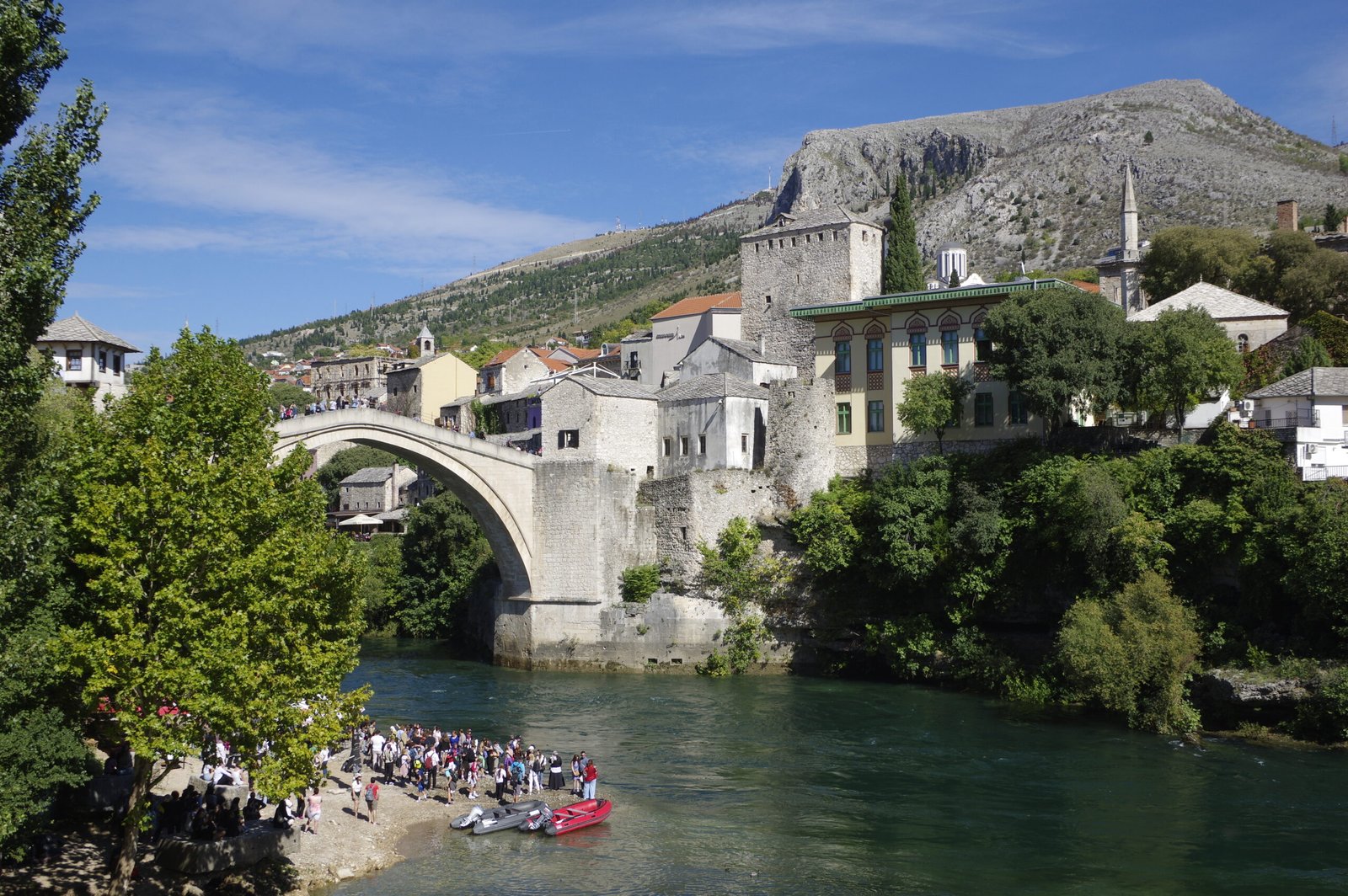
Photo: Berthold Werner, CC BY-SA 4.0, via Wikimedia Commons — Stari Most, the Old Bridge in Mostar.