
Quick answer: US, UK, EU, Canadian, and most Western passport holders can enter Bosnia and Herzegovina visa-free for up to 90 days within a rolling 180-day period — you can’t simply leave and re-enter to reset the clock. The currency is the convertible mark (BAM), fixed by law at 1 EUR = 1.95583 BAM since 1997. Bosnia’s eVisa system is aimed at nationalities that already need a visa and doesn’t affect standard Western visitors.
Contents
The 90/180 Rule
US citizens — and the allowance is the same for UK, EU, Canadian, and Australian passport holders — get up to 90 days visa-free in Bosnia and Herzegovina, counted within a rolling 180-day period rather than resetting with each visit. In practice: if you’ve already spent 90 days in Bosnia within the past 180 days, you generally can’t re-enter and start a fresh 90-day count just by leaving briefly and coming back. This is the same standard allowance used across most of the Western Balkans — Serbia, Montenegro, North Macedonia, and Kosovo all use an equivalent 90/180 structure, though Albania’s bilateral 365-day deal for US citizens is the one real exception in the region.
The eVisa System
Bosnia has introduced an eVisa system, but it’s described as early-stage and aimed specifically at nationalities that already require a visa to enter — it isn’t a new requirement layered on top of the existing visa-free allowance for US, UK, or EU travelers. If you’re from a country that already needs a visa for Bosnia, eVisa and visa-on-arrival eligibility can change with little notice, so check with the Ministry of Foreign Affairs of Bosnia and Herzegovina directly before booking rather than relying on a general travel guide’s summary.
The Currency Peg, in Detail
The convertible mark’s peg to the euro — 1 EUR = 1.95583 BAM — has held since the currency board arrangement was established by law in 1997, the same year the Central Bank of Bosnia and Herzegovina was created. It’s never been adjusted, which is unusually stable even by the standards of pegged currencies, and it means currency risk isn’t a practical concern for a short trip the way it might be in a country with a floating or recently-volatile currency. For quick mental math: roughly halve a BAM price to estimate euros, or roughly double a euro price to estimate BAM.
Entry Requirements and Documents
Beyond the visa-free allowance itself, standard entry requirements apply: a passport valid well beyond your planned departure date, and — as with most of this region — be ready to show proof of accommodation or onward travel if a border official asks, even though this is rarely actually requested for typical tourist entries. There’s no formal registration requirement that tourists typically need to handle themselves; hotels generally take care of any required guest registration automatically.
FAQ
Can I reset my 90-day allowance by leaving Bosnia for a day?
No — the 90 days are tracked within a rolling 180-day window, not per visit, so a quick border run doesn’t reset the count.
Do I need an eVisa if I’m a US, UK, or EU citizen?
No — the eVisa system targets nationalities that already required a visa before its introduction; standard Western passport holders remain simply visa-free for 90 days.
Is the convertible mark likely to change or devalue?
Its peg to the euro has held unchanged since 1997 under a currency board arrangement, making it one of the more stable currencies in the region for the purposes of a short trip.
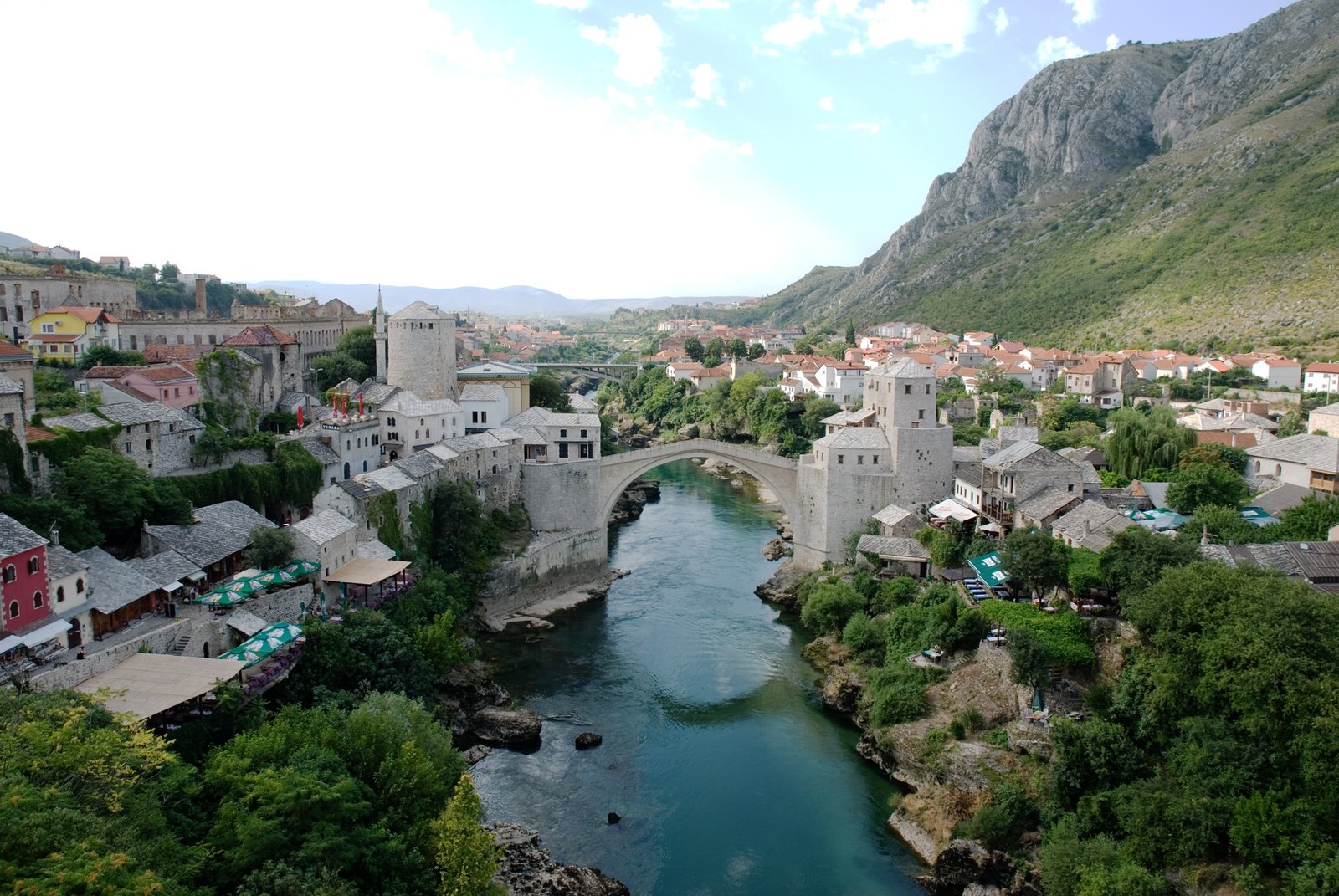
Photo: Ramirez HUN, CC BY-SA 3.0, via Wikimedia Commons — Stari Most, the Old Bridge in Mostar.