
In short
US citizens have been visa-free for 30 days since 1 January 2026; UK, Canadian, Australian, Irish and EU citizens already were. You still must register within three working days of arrival. Uzbekistan is a cash economy — bring dollars. And book Afrosiyob trains the moment the 60-day window opens at 06:00 Tashkent time: seats sell out within hours and the classic route does not work without them.
All figures checked 26 August 2026 against Uzbek government sources, the Central Bank, UNESCO, and the UK, US and Canadian travel advisories.
On this page
- What changed in 2026
- Visas
- Registration is separate, and it still applies
- Money: bring cash, and bring dollars
- When to go
- Getting around, and the one booking rule that matters
- Connectivity
- Safety, and two rules that catch people out
- What it costs
- A ten-day route
- One thing worth knowing before you look at the monuments
- What we could not verify
Uzbekistan received more than 10.7 million foreign visitors in the first eleven months of 2025 — thirteen per cent up on 2024 and seventy-three per cent up on 2019, putting it among the fastest-growing destinations in the world. Three things changed in the twelve months to August 2026 that make it markedly easier to visit than it was, and one of them applies specifically to Americans.
This is the practical guide. Everything is dated and sourced, and where we could not confirm something we say so rather than filling the gap.
What changed in 2026
United States citizens no longer need a visa. Presidential Decree No. 203, signed on 3 November 2025, took effect on 1 January 2026 and grants US passport holders visa-free entry for up to 30 days. Before that, only Americans under 16 or over 55 qualified. Note that the Uzbek embassy website in Washington had still not been updated to reflect this when we checked — do not use it as your source.
Khiva is now seven and a half hours from Tashkent instead of fourteen. A new South Korean-built high-speed train, the Jaloliddin Manguberdi, began running in early May 2026 on the Tashkent–Samarkand–Bukhara–Urgench–Khiva route.
Tashkent became a World Heritage city. In July 2026 UNESCO inscribed Tashkent Modernist Architecture — ten Soviet-era buildings including Chorsu Market and Kosmonavtlar metro station. Tashkent has spent decades being treated as a one-night transit stop. That is now a harder argument to make.
Visas
| Nationality | Status | Length |
|---|---|---|
| United States | Visa-free since 1 January 2026 | 30 days |
| United Kingdom | Visa-free | 30 days |
| Canada | Visa-free | 30 days |
| Australia | Visa-free | 30 days |
| Ireland and EU states | Visa-free | 30 days |
If your nationality is not covered, or you need longer or multiple entries, the official portal is e-visa.gov.uz. Fees are US$20 single entry, US$35 double entry and US$50 multiple entry, all for stays up to 30 days, processed within about three business days and valid 90 days from issue.
On passport validity the official sources disagree — the UK says three months beyond arrival, Canada says six. Use six and you cannot be wrong.
Registration is separate, and it still applies
Visa-free entry does not exempt you from Uzbekistan’s guest registration rule, and this is where people come unstuck. You must be registered within three working days of arrival. Hotels do it automatically; if you stay in a private home you register through the Emehmon system yourself.
The rule is widely misreported, including by several Western foreign ministries. We went through the statute line by line in our guide to Uzbekistan’s registration rules — including who is exempt, what the fines actually are, and which governments get it wrong.
Keep every hotel registration slip. They are checked on departure.
Money: bring cash, and bring dollars
Uzbekistan is still overwhelmingly a cash economy. As of 25 August 2026 the Central Bank rate was 11,818 som to the US dollar, 16,119 to the pound and 13,788 to the euro.
Foreign Visa cards have the best ATM acceptance and Mastercard works widely; Kapitalbank, the National Bank, Hamkorbank and Ipoteka Bank are the reliable machines. American Express rarely works and Discover does not. Daily withdrawal limits typically run two to five million som, roughly US$150 to US$400.
Cards are accepted at chain hotels, upscale restaurants, large supermarkets and tour agencies. Cash is required at local restaurants, bazaars, taxis, guesthouses and almost every museum. Many small card terminals run on the domestic Uzcard and Humo networks only and will refuse a foreign card even though a terminal is sitting on the counter.
Carry US$100 to 200 in reserve, in crisp, unmarked notes — worn bills get poor rates or are refused outright.
On customs, declare if you are carrying the equivalent of US$10,000 or more, keep both stamped copies of the declaration, and note the rule that you cannot leave with more foreign currency than you brought in. We found three official and semi-official sources giving three different export thresholds, so we are not printing a single number.
When to go
Uzbekistan has a genuine continental desert climate: fierce summers, cold winters and two short, excellent shoulder seasons.
| Month | Tashkent high | Khiva high | Verdict |
|---|---|---|---|
| January | 7 °C | 4 °C | Cold, clear, very quiet |
| March | 16 °C | 15 °C | Navruz on 21 March; wettest month |
| April | 22 °C | 22 °C | Excellent |
| May | 28 °C | 30 °C | Excellent, hot by late May |
| July | 36 °C | 37 °C | Avoid |
| August | 35 °C | 35 °C | Avoid |
| September | 30 °C | 28 °C | Very good from mid-month |
| October | 22 °C | 20 °C | Excellent |
| December | 9 °C | 5 °C | Cold |
Aim for April, early May, late September or October. For Khiva and the northwest specifically, mid-April to mid-May and mid-September to mid-October are the safest windows.
Take the summer warning seriously. Those July figures are monthly averages, not peaks; heatwaves regularly push past 40 °C. Khiva’s walled town is a low-lying, shadeless expanse of brick with almost no tree cover, and Khiva gets barely 103 mm of rain in a year. In July and August, sightseeing there is realistically confined to before ten in the morning and after five in the afternoon.
Navruz on 21 March is the big national celebration — wonderful to witness, but transport and hotels fill and some businesses close. Ramadan falls in roughly February and early March in 2027; Uzbekistan is secular in daily practice and restaurants stay open, so it is a mild consideration rather than an obstacle.
Getting around, and the one booking rule that matters
The Afrosiyob high-speed network is the backbone. Tashkent to Samarkand takes about two hours ten minutes, Samarkand to Bukhara about an hour thirty-five. Economy fares run around 311,000 som (US$26) on the Tashkent–Samarkand leg, with business and VIP roughly 1.5 and 2.3 times that.
Booking opens exactly 60 days ahead, at 06:00 Tashkent time, and Afrosiyob seats sell out fast — sometimes within hours. This is the single most actionable fact in this guide. A Silk Road itinerary that assumes you can buy train tickets on arrival will not survive contact with reality. Book on the operator’s own site, eticket.railway.uz, which has accepted foreign Visa and Mastercard reliably since January 2026; 12go.asia and Bookaway are the fallbacks.
The new Tashkent–Khiva service runs the full route in about seven and a half hours, with a Tashkent departure around 07:00. Reported fares are 780,000 som (US$66) economy and 1,815,000 som (US$154) VIP. Two Uzbek outlets reporting the launch a day apart give different operating days of the week, so check the operator rather than any published schedule, ours included.
Domestic flights are cheap and useful for the long return leg: Uzbekistan Airways, Centrum Air, Silk Avia and Air Samarkand, with Urgench to Tashkent around 700,000 som. Shared taxis are the standard fallback everywhere trains are full.
In Tashkent, the metro costs 3,000 som cash or 1,700 som by card. Photography in the stations has been legal since 2018 — the 41-year ban was lifted — though UK travel advice still lists metro stations among places not to photograph and has not caught up. Shoot the architecture; do not point a camera at staff or security.
Connectivity
A local SIM requires your passport and costs roughly US$2 to 7 for a 28-day plan with generous data. Beeline, Ucell, Mobiuz and Uzmobile all sell at the airports, city stores and main stations. Domestic operators have not generally offered eSIM to walk-in visitors, so international eSIM providers are the simpler option from about US$4.50.
A government National Tourism Platform app was mandated by decree in November 2025 and scheduled for July 2026, promising visitor eSIMs, automatic accommodation registration and a single ticket covering museums and transport. We could not confirm it has actually launched, and Samarkand’s monuments were still selling through at least three separate channels when we checked.
Safety, and two rules that catch people out
Uzbekistan is rated at the lowest advisory level by the United States and carries no blanket warning from the UK. Canada advises against travel within five kilometres of the Afghan border and notes unmarked landmines near the Afghan, Tajik and Kyrgyz frontiers. Violent crime against visitors is rare; pickpocketing in crowds is the realistic risk.
Two specifics deserve more attention than they get.
Carry your passport at all times. It is a legal requirement and police checks are routine.
Check your medication before you fly. Uzbekistan operates a restricted-substances list that includes codeine — which appears in ordinary over-the-counter painkillers in the UK and elsewhere — along with morphine, fentanyl, amphetamine, ketamine and various barbiturates. To bring restricted medication legally you need prescriptions, a doctor’s letter and ideally purchase receipts; a translation into Russian or Uzbek is strongly advised. Personal-use limits without medical documentation run to ten different medicines, five packages each. Expect to declare medication and be questioned at the airport. Check the official prohibited-drugs list for your specific medication before travelling — we deliberately are not publishing a list of what is and is not permitted beyond what we could verify directly.
Do not bring a drone. Import is prohibited except in transit with declaration, and lawful use requires permits from four separate bodies.
Photography is restricted at government buildings, airports, border checkpoints, military sites, bridges and police stations. Ask before photographing people.
On the legal position for LGBT travellers: sexual relations between men remain criminalised in Uzbekistan, with a penalty of up to three years’ imprisonment, and same-sex relationships have no legal recognition. Several governments’ travel advice notes this and advises against public displays of affection.
What it costs
Realistic 2026 daily budgets, excluding international flights:
| Tier | Per day | Accommodation |
|---|---|---|
| Budget | US$75–90 | Hostel dorm to economy private room, US$9–17 |
| Mid-range | US$110–140 | Guesthouse to good hotel, US$20–45 |
| Higher-end | US$160+ | Boutique and luxury, US$85–165 |
A ten-day trip lands around US$750 to 800 at the budget end. Add roughly US$25 to 35 per Afrosiyob leg in economy.
Entry fees deserve their own warning, because Samarkand’s are genuinely chaotic — the city’s own cultural authority publishes two different foreign-visitor prices for the same mausoleum and sells it online at a third. We traced all of it in our guide to Samarkand’s entry prices. Bukhara, by contrast, publishes a proper dated tariff, and Khiva publishes nothing at all.
Budget roughly US$25–35 for monuments in Samarkand, US$15–20 in Bukhara and US$21–25 in Khiva. Bring cash: most museums do not take cards.
A ten-day route
| Days | Base | Notes |
|---|---|---|
| 1–2 | Tashkent | Most flights land between 02:00 and 05:00. Metro architecture, Chorsu Bazaar, the Applied Arts museum — two of these are now World Heritage sites |
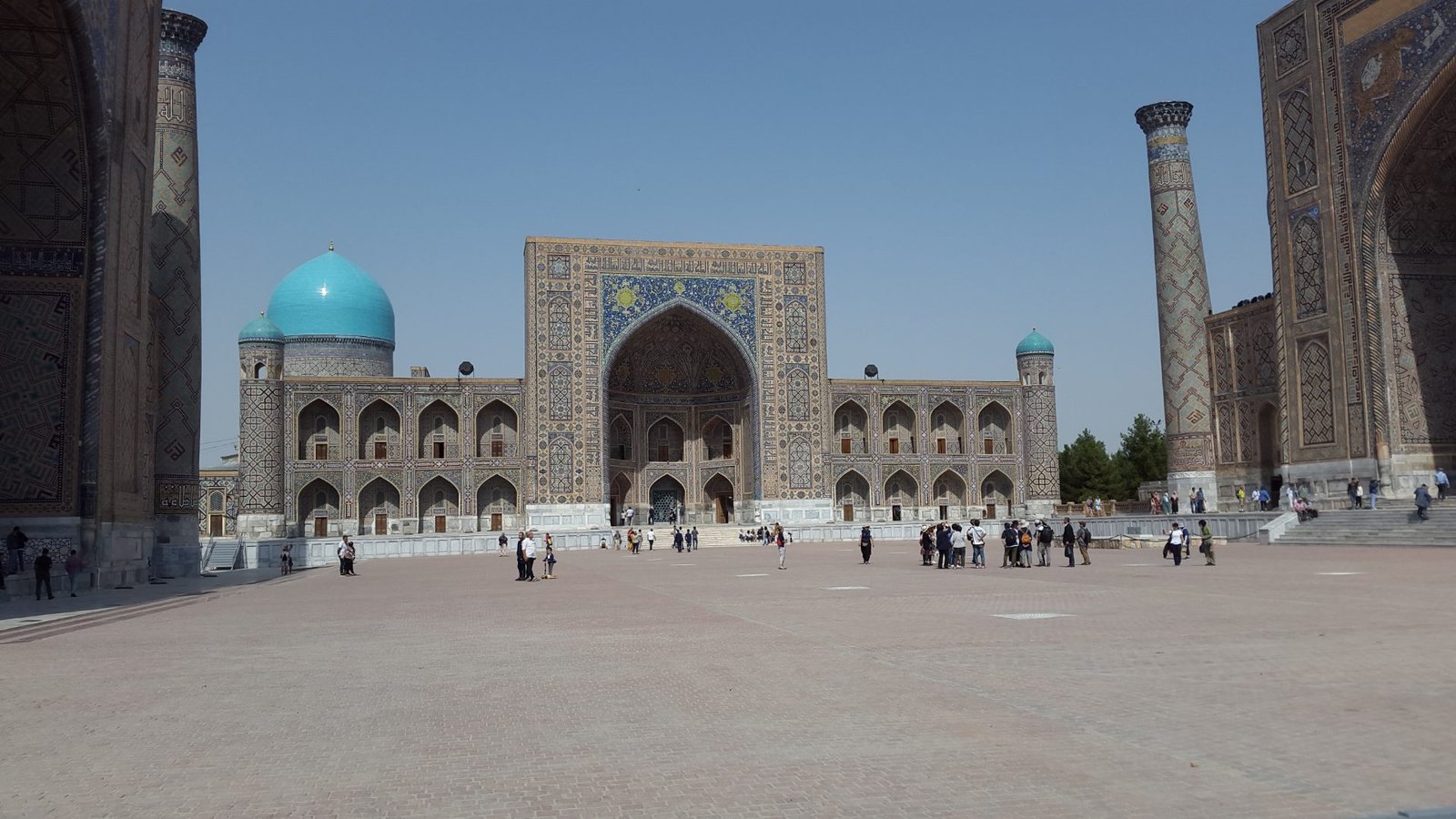
| 3–5 | Samarkand | 2h 10m by Afrosiyob. Registan, Gur-e-Amir, Shah-i-Zinda, Bibi Khanym, the Observatory. Two full days is right |
| 6–7 | Bukhara | 1h 35m from Samarkand. The Ark, Poi Kalyan, Lyab-i-Hauz, Chor Minor. Compact and walkable |
| 8–9 | Khiva | By rail from Bukhara. Itchan Kala is small enough for a day, but stay inside the walls overnight — dawn and dusk are the point |
| 10 | Return | Fly Urgench to Tashkent, about 1h 20m, rather than backtracking by rail |
This route depends entirely on booking the trains the day the 60-day window opens. Have a shared-taxi or domestic-flight fallback for each leg.
With longer, add two or three days from Khiva to Nukus and Muynak: the Savitsky Museum’s Soviet avant-garde collection is worth the detour on its own, and Muynak’s ship graveyard sits on the dried bed of the Aral Sea, three to three and a half hours by marshrutka from Nukus. Reaching the current shoreline needs two days and a four-wheel drive. The Fergana Valley — Margilan for silk, Rishtan for ceramics, Kokand for the Khan’s palace — sits in the opposite direction from the Silk Road cities and works best bolted onto the start or end of the trip, not slotted into the middle.
One thing worth knowing before you look at the monuments
Much of what you will see in Samarkand and Shakhrisabz was rebuilt in the twentieth century, and the signage rarely tells you which parts. UNESCO’s own advisers have raised exactly that as a criticism — and, separately, the story you will hear from other travellers about UNESCO nearly delisting Samarkand turns out to be attached to the wrong city entirely. We read the decisions: what UNESCO actually said.
What we could not verify
Australia’s current advisory level — the government page we reached served a stale 2021 snapshot, so check it yourself. Whether the national tourism app launched. Ticket prices on the new Tashkent–Khiva train, which no source published. The exact launch date and top speed of that service, where sources conflict. Uzbekistan’s currency export threshold, where three sources give three figures. And whether any specific opioid other than codeine appears on the restricted list — which is precisely why you should check the official list rather than trust a travel guide, this one included.
Photo: Registan square (Samarkand) by Shuhrataxmedov, via Wikimedia Commons, CC BY-SA 3.0.