
In short
Two figures decide a Çanakkale trip. Troy is €27 on one ticket covering both the museum and the archaeological site — there is no cheaper site-only option for foreign visitors. And the Gallipoli battlefields are free: there is no entrance fee, confirmed by Law No. 6546 and the ministry’s fee annex, neither of which contains a charge.
Verified against the ministry fee annex and Law No. 6546, 20 August 2026.
Çanakkale is the province where two of the most-visited places in Türkiye sit within forty kilometres of each other: Troy, and the Gallipoli battlefields. It is also the place where English-language travel writing goes wrong most often, because almost every practical number attached to it has changed and because several of the most-repeated stories about it are not true.
This guide gives you the current figures, from the authority that sets them, checked on 20 August 2026 — and it tells you plainly where we could not confirm something, rather than filling the gap with a number from another article.
What is in this guide
The four numbers that matter, and are usually wrong
| Current figure | Set by | |
|---|---|---|
| Troy admission | €27, covering the museum and the archaeological site on one ticket | Ministry of Culture and Tourism fee annex |
| Gallipoli battlefields admission | Free. There is no entrance fee. | Law No. 6546 and the ministry’s fee annex, neither of which provides for one |
| 1915 Çanakkale Bridge toll, car | 1,170.00 ₺, effective 1 July 2026 | Karayolları Genel Müdürlüğü |
| Accommodation tax | 1% until 31 December 2026, then 2% again | Presidential Decision 11263 |
Every one of those is routinely misreported. The bridge toll in particular is the single most reliably wrong number in English writing about the region, because it is quoted in euros — and the road authority publishes it in Turkish lira, revising it mid-year rather than in January.
Getting there
The bridge
The 1915 Çanakkale Bridge opened on 18 March 2022, deliberately on the 107th anniversary of the 1915 naval battle. It is 4,608 m long with a 2,023 m main span and 334 m towers, and it reduced the strait crossing to about six minutes.
The toll, effective 1 July 2026, VAT included:
| Vehicle class | Toll |
|---|---|
| Class 1, car | 1,170.00 ₺ |
| Class 2 | 1,465.00 ₺ |
| Class 3 | 2,635.00 ₺ |
| Class 4 | 2,925.00 ₺ |
| Class 5 | 5,560.00 ₺ |
| Class 6, motorcycle | 295.00 ₺ |
If you drive the whole Malkara–Çanakkale motorway rather than only crossing, a Class 1 car from Malkara to the bridge is 1,480 ₺. Short hops are cheap — Kavakköy is 175 ₺.
On currency: the toll is denominated and posted in lira. We could not verify from any government source that it is set in euros, despite that claim being common. What is confirmed is that the operator accepts lira, US dollars and euros in cash at the booths, plus HGS tag and card. If you see a euro figure quoted as the toll, treat it as somebody’s conversion, not the tariff.
From Istanbul
With the bridge and the Malkara–Çanakkale motorway, the drive from Istanbul now runs Istanbul–Tekirdağ–Malkara–bridge–Çanakkale entirely by road, with no ferry.
We could not verify coach fares or journey times from any operator’s own site. Kamil Koç’s booking domain now redirects to Flixbus, and neither that nor Truva Turizm published route detail we could retrieve. We are not going to print a journey time we cannot source — check with the operator when you book.
The ferries
The strait ferries are run by GESTAŞ, and the first correction is the web address: the live site is gdu.com.tr, not the gestasdenizulasim.com.tr that older articles give, which no longer resolves.
Fares as published on 20 August 2026 — the tariff page carries no effective date, so treat these as current-as-checked. “GestCard” is the local stored-value card; the higher figure is the walk-up fare.
| Route | Foot passenger | Car, 1–7 people |
|---|---|---|
| Çanakkale – Eceabat | 40.00 ₺ (GestCard 36.00 ₺) | 725.00 ₺ (508.00 ₺) |
| Çanakkale – Kilitbahir | 40.00 ₺ (36.00 ₺) | 715.00 ₺ (500.00 ₺) |
| Gelibolu – Lapseki | 40.00 ₺ (36.00 ₺) | 725.00 ₺ (508.00 ₺) |
| Kabatepe – Gökçeada | 250.00 ₺ (225.00 ₺) | 1,400.00 ₺ (560.00 ₺), billed return |
| Geyikli – Bozcaada | 200.00 ₺ (180.00 ₺) | 2,485.00 ₺ (995.00 ₺), billed return |
Frequency: Çanakkale to Eceabat runs roughly hourly, around the clock. Gelibolu to Lapseki runs roughly every 30 minutes, effectively 24 hours, with an operator note that sailings go by vehicle build-up at the ramp rather than strictly by the clock.
Do you need to book? For the strait shuttles, no — they are turn-up-and-go. For the island routes to Gökçeada and Bozcaada, yes, especially with a car: those fares are billed as returns, online booking uses dynamic pricing, and the price rises 30% in the final five days. Be at the pier at least ten minutes before your sailing time.
We could not verify crossing durations for any route — GESTAŞ publishes departure times and fares but no journey times. Do not trust the “25 minutes” that circulates.
Do you need a car?
Honestly, for the full peninsula: yes, or a guided tour.
The Gallipoli Historical Area covers 33,444 hectares. The Çanakkale Governorship’s own inventory lists more than 50 separate Turkish cemeteries and monuments across it, on top of 31 Allied cemeteries, strung along ridge roads with no scheduled public transport linking them.
The one genuinely walkable part is the Australian government’s signposted Anzac Walk: about 2 km with 14 stops, beginning and ending at North Beach, taking in Ari Burnu, Anzac Cove, Hell Spit, Shrapnel Valley, Brighton Beach, Artillery Road, Lone Pine, Johnston’s Jolly, Quinn’s Post, the Turkish Memorial, The Nek and Walker’s Ridge.
So the Anzac sector can be done on foot from a drop-off at North Beach. Helles, Seddülbahir, Morto Bay and Conkbayırı cannot — they are 25 to 35 km away over the ridge.
Getting to Troy is a different problem. It is about 30 km south of Çanakkale town and 4.5 km inland at Tevfikiye village. We could not verify any public dolmuş service or timetable — the municipal transport directorate publishes its schedules only as PDF downloads and through the KentKart app, and lists no line serving Tevfikiye in its page text. Budget for a taxi or a tour if you are not driving.
Where to base yourself
Çanakkale town is the default and the right answer for most people. It is the ferry hub, with sailings to Eceabat roughly hourly around the clock and to Kilitbahir; it has the Naval Museum, Çimenlik Castle and the waterfront kordon; and it is 30 km from Troy. Best if you are doing both Troy and Gallipoli without a car on the peninsula itself.
Eceabat puts you on the peninsula at the Anzac end, which is what you want for early starts on the battlefields and for walking the Anzac Walk. The Kabatepe ferry to Gökçeada leaves from near here.
Gelibolu sits at the northern end, on the half-hourly Lapseki crossing and right off the motorway at the Gelibolu junctions. Convenient if you are driving down from Istanbul — but be clear that it is far from the battlefields, which are at the southern end of the peninsula. This trips people up.
What things cost
| Site | Admission | Hours |
|---|---|---|
| Troy Museum and archaeological site | €27, one ticket for both | 08:30–20:00, ticket office to 19:30, daily |
| Gallipoli battlefields and cemeteries | Free | Permanently open |
| Assos (Behramkale) | €11 | 08:30–21:00, ticket sales to 20:30, daily |
| Apollon Smintheion | €3 | — |
| Alexandria Troas | Free | — |
| Kilitbahir Castle Museum | Not published — see below | 09:00–19:00, ticket window to 18:15, closed Mondays |
| Çanakkale Naval Museum | 13.00 ₺ as published, students free | Tue–Sun 09:00–12:00 and 13:30–17:00, closed Mondays |
Admission fees at ministry sites are set in euro and charged in lira, converted at the previous day’s Turkish Central Bank effective selling rate.
Two caveats on that table. The Çanakkale Naval Museum’s 13.00 ₺ is implausibly low for 2026 and the operator’s page may simply not have been updated — treat it as the published figure as at August 2026 and expect to pay more. And Kilitbahir Castle Museum appears on the ministry’s museum portal but is absent from the ministry’s 363-entry fee annex, so its admission price is genuinely unpublished; it is presumably administered by the Gallipoli Historical Area Presidency rather than the ministry.
On museum passes, one expensive trap. The MuseumPass The Aegean at €95 does not include Çanakkale, Troy or Assos — its own official inclusion list covers İzmir, Aydın, Muğla and Denizli only. Buying it for a Troy trip is a common and costly error. The MuseumPass Türkiye at €165, valid 15 days across 350-plus sites, is the broader product; note that we could not confirm from the sources available whether it admits foreign visitors to Troy specifically, because it publishes no inclusion list.
The accommodation tax
Türkiye’s konaklama vergisi is a national tax and Çanakkale levies no separate local one.
- The rate is 2%, applied to the accommodation charge excluding VAT
- It must be shown separately on the invoice, and cannot be discounted under any name
- It has applied since 1 January 2023
- Student dormitories and camps are exempt, as are services to foreign diplomatic missions on a reciprocal basis
Practically: if a rate is quoted “all taxes included,” it is inside. If not, add 2%.
When to go, and the two days to avoid
We are not going to publish monthly climate normals for Çanakkale, because we could not reach the Turkish State Meteorological Service to get them, and the “normals” published by commercial weather sites are frequently reanalysis products rather than station data. If you see monthly averages for Çanakkale on a travel site, they are probably not from MGM.
What we can tell you is verified. Opening hours are longest in the warm season — Troy runs to 20:00 and Assos to 21:00 — and the island ferries add sailings on Fridays to Sundays and in summer. The peninsula is exposed open ground with no shade or shelter at the memorial sites.
Two dates to avoid if you are a general visitor, both major commemorations that fill the peninsula:
- 25 April, the anniversary of the landings
- 18 March, Çanakkale Zaferi ve Şehitleri Anma Günü, the Turkish national commemoration, which brings very large domestic crowds
On 25 April, be clear about what you are choosing. You cannot enter the commemorative site without a pass registered months in advance. There is no seating. You are outdoors overnight without shelter or permanent lighting. You queue for security screening, and medical support is limited. If your interest is the battlefield rather than the ceremony, 25 April is the worst day of the year to visit — the ground is crowded, access is controlled, and quiet walking is impossible. Our guide to Anzac Day at Gallipoli covers the registration process properly.
What is actually here
Troy is 30 km south of town: nine numbered cities on one mound, a €27 ticket covering the museum and the site together, and rather more genuine archaeology than its reputation as a tourist trap suggests. Our full guide to visiting Troy covers the layers, the excavators and where Priam’s Treasure actually is — which is not where most articles say.
The Gallipoli peninsula is free to enter and enormous. The Commonwealth cemeteries and the Turkish memorials are open ground, permanently accessible. Our site-by-site guide to the Gallipoli battlefields gets the names and the geography right, which most itineraries do not.
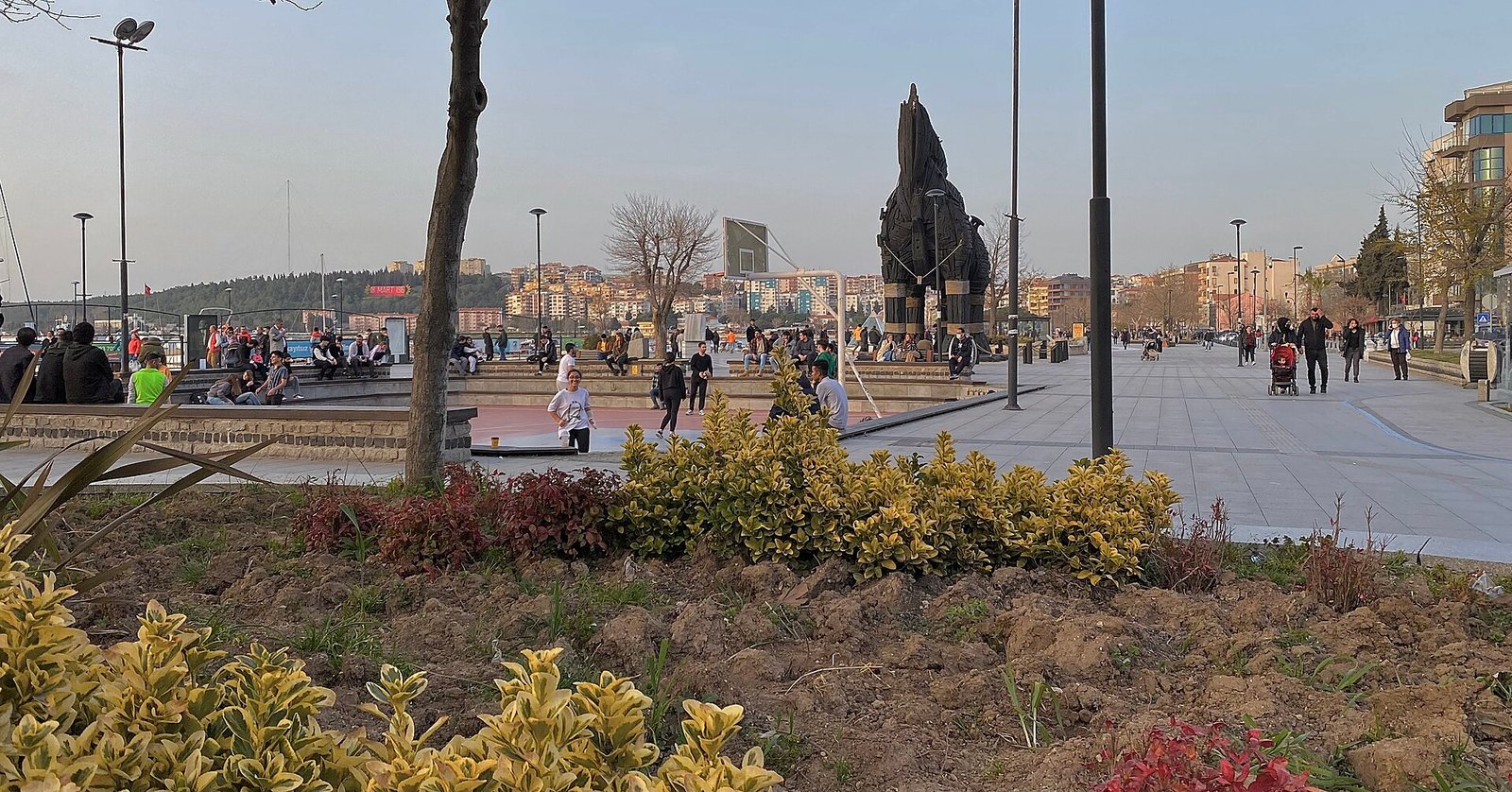
Çanakkale town has the Naval Museum, run by the Turkish Naval Forces; Çimenlik Castle, the Asian-shore partner to Kilitbahir across the narrows, the pair built so that no ship could pass without being under fire from at least one; and the kordon, the waterfront promenade, with its large wooden horse.
About that horse: there are two different wooden horses, and conflating them is the most common Troy error in English guides. One stands at the archaeological site, a modern visitor attraction. The other stands on the Çanakkale waterfront. Neither is ancient — no ancient horse has ever been excavated. The widely-repeated claim that the waterfront horse is the prop from the 2004 film Troy is not confirmed by any government source we could reach; the city, the governorship and the official destination site all confirm the horse exists and none states its provenance.
Beyond the town, Assos at €11 has the only Doric temple built in Anatolia and the hill where Aristotle founded a school, and the islands of Bozcaada and Gökçeada are a genuine day out. See our guide to Assos, Bozcaada and Gökçeada.
For context on the province: Çanakkale has 9 museums, 14 blue-flag beaches, 7 thermal facilities, 64 licensed travel agencies and 433 professional guides, and in 2024 about 829,110 visitors toured its museums and archaeological sites.
What we could not verify
- The Kabatepe simulation centre (Çanakkale Destanı Tanıtım Merkezi): admission, hours and closing days. The Gallipoli Historical Area Presidency’s own site would not serve content to us across many attempts over several hours. Do not carry over a figure from an English article.
- Coach fares and journey times from Istanbul.
- Ferry crossing durations for any GESTAŞ route.
- A public dolmuş from Çanakkale to Troy and its timetable.
- Kilitbahir Castle Museum’s admission price.
- Whether the MuseumPass Türkiye admits foreign visitors to Troy.
- The provenance of the Trojan horse on the Çanakkale waterfront.
- The Çanakkale clock tower’s date, builder or history — no official source carries an entry.
- MGM climate normals for the province.
- The Troy Museum’s opening date. The Çanakkale Governorship states 18 March 2019; we could not corroborate that from a second official source.
Frequently asked questions
Is there an entrance fee for Gallipoli?
No. Three independent lines confirm it: the enabling statute, Law No. 6546, provides for no entrance fee; the ministry’s 363-entry fee annex contains no Gallipoli entry at all, its only Çanakkale lines being Troy, Assos, Apollon Smintheion and Alexandria Troas; and the Commonwealth war cemeteries are permanently open ground with no register kept on site. Individual indoor attractions are a separate matter.
How much does Troy cost?
€27, and that single ticket covers both the Troy Museum and the archaeological site. There is no separate museum-only or site-only price for foreign visitors. The fee is set in euro and charged in lira at the previous day’s central bank selling rate.
Can you visit Troy and Gallipoli in one day?
Tightly, with a car. They are on opposite sides of the strait — Troy 30 km south of Çanakkale town, the battlefields across the water on the peninsula — and the peninsula alone deserves a full day. Two days is the honest minimum.
How much is the Çanakkale bridge toll?
1,170.00 ₺ for a car, VAT included, effective 1 July 2026, as published by the road authority. It is set in lira, not euros.
Do I need to book the Çanakkale to Eceabat ferry?
No. The strait shuttles run roughly hourly around the clock and are turn-up-and-go. Book the island ferries to Bozcaada and Gökçeada, though — those fares are billed as returns and online prices rise 30% in the final five days.
Is there a lodging tax in Çanakkale?
Türkiye’s national accommodation tax applies, calculated on the room rate before VAT and shown as a separate line on your bill. There is no additional local tax. The rate is currently 1%, not the 2% almost every English guide prints — Presidential Decision 11263, published in the Official Gazette on 1 May 2026, cut the statutory 2% to 1% until 31 December 2026 inclusive. Unless it is extended, it returns to 2% on 1 January 2027.