
In short
What is open, what it costs and what is worth the detour, from the ministry tariff: Bodrum Underwater Archaeology Museum €20, Patara €15, Myra (Demre) €13, Simena on Kekova €4, and Xanthos, Letoon and Tlos €3 each. The UNESCO-listed Xanthos–Letoon pair is among the cheapest ticketed sites on the whole coast — these fees are from the tariff effective 1 March 2024 and are labelled as such.
Fees from the ministry tariff effective 1 March 2024; status checked August 2026.
Disclosure: some links in this guide are affiliate links. If you book through one, we earn a small commission and you pay exactly the same price. We only link to services we would use ourselves, no brand pays for placement or for a favourable write-up, and every price in this article was researched independently.
Lycia was a federation of city-states on what is now Türkiye’s southwest coast, with its own language, its own script and a habit of carving its dead into cliffs. Rome absorbed it in AD 43. What it left behind is the densest concentration of ancient cities in the country outside Ephesus, and — because almost all of it is inland, off the coast road, with no bus — the emptiest.
What is in this guide
- The two structural facts that matter more than any price
- Xanthos and Letoon — one World Heritage property, two sites
- Patara — the one with a night session
- Myra and Demre — the best tomb façades in Lycia
- Simena and Kekova — the site you mostly see from a boat
- Tlos and Pınara — the two inland ones almost nobody does
- Bodrum Castle — the expensive one, and it is open
- The 1 March 2024 tariff, in full
- Practicalities
- Common questions
- Before you visit
- A short note on what Lycia actually was
This is a practical guide to seven of those sites: what is there, what is open, how you reach it, and what it costs. That last one comes with a problem we are going to state at the top rather than bury.
We could not obtain the 2026 entry tariff. Every official route was blocked — the Ministry’s ticketing portal, the heritage directorate, the museum-pass site and the Official Gazette. The prices below are the most recent tariff we could reach from an official source, and they are dated 1 March 2024. They are almost certainly superseded. We publish them labelled, because the *structure* is durable and useful even when the numbers are not, and we would rather show you our working than print a current-looking figure we cannot stand behind.
Editor’s note
Two things are firm on this page and one is not. Opening hours and closed days come from the Ministry of Culture and Tourism’s own museum portal, checked 19 August 2026 — treat those as current. The euro entry fees are the Ministry schedule republished by TÜRSAB, the statutory travel-agency association, headed “valid from 01.03.2024” — treat those as historical. Where a site’s hours were not individually confirmed, we say so rather than generalising.
The two structural facts that matter more than any price
1. Ministry sites price foreign visitors in euro. Not lira. This switched in March 2024 and it has a consequence people miss: a weaker lira makes your food, transport and hotels cheaper and does nothing at all to your entry tickets. If you are budgeting a Türkiye trip on the exchange rate, the ruins are the line item that does not move.
2. MüzeKart is not for short-stay tourists. It is open to Turkish citizens and to foreigners holding a Turkish residence permit, plus foreign students and diplomats — but not to a visitor on a 90-day stamp, who needs the separately priced Museum Pass Türkiye. Its 2026 price we could not obtain either. Guides telling ordinary foreign visitors to “buy a MüzeKart” are describing a card they are not eligible for.
Xanthos and Letoon — one World Heritage property, two sites
Inscribed together by UNESCO as a single serial property, four kilometres apart, ticketed separately.
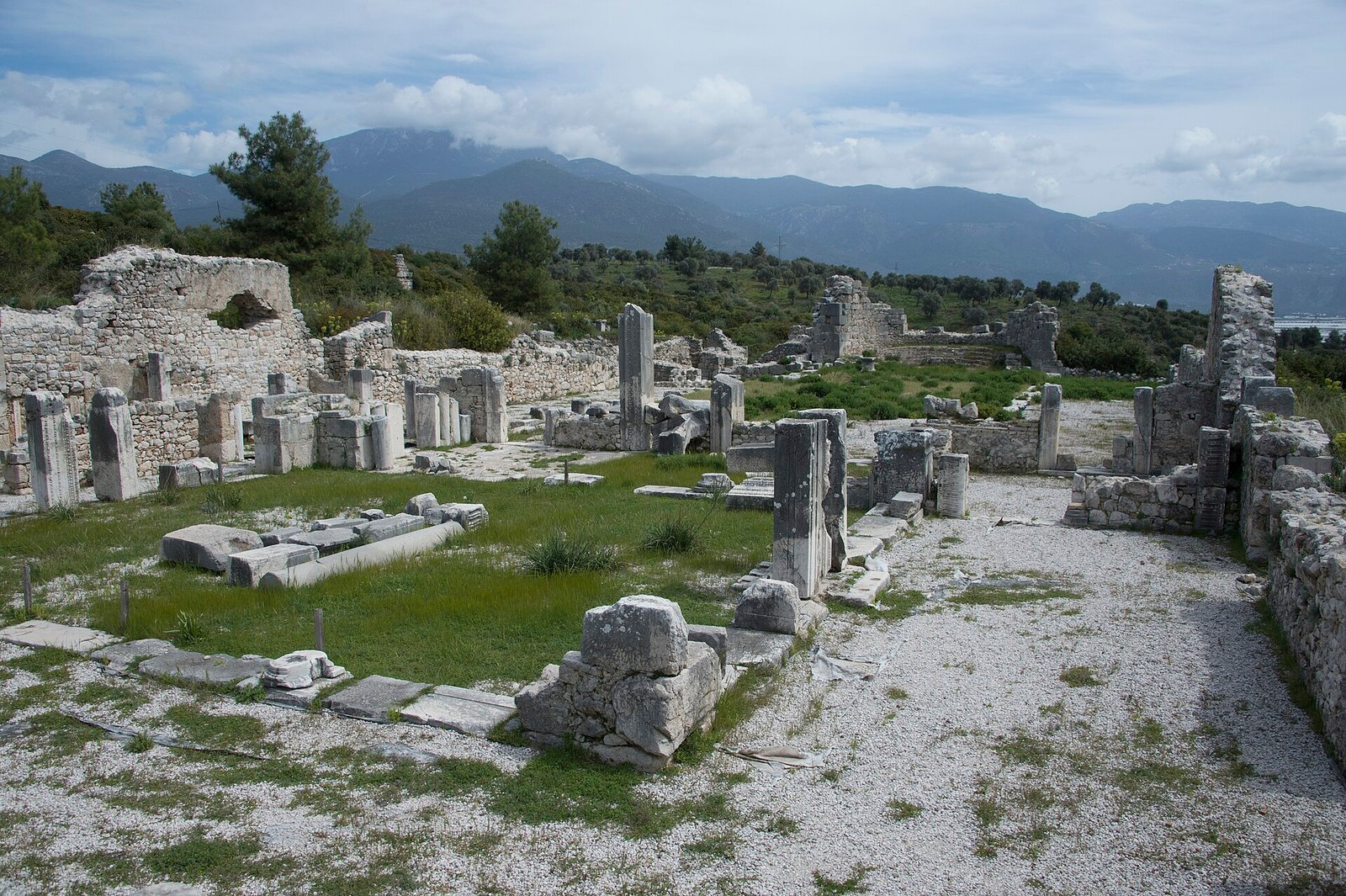
Xanthos was the Lycian capital, at Kınık on the D400 between Fethiye and Kalkan. It has the pillar tombs Lycia is known for, a Roman theatre, and a history that is genuinely hard to read about: the city destroyed itself twice — first against the Persians, then against Brutus — rather than surrender. Much of the best sculpture was removed to the British Museum in the 1840s, which is a fact worth knowing before you arrive expecting friezes.
Official hours: 08:00–20:00, ticket office to 19:30, no closed day. On the 1 March 2024 tariff, €3.
Letoon, at Kumluova, was the federation’s religious sanctuary — three temples in a row on a terrace, dedicated to Leto, Apollo and Artemis, with a nymphaeum that is usually flooded and usually full of frogs. It is lower, wetter and quieter than Xanthos, and it is where the trilingual stele was found that let scholars start reading Lycian at all. €3 on the 2024 tariff.
How to reach them: by car, in a half day, together. There is no realistic public transport option, and that is precisely why you will have them largely to yourself in a country where Ephesus does not have a quiet hour.
Patara — the one with a night session
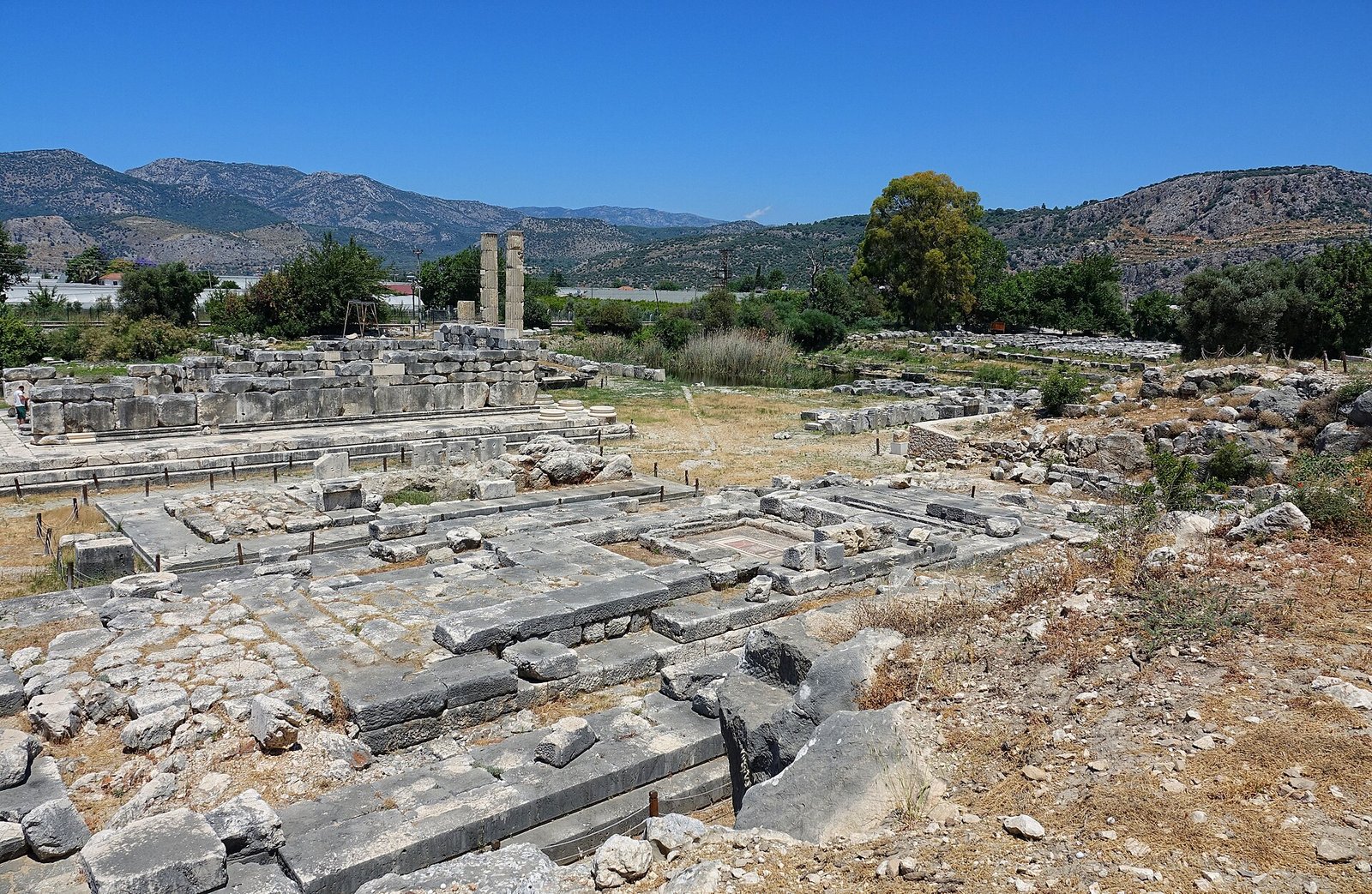
An ancient city and a very long dune-backed beach on the same site, at Gelemiş near Kalkan. Patara was Lycia’s principal port and the seat of its federal assembly; the restored bouleuterion is the most complete Lycian council chamber anywhere. There is a triumphal arch, a theatre, and a lighthouse claimed as the oldest known.
Official hours: 08:00–18:45, ticket office to 18:45 — plus a night session 19:00–22:00, ticket office to 21:30, daily, no closed day. On the 1 March 2024 tariff, €15, the second dearest site on this coast.
The night session is the recommendation. Walking a Lycian city at dusk, in September, with the heat gone, is one of the better hours available on this coast and it is nearly empty. Note that MüzeKart holders (Turkish citizens) pay an additional ₺200 for the night ticket, which tells you the Ministry treats it as a separate product.
One thing we will not tell you. Patara is a designated loggerhead turtle nesting beach and a seasonal evening restriction on the *beach* is widely described in guides. We could not verify its hours, its months or its legal basis from any official source — the environment ministry and national parks directorates were unreachable. So: the archaeological site is officially open until 22:00; whether and when you may be on the sand is a different permission over adjacent ground, and you should confirm it locally. Guides stating “the beach closes at 8pm” as fact are not working from a source we could find.
Myra and Demre — the best tomb façades in Lycia
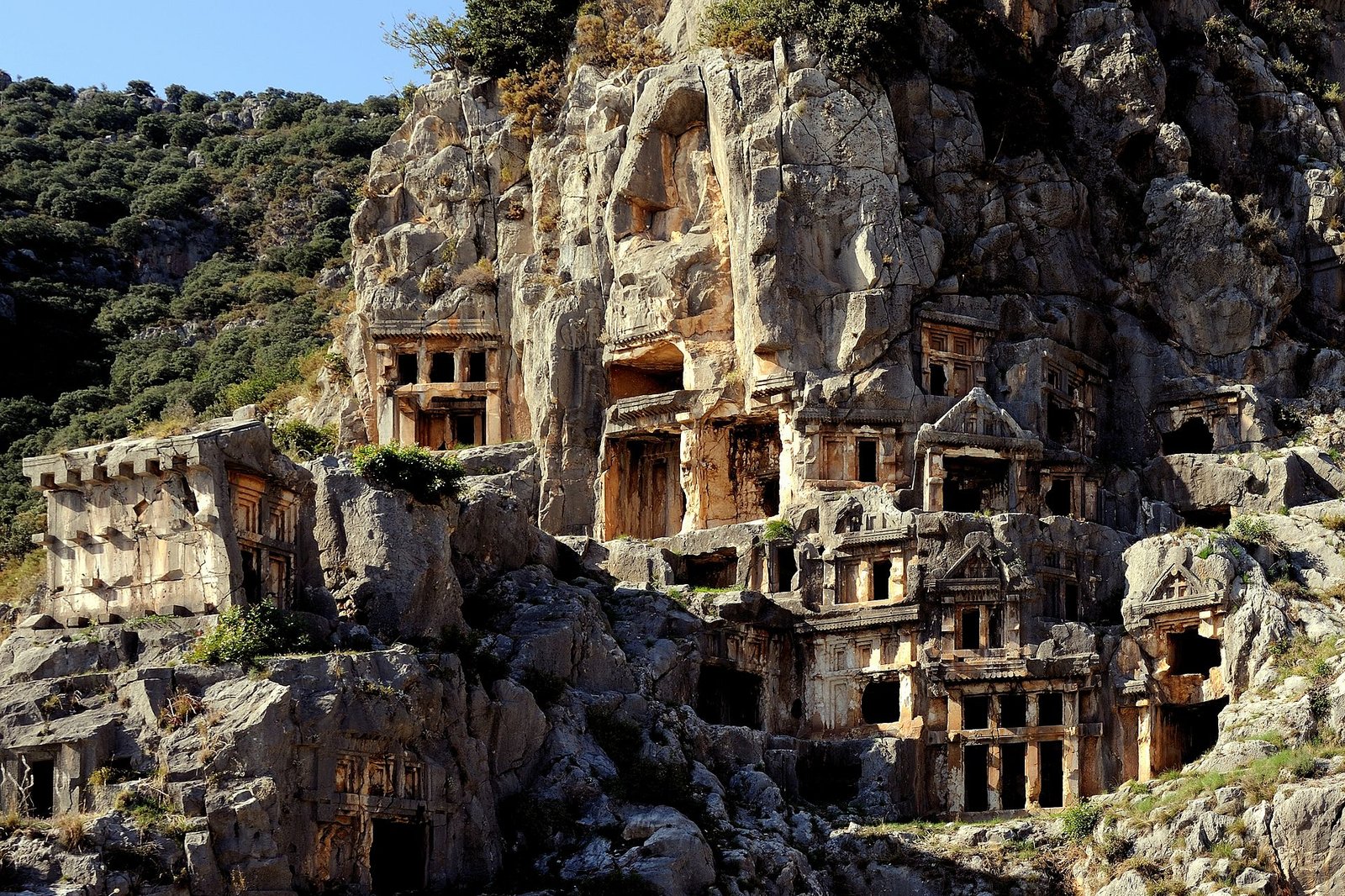
At Demre, an hour east of Kaş. Myra has a cliff face honeycombed with rock-cut house tombs, carved to imitate timber buildings, stacked above a large Roman theatre with carved masks still in place. It is the image most people have in mind when they picture Lycia, and it photographs better in the afternoon when the light comes onto the rock.
€13 on the 1 March 2024 tariff — the third dearest on this coast.
In the town below is the Church of St Nicholas, the fourth-century bishop of Myra who became Father Christmas. It is a separately ticketed Ministry site and a genuinely strange half-hour: a Byzantine church, a sarcophagus, and coach parties from three continents.
Simena and Kekova — the site you mostly see from a boat
Kekova is an island with a submerged settlement along its northern shore: earthquake-dropped foundations, staircases running into the water, and cut blocks visible through very clear sea. Simena — the village of Kaleköy — sits opposite under a Byzantine castle, has no road in, and has Lycian sarcophagi standing in the shallows.
€4 on the 2024 tariff for Simena, which made it the cheapest ticketed site on this coast.
How you visit: by boat from Kaş or, more cheaply and with less time on the water, from Üçağız. Swimming and diving directly over the submerged ruins is restricted under Türkiye’s protected-site rules. We could not retrieve the decision text setting out the current scope of that restriction, so treat your boat crew’s instruction as authoritative rather than any guide’s — including ours.
Tlos and Pınara — the two inland ones almost nobody does
Tlos is a hill city above the Xanthos valley, 45 minutes inland from Fethiye, with rock tombs cut into the acropolis — including one attributed to Bellerophon, with Pegasus carved on the façade — and an Ottoman fortress built on top of the Lycian citadel, which tells you how long the site stayed useful. €3 on the 2024 tariff. It pairs naturally with Saklıkent Gorge on the same road.
Pınara is the one to do if you want a Lycian city entirely to yourself. It sits under a vast circular cliff drilled with several hundred tomb openings, reached by a rough track and then a walk. Free on the 2024 tariff. There is no bus, no café and frequently nobody else.
Bodrum Castle — the expensive one, and it is open
Not Lycia — Bodrum is Aegean and was Halicarnassus — but it is the region’s flagship museum and it generates more confusion than any other site here.
It is open. The castle closed in October 2017 for a major restoration and reopened in June 2020 after about three years, with strengthened walls and roughly 1,100 square metres of new exhibition space. The Ministry lists the Museum of Underwater Archaeology as open daily 08:30–18:45, plus a night session 19:00–22:00, with no closure notice as of 19 August 2026. Guides still warning that it is shut for restoration are between five and nine years out of date.
€20 on the 1 March 2024 tariff — by a distance the most expensive ticket in this guide, and reasonably so: the Uluburun and Glass Wreck collections are internationally significant.
The Mausoleum Museum, on the site of one of the Seven Wonders, is a separate ticket at €3 and — importantly — is closed on Mondays, 08:30–17:30 otherwise. Manage expectations: almost nothing stands. The Knights of St John quarried the marble to build the castle and the surviving sculpture is in the British Museum. What remains is a foundation pit, some column drums and a good explanatory shelter.
The Halicarnassus theatre was free on the 2024 tariff. It is on the hillside above town on the Turgutreis road, hard against the dual carriageway, and still used for summer concerts.
The 1 March 2024 tariff, in full
Published because it is the last official schedule we could reach, and labelled because it is two years old.
| Site | Fee, tariff effective 1 March 2024 |
|---|---|
| Bodrum Underwater Archaeology Museum | €20 |
| Patara | €15 |
| Myra (Demre) | €13 |
| Simena (Kekova) | €4 |
| Xanthos | €3 |
| Letoon | €3 |
| Tlos | €3 |
| Bodrum Mausoleum | €3 |
| Halicarnassus theatre | Free |
| Pınara | Free |
Do not budget from this table. Budget from its shape: one expensive museum, one mid-priced flagship site, and a long tail of ancient cities at the price of a coffee, two of which are free. Then check at the gate.
Practicalities
You need a car for five of the seven. Xanthos, Letoon, Tlos, Pınara and Saklıkent are inland off the D400 with no realistic public transport. Patara and Myra are reachable by dolmuş and coach with effort. Kekova is a boat.
Go early or go at dusk. Every one of these sites is unshaded. Denizli, the nearest station with a long record, averages a July mean daily maximum of 34.8 °C, and the coast is not much kinder. Patara’s night session exists for a reason.
Wear proper shoes. These are not landscaped parks. Tlos and Pınara involve real walking on loose ground, and Xanthos’s theatre steps are uneven.
There is very little shade, water or food at the inland sites. Bring both.
Opening hours we did not individually confirm: Letoon, Tlos, Pınara, Myra and Simena have Ministry portal entries we did not fetch one by one. Ministry sites are broadly 08:00–19:00 or 20:00 in summer and 08:00–17:00 in winter, but verify the specific site before a long drive. The hours we state for Xanthos, Patara, Bodrum Castle and the Mausoleum were checked directly.
Common questions
Is a Museum Pass worth it here? We cannot tell you, because we could not obtain the 2026 price of Museum Pass Türkiye or the current site tariff. What we can say is that on the 2024 numbers the whole Lycian inland circuit — Xanthos, Letoon, Tlos, Pınara — came to €9, so the arithmetic only works if you are also doing Bodrum Castle and several sites elsewhere.
Which single site should I do if I only do one? Patara at dusk, or Myra in the afternoon. Xanthos if you care about the history rather than the photographs.
Can I visit Kekova without a boat tour? You can reach Üçağız and Kaleköy by road and see the sarcophagi and castle. The submerged shoreline is only visible from the water.
Are these sites suitable for children? Myra and Patara, yes — tombs in a cliff and a beach behind. Pınara and Tlos involve walking that small children will not enjoy in heat.
Why are the prices in euro? Because the Ministry set foreign-visitor pricing in euro from March 2024. It insulates the sites from the lira, and it means the usual “Türkiye is cheap right now” logic does not apply to tickets.
Before you visit
Check the specific site’s hours on the day, especially if you are driving inland — a locked gate at Pınara is a long way to come. Take cash as well as a card. And if you are building a route around these, our 10-day Turquoise Coast itinerary puts them in an order that does not involve driving the same road twice.
A car is what makes this list possible; local Turkish agencies generally undercut the international chains on this coast, and you need a 1968 international driving permit — the FCDO states the 1949 version is no longer accepted.
A short note on what Lycia actually was
It helps to know what you are looking at, because the tombs make more sense with the politics attached.
Lycia was not a kingdom. It was a federation of city-states — the Lycian League, at its height twenty-three cities, voting in proportion to size, with a federal assembly that met at Patara. That structure was unusual enough in the ancient world that Montesquieu praised it, and it was read by the framers of the American constitution as a working model of federal representation. The council chamber you can stand in at Patara is the physical remains of that idea.
The Lycians spoke and wrote their own language, related to but distinct from Hittite, The alphabet was transliterated as early as 1820–21, from a Greek–Lycian bilingual, but the language stayed poorly understood until a trilingual inscription — Lycian, Greek and Aramaic — turned up at Letoon in 1973. That stele is why the grammar and much of the vocabulary can be read at all.
And the tombs are the reason the region looks the way it does. Lycians cut their dead into cliffs in façades that copy the timber houses they lived in — you can see the joists and the beam ends rendered in stone. Others were placed in freestanding sarcophagi with high, hooded lids that still stand in the streets of Kaş and in the shallows at Kaleköy. The consistent theory is that they wanted the dead high up and visible rather than buried and forgotten.
Rome annexed the federation in AD 43 and the cities carried on, which is why almost every site here has a Roman theatre sitting inside a Lycian city.