
Quick answer: Mongolia now has seven UNESCO World Heritage sites, not six — the Xiongnu elite burial complexes were inscribed in 2026, and most existing English content hasn’t caught up. Americans get 90 days visa-free; British nationals get 30 days visa-free, but that arrangement expires 31 December 2026, and even Mongolia’s own immigration authority and its London embassy currently show conflicting information about it. This guide covers the country broadly; five companion guides below go deep on Ulaanbaatar, the Gobi, ger camps, entry rules and the Trans-Mongolian Railway.
Contents
A seventh UNESCO site, barely reported
At the 48th session of the World Heritage Committee in 2026, UNESCO inscribed the Burial Complexes of the Xiongnu Elite — a serial site of eight cultural burial complexes dating from roughly the 3rd century BC to the 2nd century AD — as Mongolia’s newest World Heritage listing. That brings the country’s total to seven sites: five cultural, two natural. The previous addition was the Deer Stone Monuments, in 2023. Practically every “Mongolia has six UNESCO sites” article in English predates this and is now out of date.
Visas, in brief
US citizens: 90 days visa-free, under the current bilateral arrangement, per the US State Department’s Mongolia page (updated 30 July 2026; travel advisory Level 1, “Exercise normal precautions,” 29 July 2026).
UK citizens: 30 days visa-free — but this expires 31 December 2026, per the UK Foreign Office’s most recently reviewed guidance (19 August 2026). This is a genuinely contested date: Mongolia’s own Immigration Agency and its London embassy both currently display older information (“2025”), while a Wikipedia entry gives 31 January 2026, and one news aggregator reports an extension to 1 January 2027. The FCDO’s 19 August 2026 review is the most recently updated official source available, so it’s the one we’d act on — but if you’re a UK traveller planning around this date specifically, it’s worth a direct check with the embassy before booking. For the full breakdown, including registration requirements for longer stays, see our Mongolia visa and entry rules guide.
Getting to Mongolia
Ulaanbaatar’s Chinggis Khaan International Airport (UBN — not the old ULN code, which belongs to a closed airport 18km from the city) sits 52km south of the capital. United Airlines became the first US carrier to fly to Mongolia, launching Tokyo Narita-Ulaanbaatar service in 2025; the route was confirmed back for a second season, 30 April – 11 October 2026, three times weekly. Other recent additions include T’way Air from Cheongju, Philippine Airlines, Juneyao Air from Sanya, and Jin Air from Muan. There’s no rail connection from the airport into the city — only bus and taxi.
Money
The tögrög (₮) floats freely; at time of research, 1 USD ≈ ₮3,598 and 1 GBP ≈ ₮4,889 (XE mid-market rates, late August 2026 — convert fresh before you travel). Credit cards work in Ulaanbaatar hotels, malls and better restaurants; museum ticket desks, taxis and markets are routinely cash-only, contrary to the “cards widely accepted” line some official sources use. Foreign Visa and Mastercard generally work at Mongolian bank ATMs, with a typical per-transaction limit around ₮500,000 (~$139) and a roughly ₮500 foreign-card fee on top of your own bank’s charges.
When to go
July-August is peak season for a reason — it’s when Naadam happens and when Gobi temperatures are at their most hospitable — but it’s also, specifically, the wettest month in the Gobi (August), which matters if your itinerary includes off-road driving. September offers a genuine shoulder-season sweet spot: fewer crowds, comfortable daytime temperatures, and the Gobi’s dirt tracks past their wettest.
Winter is a different proposition entirely. Ulaanbaatar is, by a wide margin, the only national capital on Earth with a sub-zero annual mean temperature — around -1°C, more than 5°C colder than the runner-up (Astana). January’s mean daily minimum runs about -25.6°C. That’s not a reason to avoid the city, but it is a reason to plan for it specifically rather than assume “Mongolia in winter” means something like a European cold snap.
Naadam
Naadam is a five-day public holiday, 11-15 July in both 2026 and 2027 — but the actual wrestling, archery and horse-racing competitions run only the first three days, 11-13 July. Several blogs conflate the public holiday with the competition window; they aren’t the same thing. Only the stadium opening ceremony is genuinely difficult to get into and expensive through resellers; archery, ankle-bone shooting and the horse racing at Khui Doloon Khudag, roughly 30km outside the city, are free to watch.
Safety, honestly
Both the US State Department and the UK FCDO rate Mongolia as generally safe, with petty crime — pickpocketing, bag-snatching — the main concern, concentrated in markets, train stations and tourist sites. Both governments independently flag the same two high-risk windows: Naadam (July) and Tsagaan Sar (the lunar new year, Dec-Feb), when crime rates rise. As of the FCDO’s 7 August 2026 update, there are also reports of fuel shortages, including aviation fuel, that may disrupt domestic flights and road travel to remote areas — worth checking again close to your travel dates, since it was a recent addition at time of writing.
Go deeper
- Mongolia visa and entry rules — the US/UK split, and the disputed UK expiry date
- Ulaanbaatar guide — the airport code error and the museum square everyone gets wrong
- Gobi Desert tour cost — real 2026 operator prices, and the outdated $60-a-day figure still circulating
- Mongolia ger camps — what separates a $25 camp from a $250 one
- The Trans-Mongolian Railway in 2026 — the Moscow-Beijing direct train has been dead since 2020, and almost nobody says so
FAQ
How many UNESCO World Heritage sites does Mongolia have?
Seven, as of 2026 — five cultural, two natural. The Burial Complexes of the Xiongnu Elite were the newest addition.
Do US citizens need a visa for Mongolia?
No — 90 days visa-free under the current bilateral arrangement.
What’s the best month to visit?
July-August for Naadam and the most reliable Gobi weather, though August is also the Gobi’s wettest month. September is a strong, less crowded alternative.
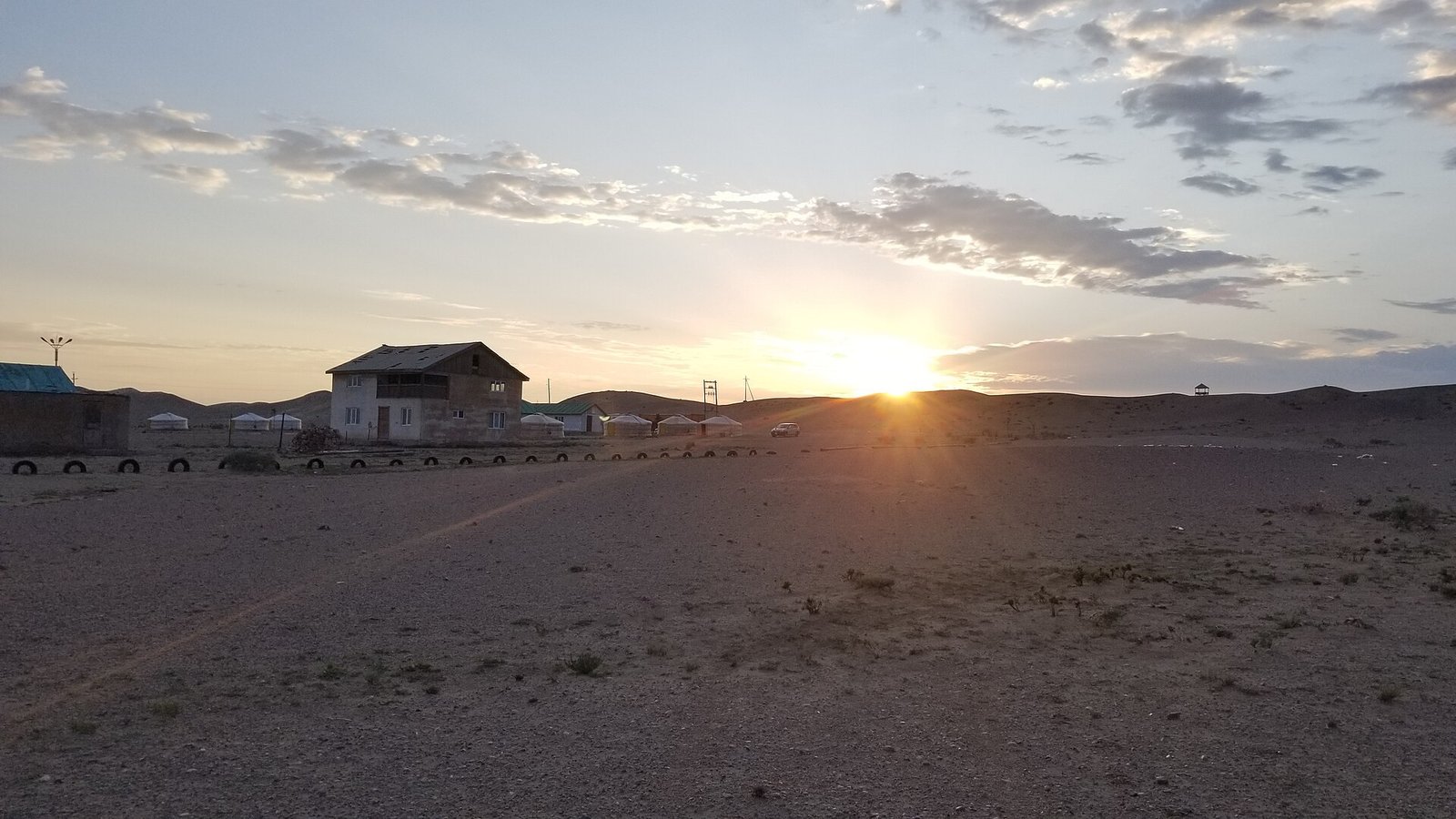
Photo: “Mongolian nature steppe house” by Orgio89, via Wikimedia Commons, licensed CC0.