
Quick answer: Three things almost every English-language Nikko page still has wrong for this season. The Akechidaira Ropeway has been closed since 15 January 2026 and won’t reopen until September 2027 — it’s off the table for your entire trip. Nikko has no lodging tax at all, only a ¥150-per-night onsen bathing tax; the town that actually got Tochigi’s first lodging tax, starting 1 October 2026, is Nasu, a different destination entirely. And autumn colour in Nikko isn’t one date — it starts in the mountains around Lake Yunoko in early October and doesn’t reach the low-elevation temple district for weeks after.
Contents
What the temples and shrines actually cost
| Site | Adult ticket | Note |
|---|---|---|
| Toshogu (shrine only) | ¥1,600 | No extra charge is listed for the famous Yomeimon Gate, sleeping cat or crying dragon ceiling — but the ticket page also doesn’t itemise what the single fee covers |
| Toshogu + Treasure Museum set | ¥2,400 | Treasure Museum (宝物館) alone: ¥1,000 |
| Toshogu Art Museum (美術館) | ¥800 | A separate building from the Treasure Museum — the two are routinely conflated in English write-ups |
| Rinnoji: Sanbutsudo + Taiyuin + treasure house/garden, all three | ¥1,000 | Buying the three separately costs ¥1,250 — the combined ticket saves ¥250 |
| Futarasan Shrine garden (Shinen) | ¥300 | The shrine grounds themselves are free; this fee is for the garden only |
| Shinkyo Bridge | ¥300 | ¥200 for high-school age |
Winter hours: you lose more time than you think
Every site in central Nikko shifts to shorter winter hours, and the cutoffs aren’t identical:
| Site | Summer hours | Winter hours (1 Nov – 31 Mar) |
|---|---|---|
| Toshogu | 9:00-17:00 | 9:00-16:00 |
| Rinnoji | 8:00-17:00 | 8:00-16:00 |
| Futarasan | 8:00-17:00 | 8:00-16:00 |
| Shinkyo Bridge | 8:30-16:30 | 9:30-15:30 — six hours a day |
| Kegon Falls elevator | 8:00-17:00 (Mar-Nov) | 9:00-16:30 (Dec-Feb) |
The practical consequence: a winter visitor loses a full hour at every temple compared to summer, and three hours a day at Shinkyo Bridge specifically. In January, a realistic sightseeing day in the temple district effectively ends by 15:30-16:00 — most English-language itineraries are still built around 17:00 closing times that no longer apply once winter hours are in effect.
The tax correction
Nikko does not have a lodging tax. A full check of the city’s own tax index — which lists all eight taxes the city collects — turns up no accommodation tax page or link at all. What Nikko does have is an onsen bathing tax (入湯税): ¥150 per person per overnight stay, ¥50 for day-use bathing. Under-12s, and anyone using a shared public bathhouse rather than a private inn, are exempt.
The lodging tax that keeps getting attributed to “the Nikko area” belongs to a different town. Nasu Town — a separate destination, also in Tochigi Prefecture — becomes the prefecture’s first municipality with an accommodation tax on 1 October 2026, four days after this article publishes. Nasu’s tax is banded in six tiers by nightly rate, from ¥100 (under ¥10,000/night) up to ¥3,000 for stays of ¥100,000 or more per person per night. If you’re staying in Nikko itself, none of this applies to you; if your itinerary also includes Nasu, it does.
The Akechidaira Ropeway is closed
The Akechidaira Ropeway — the cable car up to the observation platform overlooking Lake Chuzenji and Kegon Falls — has been suspended for renovation since 15 January 2026, with reopening planned for September 2027. That covers the entirety of the October 2026-February 2027 window this guide is written for. Almost every English-language Nikko page still lists it as a must-see attraction with a ticket price attached. It is simply not operating, and no fare is being published while it’s closed — don’t trust an old fare as current.
Autumn colour isn’t one date
Nikko’s elevation range means autumn colour arrives at dramatically different times depending on where you are, and the Nikko Tourism Association publishes peak-colour windows for the mountain areas but not for the temple district itself:
| Location | Elevation | Peak colour |
|---|---|---|
| Ryuzu Falls (Oku-Nikko) | ~1,350m | From late September — earliest colour anywhere in Nikko |
| Senjogahara wetland | ~1,400m | Late Sept-early Oct (grass colour) |
| Lake Yunoko | ~1,475m | Early-mid October |
| Temple district / Shinkyo | ~600m | No official peak date published — weeks after Oku-Nikko, by elevation alone |
The structural point: anyone who picks a single date for “Nikko autumn colour” is actually choosing between two different seasons happening 800 metres of elevation and several weeks apart. If you time your trip for Oku-Nikko’s early-October peak, the temple district will still be green; if you wait for the temples to turn, Oku-Nikko’s colour will already be gone.
Irohazaka: 20 minutes, or six hours
The Irohazaka mountain road up to Lake Chuzenji and Oku-Nikko — 48 sharp switchbacks, about 440m of elevation gain, split into a one-way-only descending road and a separate one-way-only ascending road — is, in the Nikko Tourism Association’s own words, normally about a 20-minute climb. During congestion, it routinely takes 2-3 hours; on long holiday weekends, the association has recorded waits of up to six hours. It’s also widely considered Nikko’s single most beautiful autumn-colour spot, which is exactly why it jams. A bus doesn’t get you around this — it uses the same one-way road pair as every private car.
Getting to Nikko from Tokyo
Tobu’s SPACIA X limited express runs Asakusa to Tobu-Nikko in about 50 minutes; a Standard Seat costs ¥3,340 total (base fare ¥1,400 plus a ¥1,940 limited-express charge). The older Kegon limited express takes closer to 1 hour 50 minutes on Tobu’s own access-page figures — the two sources don’t fully agree on timing, so budget for the longer figure. A rapid/local option exists too, at roughly 2 hours 5 minutes, about 15 minutes slower than the Kegon limited express for a lower fare.
If you’re heading on to Lake Chuzenji or Yumoto Onsen, Tobu Bus sells 2-day free passes that are worth comparing against point-to-point fares: the Chuzenji pass is ¥2,300 against a round-trip point fare of ¥2,500 (the pass wins, and covers other shrine-area buses too), and the Yumoto pass is ¥3,500 against a ¥3,900 round trip. One pass to specifically avoid buying in winter: the Kirifuri Highland pass simply isn’t sold from 1 December to 31 March.
Winter events worth knowing about
The Yunishigawa Onsen Kamakura Festival — a snow-igloo festival at a hot-spring village in the Nikko area — is confirmed for 29 January – 28 February 2027. A number of English pages are still carrying 2024 or 2025 dates for this event; the 2027 dates are officially published and worth using instead. Separately, a World Heritage light-up event runs 6-8 November 2026, right at the tail end of the temple district’s own foliage window.
FAQ
Is the Akechidaira Ropeway open?
No. It’s been closed since 15 January 2026 for renovation, with reopening planned for September 2027 — closed for this entire travel season.
Does Nikko charge a lodging tax?
No. Nikko has only a ¥150-per-night onsen bathing tax. The nearby town of Nasu introduces Tochigi’s first lodging tax on 1 October 2026 — a different destination.
When is the best time to see autumn colour in Nikko?
It depends entirely on elevation. Oku-Nikko (Ryuzu Falls, Senjogahara, Lake Yunoko) peaks from late September into mid-October. The lower temple district turns weeks later, with no official peak date published.
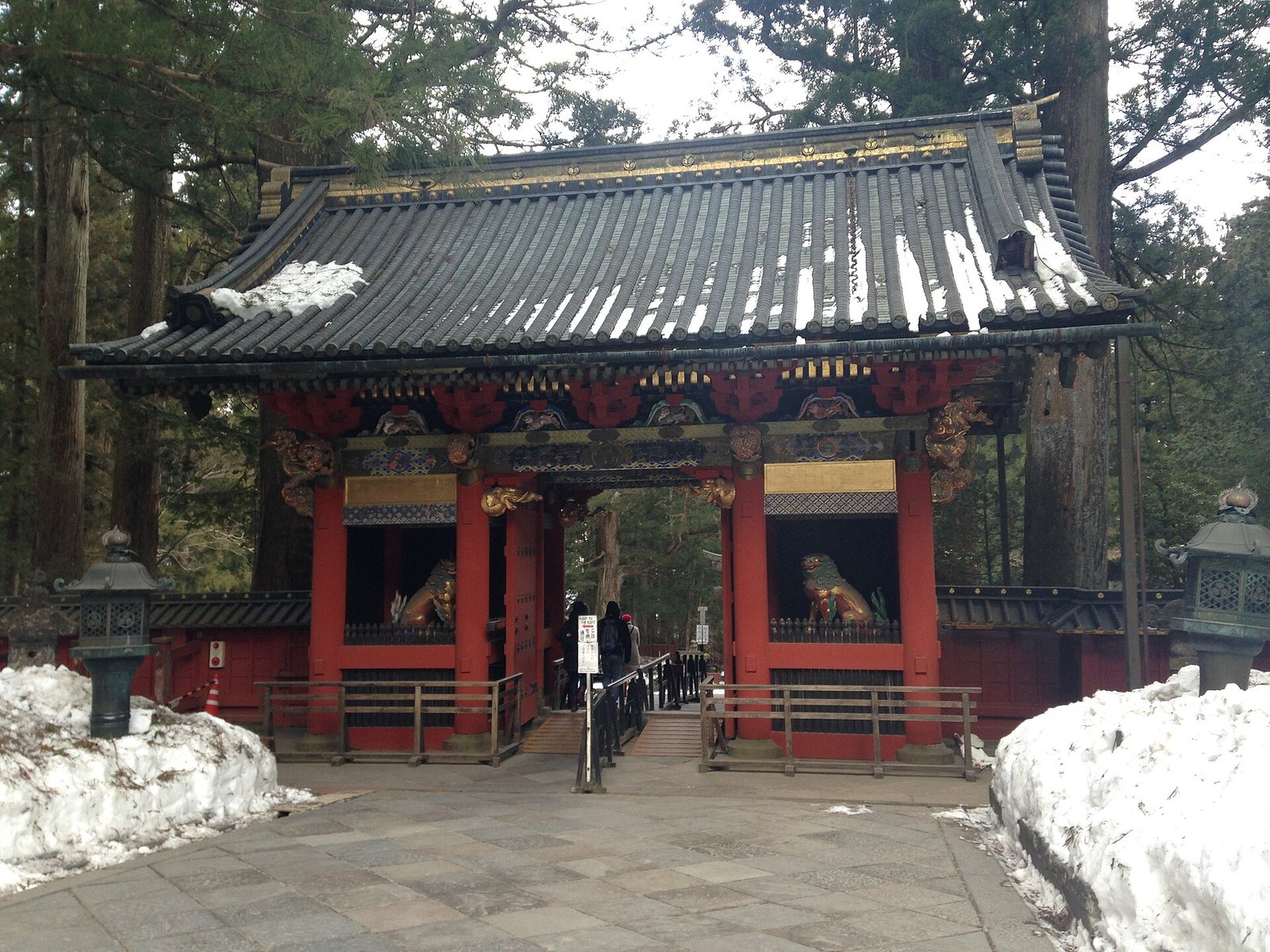
Photo: Gate of Nikko Tosho Shrine in snow, by そらみみ, via Wikimedia Commons, licensed CC BY-SA 3.0.