
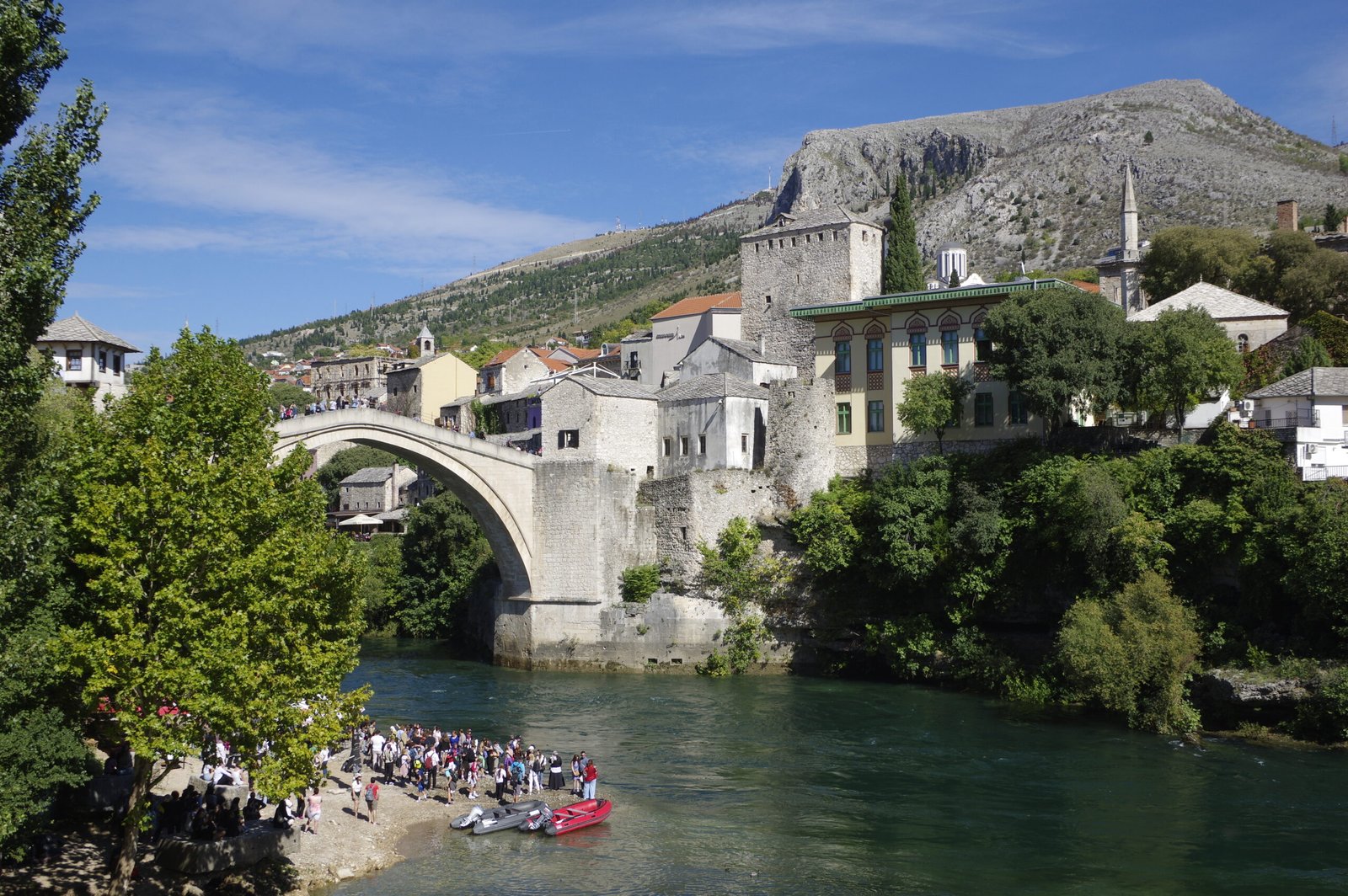
Quick answer: Mostar’s Old Bridge (Stari Most) is the city’s centerpiece — a reconstructed 16th-century Ottoman bridge over the Neretva River, with a diving tradition dating back at least to the 17th century. Watching a dive is free; the social pressure to tip the dive club beforehand is a deliberate (and honestly explained) part of the show, with 1-2 EUR considered fair for watching a complete dive. Give Mostar a half-day to a full day, and plan outdoor sightseeing for morning or late afternoon — Herzegovina’s summer heat regularly pushes past 35°C.
Contents
Stari Most, the Old Bridge
The original Stari Most was built by the Ottomans in 1566 and stood for over four centuries until it was deliberately destroyed by shelling during the 1993 war. It was rebuilt using traditional techniques and much of the original stone recovered from the river, reopening in 2004 and earning UNESCO World Heritage status for the old town around it in 2005. Walking across it is free and doesn’t require a ticket — it’s a functioning bridge and public space, not a monument you pay to access.
The Bridge Diving Tradition, Honestly
The diving itself is real athleticism, not a staged stunt — divers train seriously with a local club, and the tradition dates back at least to the 17th century. What’s worth understanding honestly is the commercial routine around it: before a dive, an associate works the watching crowd, announcing that the jump will happen “once we have enough,” often naming a target like “we need 50 euros.” The dive still happens when the diver personally chooses to go, so the stated target creates social pressure to tip rather than being a literal trigger for the jump. There’s no fixed price — tipping is optional, and 1-2 EUR is considered fair for watching a complete dive; you don’t owe more than that regardless of what number gets announced. Divers earn income from club competitions, photo sales, and other activities too, so bridge-side tips supplement rather than solely fund what they do.
Mostar’s Old Town
Beyond the bridge, Mostar’s old town is a compact warren of Ottoman-era streets, copper and jewelry workshops, and restaurants with terraces overlooking the Neretva’s turquoise water — genuinely striking color that comes from the river’s glacial and limestone-filtered source. The Koski Mehmed Pasha Mosque has a minaret you can climb for a different angle on the bridge and river, worth it if you want the classic Mostar photo from above rather than from street level.
Herzegovina’s Heat
Mostar and the surrounding Herzegovina region run noticeably hotter and drier than Sarajevo — summer temperatures regularly hit 35-38°C in July and August, occasionally touching 40°C, a sharp contrast to Sarajevo’s milder mountain climate just two hours north. Plan outdoor sightseeing for early morning or early evening in summer, and expect the old town’s stone streets to radiate heat well into the evening on the hottest days. Winters here are correspondingly milder than Sarajevo’s, generally in the 5-15°C range rather than Sarajevo’s sub-zero nights.
FAQ
Do I have to tip the bridge divers?
No — tipping is optional and 1-2 EUR is considered fair for a complete dive; don’t feel pressured by a higher announced “target.”
Is there an entrance fee for Stari Most?
No, it’s a free, open bridge; only specific nearby attractions like the mosque minaret climb charge separately.
How is Mostar different from Sarajevo?
It’s smaller, much hotter and drier in summer, and more singularly focused around the bridge and old town rather than Sarajevo’s broader mix of neighborhoods and history.
Photo: Berthold Werner, CC BY-SA 4.0, via Wikimedia Commons — Stari Most, the Old Bridge in Mostar, over the Neretva River.