
In short
Almaty to Astana is 1,320 km and takes anywhere from 13h 31m on train 701 to nearly 25 hours on the slowest — read the duration, not the departure time. Fares run 10,400 to 26,700 tenge. Book at bilet.railways.kz; the window opens 45 days ahead and popular trains sell out days in advance in summer. Most fast trains use Almaty-2, not Almaty-1.
Timetables and fares checked 27 August 2026 against KTZ channels and live inventory; where a figure could not be sourced we say so rather than estimating.
On this page
Kazakhstan has around 16,000 km of railway, moves more than 14 million passengers a year on it, and is almost entirely uncovered in English. It is also, for a certain kind of traveller, the best way to understand how big this country actually is.
Here is how the network works, checked on 27 August 2026.
Who runs it
Kazakhstan Temir Zholy (KTZ) operates almost all passenger services, though the trains themselves are run by several subsidiaries. More than half the country’s freight goes by rail, and there is a programme to modernise 5,000 km and repair 11,000 km by 2030.
The classes, explained properly
On conventional Soviet-pattern trains:
| Class | What it actually is |
|---|---|
| Platskart | Open-plan carriage, 54 berths, two levels, no doors, no privacy. The cheapest and by far the most social |
| Kupe | Enclosed four-berth compartment — two upper, two lower — with a small table, a socket and individual lights |
| SV / Lyux | Two-berth compartment, air-conditioned and soundproofed, about 16 berths to a carriage |
| Obshchiy | Seats only, no berth. Avoid for anything overnight |
On the Talgo fast trains — Spanish-built, and there is no platskart on them:
| Class | What it is |
|---|---|
| Tourist | Four-berth, the kupe equivalent |
| Business | Two-berth |
| Grand | Two-berth with a private shower and WC |
Speeds: Talgo runs at up to 150 km/h against about 100 for conventional stock, and newer coaches are rated to 160. Talgo cut the Astana–Almaty run by roughly eight hours compared with the old trains.
You will see conventional trains described as doing “about 50 km/h.” That is an average including stops, not a line speed — do not plan from it.
Almaty to Astana, which is the route you will actually take
1,320 km. Here is what the timetable really looks like:
| Train | Departs | Arrives | Duration |
|---|---|---|---|
| 701 (fast) | Almaty-2, 18:53 | 08:24 next day | 13h 31m |
| 3 (fast) | Almaty-2, 08:00 | 22:34 | 14h 34m |
| 119Т | Almaty-2, 20:40 | 12:46 | 16h 06m |
| 105Т | Almaty-2, 22:40 | 14:59 | 16h 19m |
| 015Т “Zhetysu” | Almaty-2, 08:53 | 06:25 next day | 21h 32m |
| 043Т “Tobyl” | Almaty-1, 17:33 | 18:21 next day | 24h 48m |
Twelve trains a day, and fares from around 10,400 tenge for the cheapest berth to 26,700 for something better. Rough class bands: a four-berth tourist berth runs US$18–25, a two-berth business US$27–35, and Grand Class with its own shower US$45–55.
Note the spread — 13.5 hours to nearly 25 for the same city pair. Read the duration, not just the departure time. And note the two Almaty stations: most fast trains use Almaty-2, which is the central one; Almaty-1 is further out.
Should you take it? The flight is 1.5 to 2 hours for US$60–100, with 24 to 35 departures a day. If you want to get to Astana, fly. If you want a night on a Kazakh train — and it is a genuinely good experience — take the 701, which is the fastest and leaves at a civilised hour.
Booking
The official site is bilet.railways.kz, which identifies itself in Kazakh as KTZ’s official ticket-selling site and works in Kazakh, Russian and English. There is also an official app, “KTZh Tickets.”
The booking window is 45 days for long-distance trains and 10 days for suburban, with sales closing 10 minutes before departure.
Fares are dynamic — the earlier you buy, the cheaper, with discounts of up to 40 per cent reported on fast trains booked well ahead. And sell-outs are real: expect popular trains to go days in advance in summer and around holidays. Book at least a week out between June and September.
If the official site gives you trouble, tickets.kz is the easier English interface and presents itself as KTZ-operated, displaying Visa, Mastercard, Amex and UnionPay. You can also buy at station ticket offices, agent offices and Kazpost branches.
Trains to and from China cannot be booked online at all — that is a travel-agency job.
The overnight, honestly
If you have not done a post-Soviet sleeper before, here is what to expect.
Bedding is issued by the carriage attendant — the provodnitsa — usually for a small charge included in the fare, and you make your own bed. There is a samovar of boiling water at the end of each carriage, which is the entire basis of train catering: everyone travels with instant noodles, tea and something to share.
Kupe is the sweet spot. Platskart is cheaper and more sociable but it is 54 people in an open carriage with no door, and if you are a light sleeper you will not sleep. SV is comfortable and roughly double.
Etiquette worth knowing: lower berths become communal seating during the day, so if you have booked an upper you sit on someone’s lower bunk by mutual arrangement. Take your shoes off. Bring something to share — this is how conversations start, and on a fourteen-hour run they will.
Wash facilities are basic on conventional stock. If that matters, book Grand Class on a Talgo, which has a private shower.
The other routes worth knowing
Beyond the trunk route, the network is the practical way to reach places with no airport: Aralsk for the recovering North Aral, Turkestan for the Yasawi mausoleum, Shymkent, and — over a much longer haul — Mangyshlak station for Aktau and the Mangystau desert.
We could not obtain citable journey times or fares for the Aktau services, and we are not going to estimate them; from Almaty it runs to several days.
International services operate to Russia and to Uzbekistan, with Almaty and Astana both connecting toward Tashkent — a useful link if you are building a Central Asia route through our Uzbekistan and Kyrgyzstan guides.
Practicalities
Arrive with time — stations are large, signage is in Kazakh and Russian, and platform numbering is not always obvious. Carry your passport; it is checked against the ticket. Luggage is generous by air standards and nobody weighs anything.
One historic trap worth flagging: tickets have traditionally been issued in Astana local time, which caught out travellers in western Kazakhstan. Kazakhstan moved to a single national time zone in March 2024, which may have made that obsolete — but check the departure time against local clocks if you are boarding in the west.
What we could not verify
Journey times and fares for Aktau, which no source we tried would yield. Whether the Astana-time ticketing quirk survives the single-time-zone change. Current international timetables and fares to Tashkent and Russia. And whether foreign-issued cards work reliably on the official booking site — resellers are the safer route if yours is refused.
For the country as a whole, see our Kazakhstan travel guide.
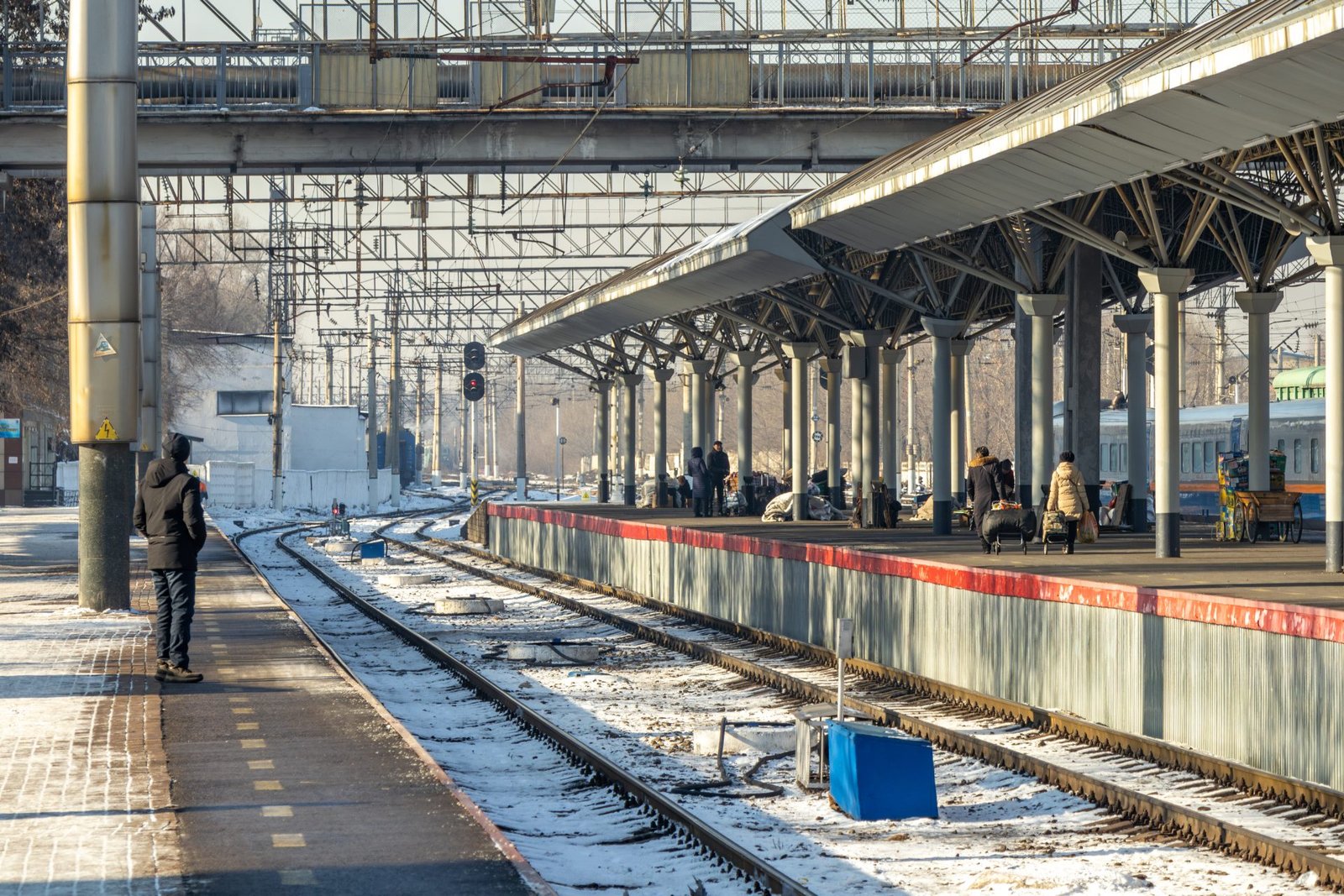
Photo: Алматы-1, первый и второй пути (1) by Nikolai Bulykin, via Wikimedia Commons, CC BY-SA 4.0.