
In short
UNESCO inscribed the Rock Mosques of Mangystau in July 2026 — five sites, Kazakhstan’s seventh property, and all still working pilgrimage places. Since late August 2026 Bozzhyra charges entry (foreigners pay double the standard 0.5 MRP) and drones are banned. Bozzhyra is 300 km from Aktau with the last 50 km on unsignposted 4WD track and no mobile signal.
Checked 27 August 2026 against the UNESCO inscription record and Kazakh reporting of the July 2026 regional decree.
On this page
In July 2026, UNESCO inscribed five rock-cut mosques in the Kazakh desert as a World Heritage Site. It is Kazakhstan’s seventh property, and English-language travel writing has not caught up with it at all.
Two months later, the region started charging for entry to its most photographed landscape, and banned drones.
Mangystau is roughly the size of Austria and the Czech Republic put together, and it is the most extraordinary place in Kazakhstan. Here is what actually applies, checked on 27 August 2026.
The mosques are now World Heritage
“Rock Mosques and Associated Sacred Sites of Mangystau” was inscribed in 2026 under criteria (ii) and (iii), at the 48th session of the World Heritage Committee in Busan.
Five components: Beket-Ata, Shopan-Ata, Karaman-Ata, Shakpak-Ata and Sultan-Epe. The property covers 91.88 hectares with a 501-hectare buffer.
These are prayer halls, mihrabs, contemplation rooms and saints’ tombs carved directly into rock, each associated with a Sufi spiritual master, dating from the twelfth to eighteenth centuries, with adjoining cemeteries spanning the tenth to twentieth. UNESCO’s framing is that they show how Sufi Islam absorbed and transformed older nomadic practices of ancestor veneration and sacred landscape.
They are working pilgrimage sites, not monuments. Kazakhs travel here in large numbers, particularly to Beket-Ata, and the shyrakshy — hereditary custodians — still keep them. UNESCO’s own recommendations stress preserving their “secluded character” and putting visitor-management protocols in place under a 2027–2032 management plan.
Visit accordingly. Dress conservatively, ask before photographing people, follow whatever the custodians indicate, and understand that if a place is busy it is because people have come to pray rather than to look. We could not find a source stating whether non-Muslim visitors face any restriction at these specific sites; the general Kazakh practice is that visitors are welcome with respect.
The new entry fees, and the drone ban
A Mangystau regional decree adopted on 20 July 2026 and published on 7 August introduced charges for state protected natural areas — covering the Kyzylsai regional park and Beyneu district, which between them include Bozzhyra and Bokty.
| Rate | |
|---|---|
| General admission | 0.5 MRP — about 2,163 tenge |
| Tourist trails | 0.2 MRP — about 865 tenge |
| Camping per tent | 0.1 MRP — about 433 tenge |
| Foreign citizens | Double the standard rate |
| Car | 2 MRP — about 8,650 tenge |
| Minibus | 3 MRP — about 12,975 tenge |
| Guide service | about 3,893 tenge |
Children under six go free, six to seventeen get half, students a quarter off. The MRP multiples are the reliable figures — our tenge conversions assume a 2026 MRP of 4,325, which we could not confirm from the budget law.
Drones and other unmanned aircraft are now banned, along with campfires outside designated areas, feeding wildlife and motorised watercraft. If you were planning aerial footage of the Fangs, that plan is over.
One honest wrinkle: two Kazakh outlets published on the same day giving different start dates — 17 August for the rules and 1 September for the tariffs. Assume you are paying, and carry cash.
Also new: a visitor centre at Bozzhyra has been running in technical mode since May 2026, handling 45 to 50 people a day, with a 14.9 km paved road to the upper viewing platform under construction. The access described below is going to get easier.
Bozzhyra
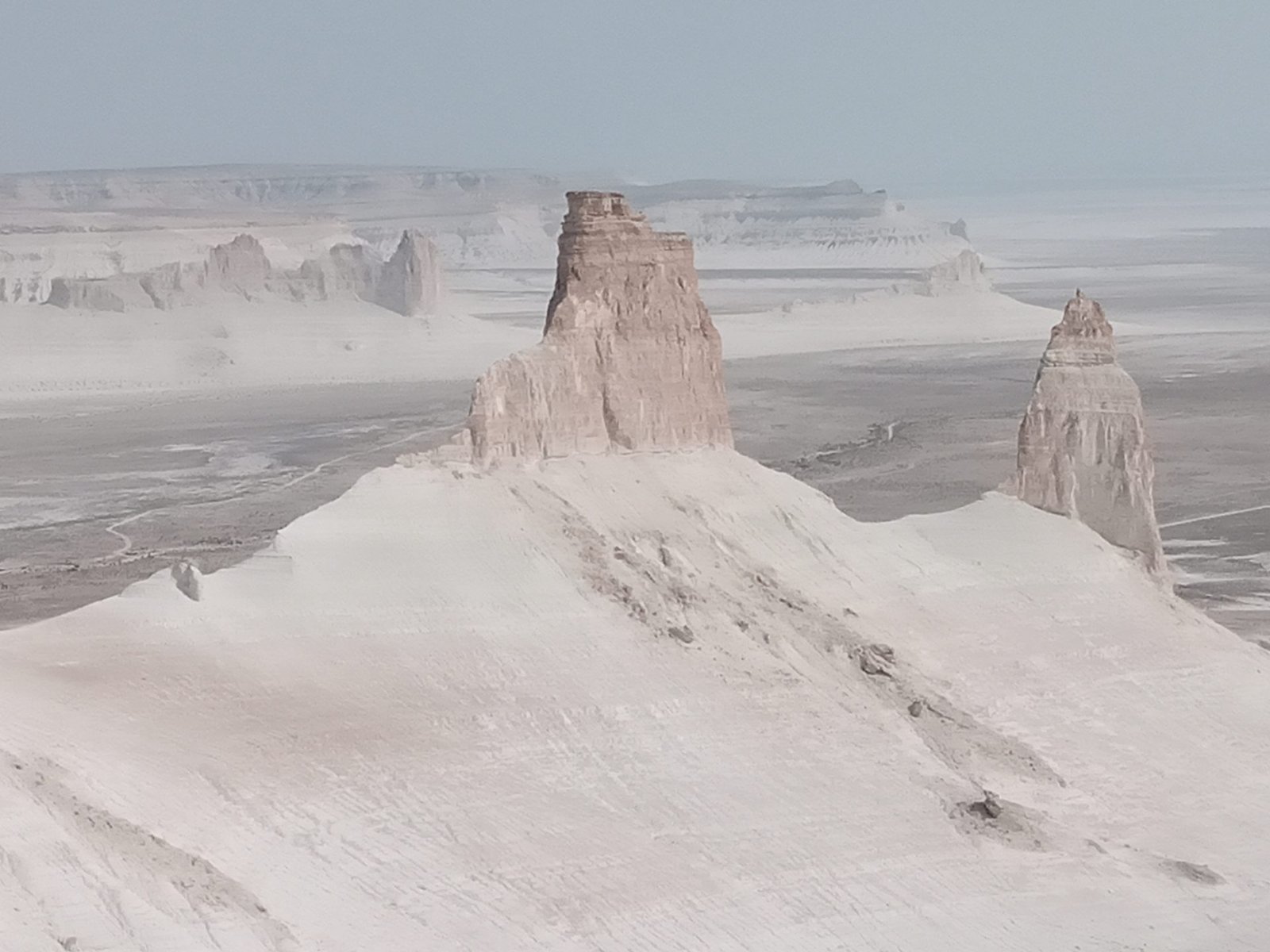
A valley of white chalk and limestone escarpments beneath the rim of the Ustyurt plateau, with two isolated pinnacles known as the Fangs.
About 300 km from Aktau — one operator’s day tour covers 590 km round trip, of which 530 is asphalt and 60 is dirt. The tarmac runs via Zhanaozen; the last 50 km need a genuine 4WD, and there are no signposts at all, so offline maps and GPS are not optional. An alternative approach from Shetpe is about 70 km and two to three hours, again with 50 km of off-road.
There is no mobile signal.
There are two vantage points: the upper rim, which gives the classic view, and the valley floor, reached by a steep descent that turns slippery after rain. Go at sunrise or late afternoon — midday sun flattens pale limestone into nothing.
Torysh, the Valley of Balls
A field of natural stone spheres, formed as mineral concretions precipitated around nuclei in ancient sea sediments and later exposed by erosion. They range from a few centimetres to four metres across, date to roughly 120 to 180 million years ago, and some contain Jurassic plant fossils.
108 km north-east of Aktau, about 8.5 km from Shetpe village, near Sherkala and the ruins of medieval Kyzylkala. No entrance fee is mentioned anywhere.
Sherkala
An isolated mountain, 332 metres high, a kilometre long and 650 metres wide, whose profile reads as a yurt, a drinking bowl or a sleeping lion depending where you stand. The name is Persian for “lion’s fortress.”
95 km from Aktau as the crow flies, 180 km by road, about three hours. Walking the circuit of its base takes about an hour. There are medieval remains around it including a caravanserai, and a yurt camp with facilities operates five kilometres away.
Getting here
Fly to Aktau (SCO). From Almaty there are 27 flights a week, about three hours, on SCAT, Air Astana and FlyArystan, with fares seen from around £55 one way. Aktau itself sits about 20 metres below sea level on the Caspian shore.
The train exists and we will not give you a number for it. The station is Mangyshlak on the Beyneu line, and journeys from Almaty run to several days, but we could not obtain a citable journey time or fare from any source.
The Caspian ferry: do not plan around it. The route is Alat, near Baku, to Kuryk — not Aktau — about 45 minutes south of the city. Port Kuryk’s own site says plainly that there is no fixed schedule; sailings depend on cargo and weather, crossings take about 18 hours in good conditions, and departures run roughly every three to five days with delays reported up to two weeks. Meanwhile the Kazakh operator’s site says it is not accepting bookings, with a launch that was targeted for April 2026 and operations complicated by falling Caspian water levels.
Freight ferries sail; passengers can sometimes get a berth through an agency in Aktau. That is not a service you build an itinerary on.
How you actually travel here
There is no public transport to any of the sites. This is 4WD country, and the honest options are:
- An organised tour with a driver-guide, which is what most visitors do and what we would recommend for a first trip
- Self-drive in a proper 4WD, which is realistic only if you are experienced in remote desert driving
Either way: carry far more water than you think you need, fill the tank at every opportunity, download offline maps, and tell someone your route. There is no signal across most of the region and distances between fuel stops are long.
When to go
April to May and September to October. Summer in this desert is punishing, and there is no shade anywhere in the landscapes above. Winter is cold and the tracks deteriorate.
What we could not verify
Whether the new fees apply to Torysh, Sherkala, Tuzbair or the mosques — the decree names only the Kyzylsai park and Beyneu district, and reporting names only Bozzhyra and Bokty. The exact date the tariffs took effect. The 2026 MRP value underlying our tenge conversions. Train times and fares to Aktau. Flight frequencies from Astana, as opposed to Almaty. And any explicit statement about non-Muslim access at the five inscribed mosques.
Also worth knowing: “Ustyurt: Landscapes and Aran Hunting Traps” sits on Kazakhstan’s UNESCO tentative list, submitted in 2021. It is not inscribed, and you will see it described as though it were.
For the country as a whole, see our Kazakhstan travel guide.
Photo: Bozzhyra valley, Mangistau, Kazakhstan by Berik Aday, via Wikimedia Commons, CC BY-SA 4.0.