
In short
Booking opens 60 days before departure — reportedly at 10:00 Tashkent time, though the railway publishes no official time, so be logged in by 09:45. Tashkent–Samarkand economy is 311,000 som (about US$26) since the 1 February 2026 rise. On eticket.railway.uz, foreigners must pick “Foreign Document” in the ID dropdown, and foreign cards only appear after the payment page is refreshed.
Fares from Uzbekistan Railways’ February 2026 increase; timetable current to 26 August 2026, including the second Khiva trainset added on 22 July.
On this page
- The one rule that matters
- Fares, from 1 February 2026
- The Khiva train is not an Afrosiyob
- Booking on the official site, step by step
- Paying with a foreign card
- When a reseller is worth the money
- The sleeper is not the poor relation
- Which Tashkent station
- At the station
- If you miss it
- What is coming
- What we could not verify
Uzbekistan has the best train network in Central Asia and one of the more awkward booking systems anywhere. A Silk Road itinerary that assumes you can turn up and buy tickets will fail, because the fast trains sell out — sometimes within hours of the booking window opening.
Here is how it actually works, with fares dated to the increase that took effect on 1 February 2026.
The one rule that matters
Booking opens 60 days before departure, and Afrosiyob seats can be gone the same day.
The 60-day window is well supported. The exact release time is not. Two independent sources — a thread of people who have actually booked, and a Russian-language Central Asia forum quoting the same instant in a different timezone — both point to 10:00 Tashkent time. A widely copied figure of 06:00 traces to a single site that also quotes fares roughly twenty per cent out of date and puts Afrosiyob at the wrong Tashkent station, so we would not rely on it.
Uzbekistan Railways does not publish the release time anywhere we could find. The practical answer: be logged in and ready by 09:45 Tashkent time, 60 days out.
Fares, from 1 February 2026
Uzbekistan Railways raised fares fifteen per cent on 1 February 2026, across Afrosiyob, Sharq, Nasaf and O’zbekiston services. A previous rise took effect in February 2025. These are the current published figures.
| Route | Economy | Business | VIP |
|---|---|---|---|
| Tashkent–Samarkand | 311,000 som | 455,000 | 709,000 |
| Tashkent–Bukhara | 509,000 som | 760,000 | 1,138,000 |
| Tashkent–Karshi | 429,000 som | 642,000 | 976,000 |
At roughly 11,800 som to the dollar, Tashkent to Samarkand in economy is about US$26, and Tashkent to Bukhara about US$43.
Journey times: Tashkent to Samarkand takes about two to two and a half hours, Tashkent to Bukhara about three hours forty. There is a restaurant car, and economy gets tea and a small snack.
For Samarkand to Bukhara we could find no official fare — the February announcement covered only the three routes above. Two secondary sources both give about 165,000 som, which is at least consistent, but treat it as unconfirmed.
The Khiva train is not an Afrosiyob
This trips up nearly everyone. The Tashkent–Khiva high-speed service that launched in 2026 uses completely different rolling stock from the Afrosiyob, which is a Spanish-built Talgo 250.
The Khiva train is a South Korean Hyundai Rotem EMU-250, named Jaloliddin Manguberdi — seven cars, about 390 seats, built to run between +50 °C and −40 °C. Trains 751 and 752. It made its first run on 5 May 2026, and you will find announcements claiming 1, 2 and 3 May; those were all superseded before launch.
Route: Tashkent — Samarkand — Bukhara — Urgench — Khiva, in about seven and a half hours. Before it existed, that journey took roughly thirteen and a half.
Fares: economy 780,000 som (about US$66), VIP 1,815,000 som (about US$154). Three classes are advertised but only those two fares have ever been published, and we could not find a business-class price anywhere.
Days of the week — this changed in July. The service launched with one trainset running three days a week each way. A second trainset entered service on 22 July 2026, and the pattern now is:
- Departs Tashkent: Monday to Saturday, 07:00 (no Sunday departure)
- Departs Khiva: Tuesday to Sunday, around 07:15 (no Monday departure)
Any source telling you this train runs three times a week is describing the timetable before 22 July 2026. Check the operator anyway before you plan around it.
Booking on the official site, step by step
The official site is eticket.railway.uz. There is also an Uzbekistan Railways app for iOS and Android that people report works.
- Switch the language. The interface defaults to Uzbek; English is top right. It may revert to Russian mid-session.
- Use a desktop browser, not mobile web. Reports are consistent on this.
- Pre-load your travellers. Fill in the “My Companions” section with everyone’s passport details before the window opens, so you are not typing passport numbers while seats disappear.
- Pick the right document type. This is the single most useful thing in this guide. On the document dropdown, foreigners must select “Foreign Document.” Not “Foreign Passport (UZ)” and not “Foreign Passport (RU)” — those are for Uzbek- and Russian-issued documents, and choosing them is a common cause of failure. We found this in a thread of actual bookers and in no mainstream guide.
- Details must match your passport exactly — surname, given name, passport number, citizenship, date of birth, gender.
Paying with a foreign card
Officially, Uzbekistan Railways’ own FAQ still states that only national Uzcard and Humo cards are accepted. In practice, foreign cards frequently do work, and the mechanism is odd enough to be worth describing.
The payment page initially shows only Humo and Uzcard, and a foreign card returns “card not found.” After refreshing, or simply waiting, a greyed-out Mastercard/Visa option appears; clicking it reveals two gateways, Octobank and Stripe, both of which have worked for foreign cardholders, with Stripe charging in your own currency. One traveller reported the option taking 51 minutes to surface.
So: it often works, it is not guaranteed, and the official position still says otherwise. Have a fallback.
When a reseller is worth the money
Bookaway and 12Go both sell Uzbek rail tickets and both reliably take overseas cards. Neither discloses a service fee, but you can infer it: Bookaway lists Tashkent–Samarkand from US$30 against an official fare of about US$26, and Tashkent–Bukhara from US$49 against about US$42. That is roughly a fifteen to twenty per cent premium.
Worth it for a single leg on a fixed itinerary, where the premium buys a working payment page and no 09:45 alarm. Poor value for a family of four or a multi-leg trip, where it compounds.
The sleeper is not the poor relation
Overnight and conventional services still run the same corridors, and on the long routes they make a real case for themselves.
| Route and class | Fare |
|---|---|
| Tashkent–Bukhara, platskart (open berth) | 177,990 som |
| Tashkent–Bukhara, kupe (4-berth) | 243,750 som |
| Tashkent–Bukhara, SV (2-berth) | 430,850 som |
| Tashkent–Khiva, platskart | 245,140 som |
| Tashkent–Khiva, kupe | 348,550 som |
| Tashkent–Khiva, SV | 640,390 som |
| Tashkent–Samarkand, Sharq second class | 200,060 som |
Tashkent to Khiva in platskart costs under a third of the high-speed economy fare and saves you a hotel night. On Tashkent–Samarkand, at two and a half hours, a sleeper is pointless.
One under-reported advantage: an overnight train ticket counts as your accommodation registration for that night, which matters because Uzbekistan requires you to be registered within three working days of arrival. We explain that rule in full in our guide to Uzbekistan’s registration rules.
Which Tashkent station
Tashkent Central, also called Northern, is where the Afrosiyob, Sharq, Nasaf and the Khiva train all depart. Take the metro to “Toshkent” station on the O’zbekiston line — it serves the main-line terminal directly.
Tashkent Yuzhny (South) handles regional and suburban services to Khojikent, Gulistan, Angren, Khavast and Bekabad. It is about seven kilometres away. Check which station your train uses; getting this wrong will cost you the train.
At the station
Security is tight. You will need your ticket and possibly your passport to enter the station building, and bags are screened before boarding. Check-in closes thirty minutes before departure, so aim to arrive thirty to forty-five minutes ahead — there is no official figure, and that range comes from an agency and a traveller account.
Tickets print in Cyrillic. Read your station name carefully.
Luggage: 36 kg of hand luggage per passenger travels free; up to 50 kg may be checked against a receipt.
Children: under fives travel free without their own seat, ages five to ten pay half fare with a seat, and over tens pay full.
If you miss it
The official refund scale is unforgiving, and worth knowing before you cut a connection fine:
- More than 24 hours before departure: a 15,000 som fee
- Under 24 hours but more than 6: 15,000 som plus half the seat cost
- Under 6 hours, up to one hour after departure: 15,000 som plus the full seat cost
- More than one hour after departure: no refund at all
What is coming
A third Hyundai Rotem trainset arrived in June 2026, out of six contracted and later increased to eight, with the extra units earmarked for Tashkent–Andijan and Tashkent–Termez. Ten Škoda electric multiple units are due from 2027 across regional routes, including circuits through the Fergana Valley.
There is also a national high-speed programme running to 2030, aiming to lift high-speed passenger numbers from 1.3 million a year to 3.25 million, with a Tashkent–Samarkand high-speed project under evaluation.
One route worth knowing about now: since 27 March 2026 the Afrosiyob has served Shakhrisabz three days a week — Friday, Saturday and Sunday — leaving Tashkent at 06:33 and returning from Shakhrisabz at 16:24. Neither the journey time nor the fare was published with the announcement.
What we could not verify
The exact ticket release time from any official source — the booking site is a JavaScript application we could not read, and the railway’s own FAQ is silent on both the window and the time. Whether the window differs by service. A live timetable pairing train numbers to departure times. The Samarkand–Bukhara official fare, and any business-class fare on the Khiva train.
We also could not substantiate reports of a national “unified ticket” rail system launching in 2026. What does exist is a new version of the online ticket service, an online queue dating from 2023, and electronic registration. We are not going to assert a unified system exists.
For the wider trip, see our Uzbekistan travel guide.
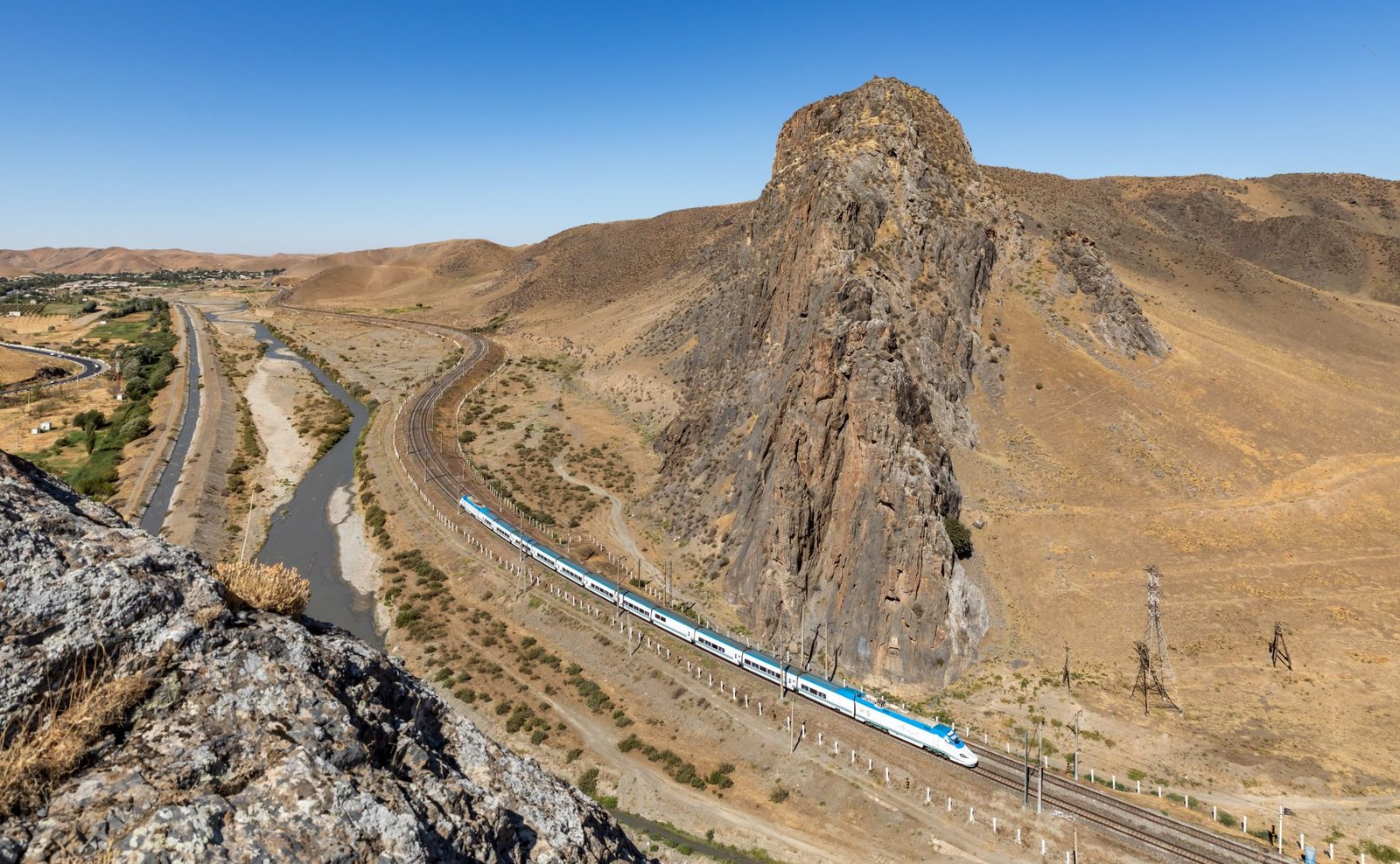
Photo: OTY Afrosiyob Jizzax – Gallaorol by Kabelleger, via Wikimedia Commons, CC BY-SA 4.0.