
In short
Takoyaki, okonomiyaki, kushikatsu and kitsune udon are entries in Japan’s Ministry of Agriculture, Forestry and Fisheries registry of regional dishes — so their definitions and origins can be checked rather than repeated. Two practical corrections follow from the same sourcing: Dotonbori touting is regulated by a city ordinance, not by custom, and Kuromon Ichiba’s own site encourages eating as you walk, which is the opposite of what most English guides advise.
Every claim traced to a government or market source, August 2026.
Osaka’s food writing in English runs on folklore. The origin stories are repeated without sources, the “rules” are asserted without checking whether anyone still follows them, and at least one widely-printed piece of etiquette advice is the precise opposite of what the market in question says on its own website.
The odd thing is that better sources exist. Japan’s Ministry of Agriculture, Forestry and Fisheries maintains a national registry of regional dishes, and takoyaki, okonomiyaki, kushikatsu and kitsune udon are all in it, with documented lineages and, in one case, a named originating shop and year. That is a government attribution, not a legend.
What is in this guide
- The four dishes, with government citations
- Dotonbori: what it is, and the law about touts
- Kuromon Ichiba, and the etiquette advice that is backwards
- “Kuidaore” — a proverb, not an etymology
- Where to eat, and what we could and could not price
- Michelin, accurately
- Practicalities for an eating trip
- What we could not verify
- Frequently asked questions
Here is Osaka’s food, sourced. Checked 20 August 2026.
The four dishes, with government citations
Takoyaki
The ministry’s registry documents the lineage: chobo-yaki in the late Meiji and Taisho eras, sold at sweet shops and festival stalls, became radio-yaki — named after the radio, then the cutting edge of civilisation, when broadcasting began in Japan in the mid-1920s. In early Shōwa, stalls in Osaka began putting octopus into radio-yaki, and takoyaki was sold.
The ministry names no inventor and no exact year. The modern sauce-and-toppings presentation it places after the Second World War.
Aizuya (会津屋) claims the invention, and it is worth reporting as the shop’s own claim rather than as fact. On its own site it names the founder Endō Tomekichi and the year 1935, and anchors the story to a customer’s remark: “In Osaka it’s meat, is it? In Akashi they put octopus in.” Aizuya also claims it was first to dissolve the flour in soy-seasoned dashi, and says its original takoyaki was served without sauce — sauce, salt, aonori and mayonnaise being later additions by other shops.
So: government-documented lineage, shop-claimed invention. Those are different things and most articles blur them.
Okonomiyaki, and the real Osaka–Hiroshima difference
This is the one everyone explains from memory, and the ministry has separate official entries for each prefecture.
Osaka’s defining technique is 混ぜ焼き — “mixed cooking.” The ingredients are mixed into the batter before it hits the griddle. The ministry explicitly contrasts this with the earlier layering method. In practice: flour mixed with dashi, shredded cabbage folded in with egg, griddled at about 200°C, flipped, pork belly laid on top, finished with sauce, aonori, katsuobushi and optional mayonnaise.
Hiroshima’s defining technique is layering and steaming. Thin batter spread wide, cabbage, pork and yakisoba noodles heaped on, a thin omelette laid over, and the whole thing steam-cooked in layers.
So the load-bearing difference is mixing versus layering — not “Osaka has no noodles.” Noodles are optional in Osaka (that is modan-yaki) and structural in Hiroshima. If you have read that the difference is the noodles, you have read a simplification that misses the actual technique.
The ministry also records Hiroshima’s intra-prefecture variants: Kure (thin udon, half-moon shape), Shōbara (rice instead of noodles, ponzu instead of sauce), Onomichi (gizzard and squid), Takehara (sake lees).
On Osaka’s claimed deep ancestry — that okonomiyaki descends from funoyaki, a tea sweet served at Sen no Rikyū’s tea gatherings in the Azuchi-Momoyama period — note that the ministry itself hedges, writing “it is said.” We are passing the hedge on rather than removing it.
Kushikatsu, and whether the no-double-dipping rule still holds
The rule is real and officially documented. The ministry’s registry states it plainly: because the sauce is shared between customers, the iron rule of “no double-dipping” is widely known.
The ministry’s origin account places kushikatsu in Shinsekai, near Tsūtenkaku, in the late Taisho to early Shōwa period, as cheap filling food for labourers — thin beef under thick breading.
Daruma, which claims to be the originator, gives its founding as 1929 in Shinsekai by Momono Yoshie, and states the rule on its own site along with the reason: so that other customers can use the shared sauce comfortably. It is a hygiene and sharing rule, not a flavour rule — which matters, because it tells you what the rule is actually for.
And here is the correction. The rule is no longer universal. Kushikatsu Tanaka, the largest kushikatsu chain, formally abandoned shared sauce vats in a corporate announcement dated 12 June 2020, switching to dispensing sauce onto skewers individually per party. Customers who prefer the old shared-bowl method can still ask for it.
Curiously, the chain’s consumer-facing site still advertises “no double-dipping” as a brand signature — the slogan has outlived the shared vat. So: observe the rule where there is a communal bowl in front of you, and do not be surprised when there is not one.
Kitsune udon — a named shop, from the government
This is the strongest attribution of the four, and it comes from the ministry rather than from a shop.
In 1893, at the udon shop Matsuba-ya in Semba — today Usami-tei Matsubaya — a customer put the fried tofu that had been served as a side dish on top of plain udon. That, the ministry records, is said to be the beginning of kitsune udon.
The method it describes: kombu-and-dried-fish dashi seasoned with sugar, salt and soy; the abura-age blanched then simmered separately in a second dashi with sugar and soy; served on hot udon with spring onion, kamaboko and yuzu. The ministry frames it as the plainest expression of the dashi culture Osaka people care most about.
Note the ministry hedges here too, with “it is said” — but a national government naming a specific shop and year is about as good as this kind of attribution gets.
Dotonbori: what it is, and the law about touts
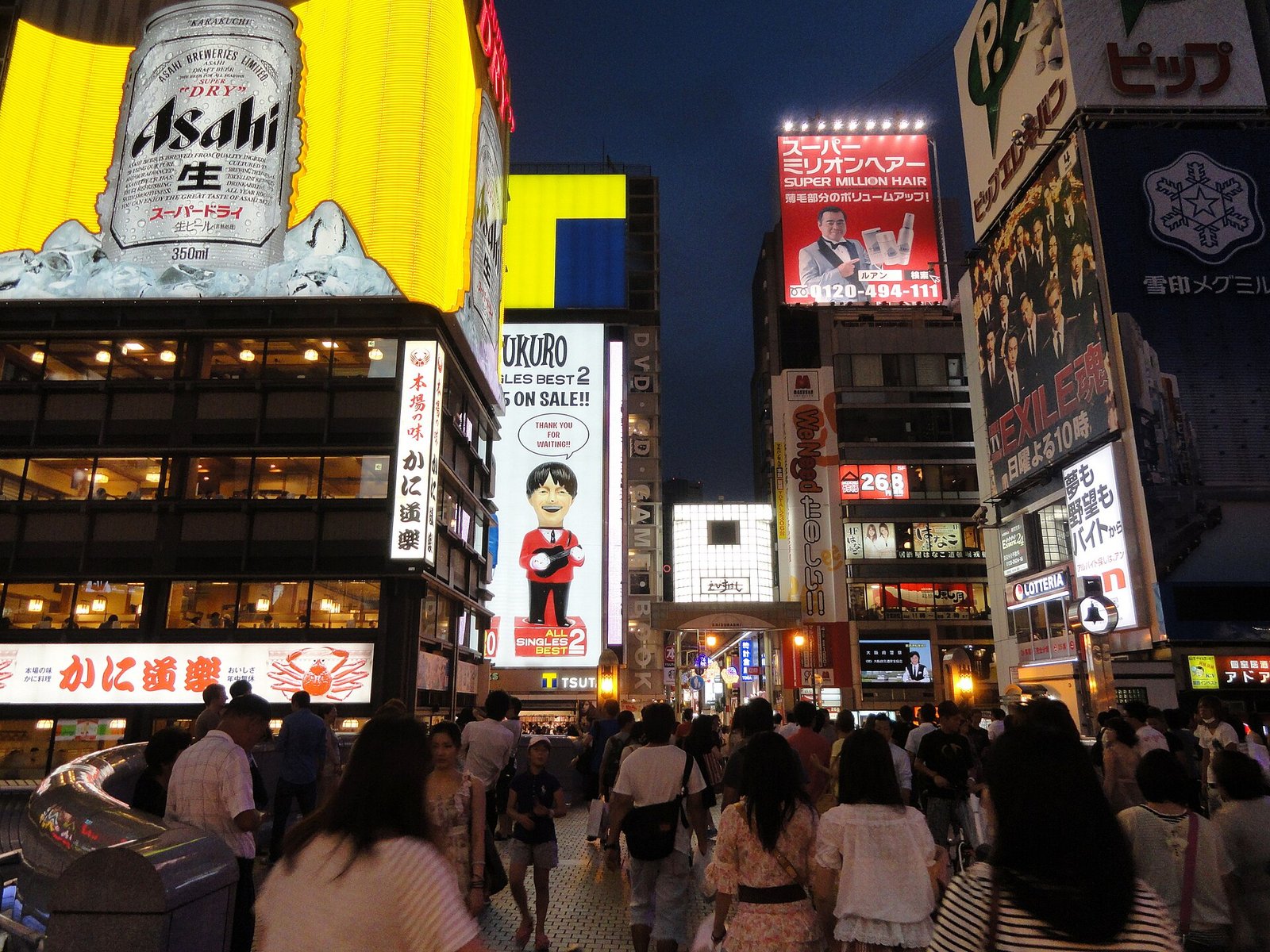
Dotonbori is a district, not a market or a single street of stalls. The official tourism bureau describes it as the symbolic business and shopping district of Minami, lined with giant three-dimensional signs, and names the Shochikuza theatre, the Kani Doraku crab and the Glico runner as the iconic ones. The riverside walkway is properly the Tombori Riverwalk.
The name comes from Yasui Dōton, who spent his fortune having the river excavated in 1612.
Now the useful part, which travel guides handle vaguely. Osaka City has an ordinance regulating touting, and it is not advisory.
- Prohibited citywide: soliciting someone who has refused; blocking, following or loitering; and causing others to do so on your behalf.
- Dotonbori sits inside a designated prohibition zone — the Minami district — where breaches carry an administrative fine of up to ¥50,000.
- The fine applies to touts, to shop operators and managers, and to contracted touting firms.
- It has been fully in force since 1 April 2021.
So the correct advice is not the usual vague “beware of touts.” It is: if someone on the street in Dotonbori tries to steer you into a bar, that solicitation is itself an offence. You owe them nothing, including politeness.
Kuromon Ichiba, and the etiquette advice that is backwards
Kuromon Ichiba is about 580 m of covered arcade holding roughly 150 shops, at Nipponbashi. The market says it took its name from the black gate of the nearby Enmyōji temple.
There are no unified opening hours. Each shop sets its own; the spread runs roughly 08:00 to 21:00, with most closing between 17:00 and 21:00, and closed days varying by shop. Plan for late morning to mid-afternoon if you want everything open.
And now the correction. A great many English guides tell readers not to eat while walking at Kuromon, presenting it as an etiquette rule.
The market’s own English page promotes the opposite. It calls Kuromon “a perfect place to enjoy Tabe Aruki, a culture of Osaka where we eat as we stroll,” and the Japanese site lists walk-and-eat menus as a market feature.
We checked the market’s home page, its English page, its rules page and its news page. No rule, prohibition, warning or manners notice about eating while walking, litter, photography or touting appears anywhere on the official Kuromon site.
Individual shops may still ask you to eat at their counter, and you should obviously do what the person selling you the food asks. But that is a shop-level courtesy, not a market rule, and writing it up as Kuromon etiquette misrepresents what the market says about itself.
“Kuidaore” — a proverb, not an etymology
You will read that Osaka is the city of kuidaore, variously translated as “eat until you drop,” “eat until you fall over,” or “eat yourself bankrupt.”
The official tourism bureau presents it as an old saying, not as an etymology it can prove: “Kyoto ruins itself on clothes, Osaka on food” — an old paired proverb.
What the bureau does support with historical argument is why the label stuck: Osaka Bay was so rich in fish that it was called a “fish garden”; Osaka was the nation’s kitchen in the Edo period, where ingredients from across Japan converged; and wealthy merchant patronage pushed up the standard of cooking.
So write it as the city’s own proverb, and treat any single literal derivation with suspicion. The bureau endorses the saying and offers no evidence for the specific literal readings that circulate in English.
The Kuidaore Tarō drum-playing mascot in Dotonbori, and the Nakaza Kuidaore Building, have their own official listing — that much is concrete.
Where to eat, and what we could and could not price
We only quote prices published as text on the operator’s own site. Most of Osaka’s famous restaurants publish theirs as images, which cannot be read, so we give hours and addresses instead of inventing numbers.
Chibo (千房), okonomiyaki — prices published as text, chain-wide, all as “from” figures: Dotonbori-yaki ¥1,480, Chibo-yaki ¥1,980, mixed negiyaki ¥1,650, grilled vegetables ¥450, teppan prawn ¥3,600, wagyu steak ¥5,600. The site notes prices differ by branch, so treat these as indicative chain prices rather than Dotonbori’s. Whether they include tax is not stated, so do not assume.
Jiyūken (自由軒), Namba — the famous dry curry with a raw egg in the middle. Text prices are published: signature curry ¥990, hayashi rice ¥990, chicken rice ¥880, omurice ¥960, katsu curry ¥1,050. But there is a live caveat: the shop’s own front page carries a notice of a price revision effective 14 July 2026, and the menu page is undated — so we cannot tell whether those figures are before or after it. Treat them as approximate.
Mizuno (美津の), Dotonbori — okonomiyaki, founded 1945, at 1-4-15 Dotonbori. Open 11:00 to 22:00, last orders 21:00. Its Thursday closing day was dropped in February 2026, so it is now effectively open daily — a change no older guide carries. Its menu is published as images and we are not transcribing prices.
Kushikatsu Daruma (元祖串かつ だるま) — founded 1929, 17 branches. Shinsekai main store 11:00 to 22:30 on weekdays, 10:30 to 22:30 at weekends; Namba main store from 11:30 on weekdays; Dotonbori from 11:00. Last orders 30 minutes before close. No menu page with prices could be reached.
Aizuya (会津屋), takoyaki — no prices appear as text or image anywhere on the official site. Hours by branch: main store in Nishinari 11:00 to 21:00, open year-round except New Year’s Day; Namba 11:00 to 22:00; Namba Walk 11:00 to 22:00; Tempozan 11:00 to 20:00, closed when the aquarium is closed; Tennoji Mio and KITTE Osaka to 23:00.
One closure to note: Aizuya’s Umeda HEP NAVIO branch closed permanently on 28 June 2026. Any guide still listing it is out of date.
Dōtonbori Imai, the udon house, founded 1946 — publishes no prices in any form, and neither hours nor a street address appear on its site. Hokkyokusei, the omurice originator, reached its centenary in 2022 and publishes no prices, hours or address either.
Michelin, accurately
From Michelin’s own announcement of the Kyoto Osaka 2026 guide, published 24 April 2026:
- The one new three-star went to Kyoto, not Osaka — Miyamasou, the first at that level in Kyoto in six years. If you have read that Osaka gained a three-star in 2026, that is wrong.
- Osaka took one new two-star (Teruya), seven new one-stars, and nine Bib Gourmand selections. Kyoto took 12 of the 21 Bib Gourmands.
- Kashiwaya Osaka Senriyama is confirmed as a three-star in Osaka, and its chef Hideaki Matsuo received the 2026 Mentor Chef Award.
- The inaugural Sommelier Award went to Miki Tanaka of LOUISE, Osaka.
We could not verify total counts of starred or Bib restaurants in Osaka — Michelin’s listing pages render in JavaScript and returned nothing to us.
Practicalities for an eating trip
August is a heat problem, not a walking problem. Japan Meteorological Agency normals for Osaka, 1991 to 2020: August averages 28.3 days at or above 30°C out of 31, with a mean daily maximum of 33.7°C and 9.9 days at or above 35°C. July is close behind at 22.6 days over 30°C. June is the wettest month at 185.1 mm.
The comfortable months for walking between food stops are April, May, October and November.
The lodging tax changed on 1 September 2025 and now bites much lower. It is a prefectural tax, not a city one — English sources calling it “the Osaka City hotel tax” have the right money under the wrong authority.
| Per person, per night | Tax from 1 Sept 2025 |
|---|---|
| Under ¥5,000 | None |
| ¥5,000 to ¥6,999 | ¥200 |
| ¥7,000 to ¥14,999 | ¥200 |
| ¥15,000 to ¥19,999 | ¥400 |
| ¥20,000 and over | ¥500 |
The exemption threshold dropped from ¥7,000 to ¥5,000 and every band rose, which means ordinary business hotels that were previously exempt now pay it.
Getting between the food districts: the Osaka Metro base fare is ¥190 for up to 3 km, rising to ¥240, ¥290, ¥340 and ¥390 by distance. The Enjoy Eco Card one-day pass is ¥820 on weekdays and ¥620 at weekends and public holidays, child ¥310, covering all Metro and Osaka City Bus lines. At the weekend it beats four ¥190 rides; on a weekday you need about four ¥240 rides to break even.
For the wider city, see our Osaka travel guide, the two-day Osaka itinerary and the best things to do in Osaka.
What we could not verify
- Prices at Mizuno, Dōtonbori Imai, Kushikatsu Daruma, Aizuya and Hokkyokusei — published as images, or not published at all.
- Whether Jiyūken’s listed prices predate its own 14 July 2026 revision.
- Whether Chibo’s published prices include tax.
- Total Michelin star and Bib Gourmand counts for Osaka.
- Any shop-level rule at Kuromon about eating at the counter — plausible and widely reported, but not on any official page.
- An Osaka Prefecture litter initiative in the Dotonbori shopping street — the press release exists in search indexes but the page returned 404.
Frequently asked questions
What food is Osaka famous for?
Takoyaki, okonomiyaki, kushikatsu and kitsune udon — all four are in Japan’s national government registry of regional dishes, along with 26 others from Osaka. Add omurice and the dry curry at Jiyūken.
Is it rude to eat while walking in Osaka?
Not at Kuromon Ichiba. The market’s own site actively promotes tabe aruki, eating as you stroll, as one of its attractions, and publishes no rule against it. Elsewhere, follow what the shop asks.
What is the difference between Osaka and Hiroshima okonomiyaki?
Per the agriculture ministry’s registry: Osaka mixes the ingredients into the batter before cooking; Hiroshima layers them — thin batter, then cabbage, pork and yakisoba noodles, then a thin omelette — and steam-cooks the stack. The difference is mixing versus layering, not simply the noodles.
Is the no-double-dipping kushikatsu rule real?
Yes, and it is officially documented — the shared sauce bowl is why. But it is no longer universal: the largest chain, Kushikatsu Tanaka, moved away from shared sauce vats in June 2020. Follow it where there is a communal bowl.
Who invented takoyaki?
The government registry documents the radio-yaki to takoyaki lineage in early-Shōwa Osaka but names no inventor. Aizuya claims it, giving 1935 and founder Endō Tomekichi — that is the shop’s own claim, not an official attribution.
Are the touts in Dotonbori dangerous?
Mostly they are just persistent. But touting in Dotonbori is an offence under a City of Osaka ordinance, carrying fines of up to ¥50,000 in the designated zone, in force since April 2021. Ignore them without guilt.
Photo: “Dotonbori, Osaka – DSC05742” by Daderot, via Wikimedia Commons, licensed CC0.