
In short
South Korea charges no accommodation tax, and hotel VAT is refundable — but the refund is the part to check before you rely on it. The minimum purchase is 15,000 won, not 30,000, with an immediate refund capped at 1,000,000 won per transaction and 5,000,000 won per trip. Eligible: foreigners staying under six months; services are excluded. On 7 August 2026 the finance ministry proposed ending the hotel VAT refund on 30 June 2027.
Verified against Korean government sources, August 2026.
South Korea is the rare destination where the tax system works in a visitor’s favour. There is no lodging tax and no tourism tax — not nationally, not municipally, not in Seoul. And foreign tourists can reclaim VAT on hotel stays, which is the opposite of the arrangement in Japan, where Tokyo, Kyoto and Osaka all add an accommodation levy.
That hotel VAT refund may not last. On 7 August 2026 the Ministry of Economy and Finance proposed ending it early, on 30 June 2027, in its 2026 Tax Reform Plan. It is a proposal, not law. But if you are planning a 2027 trip, it is the single most consequential thing on this page.
What is in this guide
Here is what a trip actually costs, with the official figures, checked 20 August 2026.
The taxes: what you do not pay, and what you can claim back
No lodging tax
South Korea levies no tourism tax and no accommodation tax at any level of government. We looked for one nationally and municipally, including Seoul, and found none.
For anyone combining Korea with Japan, that is a real difference. Our Japan lodging tax calculator shows what the Japanese cities charge; Korea’s equivalent line is zero.
The hotel VAT refund, and the threat to it
Foreign tourists can claim back VAT on hotel accommodation. The Ministry of Culture, Sports and Tourism designates participating hotels quarterly.
The condition on the hotel is the part nobody writes about: a hotel qualifies only if it has not raised its average daily rate by more than 10% against the same period the previous year. It is, in effect, a price-restraint scheme dressed as a tourist incentive.
The conditions on you:
- Not a Korean national, and holding no residence or work visa
- In Korea for less than six months
- Leaving the country within three months of checking out
- Staying fewer than 30 days
- Paying the hotel directly
Breakfast included in the room rate is covered. Other charges billed to the room are not.
Two honest caveats. First, we could not verify the refund rate, so we are not going to tell you “you get 10% back.” Second, sources disagree on the scheme’s legislated end date — some say 31 December 2026, others 31 December 2028 — so we are not printing one.
And then there is the August 2026 proposal to end it on 30 June 2027. The ministry’s stated reasoning is that the effect on where foreigners choose to travel is negligible and the benefit concentrates in luxury hotels in Seoul, Busan and Jeju. Watch this before you build a 2027 budget around it.
The general VAT refund, and the number everyone gets wrong
The minimum purchase for a VAT refund is 15,000 won, not 30,000. That correction is worth real money over a trip, because it brings ordinary purchases into scope.
| Immediate refund, at the till | Standard refund, claimed later | |
|---|---|---|
| Minimum purchase | 15,000 won | 15,000 won |
| Cap per transaction | 1,000,000 won | City refund 6,000,000 won |
| Cap per trip | 5,000,000 won | — |
Eligible: foreigners staying under six months.
Not eligible: services. That means restaurant meals, massages and the like are out — a common and expensive misunderstanding. Also excluded: goods you have opened or used, and duty-free purchases (which were never taxed).
The airport charge
Nothing is collected at the airport. The passenger service charge is embedded in your ticket: 17,000 won at Incheon and Gimpo, 12,000 won elsewhere, 10,000 won for transfers.
What you will actually spend
Food
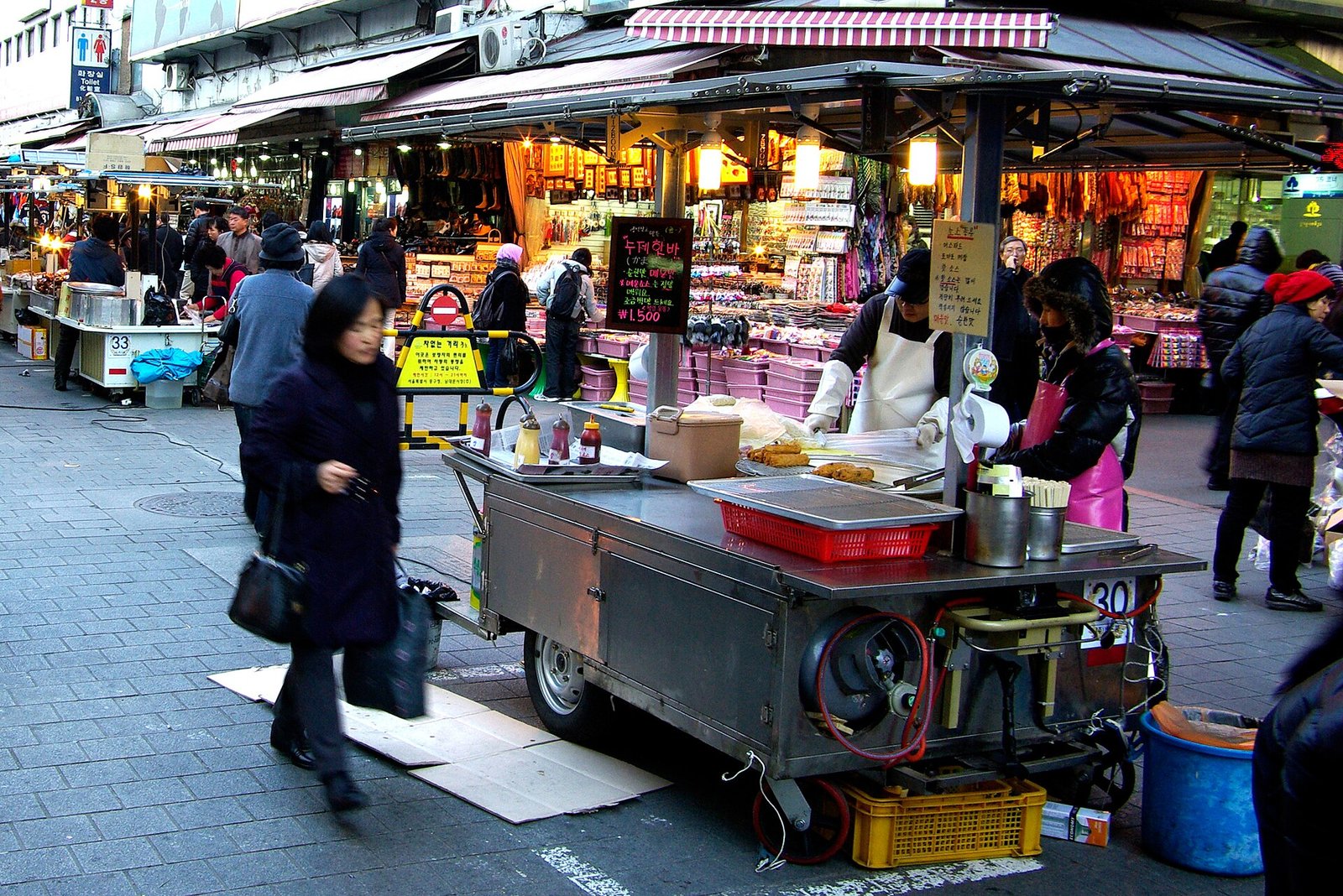
South Korea publishes official restaurant price statistics, which is unusual and makes budgeting unusually reliable. These are Seoul averages from the Korea Consumer Agency, April 2026.
| Dish | Seoul average |
|---|---|
| Kimbap | 3,800 won |
| Jjajangmyeon | 7,731 won |
| Kimchi jjigae set meal | 8,654 won |
| Kalguksu | 10,038 won |
| Naengmyeon | 12,615 won |
| Samgyetang | 18,154 won |
| Samgyeopsal, per 200 g portion | 21,321 won |
Kalguksu passed 10,000 won for the first time in 2026. By the June update kimbap had reached 3,838 won, up 5.9% year on year — the fastest riser of the eight dishes tracked, on rice up 13.2% and eggs up 9.0%.
Three things that will make your barbecue bill higher than that table suggests.
Meat is priced per person (1인분) and everyone at the table is expected to order at least one portion. Two people is about 42,600 won in meat alone at the official average, before rice, stew or drinks.
The portion is no longer 200 g. A survey of 20 grill restaurants in Jongno found only two serving a full 200 g; most served 150 to 160 g and some 120 to 130 g, at the same price. It is discussed openly in Korea as shrinkflation.
Banchan, though, are free and unlimited — the little side dishes keep coming at no charge. Rice, stews and noodles are extra.
Soju: restaurants buy a bottle for 1,530 to 1,560 won and sell it at 4,000 to 5,000 — 6,000 somewhere smart. 7,000 to 10,000 is gouging. The pre-pandemic norm was 3,000 won, so the restaurant price has roughly doubled in three years. We could not verify supermarket or beer prices.
Tipping: there is nothing to add
Most guides tell you tipping is not customary. The accurate statement is that all-in pricing is a legal requirement.
Under the final payment price display rule, food and drink businesses may not display VAT or a service charge separately. The menu price must be the final price the customer pays. Non-compliance draws an order, then a seven-day closure, then a fifteen-day closure.
The number on the menu is the number you pay.
Admissions
This is where Korea gets genuinely cheap, and where the guides are most out of date.
| Site | Admission |
|---|---|
| Gyeongbokgung | 3,000 won |
| Changdeokgung | 3,000 won |
| Changgyeonggung | 1,000 won |
| Deoksugung | 1,000 won |
| Jongmyo | 1,000 won |
| Combined ticket, all five | 6,000 won |
| Huwon (Secret Garden) | 5,000 won on top of the Changdeokgung ticket |
| Bulguksa, Seokguram and 63 other temples | Free |
| Daereungwon, Gyeongju | 3,000 won |
| Donggung Palace and Wolji | 3,000 won |
| Korean National Museum, permanent collection | Free |
| Hwaseong fortress wall, Suwon | Free |
| Hwaseong Haenggung | 2,000 won |
Free at the palaces: anyone 18 and under, anyone 65 and over, anyone wearing hanbok, and everyone on Culture Day, the last Wednesday of each month.
The temple change is the big one. Since 4 May 2023, 65 Jogye Order temples holding nationally designated heritage have charged nothing, with the state compensating them — 41.9 billion won budgeted in 2023. Guides still quoting 6,000 won for Bulguksa are three years out of date. Only five temples still charge. Our guide to Korea beyond Seoul has the detail.
Two warnings on the palace prices.
They have been frozen since 2005, and the National Heritage Service is reported to be announcing new prices in November 2026 for implementation on 1 January 2027, possibly with a domestic-versus-foreign distinction. That is trade press rather than official announcement, so treat it as a signal rather than a fact — but every price on this page has a known shelf life.
And the combined ticket’s validity is disputed. The Heritage Service’s own English page says three months; Seoul city’s media page says six. We are going with three, because the Heritage Service is the authority.
The hanbok rule, correctly stated
Free palace entry for hanbok wearers is real, and the rules are more permissive than English guides suggest.
- Valid at the four main palaces, Jongmyo, and 40 Joseon royal tombs
- It must be two pieces: an upper garment (jeogori) plus a lower one (chima or baji). The jeogori must keep its wrap-front form; ties are not required
- Not accepted: a durumagi alone, a one-piece dress, gonryongpo, cheollik
- Fusion hanbok is not banned. Both traditional and modernised saenghwal hanbok are accepted. What gets refused is the cut — the one-piece “hanbok dress” — not the modernity
- Wearing the opposite sex’s hanbok has been permitted since July 2019
- No age limit
Transport
Busan Metro is 1,600 won for zone 1 and 1,800 won for zone 2, unchanged since 3 May 2024 — higher than most visitors expect.
Two dates change the transport picture, and we are not writing the transport guide until they pass:
- 1 September 2026: KORAIL and SR merge. KTX fares fall by about 10% and the SRT brand is absorbed.
- 1 October 2026: the Seoul Climate Card is discontinued and replaced.
Any transport costing you read that predates those is going to be wrong. We will publish a proper transport and rail-pass guide once the new fares are live.
Customs, and an official page that is out of date
Worth knowing if you are buying alcohol.
- Basic duty-free allowance: 800 USD
- Alcohol: 2 litres and under 400 USD. The limit on the number of bottles was abolished on 21 March 2025 — but the tourism organisation’s own page and Incheon Airport’s page still say “2 bottles.” A good illustration that official does not mean current.
- Tobacco 200 cigarettes; perfume 100 ml; currency declaration over 10,000 USD
- No allowance at all for under-19s on alcohol or tobacco
- Since 1 May 2023, travellers with nothing to declare do not fill in a customs form
A daily budget
These are our own estimates built from the official figures above, not published data — treat them as a model rather than a measurement. Per person per day, excluding accommodation and international flights.
| Daily | |
|---|---|
| Frugal — kimbap and noodle-shop meals, metro, free temples and museums | 25,000–35,000 won |
| Comfortable — one sit-down meal a day, a paid palace or two, taxis occasionally | 55,000–75,000 won |
| Generous — barbecue with drinks, everything ticketed, taxis freely | 110,000–150,000 won |
Accommodation is deliberately absent, and we should be straight about why: we could not verify a reliable current price band for Korean hotels from an official source. Rather than invent a range, we have left it out. Add your own quoted rate — and remember there is no lodging tax on top of it, and that you may be able to reclaim the VAT.
What we could not verify
- The hotel VAT refund rate, and the scheme’s legislated end date, on which sources disagree.
- A reliable accommodation price band for any Korean city.
- Supermarket alcohol and beer prices.
- Admission to Seongsan Ilchulbong’s summit path on Jeju.
- Gyeonggijeon’s fee at Jeonju.
- The full 12-month Seoul climate table and the count of days above 30°C — the meteorological administration’s tables load through JavaScript.
- Gamcheon, Haeundae and Jagalchi in Busan.
Frequently asked questions
Is there a tourist tax in South Korea?
No. There is no national or municipal lodging tax or tourism tax anywhere in the country, including Seoul. Korea instead refunds hotel VAT to qualifying foreign visitors — though a Ministry of Finance proposal of 7 August 2026 would end that scheme on 30 June 2027.
What is the minimum spend for a VAT refund in Korea?
15,000 won, not the 30,000 that is widely repeated. Caps are 1,000,000 won per transaction and 5,000,000 won per trip for immediate refunds. Services, including restaurant meals, are not eligible.
Do you tip in South Korea?
No. Businesses are legally barred from displaying VAT or service charges separately — the menu price must be the final price. There is nothing to add.
How much are the Seoul palaces?
3,000 won for Gyeongbokgung or Changdeokgung, 1,000 won for Changgyeonggung, Deoksugung or Jongmyo, and 6,000 won for a combined ticket. Huwon is 5,000 won extra. Free if you are 18 or under, 65 or over, wearing hanbok, or visiting on the last Wednesday of the month.
Is Bulguksa free?
Yes. Since 4 May 2023, 65 major temples including Bulguksa and Seokguram have charged no admission, with the government compensating them. Only five temples still charge.
How much does a day in Seoul cost?
On our own model: roughly 25,000 to 35,000 won frugally, 55,000 to 75,000 won comfortably, or 110,000 to 150,000 won generously — per person, per day, before accommodation. Korean barbecue for two is about 42,600 won in meat alone.
Do I need a K-ETA for South Korea?
If you hold a US or UK passport, you are exempt until 31 December 2026 — but the exemption does not remove the arrival card requirement. See our full guide to the K-ETA rules, and our Seoul travel guide for the city itself.