
In short
Ten days across Istanbul, Cappadocia and the coast, with the driving decision made explicitly: on the coastal leg local car hire becomes the best decision of the trip. Two rules that catch people out — you need a 1968 international driving permit, as the 1949 version is no longer accepted, and motorway tolls are electronic-only, with no cash lane.
Entry and driving rules verified against official sources, August 2026.
Disclosure: some links in this guide are affiliate links. If you book through one, we earn a small commission and you pay exactly the same price. We only link to services we would use ourselves, no brand pays for placement or for a favourable write-up, and every price in this article was researched independently.
Ten days is the length at which a Türkiye trip stops feeling like a commute and starts feeling like a holiday. Seven is enough for Istanbul plus one other region. Fourteen lets you add the southeast or the Lycian coast. Ten sits exactly on the line where you can see the three things most people come for — Istanbul, Cappadocia and the classical Aegean — without spending half of it in transit.
What is in this guide
That last clause is the whole design problem. Türkiye is bigger than it looks on a map that also contains Greece. Istanbul to Antalya is further than London to Edinburgh. There is no high-speed train to Cappadocia, none to Antalya, and none between Istanbul and İzmir, so every leg is either a flight, a long coach, or a drive. The itinerary below is built around minimising those legs rather than maximising the pin count.
We have written it as a route with the transport specified, the timings realistic, and the costs dated — and we have flagged the two decisions where a reasonable person would do something different.
Editor’s note
This itinerary assumes you arrive and depart Istanbul, which is how most long-haul flights work, and that you are travelling in one of the two good windows — late April to early June, or mid-September to late October. In July and August the Ephesus and Pamukkale days need to shift to first thing in the morning. Prices are dated where given; transport figures are from August 2026 and opening arrangements change, so re-check the specific sites in the week before you go.
The route at a glance
| Days | Where | Nights | How you got there |
|---|---|---|---|
| 1–3 | Istanbul | 3 | Arrival |
| 4–5 | Cappadocia | 2 | Flight to Kayseri or Nevşehir, or overnight coach |
| 6–7 | İzmir and Ephesus | 2 | Flight Kayseri–İzmir, usually via Istanbul |
| 8 | Pamukkale | 1 | Coach or car, İzmir–Denizli, 3 h 13 |
| 9–10 | Istanbul | 2 | Flight Denizli or İzmir–Istanbul |
Four internal moves, three of them by air, one by road. That is close to the minimum for this set of destinations. Every alternative we tested either added a move or cut something people regret cutting.
The two honest alternatives. If Cappadocia’s balloons are the reason for the trip, add a night there and take it from the second Istanbul block — a single spare morning is not enough insurance against a wind cancellation. And if you would rather swim than look at ruins, replace days 6–8 entirely with Antalya and the Lycian coast; it is a better holiday and a worse survey of the country.
Days 1–3: Istanbul
Day 1 — the historic peninsula. Land, drop bags, and do not attempt anything ambitious. Sultanahmet’s core — Hagia Sophia, the Blue Mosque, the Hippodrome, the Basilica Cistern — is a compact walk, and jet lag is real. Get an İstanbulkart at the airport or the first metro station and load it; a journey costs 46.20 TL and the card works on the ferries too.
If you land early and cannot check in until 14:00, this is the day left luggage earns its keep. Radical Storage has drop points near Sultanahmet and Taksim, and walking the peninsula with a wheelie bag on those cobbles is a mistake you make once.
Eat lunch at an esnaf lokantası, pointing at the steam table — 250 to 500 lira for a proper meal — and treat the restaurant strip immediately around the Blue Mosque as scenery rather than dinner.
Day 2 — Topkapı, the bazaars, and across the water. Topkapı Palace deserves a full morning and the Harem is a separate ticket worth buying. Walk down through the Grand Bazaar and the Spice Bazaar to Eminönü — buy a balık ekmek at the water, 150 to 200 lira — then take the ferry to Kadıköy on the Asian side for the afternoon. This is the single best-value thing in Istanbul: a proper Bosphorus crossing for 65.21 TL on your İstanbulkart, and a neighbourhood where people actually live.
Day 3 — Beyoğlu, Balat, and the Bosphorus. Galata Tower and the Karaköy waterfront in the morning, İstiklal and the Cihangir side streets after. Then Balat and Fener, whose painted houses are the photograph everyone brings home. Finish with a longer Bosphorus ferry north — the public boat, not a tour boat, costs a fraction as much and shows you the same shoreline.
Where to stay: Karaköy, Galata or Beyoğlu over Sultanahmet. You lose five minutes’ walk to Hagia Sophia and gain a neighbourhood that is open in the evening.
Days 4–5: Cappadocia
Getting there. Fly to Kayseri (ASR) or Nevşehir (NAV) — about ninety minutes, and both airports run shuttle transfers into Göreme. Or take the overnight coach: Istanbul–Nevşehir is 1,500 TL and 10 hours 22, with departures clustering between 20:00 and 23:00 and arrivals between 07:00 and 09:30. Turkish coaches are 2+1 recliners with an attendant serving tea, not what the word “bus” suggests to a British or American reader, and taking the overnight saves you a hotel night. There is no train; do not let anyone tell you otherwise.
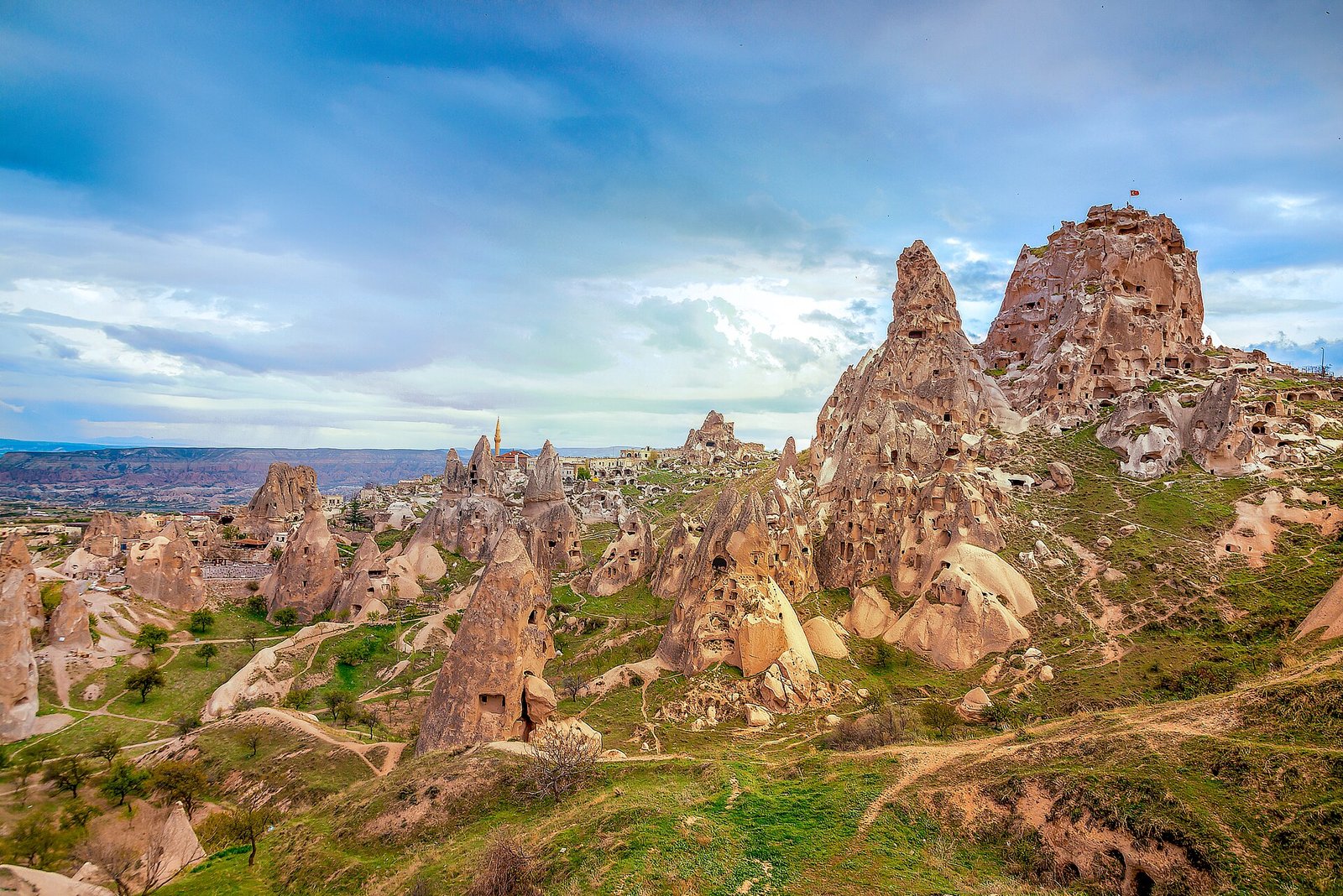
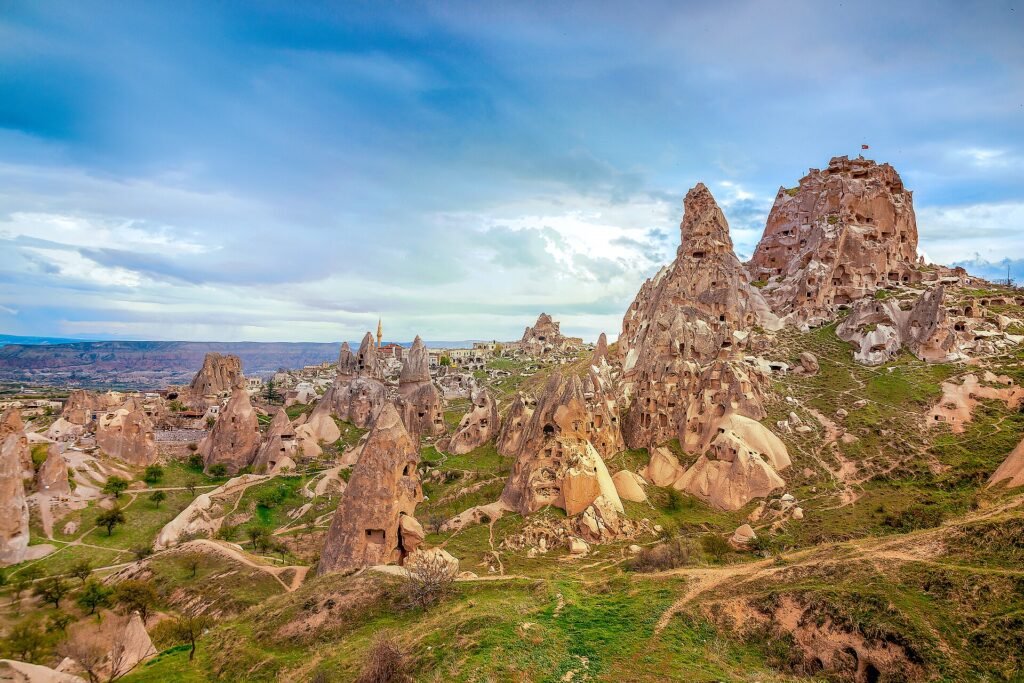
Day 4 — the central valleys. Göreme Open Air Museum first thing, before the coach parties. Then the Uçhisar rock castle for the view over the whole basin, and Paşabağ and Devrent for the fairy chimneys. Sunset from Rose Valley or the Göreme panorama. This is a day you can do on foot and by dolmuş if you are prepared to walk, and it is a day that a car or a guided vehicle makes considerably easier.
Day 5 — the outer valleys and the underground. Derinkuyu or Kaymaklı underground city, Ihlara Valley, and Avanos for the pottery. These are spread out and awkward on public transport, which is the honest case for a guided day here — more so than anywhere else in Türkiye. If you want the structure without a coach party, WeGoTrip’s self-guided audio tours work well in Cappadocia because the geology genuinely needs explaining.
The balloons. Flights launch before dawn and are cancelled for wind, not cold. September and October have the lowest cancellation rate, April and May are close behind, and winter has the most. Book direct or through a named operator, not a street desk. And note the temperature: Nevşehir’s mean minimum is below freezing from November to February and only 5.1 °C in April. The days are warm; the 5 a.m. call is not.
Where to stay: a cave hotel in Göreme, Uçhisar or Ürgüp. This is the one place in Türkiye where the accommodation is part of the attraction rather than an upsell, and we would defend the splurge.
Days 6–7: İzmir and Ephesus
Getting there. Kayseri or Nevşehir to İzmir, usually connecting through Istanbul, around three to four hours door to door. This is the least elegant leg of the trip and there is no better version of it — the Ankara–İzmir high-speed line was originally targeted for 2027, but no opening year has been reaffirmed and it does not help you now.
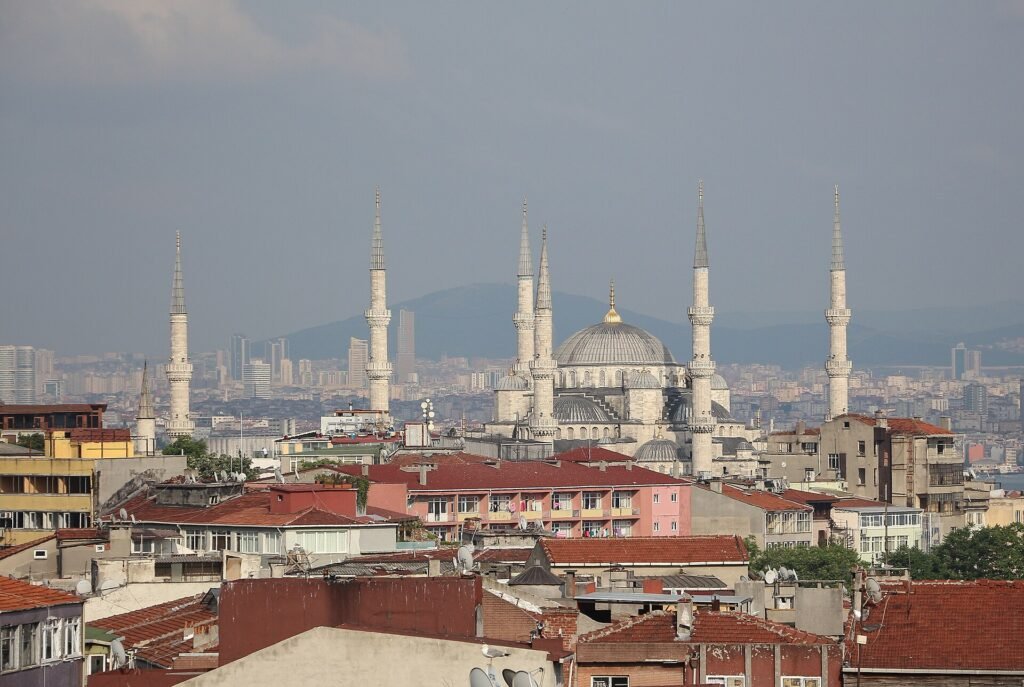
Day 6 — Ephesus and Şirince. Ephesus is the reason you came to this corner of the country: the Library of Celsus, Curetes Street, the Great Theatre, and the Terrace Houses, which are a separate ticket and are the part most people skip and then regret skipping. Go at opening. The site is large, largely unshaded, and unlabelled in places, so it repays either a guide or an audio tour.
Afternoon in Şirince, the hill village above Selçuk, or the Basilica of St John and the İsa Bey Mosque in Selçuk itself if you would rather stay with the archaeology.
Day 7 — İzmir. Konak Square and the clock tower, the Kemeraltı bazaar — which is a working market rather than a tourist one and is better for it — the Agora of Smyrna, and then the Kordon waterfront in the evening, which is where İzmir goes to walk. If you would rather have another coastal day, Çeşme and Alaçatı are ninety minutes west.
A practical note on İzmir transport, because guides get this wrong: buses, the metro and the trams are flat fare, not distance-based. The distance-based “pay as you go” system applies to İZBAN suburban rail beyond about 20 km and to a short list of long-distance suburban routes, not to the city network you will actually use.
Where to stay: Alsancak in İzmir, for the walk to the Kordon. Or Selçuk, if you want to be at Ephesus for opening and skip İzmir entirely — a defensible trade.
Day 8: Pamukkale
Getting there. İzmir to Denizli is 420 TL and 3 hours 13 by coach, with around 95 departures a day, or the same by car on a good road. Denizli town is 20 km from the travertines; Pamukkale village is at the foot of them.
The site. Pamukkale and Hierapolis are one ticket and one visit — the white terraces are the photograph, but Hierapolis above them is a substantial Roman city with a theatre and a necropolis, and it is what fills the day. Two things worth knowing before you go:
- You can bathe in the designated pools. UNESCO’s own site description states that areas where visitors can bathe in the hot springs have been established. What is prohibited is walking on the terrace formations outside the marked barefoot path — that restriction is about the travertine, not about the water.
- Cleopatra’s Antique Pool reopened on 1 May 2026 after sixteen months closed. Any guide describing a swim there during 2025 is describing something that did not happen.
Go early or late. Denizli averages 34.8 °C in July and the travertines are unshaded white stone walked barefoot, which reflects the heat straight back up at you.
Where to stay: one night in Pamukkale village lets you be on the terraces at opening and again at sunset, which is when they are worth the trip. Karahayıt, four kilometres north, has the red springs and the larger thermal hotels.
Days 9–10: back to Istanbul
Getting there. Denizli has a small airport with Istanbul flights; İzmir has many more. Either way it is about an hour and fifteen in the air.
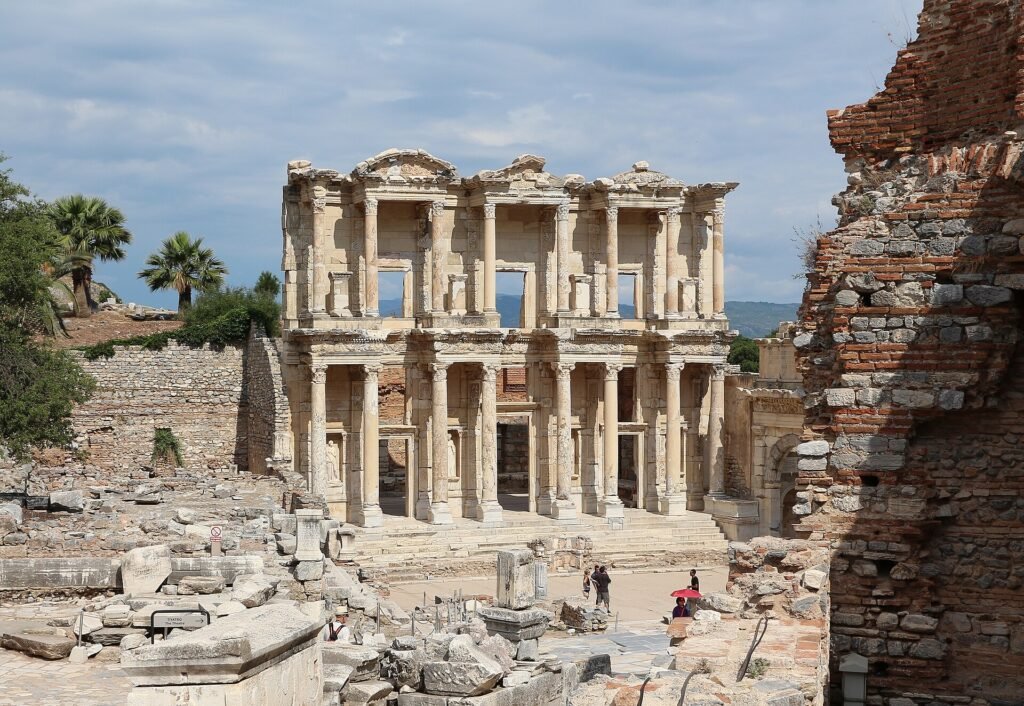
Day 9 — the Istanbul you did not have time for. Süleymaniye Mosque, which is quieter and, to a lot of people, better than the Blue Mosque. The Chora Church mosaics. Ortaköy and the Bosphorus bridges. Or a hamam, which is the correct use of a penultimate day.
Day 10 — depart. Keep this day soft. Which brings us to the single most common Istanbul logistics failure.
The two-airport trap. İstanbul Havalimanı (IST) is on the European side, north of the city, and handles Turkish Airlines and all long-haul. Sabiha Gökçen (SAW) is on the Asian side and is where Pegasus and the cheapest AJet domestic fares operate. There is no rail link between them; the M11 serves IST and the M4 serves SAW, and connecting means a long cross-city journey over the Bosphorus. If your itinerary arrives at one and departs from the other, allow three hours. Check this before you book the internal flights, not after.
What this costs
Per person, sharing a double, mid-range, on the ground and excluding international flights:
| Line | TL |
|---|---|
| Hotels, 9 nights averaging 4,800 (per person) | 21,600 |
| Accommodation tax at 1% | 216 |
| Internal flights, three legs | 5,500 |
| İzmir–Denizli coach and local transfers | 2,400 |
| Local transport, three cities | 2,500 |
| Food, 10 days | 13,000 |
| Sights: Göreme, Ephesus, Terrace Houses, Pamukkale, Topkapı | 6,000 |
| Incidentals, water, coffee, tips | 2,500 |
| Total per person | ≈53,700 TL |
At the Turkish central bank’s rate of 18 August 2026 — 55.47 TL to the euro, 64.93 to the pound, 47.92 to the dollar — that is roughly £830 / $1,120 per person. A Cappadocia balloon flight is priced in euros by most operators and sits outside this figure entirely; budget it as its own line.
Two cost notes. The accommodation tax is 1 per cent until 31 December 2026 and reverts to 2 per cent on 1 January 2027. And mandatory service and cover charges have been illegal since 30 January 2026 — if one appears on a restaurant bill, you can decline it. Voluntary tipping is unaffected and now matters more: ten per cent in cash at a sit-down restaurant.
Common questions
Can I do this in the reverse direction? Yes, and it is slightly better if your long-haul flight arrives in the morning: Istanbul at the end means you are not fighting jet lag through the peninsula. The route works either way.
Could I do it without flying? Not in ten days. Istanbul–Cappadocia is ten hours by coach and Cappadocia–İzmir is not a sensible road journey. If you are committed to surface travel, drop one region and take the coaches.
Is ten days enough for Türkiye? For these three regions, yes, at a brisk pace. It is not enough to add Antalya or the southeast — that is a fourteen-day trip.
Should I hire a car? Not for this itinerary. It would be dead weight in Istanbul and İzmir, and Cappadocia’s valleys are the only stretch where it clearly helps. If you extend to the Lycian coast, the answer flips completely and local car hire becomes the best decision of the trip. Note that you need a 1968 international driving permit — the 1949 version is no longer accepted — and that motorway tolls are electronic-only.
What about the balloon flight — how much spare time do I need? One spare morning is the minimum and two is safer. Flights are cancelled for wind, and in the wrong season that happens often enough to matter. If the balloon is the reason for the whole trip, build the itinerary around three Cappadocia nights rather than two.
Is this too much moving? It is four moves in ten days, which is at the upper end of comfortable. If you would rather slow down, cut Pamukkale — it is the most easily removed piece and it costs you a day of coach travel as well as the night.
When should I go? Late April to early June, or mid-September to late October. In July and August the Ephesus and Pamukkale days need to start at opening, and Cappadocia’s valley walking becomes unpleasant.
Before you book
Book the internal flights before the hotels, because the Kayseri and Nevşehir schedules are thinner than you expect and they determine your arrival times. Check whether your Istanbul arrival and departure use the same airport. And compare fares across carriers — Turkish Airlines, AJet and Pegasus price the same routes very differently by season, and the cheapest domestic fares often depart from the airport that is inconvenient for you.