
In short
Pamukkale and Hierapolis are one UNESCO site on one ticket: €30 for foreign visitors, quoted in euro and paid in lira. It opens 08:00–18:45 every day, with a night session from 19:00. The travertines and the Roman city are not separate visits and there is no cheaper terraces-only ticket, whatever the tour sellers at the gate suggest.
Verified against the Ministry portal, August 2026.
Disclosure: some links in this guide are affiliate links. If you book through one, we earn a small commission and you pay exactly the same price. We only link to services we would use ourselves, no brand pays for placement or for a favourable write-up, and every price in this article was researched independently.
Two things about Pamukkale are worth knowing before you read anything else about it.
What is in this guide
- The short version
- Nine things that changed, and most guides have not caught up
- The travertines, honestly
- The three gates, and which one you want
- Hierapolis, which most day-trippers skip
- Cleopatra’s Antique Pool
- Getting there, and the train that does not exist
- When to come
- Morning, midday or night
- Stay the night. We mean this.
- A note on our numbers
- Two hours, or a day and a half?
- The site, in the order we would walk it
- Practical notes people wish they had known
- Combining Pamukkale with the rest of the Aegean
- Is it still worth going?
- Before you book
The first is that Cleopatra’s Antique Pool was closed for sixteen months — from January 2025 until 1 May 2026. Any guide describing a swim there during 2025 is describing something that did not happen.
The second is that visitor numbers are falling, not rising. Between January and May 2026 the site received 625,199 people against 714,677 in the same period of 2025, a drop of 12.5 percent, and the entire decline is in organised tours, which fell 27.7 percent. Every guide still warns you about the growing crowds. The opposite is happening.
This guide is built on official Turkish sources where we could reach them, and it tells you plainly where we could not.
Verified: August 2026 · Exchange rate: €1 = ₺55.47 · $1 = ₺47.92 (TCMB, 18 Aug 2026)
Editor’s note
Two corrections before anything else. Cleopatra’s Antique Pool was closed for sixteen months and only reopened on 1 May 2026, so any guide describing a 2025 swim is describing something that did not happen. And foreign visitor numbers are down 12.5 percent this year, not up — the crowding everyone warns about has moved to Turkish public holidays.
The short version
| What it is | Calcite terraces and the Roman city of Hierapolis, one UNESCO site |
| Admission | €30 for foreign visitors — quoted in euro |
| Day hours | 08:00–18:45, every day |
| Night hours | 19:00–23:00, every day |
| Antique Pool | Separate ticket, ₺600 for foreigners. Reopened 1 May 2026 |
| Pool temperature | Constant 36 °C, year-round |
| Base town | Pamukkale village, at the foot of the terraces |
| Best months | Late April–May · late September–October |
| Ideal length | One night. Genuinely — see below |
Nine things that changed, and most guides have not caught up
| # | What guides say | What is actually true in 2026 |
|---|---|---|
| 1 | Swim in Cleopatra’s Pool | It was shut from Jan 2025 to 1 May 2026. Now open again, ₺600 |
| 2 | Entry costs a few hundred lira | €30, quoted in euro since April 2025 |
| 3 | Closes at sunset | Open until 23:00, every day, since April 2024 |
| 4 | Crowds are getting worse | Foreign visitors down 12.5%; tour groups down 27.7% |
| 5 | Walk across the terraces | Access is one designated barefoot path. UNESCO records that terrace access and bathing are prohibited |
| 6 | The pools are full of water | Source flow has fallen from 450 to 150 litres per second in thirty years |
| 7 | Nothing has changed at the gates | Two new welcome centres opened 7 May 2026, with a buggy service |
| 8 | There is an İstanbul–Denizli train | There is not. You change at Eskişehir; realistically 11–12 hours |
| 9 | Accommodation tax is 2% | Cut to 1% for 1 May – 31 December 2026 |
The travertines, honestly
This is the part where popular writing and the actual site diverge most sharply, so we are going to be direct.
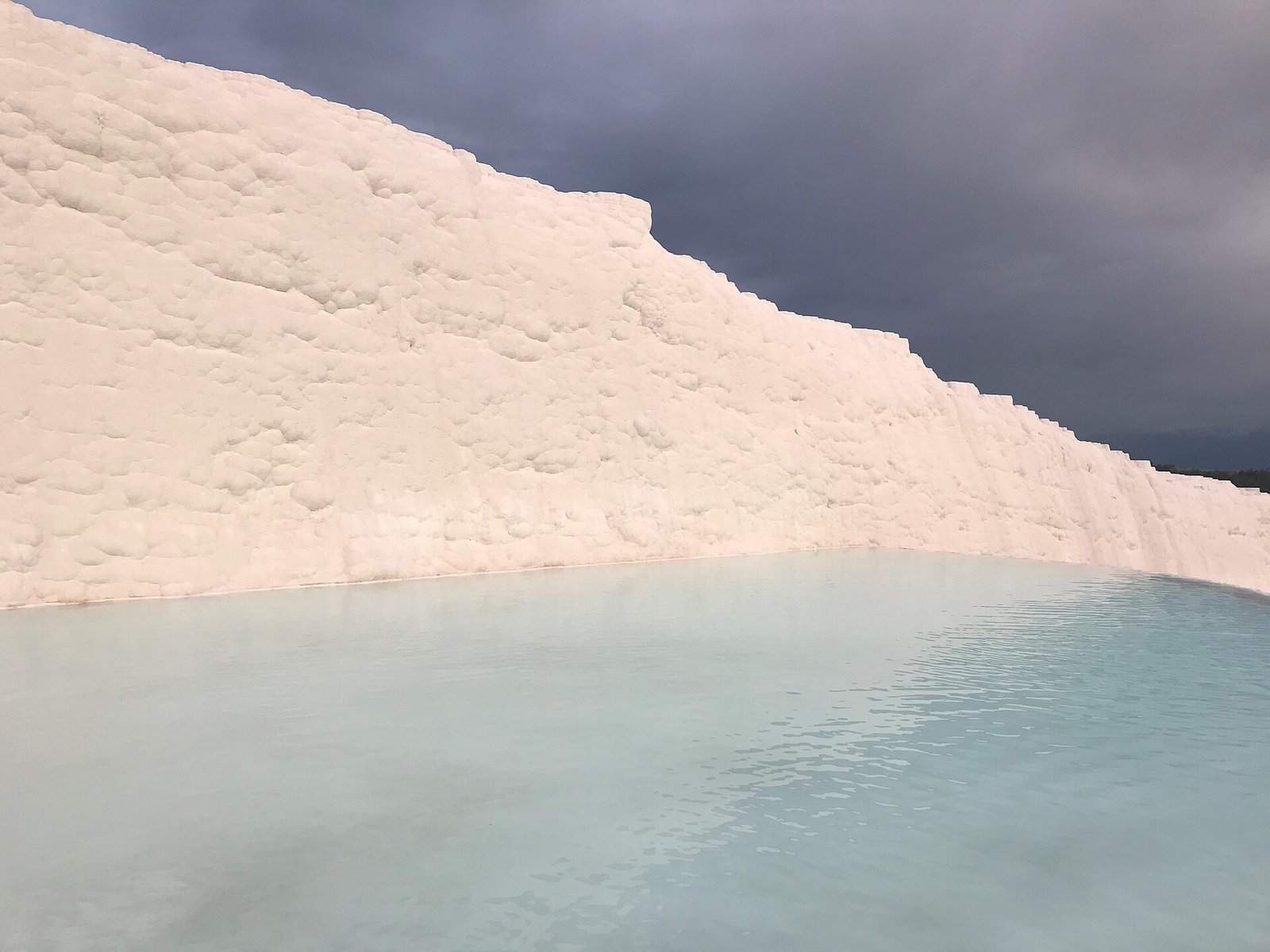
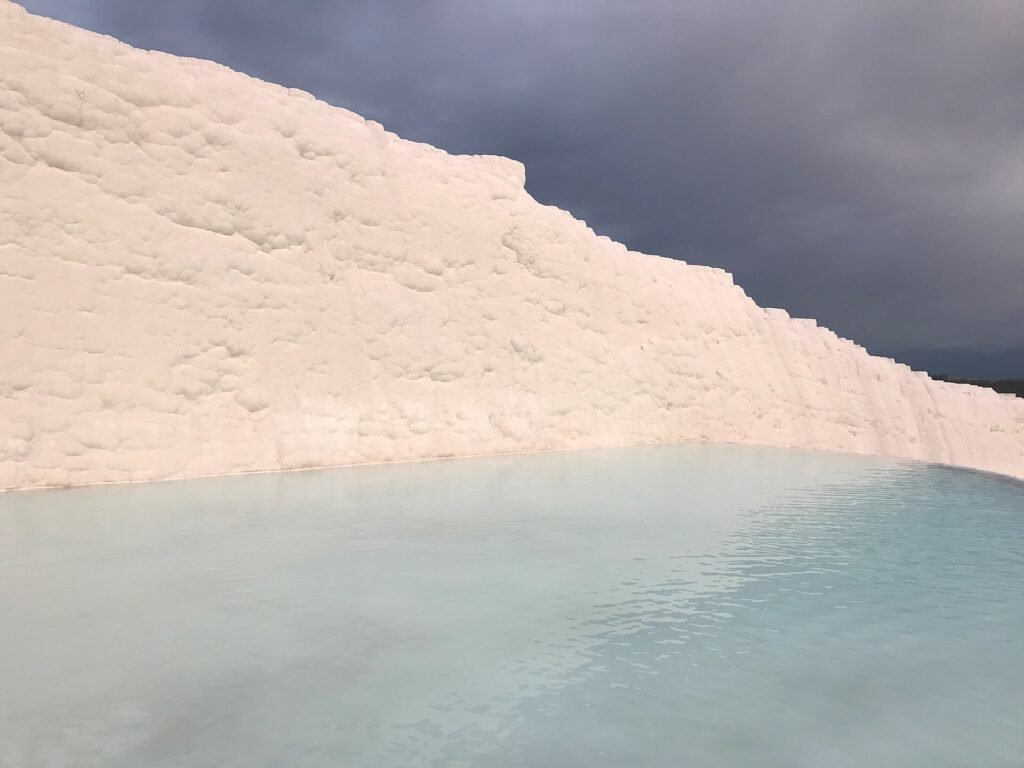
UNESCO’s own property page states that “visitor access to the travertine terraces is prohibited” in order to sustain water flow and preserve the structure, Access is confined to designated paths. The same UNESCO text also records that designated bathing areas in the hot springs have been established — so the swimming you have read about is real, it just happens in specific places rather than in the terraces themselves.
In practice what you get is one barefoot causeway running up the white face, with the famous basins you have seen in photographs roped off on either side. That walk is genuinely wonderful — warm shallow water over textured calcite, the whole valley below you — but it is not “wandering the terraces”, and it is not a swim.
Shoes come off, and it is enforced. Sandals and water shoes count as shoes. The surface is textured, slippery when wet, and sharp in places.
There is less water than the photographs suggest. Flow at the source has dropped from 450 litres per second in 1993 to about 150 today, attributed to uncontrolled abstraction, roughly two hundred illegal wells, geothermal plants, agriculture and irregular rainfall. The IUCN’s October 2025 assessment records that there is no water management plan for the site at all. Sections are periodically roped off, drained and left to re-whiten, and no schedule for that is published — so nobody, including us, can tell you which basins will hold water on the day you arrive. Any guide that claims to is inventing it.
One honest contradiction we could not resolve: UNESCO says bathing is prohibited, while several secondary sources describe shallow wading in the walkway pools as permitted and normal. We are reporting the tension rather than picking whichever version reads better.
The three gates, and which one you want
| Gate | Suits |
|---|---|
| South (Güney) | Cars and coaches. Largest car park, terraces in 10–15 minutes. Rebuilt in 2026 with a new welcome centre |
| North (Kuzey) | The archaeology. Drops you at the Necropolis and theatre end, 45–60 minutes of tombs and monuments before the terraces |
| Town gate | Pedestrians staying in the village. The only gate where you walk up the travertine face barefoot |
The classic route is in at the town or South gate, up and through the site, out at the North gate. If you are staying in the village, the town gate is walkable and gives you the approach the photographs are taken from.
Hierapolis, which most day-trippers skip
The terraces get the photographs; the Roman city behind them is the reason to allow more than two hours.
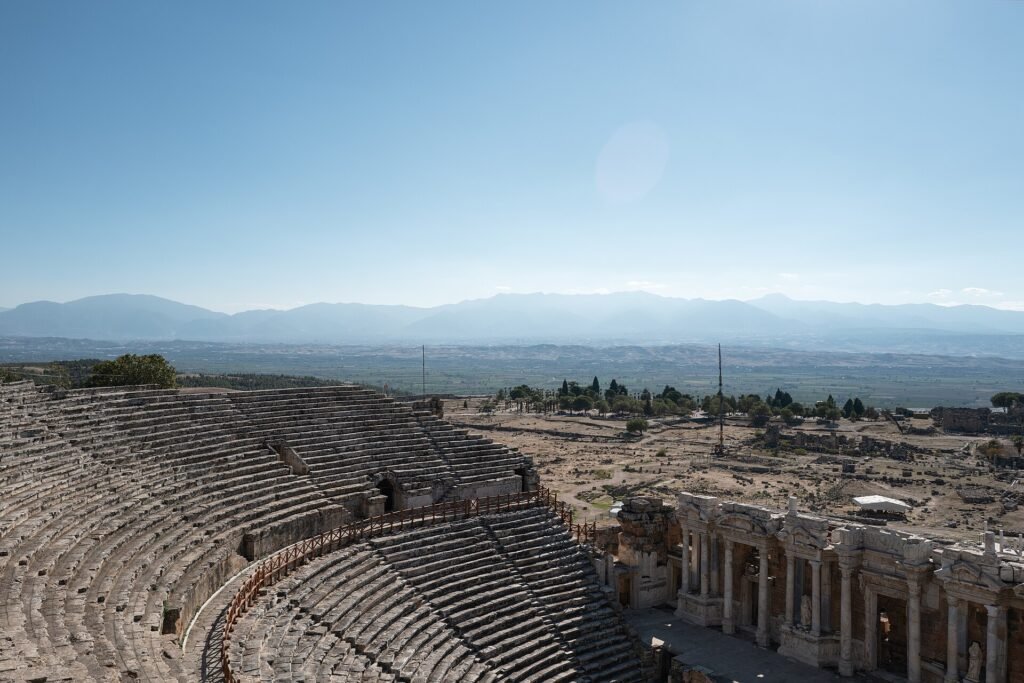
The theatre is one of the best-preserved in Türkiye, seating somewhere between twelve and fifteen thousand depending on which source you believe, restored over decades from 1977. It is included in the main ticket and, unlike the terraces, you keep your shoes on. Whether you may climb the seating we could not confirm from an official source — only a commercial ticket seller says so — and the marble steps are uneven.
The Necropolis is one of the largest ancient cemeteries anywhere, lining the approach to the North Gate. On the main route, included.
The Plutonium, the “Gate to Hell”, was restored and opened to visitors in 2018 with a replica of Hades and Cerberus. The carbon dioxide emission that made it sacred is real; you view it from outside.
The Archaeology Museum is in the Roman baths, open every day 08:00–20:30. Secondary sources say it is included in the €30 ticket; we could not confirm that officially.
Cleopatra’s Antique Pool
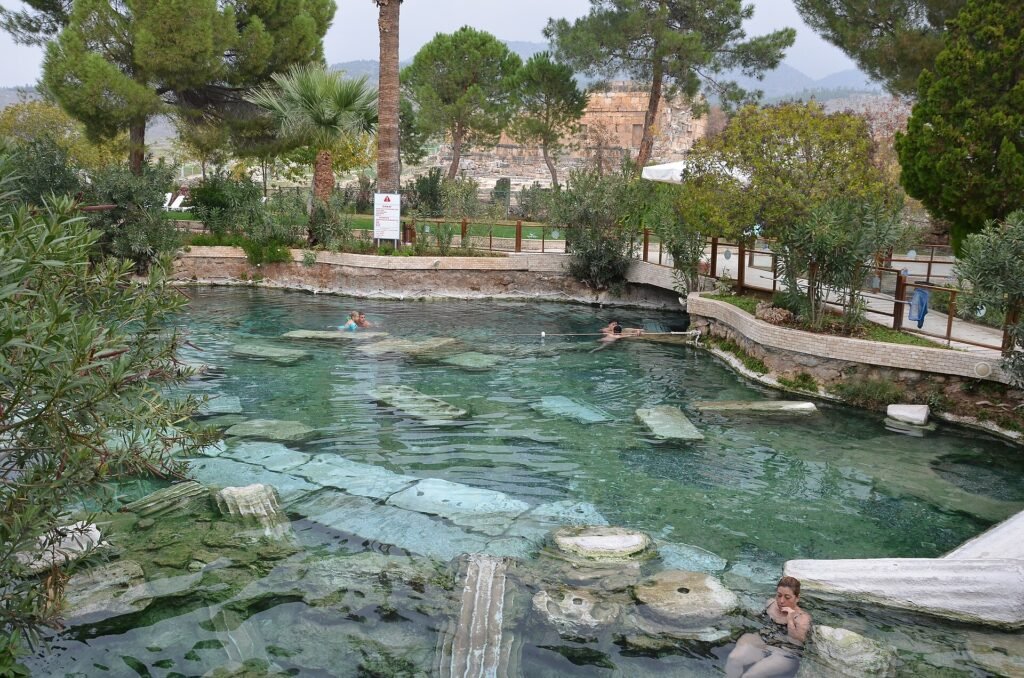
Closed January 2025, reopened 1 May 2026 after contractor delays and technical remediation, now run by a Ministry-owned company. A new welcome centre alongside it added a restaurant, changing rooms and showers.
| Foreign visitors | ₺600 (about €10.80) |
| Water temperature | 36 °C, constant, year-round |
| Depth | Roughly 0.5–2 m, with submerged ancient columns |
Three things widely stated online that we could not confirm from any primary source: a two-hour time limit, a booking requirement, and the sunscreen ban. All three are plausible and all three are repeated everywhere. Since the pool only reopened in May 2026 under a new operator, we would check on arrival rather than trust a blog — including this one.
Getting there, and the train that does not exist
There is no direct İstanbul–Denizli train. The Pamukkale Ekspresi runs Eskişehir to Denizli, once daily, about eight hours. From İstanbul you take the high-speed train to Eskişehir and change, which makes the realistic total 11–12 hours. Flying to Denizli Çardak or taking an overnight coach makes far more sense.
İzmir to Denizli by train takes about five hours, daily. Fares rose 6.45 percent on 17 August 2026 — the Göller Ekspresi is now ₺400 and the regional service ₺370.
Denizli Çardak Airport is 63 km from the city, 45–50 minutes, with a shuttle serving Denizli, Pamukkale and Karahayıt. It is a small airport and shuttles are timed to flights, so budget about an hour and a quarter airport to village.
Denizli otogar to Pamukkale is a dolmuş, roughly every 15–20 minutes, about 20 minutes, around ₺28–33.50 as of February 2026. Those fares come from transport aggregators that explicitly disclaim official status.
When to come
Official Denizli climate figures, Turkish State Meteorological Service, 1957–2025 averages.
| Month | Avg max °C | Rain mm | Verdict |
|---|---|---|---|
| January | 10.7 | 89.8 | Cold and wettest — but empty, and the 36 °C pool is at its best |
| February | 12.4 | 68.9 | Quiet |
| March | 16.1 | 62.6 | Improving |
| April | 21.1 | 51.6 | Excellent from mid-month |
| May | 26.5 | 44.2 | Excellent — but avoid Kurban Bayramı |
| June | 31.5 | 28.8 | Hot |
| July | 34.8 | 14.7 | Barefoot on white limestone at 35 °C. No |
| August | 34.7 | 11.2 | Same |
| September | 30.3 | 15.9 | Good from mid-month |
| October | 24.0 | 34.9 | Probably the best month of the year |
| November | 17.6 | 54.7 | Quiet, wet |
| December | 12.4 | 89.0 | Cold and wettest |
The July and August problem is specific: you walk the terraces barefoot on unshaded white limestone that radiates heat back at you. Midday in high summer is genuinely unpleasant and mildly hazardous for children and older visitors.
Avoid Turkish public holidays regardless of month. The all-time single-day record — 21,192 visitors — was set on 29 May 2026, the third day of Kurban Bayramı.
Morning, midday or night
| 08:00 | Midday | After dark | |
|---|---|---|---|
| Crowds | Minimal | Peak — every coach converges | Nearly empty |
| Light | Low and warm, best photographs | Harsh; the white blows out | Floodlit |
| Water | More flowing water | Less; more evaporation | — |
| Underfoot | Comfortable | In summer, uncomfortably hot | Cool |
The 19:00–23:00 night session has been running since April 2024 and covers the travertines, the theatre and the Plutonium. It is the least-known good slot at the site, and only people staying locally can use it.
Stay the night. We mean this.
Every coach day trip from İzmir, Antalya, Marmaris and Fethiye arrives around midday — peak heat, peak crowd, least water. One night in Pamukkale village changes five things at once:
- You can be at the gate at 08:00, when there is more flowing water and the terraces are empty.
- You can use the night session, free with the same ticket, which no day-tripper can.
- The town gate is walkable from the village. No car, no parking.
- You avoid 34.7 °C at midday, barefoot.
- You can split the site — terraces at dawn, Hierapolis and the museum late afternoon, pool in between — rather than force-marching it in three hours.
Pamukkale village averages around ₺3,511 a night on Turkish booking platforms, roughly €63. That is about twice the entrance fee, and about what a coach tour seat costs. It is the highest-leverage decision a visitor to Pamukkale makes.
A note on our numbers
Opening hours and the museum listings come from the Turkish Ministry of Culture and Tourism’s museum portal, checked 19 August 2026. Climate figures are Turkish State Meteorological Service 1957–2025 averages. Visitor statistics, the pool closure and reopening, the welcome centres and the water-flow decline are from Turkish press and the IUCN’s 2025 World Heritage Outlook assessment.
The €30 admission could not be confirmed against the Ministry’s master tariff document, which was unreachable when we checked; it rests on three independent sources that agree. Where we could not verify something — the pool’s time limit, booking rules and sunscreen ban among them — we have said so instead of repeating what everyone else prints.
Two hours, or a day and a half?
Most visitors give Pamukkale about three hours, which is roughly the time it takes to walk up the travertines, photograph them and leave. That is enough to see the famous thing and miss everything else.
| Visit | Time | What you get |
|---|---|---|
| Coach day trip | 2–3 hours | Travertine walk, photographs, a rushed look at the theatre |
| Half a day, well timed | 4–5 hours | Travertines at 08:00, theatre, Necropolis, Plutonium |
| One night | Two sessions | The above, split across dawn and dusk, plus the pool and the night opening |
| Two nights | Add Laodikeia | Everything, without hurrying |
Hierapolis is a large site. The distance from the travertine top to the far end of the Necropolis is well over a kilometre of walking, most of it unshaded.
The site, in the order we would walk it
Enter at the town gate if you are staying in the village. The barefoot climb up the travertine face is the approach the photographs are taken from and the only gate that gives it to you.
The travertine causeway, twenty minutes up, shoes in hand.
The Antique Pool, at the top, if you are swimming. Separate ticket, ₺600 for foreigners, 36 °C.
The Archaeology Museum, in the Roman baths beside the pool. Open 08:00–20:30 daily, indoors, and in July that matters as much as the collection.
The Temple of Apollo and the Plutonium, just above. The gas seep is real and you view it from outside.
The theatre, up the slope behind. This is where the site rewards the walk, and where most day-trippers have already turned back.
The Necropolis, stretching north along the road to the North Gate — tumuli, house-tombs and sarcophagi across a hillside, usually almost empty.
Out at the North Gate, or turn around and walk back down the travertines at dusk.
Practical notes people wish they had known
Bring a bag for your shoes. You carry them up the travertines and you will want both hands.
The water is warm, not hot. The travertine pools are ankle to calf deep where they hold water at all, and the temperature is pleasant rather than thermal. The 36 °C is the Antique Pool, which is a separate thing.
There is no shade on the terraces. None. The white surface reflects heat upward as well as down.
Buggies now exist. The welcome centres opened in May 2026 introduced a buggy service at the South Gate and the Antique Pool, which is genuinely useful for anyone who cannot walk the site comfortably. No English guide mentions it.
Bring a towel and swimwear if the pool is on your list; changing rooms and showers exist at the new welcome centre, but a towel is not provided.
Combining Pamukkale with the rest of the Aegean
| Combination | Sense |
|---|---|
| Selçuk / Ephesus → Pamukkale | Natural. Train or bus, about five hours from İzmir |
| Pamukkale → Laodikeia | 12 km. Half a day. The best-value ticket in the region |
| Pamukkale → Aphrodisias | ~100 km. Underrated, and both are covered by the Aegean museum pass |
| Pamukkale → Antalya | ~240 km, three hours by car. Feasible as a transfer, not as a day trip |
If you are buying the €95 Aegean MuseumPass anywhere, this is the corner of the country where it starts to make sense — Ephesus, Hierapolis, Aphrodisias, Laodikeia and Bergama together clear the price comfortably. On a Selçuk-only trip it does not.
Is it still worth going?
We have spent this page telling you the pools hold less water than the photographs suggest, that terrace access is restricted to one path, and that the source flow has fallen by two-thirds in thirty years. So it is worth answering the obvious question directly.
Yes — but go for the whole site rather than the postcard. The barefoot climb at eight in the morning, with the valley below and warm water running over your feet, is genuinely unlike anywhere else. The Roman city behind it is one of the largest and least-visited in Türkiye. And the night session, floodlit and empty, is the version of Pamukkale that almost nobody sees.
What we would not do is travel five hours each way, arrive at midday with a coach, spend ninety minutes and leave with a photograph. That version of Pamukkale is the one people come back disappointed from, and it is entirely avoidable.
Before you book
Two things shape this trip more than the ticket price. Flights into İzmir or Denizli — İzmir has far more connections and a five-hour train, Denizli is closer with fewer options. And a hire car if you want Laodikeia and Karahayıt on your own schedule rather than a dolmuş timetable.