
In short
Astana LRT Line 1 opened on 16 May 2026 — airport to Nurly Zhol station, 22.4 km, 40 minutes, every 5–10 minutes. Bayterek costs 2,000 tenge, the National Museum from 500 (closed Mondays and the last Tuesday of the month), and the Grand Mosque welcomes non-Muslim visitors. Give the city two days, and go in May or September — January means −14.4 °C.
Checked 27 August 2026 against operator sites, the presidency’s own pages and Kazakh news reporting of the LRT opening.
On this page
Astana got a metro in May 2026 — fifteen years after work started, after two suspensions, a collapsed financing deal and criminal convictions for embezzlement.
It is the newest thing in a city where almost everything is new. Kazakhstan moved its capital here in 1997, onto open steppe, and then built a skyline from nothing. Here is what is actually worth your time, checked on 27 August 2026.
The name, because it keeps changing
| Name | Period |
|---|---|
| Akmolinsk | 1832–1961 |
| Tselinograd | 1961–1991 |
| Akmola | 1991–1998 |
| Astana | 1998–2019 |
| Nur-Sultan | 2019–2022 |
| Astana | 2022– |
The capital formally moved from Almaty on 10 December 1997. The city was renamed Nur-Sultan in March 2019 for the departing president, and changed back to Astana on 17 September 2022 when Tokayev signed the constitutional amendments. If your guidebook says Nur-Sultan, it is at least four years old.
The new metro
Astana LRT Line 1 opened on 16 May 2026. It runs from the airport to Nurly Zhol railway station — 22.4 km, 18 stations, 40 minutes end to end, with trains every five to ten minutes from 06:00 to 23:00. The trains are four-car, driverless, and there are nineteen of them.
For a visitor this solves the airport transfer neatly, and it connects the two things you are most likely to arrive at.
The backstory is worth knowing. Construction began in 2011 for a 2017 opening, was suspended in 2013 on cost grounds, revived with Chinese financing that collapsed, and in 2019 criminal investigations found embezzlement and inflated costs, with prison sentences for former officials. The president who had publicly doubted the project rode it first.
The buildings
Everything below is on the Left Bank, south of the Ishim river — the new capital. The Right Bank to the north is the old Soviet city, and it is where Astana feels lived-in rather than staged. Khan Shatyr, Bayterek and Akorda sit on one straight axis along Nurzhol Boulevard, so the signature walk is genuinely a walk.
Bayterek Tower — architect Akmurza Rustembekov, built 1996–2002. 105 metres to the spire, observation deck at 97, topped by a 22-metre gold-mirrored sphere. Open 10:00–22:00 in summer, 10:00–21:00 the rest of the year. Admission 2,000 tenge for adults, 1,000 for children 6–15, 1,500 for pensioners.
Upstairs there is a gilded cast of the first president’s right hand set into a pedestal, which visitors place their hand in and make a wish. You will hear that Nazarbayev sketched the tower’s concept himself; we found no official source for that, so treat it as legend.
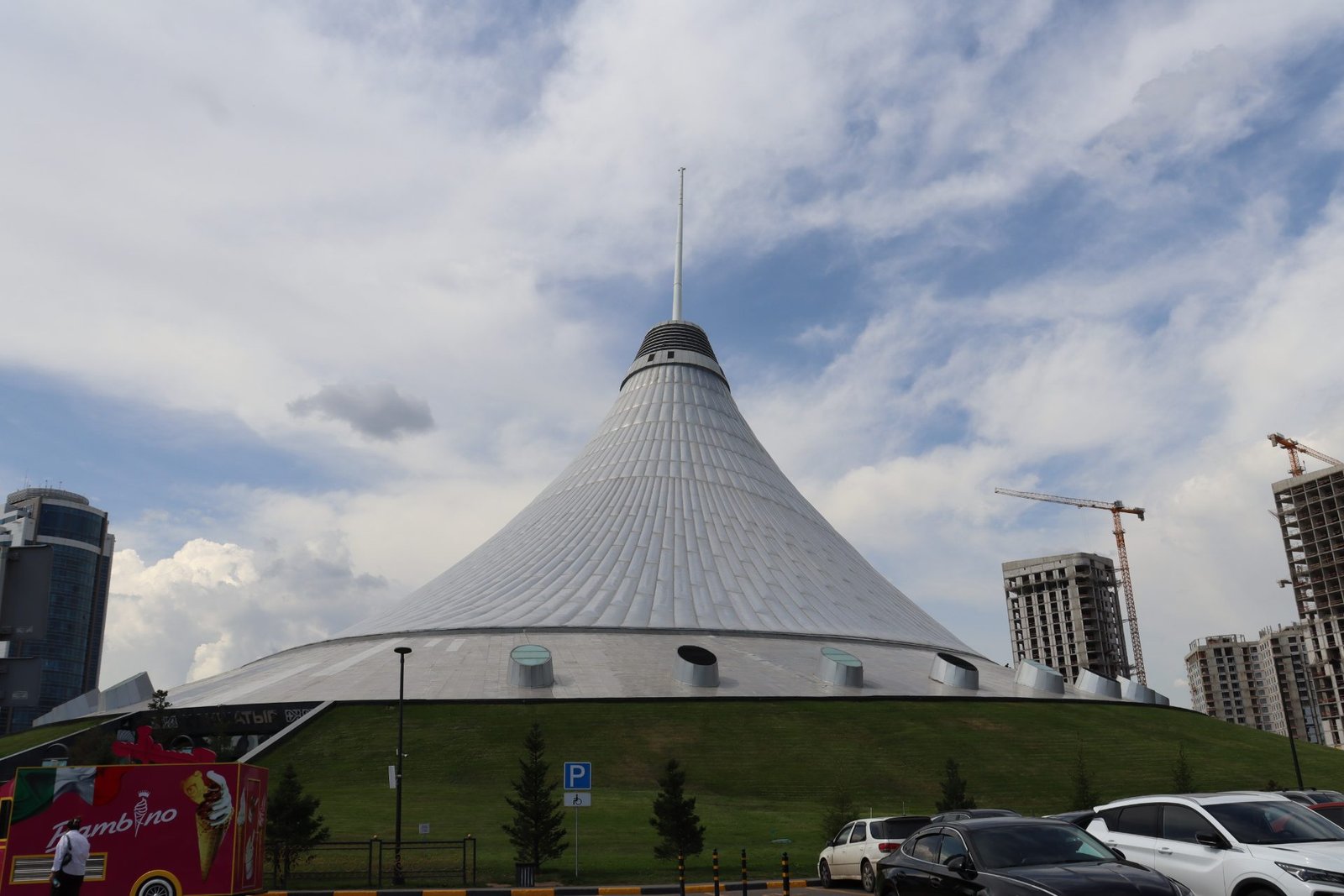
Khan Shatyr — Norman Foster, opened over 5–6 July 2010 for Capital Day. 150 metres, a tented envelope over six storeys and 127,000 square metres of development. Inside is a shopping centre, a cinema, a family gaming centre and the Sky Beach Club, an indoor beach and waterpark. Free to walk into; the attractions charge separately.
The Palace of Peace and Reconciliation — Foster again, built 2004–2006, inaugurated 1 September 2006. A pyramid 62 metres high on a 62-metre square base, with a 1,300-seat opera house inside, a circular congress chamber, and rooms for six religions. The apex is glazed with Brian Clarke’s screen-printed doves. The only hours we could find date from 2018 — Tuesday to Saturday, 10:00 to 18:00 — so confirm before you go.
The Astana Grand Mosque opened on 12 August 2022 and is consistently described as the largest in Central Asia. The numbers are absurd in a good way: 57,000 square metres, a main dome 83.2 metres high and 62 across, four 130-metre minarets each in five sections for the five pillars of Islam, and 72 smaller domes. The entrance doors are 12.4 metres of African iroko, the carpet is 15,525 square metres, and the chandelier is 27 metres across and weighs twenty tonnes.
Capacity is about 30,000 indoors, with courtyards said to hold roughly 200,000 more. Non-Muslim visitors are welcome, with restrictions around prayer times, and one tower has a lift to a viewpoint.
Hazrat Sultan Mosque, opened 2012, is the older and more conventionally beautiful of the two — a 51-metre central dome, four 77-metre minarets, capacity 5,000 rising to 10,000 on holidays. Named after Khoja Ahmed Yasawi, whose mausoleum is at Turkestan.
Nur-Astana Mosque, by the Beirut architect Charles Hadife, is 40 metres tall with 63-metre minarets — the heights encoding Muhammad’s age at revelation and at death.
Akorda, the presidential palace, is 86 metres to the spire and closed to the public. Photograph it from outside; there is no visitor programme.
The National Museum on Independence Square is 74,000 square metres and twenty halls. Open Tuesday to Sunday 10:00–18:00, closed Mondays and the last Tuesday of each month. Admission from 500 tenge, or 425 through the Freedom app, with a higher tariff that adds the Gold Halls. Allow two hours.
The EXPO site
EXPO 2017’s centrepiece, the Nur Alem sphere, survives as the Museum of Future Energy — 80 metres across, 100 tall, eight floors running up through space, solar, wind, water, biomass and kinetic energy, with a glass floor on the eighth level. It was the fair’s most-visited pavilion at 1.3 million people.
You will see it called the world’s largest sphere. It is not, and the claim is contested; 80 metres across is impressive enough on its own.
The prices we could find are from 2020 — 1,500 tenge for adults, 800 for students — and we would not publish them as current. Check before you go. The wider site is now occupied by the Astana International Financial Centre and a university.
The winter
The claim that Astana is the world’s second-coldest capital, behind Ulaanbaatar, stands up across independent sources.
| Astana | |
|---|---|
| January mean | −14.4 °C |
| January average daily low | −18.6 °C |
| July mean | 20.8 °C |
| Record low | −51.6 °C (January 1893) |
| Annual sunshine | 2,505 hours |
What that means in practice: this is open steppe with nothing to break the wind, and a January visit is a serious undertaking rather than a picturesque one. Proper insulated boots, a genuinely rated coat, and a plan that moves between heated buildings.
Go in May or September instead — means of 14.6 °C and 13.0 °C, long days, and the architecture looks better in low sun anyway.
Getting there from Almaty
Fly. It is 1.5 to 2 hours, typically US$60–100, with 24 to 35 flights a day.
The train takes at least sixteen hours and often more like twenty-two, with twelve services a day. Fares run from about 10,400 tenge for the cheapest to 26,700 for a better berth. It is a genuine overnight and a real experience, and we have written it up in our Kazakhstan rail guide — but do not take it because you think it is quicker than it is. The bus is 16 to 20 hours for US$20–35.
How long, and is it worth it?
Two days. One for the Left Bank axis — Khan Shatyr, Bayterek, the Pyramid, Akorda from outside — and one for the National Museum, the Grand Mosque and the EXPO sphere, with an evening on the Right Bank to see a city people actually live in.
Is it worth the detour? If you have ten days in Kazakhstan and you have to choose between Astana and the Mangystau desert or the Kolsai lakes, take the landscape. Astana is remarkable as a project rather than as a place — a capital conjured out of steppe inside thirty years, by architects whose names you know. That is genuinely interesting, and it is also a day and a half of interest, not four.
If you are passing through anyway, or you care about architecture, it earns its two days comfortably.
What we could not verify
Current admission and hours for the Palace of Peace and Reconciliation, where our only source is eight years old. Current Nur Alem prices — ours are from 2020. Any admission fee for the Grand Mosque or Hazrat Sultan; mosques here are normally free but no source says so for these two. Hazrat Sultan’s architect, who is named nowhere we looked. And whether the individual EXPO country pavilions admit walk-in visitors today.
For the country as a whole, see our Kazakhstan travel guide.
Photo: Khan Shatyr by Quarot, via Wikimedia Commons, CC0.