
In short
Big Almaty Lake is closed to all private vehicles since 30 April 2026 — it is now a 15 km walk each way. Medeu’s skating rink has been closed since March 2025 and reopens around autumn 2027, though the gorge and dam are the real draw. Charyn and Kolsai both cost 865 tenge per person plus 2,595 per car, cash only, under the tariff that took effect 1 January 2026.
Checked 27 August 2026 against Kazakh news reporting of the park announcements and the official 2026 MRP-linked tariff schedule.
On this page
Two of Almaty’s most-recommended day trips have changed in ways that almost nothing online has caught up with.
The Medeu skating rink has been closed since March 2025 and is not expected to reopen until autumn 2027. And since 30 April 2026 you cannot drive to Big Almaty Lake at all — no cars, no motorcycles, no scooters, no e-bikes.
Both are checkable. Both are still being written about as though nothing happened. Here is the current picture, dated 27 August 2026.
Big Almaty Lake: you walk now
In April 2026 the national park forestry service announced that access to Big Almaty Lake is prohibited to private vehicles, motorcycles, electric scooters and electric bicycles. The reasons given were steep gradients, poor visibility, rockfall zones, documented injuries involving rental electric transport, and off-trail damage from riders on powerful e-bikes.
Hiking is still permitted, and 38 of the park’s 46 marked routes remain open, 19 of them in the Medeu section.
On foot, the lake is about 15 km uphill from the checkpoint — four to six hours one way, finishing at 2,511 metres. Season is May to October, with September the quietest. Swimming is prohibited: this is Almaty’s drinking water.
Park entry is 648 tenge per person per day, cheaper than the other parks, and Ile-Alatau has been accepting Kaspi QR at the gate.
Worth knowing that this road has a history: restricted from 2019, reopened to cars in mid-2023, restricted again that September, and now banned outright. A 5.3 km organised pedestrian route is under construction with around 665 million tenge of city funding, targeted for the end of 2026. If you see a tour operator selling e-bike trips up there — and some still are — that product no longer legally exists.
Medeu and Shymbulak
The rink is shut. It closed after the 2024–25 season ended on 31 March 2025, for a reconstruction running to 2027, with reopening expected for the 2027–28 winter. The work covers utilities, a modernised refrigeration system for longer ice retention, a new observation deck and restoration of the historic swimming pool alongside it.
Go anyway, but go for the gorge. Medeu sits at 1,691 metres, and the reason to make the trip is the enormous anti-mudflow dam above it and the 842-step staircase that climbs it. We could not confirm whether the staircase and dam are formally open during the works, so check before committing your morning.
Getting there: bus 12 from Hotel Kazakhstan, every 15 to 30 minutes, 120–150 tenge, 30 to 45 minutes, paying with an ONAY card. A Yandex ride from the centre is 1,600–3,500 tenge.
Shymbulak above it is unaffected. The gondola from Medeu costs 4,000 tenge one way for non-skiers, or 6,500 return, and takes about fifteen minutes. You can also taxi up for 2,000–3,000 or walk it in 60 to 100 minutes.
Allow two to three hours for Medeu alone, four to six with Shymbulak. Pack for 10–15 °C colder than the city — that gap catches people out badly.
The city itself
Panfilov Park and the Ascension Cathedral are the obvious start, and the park is free. The cathedral was built between 1904 and 1907, stands 56 metres, and is often called the second-tallest wooden church in the world. You will be told it was built without nails; that claim is universally repeated and we could find no source that either tests it or documents the fixtures, so treat it as folklore rather than engineering.
The much better fact is verifiable: it survived the 1911 Kebin earthquake with minimal damage, which some bishops attributed to divine intervention. Hold that thought — the same earthquake sequence created Kaindy Lake, below.
The Central State Museum holds around 200,000 objects and is one of Central Asia’s largest. Be ready for dual pricing, which is real and steep: 1,500 tenge for locals, 5,000 for foreign visitors, or 10,000 with a guided tour.
The Almaty Museum of Arts is the better-value alternative and barely covered in English: 2,000 tenge flat with no foreigner surcharge, open Tuesday to Sunday 11:00–21:00, closed Monday, last entry an hour before close, at 28 Al-Farabi.
The Green Bazaar is the city’s central market — produce, spices, horse meat and kazy — and the Uyghur eateries upstairs serving laghman and beshbarmak are consistently named as the cheapest good meal in Almaty.
Kok-Tobe is the hill above the city at about 1,100 metres. The cable car costs 10,000 tenge return for adults in 2026, 6,000 one way, 5,000 return for children. It runs daily from 10:00 — 13:00 on Tuesdays — until 23:00, and to midnight from Friday to Sunday. The lower station is on Dostyk Avenue by Hotel Kazakhstan; bus 99 goes there.
The metro is 11 stations on one line, 13.4 km, opened in 2011 and extended in 2022. A ride is 120 tenge, payable by ONAY card, token or contactless bank card, running roughly 06:20 to midnight. There is no metro to the airport — take bus 79, 86, 92 or 106, about 40 minutes.
How long does Almaty need? The city core is honestly a day and a half to two days. Almaty earns four to six days because of what is within three hours of it, not because of its museums. Most guides pad the city list rather than say that.
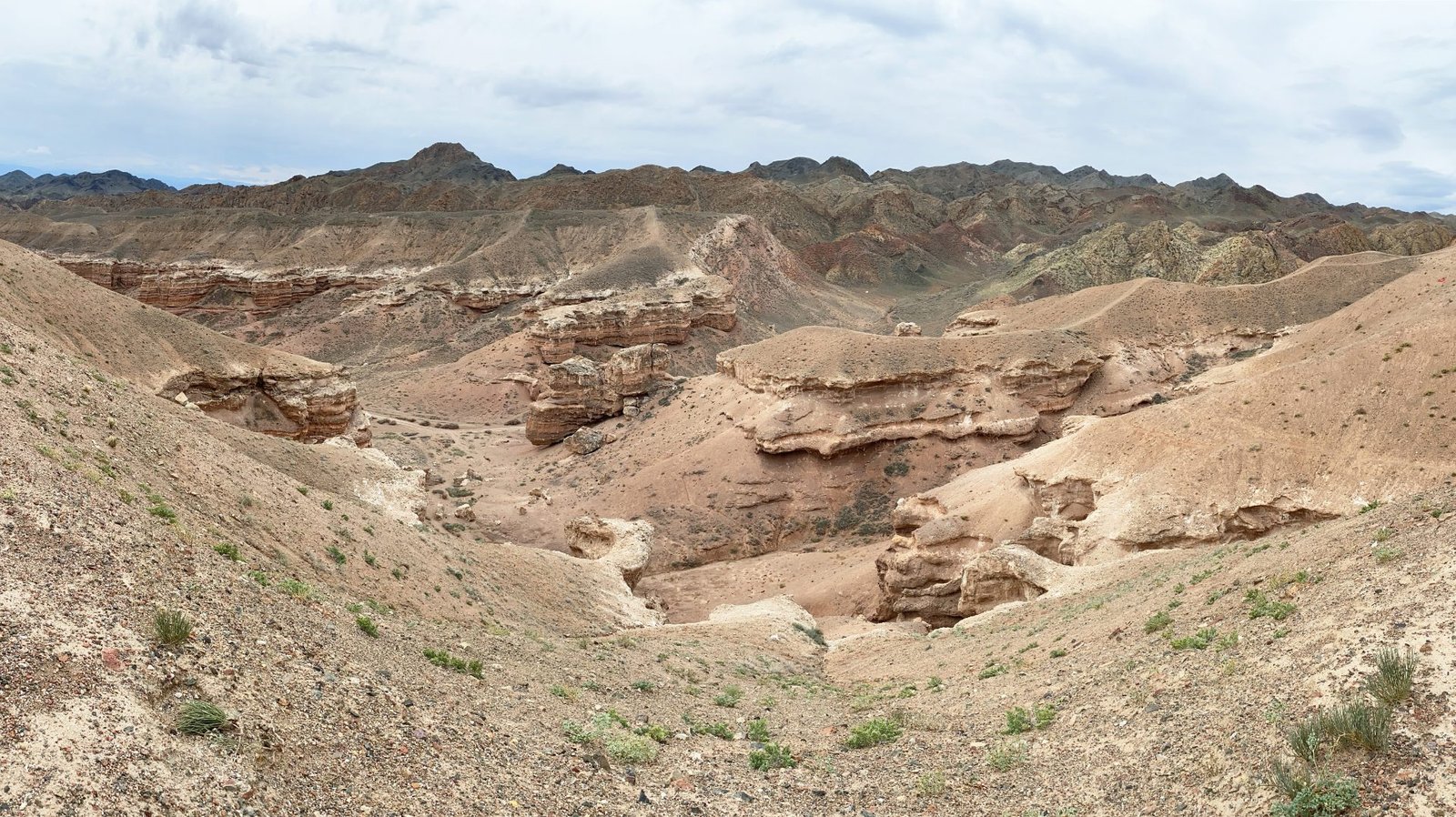
Charyn Canyon
About 195–200 km east, three to three and a half hours’ drive.
The 2026 fees are official and MRP-linked: 865 tenge per person per day, plus 2,595 tenge per passenger car. Minibuses are 8,650, buses 12,975 or 21,625 by size. These took effect on 1 January 2026. Cash, in tenge — gate staff rarely take cards, and bring your original passport, as photocopies are reportedly refused.
Getting there independently is genuinely hard. There are no regular buses. The options are a group tour at 5,000–15,000 tenge per person, a private taxi round trip at 25,000–35,000, or self-drive with a rental at 15,000–20,000 a day. Ride-hailing works outbound and is unreliable for the return.
The Valley of Castles walk is 3 km each way with 220 metres of descent, about an hour in each direction — allow two to two and a half hours with stops. A shuttle back up costs 500–800 tenge and you buy the ticket before you walk down.
You can stay. Glamping tents and cabins at the visitor centre run 40,000–75,000 tenge a night, and camping is permitted at around 350 tenge per tent. Nights are cold; bring your own gear.
The summer warning is serious. The canyon floor exceeds 40 °C with almost no shade, and mobile signal disappears down there. Carry two to three litres of water per person, download offline maps, and arrive before 10:00 to beat both the heat and the tour buses. Budget 10 to 12 hours door to door from Almaty.
Kolsai and Kaindy
About 300 km and four to six hours to Saty village, the base for both.
Same fee schedule as Charyn: 865 tenge per person, 2,595 per car, cash only, camping around 350 tenge a tent.
The roads differ sharply. Kolsai 1 is reachable in a normal car, bumpily. Kaindy needs a proper 4×4 — the track follows and crosses the river twice and is often part-flooded. Standard practice is to leave your car in Saty and take a local UAZ transfer arranged through your guesthouse.
The walk from Kolsai 1 to Kolsai 2 is, per the park’s own route table, 7 km each way and about three and a half hours of walking — call it six hours round trip with stops, on a narrow trail with loose stones and steep sections.
Kaindy is the one you have seen photographs of. The lake formed in 1911, when an earthquake triggered a landslide that dammed the valley and drowned a spruce forest. The lake is about 400 metres long, the drowned trunks still stand above the surface like masts, and the water peaks at around 6 °C in summer — which is precisely why they have not rotted.
Homestays in Saty run roughly 20,000–30,000 tenge for a double with breakfast and dinner. Give this two nights. With four to six hours of driving each way, a day trip is not a real proposition, and public transport out here is unreliable enough that we would not plan around it.
Altyn-Emel
250 km from Almaty, entered at Basshi village. Inside, the Singing Dune is another 50 to 60 minutes and the Aktau Mountains 90.
The fees here are different — vehicle-based and higher. A passenger car is 3,892.50 tenge, a motorcycle 2,595, a minibus 15,137.50, buses 30,275 or 45,412.50. Parking is 260 tenge a day. Notably, no per-person hiking rate is listed for Altyn-Emel, unlike the other parks. Permits are bought at the Basshi office, cash only.
No public transport reaches Basshi. You drive, or you take a tour — quoted at around US$500 solo, or US$184 per person in a group of six including transport, meals, camping kit and entry fees.
It needs an overnight, minimum. Five hours of driving each way leaves three or four hours in a park where the highlights are another 90 minutes past the gate. Two days minimum, three ideally. There is a campsite with yurts and caravans at Basshi.
What we could not verify
Opening hours for the Central State Museum and the Green Bazaar. The upper Shymbulak cable-car stages and the price to Talgar Pass — the operator’s site redirect-looped on every URL we tried. Whether the Medeu dam and staircase are open during reconstruction. And a properly located inventory of Almaty’s Soviet mosaics, which desk research cannot assemble and which remains a genuine gap.
For the country as a whole, see our Kazakhstan travel guide.
Photo: Charyn Canyon, Kazakhstan 01 by Bgag, via Wikimedia Commons, CC0.