
In short
The Savitsky Museum in Nukus charges foreign adults 25,000 som — but 120,000 som to take photographs. Muynak is about three hours north by bus (around 20,000 som), and reaching the actual shoreline needs a two- to three-day 4WD trip at US$500–700 per jeep. There is a real air-quality advisory for the region, but no advisory says a short visit is dangerous.
Checked 26 August 2026 against the museum’s published tariff, UK travel advice updated March 2026, and USGS, NASA and World Bank data on the sea.
On this page
Nukus is a twelve-hour drive or a hundred-minute flight from anywhere you have heard of, and it holds the second-largest collection of Russian avant-garde art in the world. Three hours further north, a fishing fleet sits rusting on a desert that used to be the fourth-largest lake on Earth.
This is the part of Uzbekistan that most itineraries skip. It is also the part you will still be thinking about a year later.
The museum that should not exist
Igor Savitsky came to Karakalpakstan on an archaeological expedition in 1950 and stayed. In 1966 he persuaded the Soviet authorities to let him found a state museum in Nukus, and then spent nearly two decades using it as cover.
What he collected was work that could not safely be shown anywhere else: Russian and Central Asian modernists whose careers had been ended by the state. Mikhail Kurzin was imprisoned and exiled for anti-Soviet propaganda. Vladimir Lysenko was arrested and confined to a psychiatric asylum — every one of his known surviving paintings is in this building, and his canvas The Bull is the museum’s emblem. One artist in the collection was arrested for his sexuality; another was sent to a labour camp.
The museum holds more than 82,000 items, of which roughly 10,000 are avant-garde works. It has about a hundred paintings by Alexander Volkov, more than any other museum anywhere. Ural Tansykbaev is here in depth.
One caution about how this story is usually told. The standard version is a lone Russian hero rescuing art in a desert, and at least one serious account pushes back on that framing, crediting Karakalpak collaborators — notably the ethnographer Marat Nurmukhamedov — who made the museum possible and are routinely written out. Worth holding in mind while you walk around.
What it costs
These are the museum’s own published figures for foreign visitors.
| Entry | Guided tour | |
|---|---|---|
| Adults | 25,000 som | 15,000 som |
| Students | 15,000 som | 8,000 som |
| Children | 10,000 som | 8,000 som |
Photography costs 120,000 som and video 350,000 som — the photo fee is nearly five times the entry ticket, which is worth knowing before you get to the desk.
Hours: Monday to Friday 09:00–17:00 with a lunch closure from 13:00 to 14:00; Saturday and Sunday 10:00–16:00. Open every day. The exhibition halls are on K. Rzaev Street; the archives are elsewhere, on Dosliq Avenue.
One honest caveat: the museum’s website carries no date on this tariff, and Uzbek prices have moved a great deal. Treat these as the published figures and expect to pay more.
Getting to Nukus
By air is the sensible option: around sixteen flights a week from Tashkent, roughly two a day, one hour forty minutes for 810 km, on Uzbekistan Airways and Centrum Air. Quoted fares vary widely — one operator gives about 485,000 som — so treat any single figure with suspicion.
By train, service 54 runs daily from Tashkent, leaving at 13:15 and arriving 05:18, about fifteen hours, in sleeping-car, kupe or platskart. Other sources put it at sixteen to twenty hours from about 340,000 som. It is a real overnight, and the ticket doubles as your accommodation registration for that night.
From Khiva or Urgench it is 183 km and about three hours by road. A shared-taxi seat runs roughly US$8–15, a bus or marshrutka US$3–5, and a private transfer US$80 for a sedan up to US$155 for a minivan. There is no direct train from Khiva to Nukus.
Muynak, and the ships
Muynak is about ninety kilometres north of Nukus, roughly three hours by road.
The bus goes from Konye Qala bus station, which you reach by marshrutka number 5 from the Nukus bazaar for about 1,500 som. Departures are around 08:50, 12:00 and 15:00 and the fare is about 20,000 som. A shared-taxi seat is roughly 30,000 som. Return buses leave at 09:00 and 15:00 and they are packed — get there early or you will be standing.
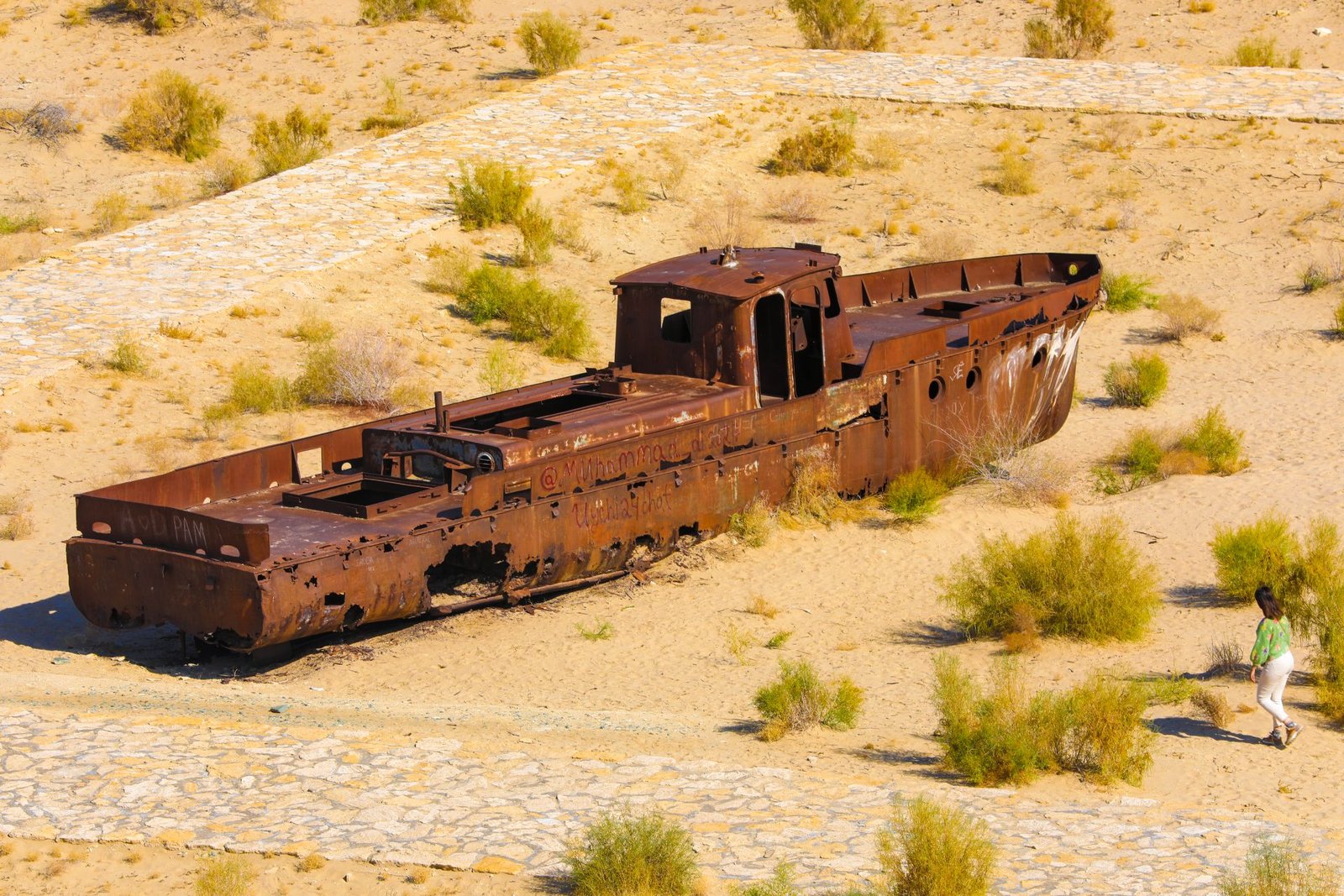
What you have come for is a stretch of dried seabed below the town with about ten fishing vessels on it, viewed first from an observation platform beside the Aral Sea memorial and museum, and then from the seabed itself.
The museum in Muynak is officially the Ecological Museum of the Muynak region. It was founded in 1984 in the port village of Uchsay and moved into town in 1998. Alongside the fishing gear and taxidermy it holds something more affecting: paintings from the 1960s and 1970s by Rafael Matevosyan and Faim Madgazin, showing the sea while it was still there. It publishes no hours and no admission price.
What actually happened to the sea
The numbers are worth stating plainly, because the scale is difficult to hold otherwise.
| 1960 | Now | |
|---|---|---|
| Surface area | 68,000 km² | About 10% of that |
| Salinity | 10 g/L | Over 100 g/L in the South Aral |
| Rank | Fourth-largest lake on Earth | Two shrunken basins |
The water level fell about 20 cm a year through the 1960s, 50–60 cm a year in the 1970s, and 80–90 cm a year in the 1980s. The lake split into North and South Aral in 1987; the South split again into eastern and western basins in 2003.
Where the sea went, a desert arrived. The Aralkum now covers some 60,000 km² of former seabed. The dust it throws off costs Karakalpakstan alone an estimated US$44.2 million a year — about 2.1 per cent of the region’s economic output.
The north has recovered. The south has not.
This is the part almost no travel article gets right, because the two halves have gone in opposite directions.
In the north, Kazakhstan built the Kokaral Dam — 13 km long, completed in August 2005 with World Bank finance — across the channel to the south, and simply stopped the water leaving. By 2008 the North Aral had risen twelve metres. By 2013 salinity had fallen from 30 g/L to 8 g/L and freshwater fish had returned. As of 2026 its volume is up more than forty per cent, some 870 km² of dried seabed is under water again, and a second phase running to 2029 aims to raise the level further.
It is one of the more successful environmental interventions anywhere, and it is genuinely worth saying so.
One caveat on the fishing revival: the often-quoted 8,000 tonnes a year is not current. The 2025 catch reportedly fell to about 3,900 tonnes, down from 7,800 the year before. The recovery is real; the most recent year was poor.
In the south, which is the Uzbek side and the one you can visit, the story is the opposite. The eastern lobe dried completely for the first time in modern history in August 2014, refilled a little from snowmelt in 2015, and was lost entirely again in October 2019. Not enough Amu Darya water reaches it.
Uzbekistan’s response has been to plant the seabed rather than refill it: some 500,000 hectares restored by 2020, hitting an international restoration target a decade early.
Reaching the actual water
The shoreline is a long way from Muynak, and sources give the distance as 80, 100 or 150 km. The honest answer is that it varies and it moves.
Getting to it is a proper expedition: two to three days in a four-wheel drive with an experienced driver, camping at the shore. The Jipek Joli Inn in Nukus organises these at roughly US$500–700 per jeep, including tents and meals. This is not a self-drive proposition.
If you only have a day, Muynak alone is entirely worthwhile.
Is it safe to go?
There is a real advisory, and it is narrower than the rumour.
UK travel advice, updated in March 2026, states that air quality in Karakalpakstan and Khorezm can be poor year-round because storms over the Aral carry salt, dust and pollutants, and flags the risk to children, the elderly and people with existing conditions. That is a health and air-quality note, not a security warning.
The underlying science is serious. A peer-reviewed study published in November 2025, based on 140 samples from 79 locations, found that every water sample tested exceeded US reference levels for organochlorine pesticides, with soil salt content reaching 8.7 per cent.
But read what that measures. It documents contamination of the regional environment — the water, the soil, the sediment — which is a grave problem for the people who live there. It does not measure inhalation exposure for a visitor spending two days in Muynak, and no advisory we found says a short visit is dangerous.
The widely repeated traveller claim that Muynak is unsafe to visit briefly is not supported by any government advisory we could locate. Take a dust mask if it is windy, and be honest with yourself that the risk here is borne by residents, not by you.
Where to stay
In Nukus, the Jipek Joli Inn is the established choice — about ten minutes’ walk from the Savitsky Museum, with a restaurant, and the main organiser of Aral expeditions. It publishes no nightly rate.
In Muynak, yurt camps run about US$10–12 per person, and there are two small hotels; the prices we found for those date from 2022 and should be treated as stale.
The festival, and a warning about it
Stihia is an electronic music festival held at the Aral Sea memorial in Muynak, founded in 2018, drawing 2,500-plus people for music, installations and science talks. The 2025 edition ran from 29 May to 1 June with more than seventy artists, tickets from 350,000 to 750,000 som.
We could find no 2026 edition — no announcement, and no report of one having happened. Since the festival runs in late May and early June, a 2026 event would have taken place and been covered by now. Do not plan around it without checking the organisers directly.
What we could not verify
Muynak museum hours and admission. Nightly rates at the Jipek Joli Inn. Any Muynak hotel price newer than 2022. A current square-kilometre figure for the South Aral — the best available is “about ten per cent of 1960,” from satellite imagery to August 2024. And whether Stihia is continuing.
We also could not resolve the distance from Muynak to the water, which is given as anything from 80 to 150 km depending on the source and the year.
For the rest of the country, start with our Uzbekistan travel guide; to get here from the walled city, see our Khiva guide.
Photo: Kemalar qabristoni 760 by MarjonaKhidirova, via Wikimedia Commons, CC BY-SA 4.0.