
In short
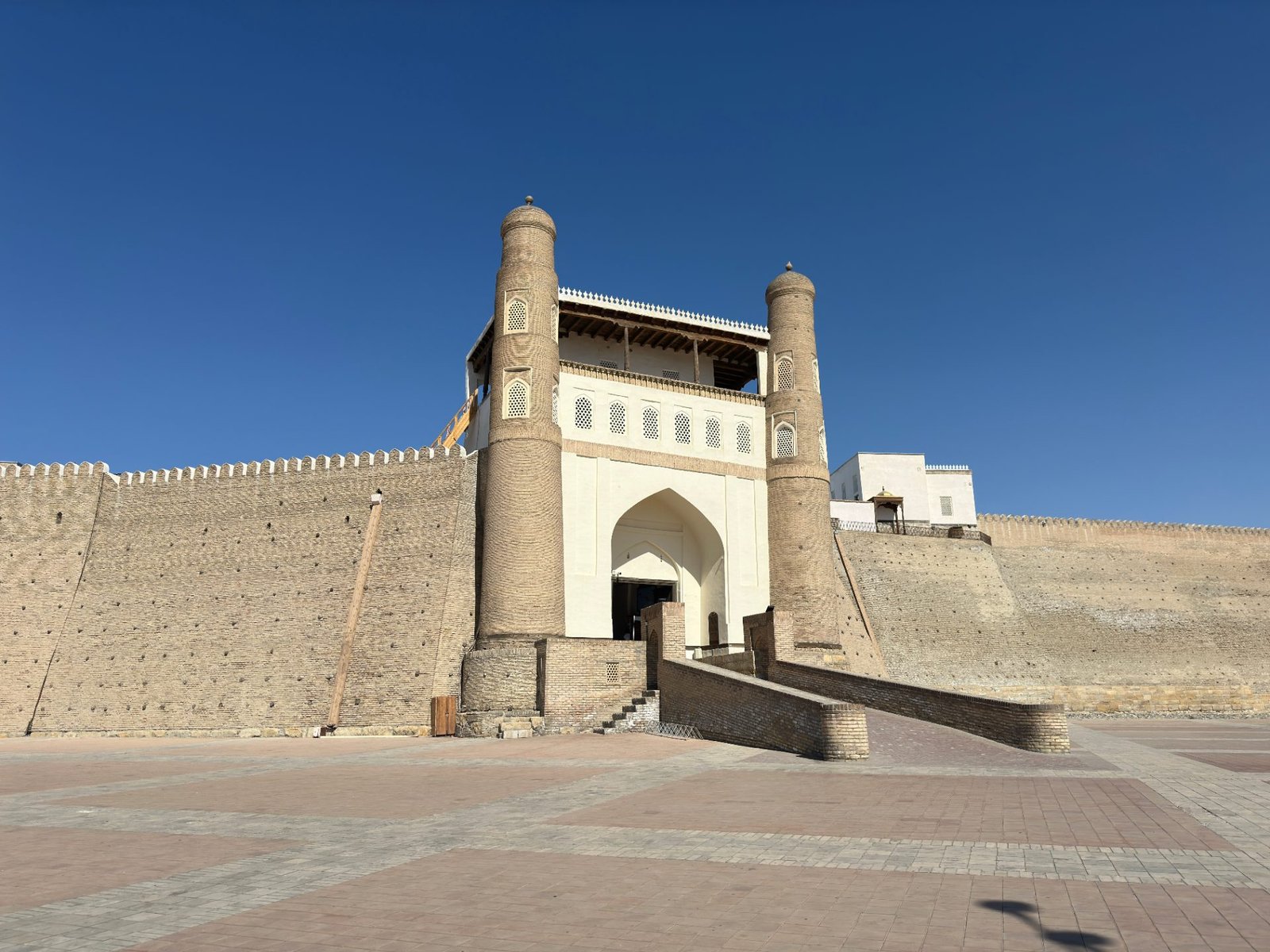
The Ark costs 60,000 som (about US$5) for foreign visitors, Sitorai Mokhi-Khosa the same, and most other museum sites 20,000 som. The tariff has been in force since 1 January 2025 and there is no weekly closing day. But the Kalyan Mosque, Chor Minor, the Samanid Mausoleum and Bolo Hauz belong to no museum and have no published price at all — carry extra cash.
Checked 26 August 2026 against the Bukhara State Museum-Reserve’s published price list, corroborated by a May 2025 feature produced with the Tourism Committee.
On this page
- What a foreign visitor pays
- The trick nobody mentions: half of these are monuments, not museums
- The buildings that are not on any list
- Photography, guides and the other charges
- Opening hours, and the closing day that does not exist
- Who gets in free
- Getting there in 2026
- How Bukhara compares with Samarkand
- What we could not verify
Having spent a day failing to establish what a ticket costs in Samarkand, we went looking for the same information in Bukhara and found something unexpected: a complete, dated, published tariff, in force since 1 January 2025, listing every site the state museum-reserve controls, with separate rates for foreign visitors, locals, students and schoolchildren.
It is the only tariff of its kind we could find anywhere in Uzbekistan. It is also incomplete in a way nobody tells you about, and the gap matters more than the prices do.
What a foreign visitor pays
These are the museum-reserve’s own published figures, in force since 1 January 2025 and unchanged on its price page as of 26 August 2026. Dollar conversions use the Central Bank of Uzbekistan’s rate for that day, 11,778.52 som to the dollar.
| Site | Foreign visitor | US$ | Local adult |
|---|---|---|---|
| The Ark | 60,000 som | 5.09 | 10,000 som |
| Sitorai Mokhi-Khosa (summer palace) | 60,000 som | 5.09 | 10,000 som |
| Fayzulla Khodjaev merchant’s house | 30,000 som | 2.55 | 5,000 som |
| Zindan (the jail) | 20,000 som | 1.70 | 5,000 som |
| Chashma-Ayub | 20,000 som | 1.70 | 5,000 som |
| Magoki Attori mosque | 20,000 som | 1.70 | 5,000 som |
| Abdulaziz Khan Madrasah | 20,000 som | 1.70 | 5,000 som |
| Ulugbek Madrasah | 20,000 som | 1.70 | 5,000 som |
| Kukeldash Madrasah | 20,000 som | 1.70 | 5,000 som |
| Lyab-i-Hauz museum | 20,000 som | 1.70 | 5,000 som |
| Bahauddin Naqshband complex museum | 20,000 som | 1.70 | 5,000 som |
| Museum of Fine Arts | 20,000 som | 1.70 | 5,000 som |
| Ibn Sina Memorial Museum | 20,000 som | 1.70 | 5,000 som |
| Imam al-Bukhari Memorial Museum | 20,000 som | 1.70 | 5,000 som |
| Ancient Paykend Museum | 20,000 som | 1.70 | 5,000 som |
| Mutal Burkhanov House-Museum | free | — | free |
Students pay 8,000 som at the Ark and Sitorai Mokhi-Khosa and 5,000 elsewhere; schoolchildren pay 2,000 som everywhere.
A second, quasi-official source corroborates the headline numbers independently. A May 2025 feature produced with the support of Uzbekistan’s Tourism Committee gives the Ark at 60,000 som for foreigners and 10,000 for locals, Sitorai Mokhi-Khosa the same, and the smaller museums at 20,000 and 5,000 — matching the tariff exactly.
The trick nobody mentions: half of these are monuments, not museums
Read that list again and you will notice that several entries are famous buildings dressed as museums. The Ulugbek and Abdulaziz Khan madrasahs face each other across the street and hold, officially, the Calligraphy Museum and the Woodcarving Museum. Magoki Attori — the half-buried mosque that is among the oldest surviving buildings in Central Asia — is officially the Carpet Museum. Chashma-Ayub is the Museum of Water Supply History. Kukeldash Madrasah is the Literature Museum.
This is why so many travellers report that Bukhara has no entry fees. They are looking for a monument ticket office and finding a museum one. The building and the ticket are the same thing, and it costs 20,000 som.
The buildings that are not on any list
Here is the gap. The following are among the most visited structures in Bukhara, and none of them belongs to the state museum-reserve. None appears on the tariff, and we could find no published price for any of them, from any official source, in any language:
- The Kalyan Mosque
- The Kalyan Minaret
- Mir-i-Arab Madrasah
- Chor Minor
- The Samanid Mausoleum
- Bolo Hauz Mosque
- The Lyab-i-Hauz square itself
We checked the museum-reserve’s full object catalogue, Uzbekistan’s legal database, the state heritage portal, and Russian- and Uzbek-language searches for a Bukhara regional heritage price list. There is nothing published.
Unofficial figures circulate and contradict each other badly — the Kalyan Mosque is quoted at 20,000 som by two tour operators and at around 6,000 som by another site, and Chor Minor at 5,000. The Samanid Mausoleum, Bolo Hauz and the Lyab-i-Hauz square are consistently reported as free. Mir-i-Arab is a working madrasah and is generally not open to non-Muslim visitors beyond a view of the courtyard; we could not verify any admission price for it at all.
Carry an extra 100,000 som in small notes and expect to pay some of these at the door.
Photography, guides and the other charges
The same tariff prices everything else, which is unusual and useful:
| Service | Price |
|---|---|
| Photography permission | 30,000 som |
| Video recording | 100,000 som |
| Audio guide | 20,000 som |
| Radio guide, set of ten | 50,000 som |
| Guided tour in Uzbek | 35,000 som (70,000 at the Ark and Sitorai Mokhi-Khosa) |
| Guided tour in a foreign language | 60,000 som (120,000 at the Ark and Sitorai Mokhi-Khosa) |
| Commercial photo session | 300,000 som |
| Commercial video filming | 1,000,000 som per hour |
A foreign-language guided tour of the Ark therefore costs twice the admission. Worth it once; the audio guide at 20,000 som is the better default elsewhere.
Opening hours, and the closing day that does not exist
The museum-reserve publishes, verbatim, three overlapping schedules: a general 09:00 to 18:00, a seasonal 08:00 to 21:00, and a Tuesday, Wednesday and Sunday variant of 09:00 to 17:00. We are quoting it as published rather than smoothing it, because we cannot tell which supersedes which.
What is unambiguous is the last line: no weekly closing day. The Tourism Committee-backed feature confirms it independently. Bukhara’s museum sites are open every day of the week, which is not true of most museum systems in the region and is worth planning around.
Who gets in free
Under-18s on designated Tuesdays and Fridays and throughout 1 to 8 September; people with disabilities; war veterans; orphans; and all citizens on the first Sunday of each month.
Getting there in 2026
Bukhara sits on the Afrosiyob high-speed line and is roughly four to four and a half hours from Tashkent, with morning departures around 08:00. Fares reported for 2026 run about 509,000 som (US$43) in economy, 760,000 in business and 1,138,000 in VIP.
Since early May 2026 there is also a new through service. A South Korean-built Hyundai Rotem EMU-250, named the Jaloliddin Manguberdi, now runs Tashkent to Samarkand to Bukhara to Urgench to Khiva in about seven and a half hours end to end, down from roughly fourteen. Bukhara is a stop, so the same train links the two cities in this cluster. One-way fares are 780,000 som (US$66) in economy and 1,815,000 som (US$154) in VIP.
Days of the week are the one thing we could not pin down: two Uzbek outlets reporting the launch within a day of each other give different operating days. Check the operator, eticket.railway.uz, before you plan around it. Afrosiyob seats sell out quickly, sometimes soon after booking opens sixty days ahead.
How Bukhara compares with Samarkand
The contrast is stark and worth stating plainly. Samarkand’s own cultural authority publishes two different foreign-visitor prices for the same mausoleum and sells it online at a third — we traced the whole mess in our guide to Samarkand’s entry prices. Bukhara publishes one tariff, dates it, and sticks to it.
Bukhara is also considerably cheaper. The Ark, the city’s headline monument, costs 60,000 som against the Registan’s 100,000, and Bukhara’s secondary sites cost 20,000 against Samarkand’s 25,000 to 30,000 on paper and 70,000-plus in practice. A full day of sightseeing in Bukhara is realistically 200,000 to 300,000 som, around US$17 to US$25.
If you are arriving from abroad, read our guide to Uzbekistan’s registration rules first — the three-working-day clock catches people out.
What we could not verify
The tariff page carries no decree, order or protocol number, and we could not find the underlying legal act on Uzbekistan’s legal database. It is published as a price list, not as a linked instrument — better than Samarkand, but still not traceable to law.
We could not verify any price for the Kalyan complex, Mir-i-Arab, Chor Minor, the Samanid Mausoleum, Bolo Hauz or Lyab-i-Hauz square, and we are not going to guess. We could find no official combined or multi-site ticket for Bukhara; the price page does not mention one, and neither does anything else we searched. And we could not verify any 2025 or 2026 price change — the tariff still carries its January 2025 heading, but absence of a reported change is not proof of no change.
One more warning. Several widely-read English-language guides still print 15,000 or 40,000 som for the Ark. Those are pre-2025 figures and they are now wrong by a factor of up to four.
Photo: Ark.Bukhara by Umid1108, via Wikimedia Commons, CC0.