
In short
Sarazm — inscribed by UNESCO in 2010, occupied from around 3500 BCE — is 15 km from Penjikent, costs about 30 somoni, and a taxi with waiting time is another 30. Ancient Panjakent is also 30 somoni. The Jartepa crossing puts you in Samarkand about 90 minutes after leaving central Penjikent. No permits are needed anywhere in the Zarafshan valley.
Checked 26 August 2026 against UNESCO’s inscription record and dated 2023–2026 visitor reports; admission figures are visitor-reported, as no official tariff is published.
On this page
A few hundred metres from the Uzbek border post outside Penjikent lies a settlement that was trading with the Iranian plateau and the Indus valley five and a half thousand years ago. It is Tajikistan’s first UNESCO World Heritage site. Most people who go there see it as a forty-minute taxi stop on the way to Samarkand, and its museum routinely has no electricity.
This is the story of Sarazm, the Sogdian city up the road, and the easiest border crossing in Central Asia.
Sarazm
The Proto-urban Site of Sarazm was inscribed in 2010 under criteria (ii) and (iii) — Tajikistan’s first World Heritage property. UNESCO’s citation is unusually direct about why it matters: it testifies, from the fourth millennium BCE, to trade and cultural exchange between the pastoral nomads of the Central Asian mountains and the farming peoples of Transoxiana, and it constitutes a remarkable human settlement, exceptional in its geographical situation, in the fourth and third millennia BCE.
In plain terms: this was a proto-city with metallurgy and long-distance trade connections reaching the Iranian plateau, the Indus valley and Indian Ocean networks, occupied from around 3500 BCE. The inscribed property covers 15.93 hectares.
What is actually there: five covered excavation areas — foundations and clay structures under metal awnings, with walls standing up to about a metre — plus a small on-site museum with basic finds, photographs, skeleton displays and a recreated ancient dwelling. Signage is in Tajik, Russian and English.
We should be honest: reviewers consistently say there is not much to see. This is a site for people who find the idea electrifying rather than the ruins photogenic. A guide transforms it, and several visitors say exactly that — arrange one through the Rudaki Museum in Penjikent.
Practicalities: admission around 30 somoni. It is 15 km west of Penjikent, and a taxi from the bazaar including a 30–40 minute wait costs about 30 somoni total. Infrequent morning marshrutkas go to Sarazm village, 2 km from the site.
Two warnings. A visitor in June 2026 found the museum without power or water and was told this happens very often. And wear long trousers — the grass is thorny. There are no cafés, banks or facilities nearby.
One more thing worth knowing before you go: the most significant finds are not here. They are in the National Museum of Antiquities in Dushanbe.
Ancient Panjakent
Twenty minutes’ walk from the modern bazaar are the remains of a Sogdian city — one of the great trading cultures of the Silk Road, whose merchants ran the commerce between China and Persia.
You can make out foundations of houses, temples and a bazaar, with the citadel to the west, spread across a large area. There is some reconstruction, including a Zoroastrian temple. Because it was built in mud brick, little stands, and most of the site is still underground and unexcavated.
Admission is 30 somoni, corroborated by dated visitor reports from 2023 and 2025. There is a small museum at the entrance with fresco examples and artefacts, open Tuesday to Sunday, 10:00 to 17:00, though the lighting is poor.
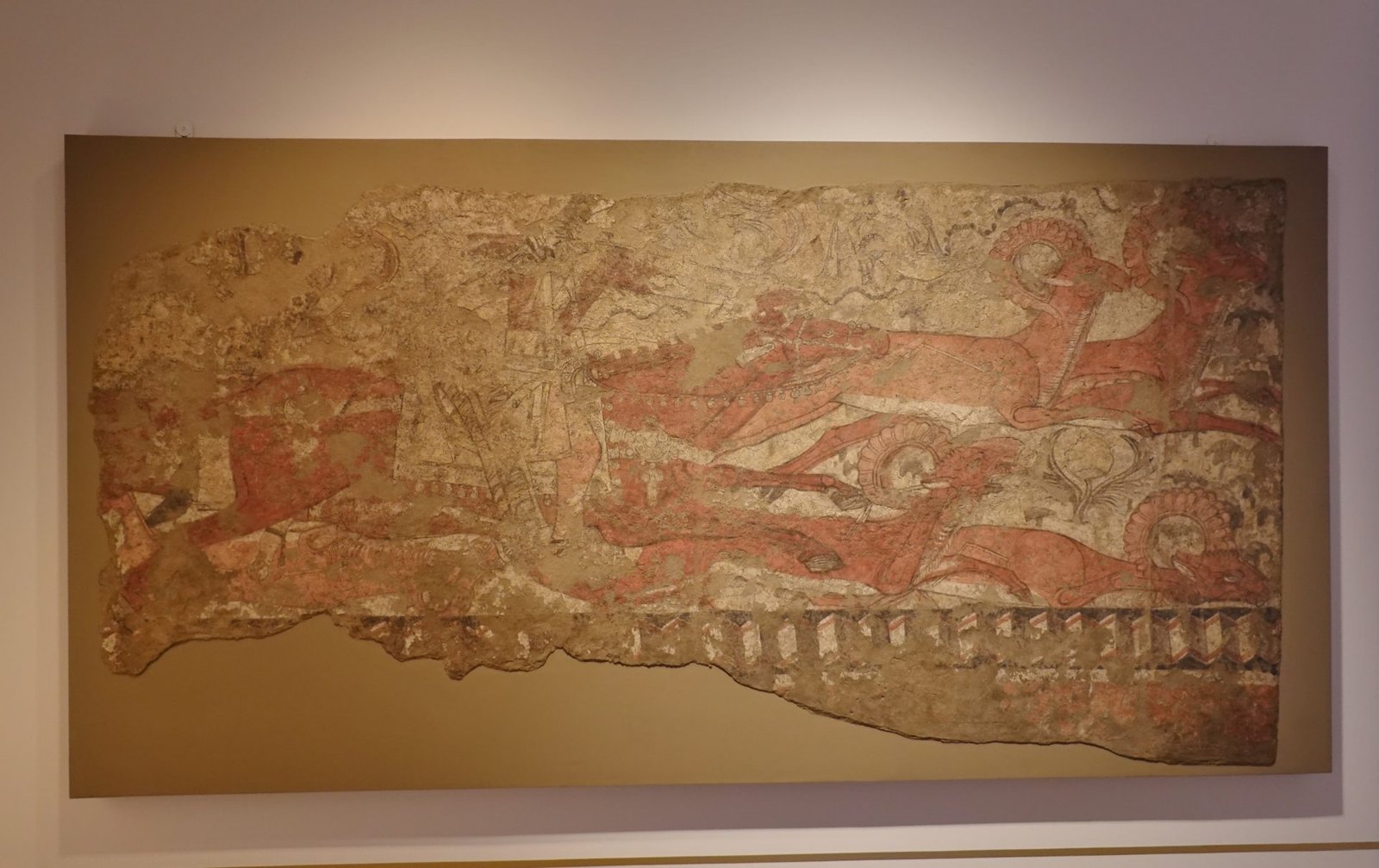
The frustration here is the same as at Sarazm and worth stating plainly: the best material is elsewhere. Panjakent’s celebrated Sogdian murals are in the Hermitage in St Petersburg and in Dushanbe. What you get on site is the shape of the city and the view.
The Rudaki Museum
If you only have an hour in Penjikent, spend it here rather than at the ruins. Fifteen somoni, Tuesday to Sunday 08:00 to 17:00, on Rudaki Street.
It holds Sogdian frescoes, statues, ossuaries, tools excavated from Sarazm, and the Mount Mugh documents — a genuinely famous archive of Sogdian-language texts — alongside local ethnography. It is an elegant single-storey building with white Doric columns, and one room is devoted to Abu Abdullah Rudaki, the tenth-century poet regarded as the father of Persian literature, who was born nearby.
It is also where you arrange a guide for the archaeological sites, which is the single best thing you can do with your money here.
Crossing to Samarkand at Jartepa
This is the easiest border crossing in Central Asia and the reason Tajikistan and Uzbekistan work as one trip.
The crossing is Jartepa on the Uzbek side, Sarazm on the Tajik side, listed as an international checkpoint operating 24 hours, open to third-country nationals, reopened in 2018 after roughly a decade closed.
| Leg | Detail |
|---|---|
| Penjikent → border | 20 km, 15–20 min, shared taxi from the bazaar, 10–15 somoni |
| At the border | Exit stamp, walk across, Uzbek immigration and luggage X-ray — 20–60 minutes |
| Border → Samarkand | 40–45 km, 45–60 min, shared taxi or damas, 15,000–30,000 UZS |
| Total | About 90 minutes, central Penjikent to Samarkand |
There is currency exchange on the Tajik side, Wi-Fi at the checkpoints, 4G, and fuel within a kilometre either way.
And here is the reason to build your route this way round: Sarazm sits a few hundred metres from the border post. You can see a five-and-a-half-thousand-year-old proto-city and be in Samarkand in time for dinner.
Our Samarkand guide covers what happens next — including the fact that the city publishes three different official prices for the same monument.
Where to stay in Penjikent
Named places that operate: Salom Hostel at the budget end; Umariyon, Sugd, Zarafshon and Zurmich in the middle; and Panjakent Plaza at the top. We could not find dated 2025 or 2026 rates for any of them, so we are not printing a range.
Penjikent works as a base rather than a destination — a good bazaar where you can eat, shop and pick up onward transport, and the gateway both to the Fann Mountains and to Haft Kul.
Permits
None. No part of the Zarafshan valley requires a permit. Tajikistan’s permit areas are GBAO and Lake Sarez, both far east of here.
You will have your passport and e-visa checked at the Shing checkpoint if you head up to the Seven Lakes, and that is the extent of it.
What we could not verify
Current accommodation rates in Penjikent. Whether the Sarazm museum’s power supply has been fixed. And current opening hours for the Sarazm site itself — the 30 somoni admission comes from dated visitor reports rather than any published tariff, which is a recurring theme across the region.
For the wider trip, see our Tajikistan travel guide.
Photo: Hunting scene; wall painting from Penjikent in Tajikistan, 6th cent.; Amsterdam Hermitage by Richard Mortel, via Wikimedia Commons, CC BY 2.0.