
In short
The Pamir Highway is open and permits are being issued. But there have been fatal cross-border incidents in Darvoz district, inside GBAO and on the main route — most recently on 13 August 2026 — and the US Embassy issued a security alert on 19 August. Canada advises avoiding all travel within 10 km of the Afghan border, which covers roughly 60% of a standard itinerary. The high eastern Pamir from Osh is far from the frontier; the western Panj section is not.
Compiled 26 August 2026 from US, UK, Canadian and Irish government advice and dated reporting by Tajik and regional outlets. Check your own government’s advice on the day.
On this page
Most English-language writing about the Pamir Highway is a photograph of a road with mountains behind it, some prices from 2015, and an invitation to go.
This article is not that. We set out to write a how-to guide and stopped, because of what the research turned up. What follows is the situation as of 26 August 2026, dated and sourced, so you can make your own decision rather than ours.
The short version
The Pamir Highway is open. Permits are being issued. People are travelling it right now.
And on 13 August 2026, thirteen days before we published this, a young woman was killed in her own home in Darvoz district by stray fire from the Afghan side of the river. Darvoz is inside Gorno-Badakhshan, on the road that essentially every Pamir Highway itinerary uses.
Both of those statements are true. The honest framing is not “closed” and not “come on down.” It is: administratively open, tourism functioning, and sitting alongside an active conflict that has produced repeated fatal spillover into the exact districts the road runs through.
Note carefully what the constraint is not. The 2021–22 unrest in Khorog and the permit refusals that followed are not the current issue. Permits are flowing. The issue is the Afghan border.
What has actually happened
| Date | Where | What |
|---|---|---|
| 26 Nov 2025 | Shamsiddin Shohin, Khatlon — outside GBAO | Three Chinese nationals at a gold-mining site killed by gunfire and a drone-carried explosive from Afghan territory |
| 30 Nov 2025 | Darvoz district, GBAO | Two Chinese road workers killed, two wounded, by fire from across the Panj |
| Dec 2025 onward | Kalai-Khumb–Vanj, on the M41 | Construction of the 109 km highway upgrade suspended; Chinese workers withdrew. The transport ministry said work resumes only after “restoration of safety on the Tajik–Afghan border” |
| Feb 2026 | — | The CSTO sent weapons to Tajikistan to secure the Afghan border |
| Aug 2026 | Nusay, Afghan Badakhshan — directly opposite Darvoz | Fighting between Taliban forces and a local commander, who surrendered on 17 August |
| 13 Aug 2026 | Dashtak village, Darvoz district, GBAO | A 21-year-old woman killed by a stray bullet that came through her window. Tajikistan sent a formal protest note |
| 19 Aug 2026 | — | The US Embassy issued a security alert and temporarily prohibited its own personnel from travelling to these border areas |
One number puts the trend in context. The conflict monitoring project ACLED recorded 22 armed anti-Taliban events in Afghan Badakhshan between January and July 2026, against four in the whole of June to December 2025. The activity across the river is increasing, not settling.
To be precise about the road: the M41 is not closed. What was suspended is the Chinese-funded upgrade of one section. Local crews continue maintenance work and traffic runs.
What four governments say
| Government | Country level | On Gorno-Badakhshan | Dated |
|---|---|---|---|
| United States | Level 2 — increased caution | Level 3 — Reconsider Travel, for potential armed conflict | Advisory May 2025; embassy alert 19 Aug 2026 |
| Canada | High degree of caution | Avoid non-essential travel to GBAO. Separately: avoid all travel within 10 km of the Afghan border | 29 July 2026 |
| United Kingdom | No blanket advice against travel | Risk of civil unrest in Khorog; marked and unmarked minefields — do not walk off-road; carry your permit for Border Guard checks | 23 July 2026 |
| Ireland | High degree of caution | Be cautious in Gorno-Badakhshan including Khorog; situation can change at short notice | 23 March 2026 |
The Canadian line is the one that matters most and the one nobody quotes. “Avoid all travel to within 10 km of the border with Afghanistan” covers, literally: the entire Kulob–Kalaikhum–Rushan–Khorog road, Khorog town itself, Ishkashim, and the whole Wakhan corridor from Ishkashim to Langar.
That is roughly sixty per cent of a standard Pamir Highway itinerary. If you are British or Canadian and you check your own government’s advice after reading a typical travel blog, the two will be irreconcilable. We would rather you found that out here.
We could not verify Australia’s current position: every attempt to reach its government travel page returned an archived version from January 2021 carrying a blanket COVID-era warning. Do not rely on any figure attributed to it, including in other articles.
What is genuinely still working
Set against all of the above, the practical machinery of visiting is functioning:
- GBAO permits are being issued through three channels — the e-visa portal with the GBAO box ticked (US$20), an in-person OVIR office in Dushanbe, Khorog or Khujand (100–180 somoni), or an agency (US$35–45).
- A Tajik news outlet published a tourist guide to GBAO in March 2026 — a domestic publication treating the province as a destination is meaningful evidence it is not sealed.
- The Kyzyl-Art crossing from Kyrgyzstan is open to third-country nationals, at 4,280 metres, with about 20 km of no-man’s-land between the posts. Note it is open only to foreigners, which is why there are no shared taxis and you must charter.
- We searched specifically for reports of permit refusals or suspensions in 2025 and 2026 and found none.
One standing caveat, from the US State Department itself: the government can suspend travel permits for non-citizens at short notice. The realistic risk to someone who has booked flights is not that a permit is refused today, but that the regime changes between booking and arriving.
The other risk, which has nothing to do with the border
Altitude kills more travellers in the Pamirs than anything else, and it is entirely manageable if you respect it.
Murghab sits at 3,650 metres, Karakul at around 3,900, and the Ak-Baital pass at 4,655. Standard guidance is to gain no more than about 500 metres of sleeping altitude a day above 2,500.
This is the real argument for direction of travel. Coming from Osh you climb gradually over several days. Coming from Dushanbe, at 800 metres, you can find yourself sleeping above 3,600 within two days. If you go, go west to east — Osh to Dushanbe — and build in nights at Sary-Tash and Karakul.
Separately, the Bartang valley road is chronically closed by avalanches, rockslides, mudflows and flooding. That is a road-condition problem rather than a permit one, and it can strand you.
The route, for context
The classic run is Osh to Dushanbe, roughly 1,250 km, or about 1,500 via the Wakhan. Realistic driving times, and note how the surface deteriorates in the middle:
| Section | Distance | Time | Road |
|---|---|---|---|
| Murghab – Osh | 410 km | 10–12 h | About 90% paved |
| Langar – Murghab | 255 km | 7–8 h | Poor; 100 km of dirt then wavy pavement |
| Khorog – Ishkashim | 110 km | 3.5–4 h | Half dirt, half decent |
| Kalai-Khumb – Khorog | 240 km | 8 h | Poor — dirt and broken pavement, sections too narrow to pass |
| Dushanbe – Kalai-Khumb | 370 km | 8 h | Mostly good; last 40 km dirt through a gorge |
Expect six to eight checkpoints between Kalaikhum and the Kyrgyz border, each logging your passport and permit — carry photocopies, because some checkpoints keep one.
Season is roughly mid-June to mid or late September. We could not find an authoritative source giving pass opening and closing dates; treat it as a window, not a timetable.
Our position
We are not telling you not to go, and we are not going to pretend we can assess your risk tolerance from here.
What we would say is this. The danger is not evenly spread. The high eastern Pamir — Murghab, Karakul, Ak-Baital, the road to Osh — is a long way from the Afghan frontier and is not where any of the incidents above happened. The stretch that carries the warnings is the western section along the Panj: Kulob to Kalaikhum to Khorog, and the Wakhan.
If the Pamirs are the reason you are going to Central Asia, the honest options are to travel the eastern section from Osh and turn back, to go with an operator who is actively monitoring the border situation, or to wait.
And if what you actually want is high-altitude trekking in Tajikistan, the Fann Mountains are in the north of the country, carry no comparable warning, and are superb. That is not a consolation prize.
Whatever you decide, check your own government’s advice on the day, not this article — and read our guide to GBAO permits for how the paperwork works.
What we could not verify
Australia’s current advisory. Whether any escort or convoy requirement applies to foreigners in GBAO — we checked five permit guides and four advisories and found none, which is absence of evidence rather than evidence of absence. Pass opening and closing dates. And whether the suspended Kalai-Khumb–Vanj construction has resumed.
We will update this page if the picture changes.
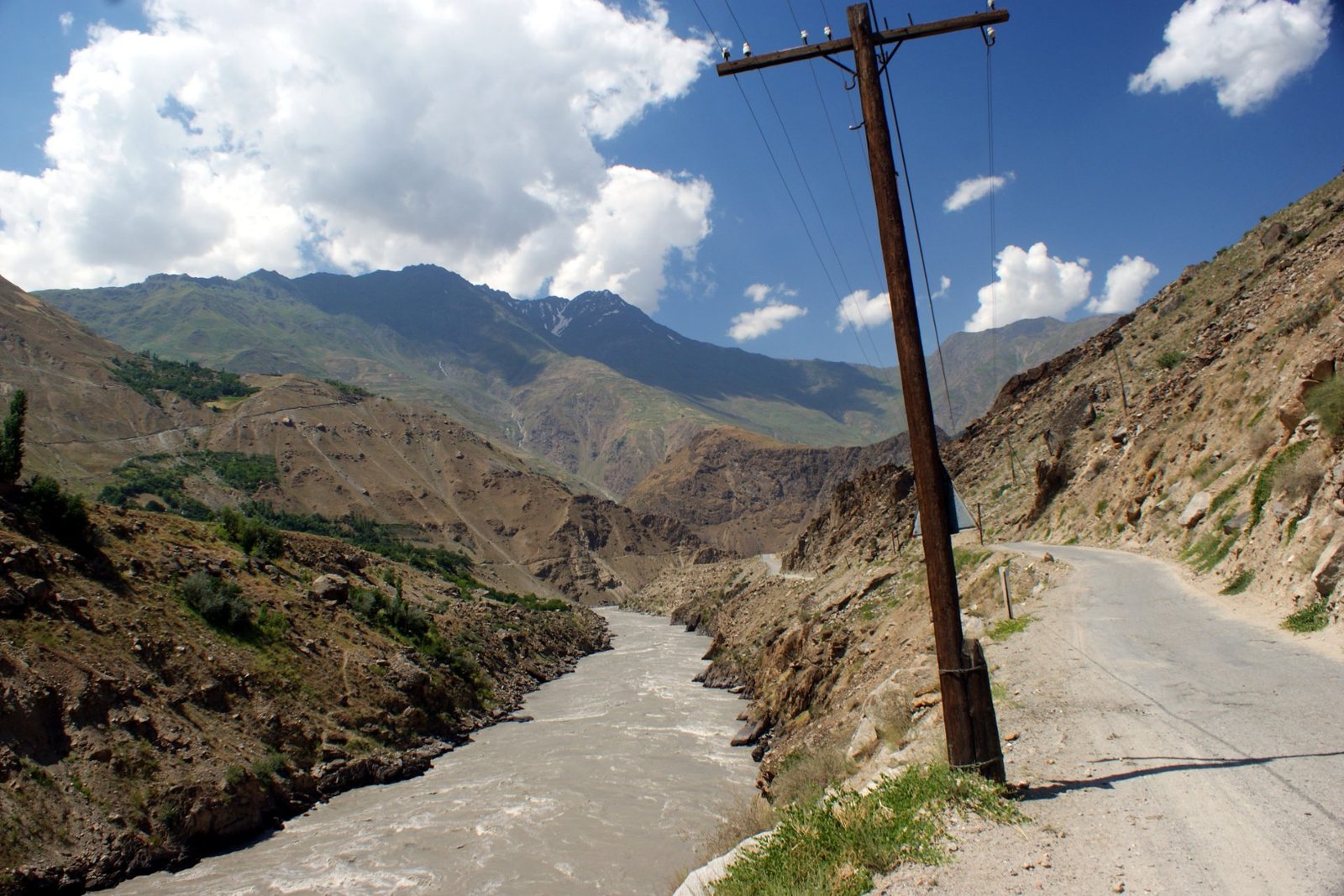
Photo: Pamir Highway and Panj 1 by Kondephy, via Wikimedia Commons, CC BY-SA 4.0.