
In short
İzmir is a base, and the honest answer is that its best days are outside the city. Ephesus and Selçuk, 80 km south, is a full day and deserves an overnight in Selçuk rather than a day trip. Şirince, 90 km south, is a free half-day added on. The guide also names three things widely recommended that we would skip, and says why.
Distances and fees checked August 2026.
Disclosure: some links in this guide are affiliate links. If you book through one, we earn a small commission and you pay exactly the same price. We only link to services we would use ourselves, no brand pays for placement or for a favourable write-up, and every price in this article was researched independently.
İzmir is Türkiye’s third city and its least visited by foreigners, which is roughly the whole point. There is no single monument here that people fly in for. What there is instead is a long waterfront, a genuinely good food culture, ferries that cross the bay for the price of a bus ride, and a set of ancient sites within an hour that most people rush past on the way to Ephesus.
What is in this guide
- The one thing to do first
- Kordon, and why the waterfront is the city
- Kemeraltı Bazaar
- Konak Square and the Clock Tower
- Agora of Smyrna
- Alsancak in the evening
- Day trips worth the journey
- What we would skip
- Practical notes
- When to come
- Common questions
- A note on our numbers
- Where to eat, and what to order
- The Aegean day trips, compared
- Understanding the geography
- A word on İzmir’s reputation
- Before you book
This is what we would actually spend time on, and what we would skip.
Verified: August 2026 · Exchange rate: €1 = ₺55.47 · $1 = ₺47.92 (TCMB, 18 Aug 2026)
Editor’s note
İzmir is routinely written up as somewhere to pass through on the way to Ephesus. That gets one thing right — there is no single monument here — and one thing badly wrong. What İzmir offers is a large Mediterranean city that has not been reorganised around visitors: a bazaar selling hardware rather than souvenirs, ferries used by commuters, menus in one language.
The one thing to do first
Take the ferry across the bay. Not a cruise — the ordinary commuter ferry that runs between Konak, Pasaport, Alsancak, Karşıyaka, Bostanlı, Göztepe and Üçkuyular.
It costs the same as any other public transport ride, it takes about twenty minutes, and it gives you the view of the city that no land route does: the arc of the bay, the hills behind, the Kadifekale fortress above. Do it around sunset and it is the best-value thing in İzmir by a distance.
A practical detail that catches people out: İzmir’s two tram lines do not connect to each other. The Konak tram runs the south shore, the Karşıyaka tram runs the north. The ferry is how you join them. That is not a design flaw; it is how the city works.
Kordon, and why the waterfront is the city
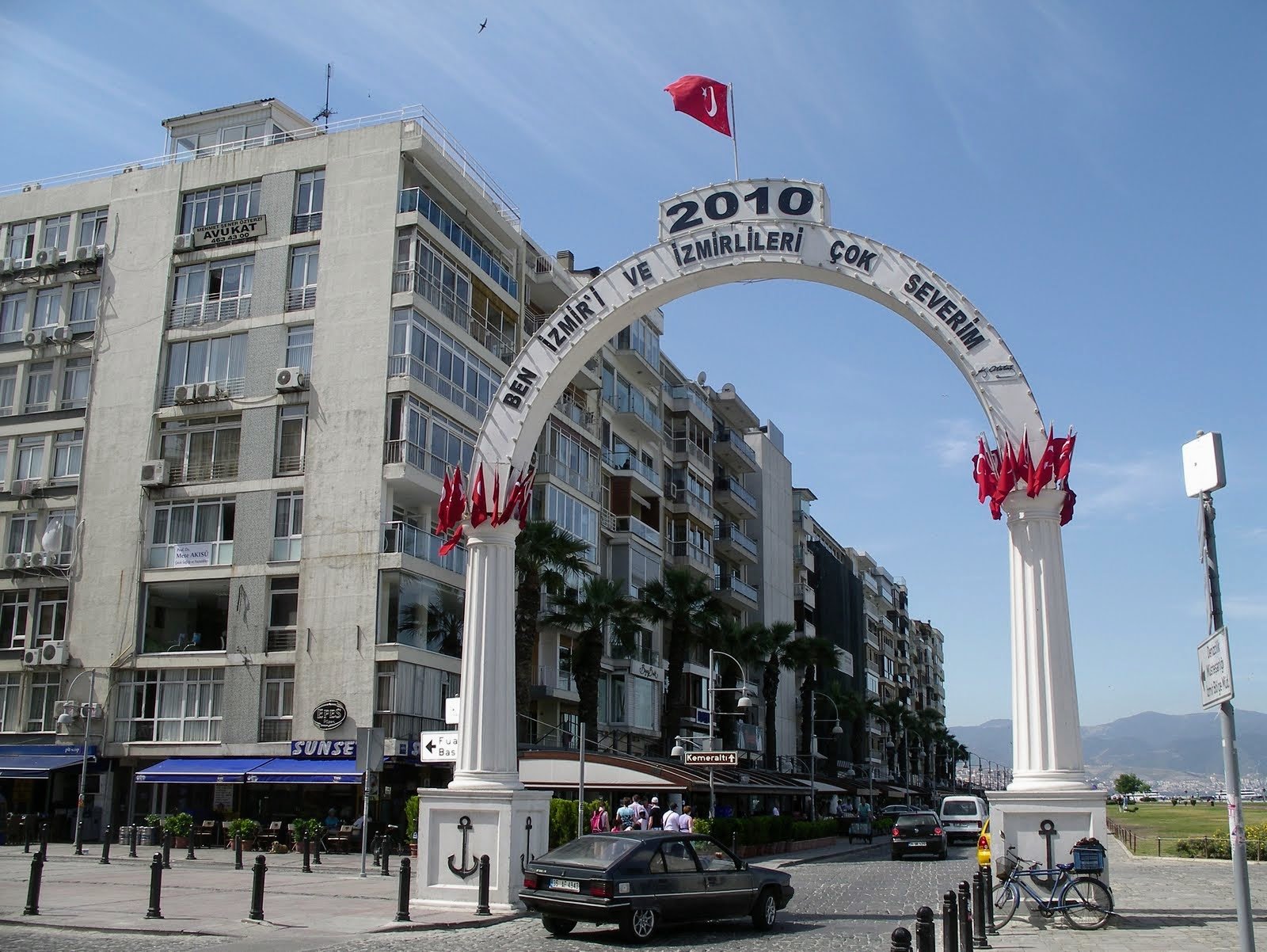
The Kordon is the seafront promenade running north from Konak through Alsancak. In the evening it fills with the entire city — families, students, cyclists, people who have brought their own chairs. There are cafés along it and they are fine, but the promenade itself is the attraction.
Walk it from Konak to Alsancak at dusk. It is about 3 km, flat, and it will tell you more about how İzmir lives than any museum.
Kemeraltı Bazaar
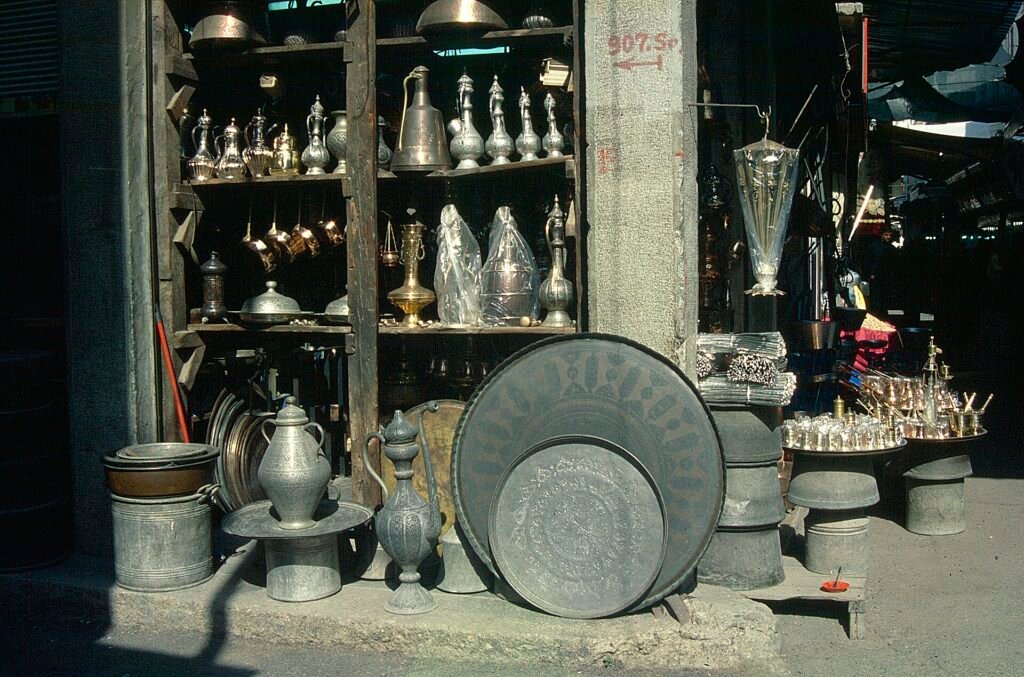
A working market, not a restored tourist one. It runs inland from Konak in a tangle of covered lanes: textiles, spices, hardware, coffee, jewellers, and the Kızlarağası Han caravanserai in the middle of it.
Go in the morning on a weekday when it is trading rather than closing. Bargaining is normal but not aggressive; İzmir is not Istanbul in that respect.
Konak Square and the Clock Tower
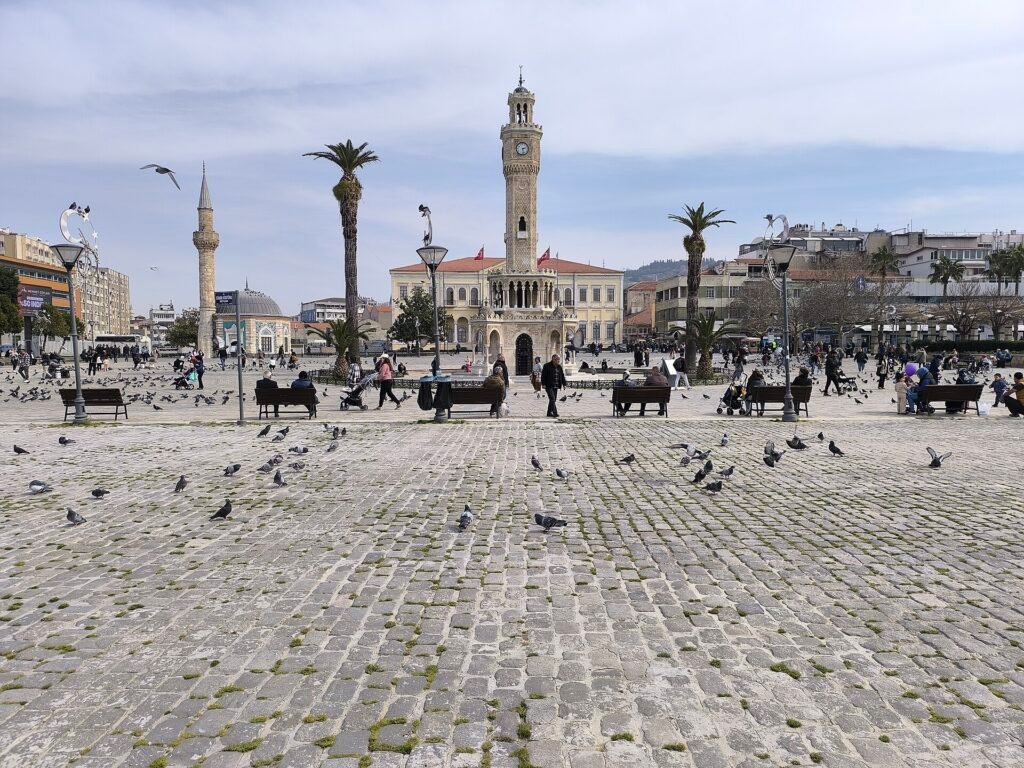
The Clock Tower, built in 1901, is İzmir’s emblem and takes about four minutes to appreciate. Konak Square around it is a transport hub more than a destination.
We are including it because you will pass through it constantly — the ferry pier, the tram and the bazaar all meet here — not because it deserves an afternoon.
Agora of Smyrna
The Roman agora sits in the middle of the modern city, a rectangle of vaulted basement galleries and standing columns surrounded by apartment blocks. It is small, it is rarely busy, and the contrast between the second-century arcade and the traffic above it is the reason to go.
Half an hour. Worth it if you are walking between Konak and Basmane anyway.
Alsancak in the evening
Alsancak is where İzmir eats and drinks. The grid of streets behind the Kordon is dense with meyhanes, wine bars and small restaurants, and it stays busy late.
If you want one thing to order: boyoz, a flaky pastry that is essentially an İzmir invention, eaten at breakfast with a hard-boiled egg. It is sold from tiny shops all over Alsancak and Kemeraltı and it costs almost nothing.
Day trips worth the journey
| Where | Distance | Time needed | Verdict |
|---|---|---|---|
| Ephesus & Selçuk | 80 km south | Full day | The reason most people come. Deserves better than a day trip — stay in Selçuk |
| Şirince | 90 km south | Half day, added to Selçuk | Greek stone village, free to walk around, fruit wine of variable quality |
| Çeşme & Alaçatı | 85 km west | Full day | Beaches and a boutique village. Peak season is expensive and packed |
| Bergama (Pergamon) | 110 km north | Full day | Acropolis and Asklepion. The strongest argument for buying the Aegean museum pass |
| Pamukkale | 235 km east | Do not day-trip it | Three hours each way. Stay overnight — see our Pamukkale guide |
What we would skip
The Historical Elevator (Asansör) in Karataş is charming and takes eight minutes. It is not a destination, though every list puts it on one. Go if you are in Karataş.
Kadifekale has the view but very little else, and the walk up is unpleasant. The ferry gives you a better panorama with less effort.
Any “İzmir city tour” sold as a half-day coach product. The city is small, walkable and connected by cheap public transport. There is nothing here a tour unlocks.
Practical notes
İzmir uses a flat fare on buses, metro and trams, with distance-based pricing on İZBAN and on about twenty long-distance suburban bus routes — “Gittiğin Kadar Öde”, pay as you go. This is unusual in Türkiye and most guides get it wrong.
On the actual 2026 fare we are going to be straight with you: two mainstream Turkish outlets publish incompatible figures, one reporting a rise to ₺20 in late 2025 and another a rise to ₺40 in April 2026, and the transport authority’s own site was unreachable when we checked. Budget roughly ₺20–40 per journey depending on distance and confirm when you buy your card. We would rather say that than print a number we cannot stand behind.
İzmirim Kart is sold and topped up at grocery shops, markets and tobacco kiosks across the city, and there is an app that will sell you a digital version.
Accommodation tax is 1%, not 2%, for the whole of 2026 — it was halved by decree effective 1 May and runs to 31 December. Every English guide still says 2%.
When to come
Late April to May, and late September to October. İzmir in May averages a 26 °C maximum with about 31 mm of rain. July and August average 33 °C with 4–6 mm of rain for the entire month, which means relentless sun; December and January are mild but are the two wettest months of the year.
Common questions
Is İzmir worth a night, or should I go straight to Selçuk? One night is worth it if you arrive in the afternoon — the Kordon at dusk, dinner in Alsancak, the ferry. Two nights only if you want the city rather than the ruins. If your flight lands in the morning, go straight to Selçuk and see İzmir on the way back.
Is İzmir safe? Yes, in the ordinary way that large Mediterranean cities are. The waterfront and Alsancak are busy late into the evening. Normal city precautions apply around Basmane and the bus station at night.
What is the best way to get around? An İzmirim Kart, bought at any grocery shop or kiosk, covering bus, metro, tram and ferry. İzmir charges by distance rather than a flat fare, so a card is worth having from your first journey.
How long does the ferry take? About twenty minutes across the bay, running frequently through the day and evening. It is ordinary public transport at ordinary fares, not a tourist cruise, and it is the best value in the city.
Is Kemeraltı a tourist trap? No — it is a working bazaar selling hardware, textiles and food to people who live there. That is exactly why it is worth going. Prices are normal and haggling is expected but not aggressive.
When does Alaçatı get expensive? July and August, sharply. It is a premium boutique destination and peak season prices reflect that. May, June, September and October are the same village at a fraction of the cost.
Can I swim in İzmir itself? Not really in the bay. The beaches are out on the Çeşme peninsula, about an hour and a quarter west by bus from Üçkuyular.
Is there a hop-on-hop-off bus? There is, and we would not bother. İzmir’s centre is walkable, the tram runs the waterfront, and the ferry gives you the best view in the city for the price of a bus ticket.
What should I eat? Boyoz for breakfast, kumru as a snack, and a meyhane evening in Alsancak if you have one night. İzmir’s food is Aegean — olive oil, herbs, fish — rather than heavy Anatolian.
Is October really better than August? For everything except swimming, yes. October averages 24 °C with modest rain against August’s 33 °C with almost none, and the crowds have gone.
A note on our numbers
Climate figures are from the Turkish State Meteorological Service, 1938–2025 averages. Transport and accommodation-tax details were checked in August 2026. Where sources conflicted — and on İzmir’s 2026 transit fare they genuinely do — we have said so rather than picking whichever number looked tidiest.
Where to eat, and what to order
İzmir’s food culture is Aegean rather than Anatolian: more olive oil, more herbs, more fish, less meat than İstanbul. Three things are worth going out of your way for.
Boyoz. A flaky, layered pastry brought to İzmir by Sephardic Jews expelled from Spain, and now effectively the city’s civic breakfast. Eaten with a hard-boiled egg and black tea, sold from tiny shops across Alsancak and Kemeraltı, and it costs almost nothing. If you eat one thing in İzmir, eat this.
Kumru. A sesame bread roll filled with cheese, tomato and sausage, associated with Çeşme but sold everywhere. Street food that fills a gap.
Şambali. A semolina cake soaked in syrup, sold from carts. Sweet enough to be a whole snack.
For meals: the streets behind the northern Kordon in Alsancak are where the meyhanes are, and a meyhane evening — small plates, rakı, several hours — is the way İzmir eats. Kemeraltı at lunchtime feeds the market rather than tourists, which makes it both cheaper and better. The Kordon waterfront itself charges a view premium; the food is fine and the price reflects the sea.
The Aegean day trips, compared
| Where | Distance | Time needed | Public transport | Worth it? |
|---|---|---|---|---|
| Selçuk & Ephesus | 80 km | Full day, better overnight | Train from Basmane | The reason most people come |
| Şirince | 90 km | Half day with Selçuk | Dolmuş from Selçuk | Yes, before 10:00 or after 16:00 |
| Çeşme & Alaçatı | 85 km | Full day | Bus from Üçkuyular | In shoulder season, yes |
| Bergama (Pergamon) | 110 km | Full day | Bus | Yes, and it justifies the museum pass |
| Foça | 70 km | Half day | Bus | Quiet fishing town, underrated |
| Pamukkale | 235 km | Do not day-trip it | Train to Denizli | Stay overnight instead |
Bergama deserves a note. The Acropolis sits on a hill above the modern town, reached by cable car, with a theatre built into the slope at an angle so steep it is startling. The Asklepion, a Roman healing sanctuary, is a separate site below. Together they are a full day and they are the single strongest argument for buying the €95 Aegean museum pass, because on their own plus Ephesus you start to approach the break-even point.
Understanding the geography
İzmir wraps around a long bay, and almost everything a visitor wants is on the eastern and southern shore.
Konak is the hinge: the ferry pier, the Clock Tower, the tram terminus and the entrance to Kemeraltı bazaar are all within two hundred metres of each other.
Alsancak runs north from Konak along the water. This is the going-out district.
Karşıyaka is across the bay on the north shore, reached by ferry in about twenty minutes, and it is where İzmir lives rather than where it entertains visitors. Its waterfront is quieter and its tram does not connect to the southern one.
Bornova and Bayraklı inland are university and business districts with little for visitors.
The practical consequence: stay on the southern shore, and use the ferry as sightseeing rather than as a commute.
A word on İzmir’s reputation
İzmir is often described in English guides as a place to pass through on the way to Ephesus. That framing has one thing right — it is not a monument city — and one thing badly wrong.
What İzmir offers is the ordinary life of a large Mediterranean city that has not been reorganised around tourism: a promenade full of local families rather than tour groups, a bazaar that sells hardware and spices rather than souvenirs, ferries used by commuters, and restaurants where the menu is not in four languages.
If you want ruins, go to Ephesus. If you want to spend an evening somewhere that feels like a real place, stay a night in İzmir on the way.
Before you book
İzmir is a walking and ferry city, so very little needs pre-booking. Two exceptions: flights into İzmir, where shifting your dates a few days routinely saves more than everything else combined, and a luggage drop if you arrive early and your room is not ready.