
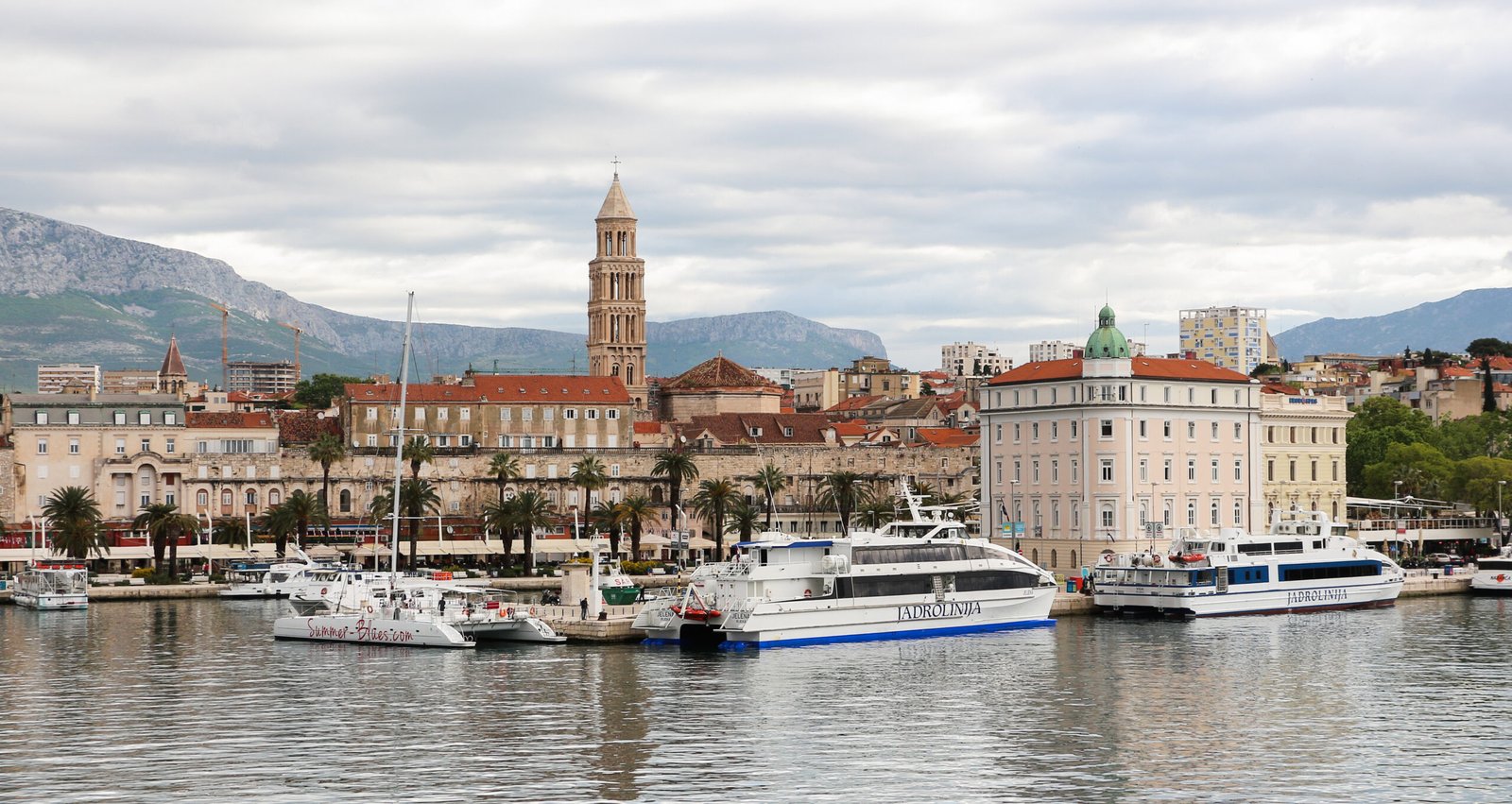
Split’s Diocletian’s Palace isn’t a ruin behind a fence — it’s a living neighborhood. Roman walls from 305 AD now hold apartments, cafes, and a cathedral, and roughly 3,000 people still live inside the palace perimeter. Split is also the main ferry hub for Hvar, Brač, and Korčula, which makes it the natural base for island-hopping.
Contents
Diocletian’s Palace
Wandering the palace’s narrow limestone streets costs nothing — it’s an open, lived-in part of the city, not a ticketed museum zone. The one paid add-on most visitors do is the basement cellars beneath the palace’s central hall, atmospheric vaulted substructure chambers that also stood in as Daenerys’s throne room set in HBO’s Game of Thrones. Climbing the cathedral’s bell tower for a rooftop view over the terracotta roofs is the other worthwhile paid stop.
The Riva and Marjan Hill
The Riva is Split’s palm-lined waterfront promenade, lined with cafes that double as the city’s evening social hub. For a quieter, greener contrast, Marjan Hill rises just west of the Old Town — a forested park with walking trails, small medieval chapels, and viewpoints over the harbor; locals jog and swim off its rocky coves rather than the city beaches.
Day trips: Trogir and Krka
Trogir, a UNESCO-listed walled island-town, is about 30 minutes away by bus and small enough to see thoroughly in a few hours. Krka National Park, roughly 1-1.5 hours north, has waterfalls similar in style to Plitvice but with swimming allowed in a designated area below Skradinski Buk — a genuine point of difference from Plitvice, where swimming is banned throughout the park.
Split as a ferry hub
Jadrolinija and several private catamaran operators run from Split’s ferry port to Hvar, Korčula, Brač, and Vis, with sailings far more frequent in summer than winter. See our full island ferry guide for routes, approximate prices, and the seasonal schedule gap to plan around.
FAQ
Can you swim at Krka but not Plitvice?
Yes — Krka National Park has a designated swimming zone below its main waterfall, while swimming is prohibited throughout Plitvice Lakes National Park.
Do people really live inside Diocletian’s Palace?
Yes, it’s a continuously inhabited part of central Split, not a fenced archaeological site — expect laundry lines and doorbells alongside Roman stonework.
Photo: Diocletian’s Palace in Split, by Bernard Gagnon, CC BY-SA 4.0, via Wikimedia Commons.