
Quick answer: Serbia is visa-free for 90 days within any 180-day period for US, UK, and EU passport holders — standard terms, no special deals like Albania’s 365-day rule for Americans. The currency is the Serbian dinar (RSD), not the euro; euros are only informally accepted near borders and for some accommodation bookings, so plan to use dinars for everyday spending. The one real complication in the region involves Kosovo: Serbia doesn’t recognize Kosovo’s independence, and if you’re combining the two on one trip, the entry order matters — see the section below and our existing Kosovo visa and entry rules guide for the full picture from the other side of that border.
Contents
Visa and Entry Rules
US, UK, and EU citizens can enter Serbia visa-free for up to 90 days within any rolling 180-day period. Because Serbia is outside the Schengen Area, this allowance is tracked separately from any Schengen days you’ve used elsewhere on the same trip — a useful fact if you’re combining Serbia with a Schengen-zone itinerary. There’s no special long-stay arrangement here like Albania’s 365-day rule for US citizens; Serbia follows the standard allowance most of the region uses. Your passport should be valid for at least three months beyond your planned departure date.
The Serbia-Kosovo Border, Explained Honestly
Serbia does not recognize Kosovo’s independence, and this shapes how border crossings work in practice. The safest sequence is to enter Serbia first — get a Serbian entry stamp at an airport (Belgrade, Niš, or Kraljevo) or land border — then travel to Kosovo and back; Serbia treats your return as a normal re-entry. If you arrive in Kosovo first (via Pristina, or overland from Albania, North Macedonia, or Montenegro), don’t cross directly into Serbia from Kosovo — exit through Montenegro or North Macedonia instead, then enter Serbia from there. Albania has no direct border with Serbia, so it only works as a transit point either way.
To be precise about the actual risk: a Kosovo entry stamp alone is not, by the numbers, an automatic refusal. The UK Foreign Office describes “isolated incidents” of Serbian border officials cancelling Kosovo stamps or denying entry to travelers carrying them — real, but uncommon rather than standard practice. Official advice differs by country: the UK treats a Serbia-after-Kosovo itinerary as generally workable, while Canada advises against entering Kosovo directly from Serbia. If Serbia and Kosovo are both on your itinerary, check your own government’s current travel advice close to your departure date rather than relying on a fixed rule, since border practice here has shifted before and can shift again.
Money: Dinars, Euros, and ATMs
The Serbian dinar (RSD) is the currency you’ll actually spend day to day. Euros are sometimes informally accepted near borders and for accommodation bookings, but you’ll get a better effective rate paying in dinars. For ATMs, stick to bank-branded machines — Banca Intesa, Raiffeisen, UniCredit, OTP, and NLB Komercijalna are commonly recommended — choose RSD when prompted, and decline any “dynamic currency conversion” offer that charges you in USD or EUR instead; it’s a worse rate dressed up as a convenience. Standalone Euronet ATMs in tourist areas are best avoided for the same reason. Visa and Mastercard are widely accepted in Belgrade and Novi Sad; cash still matters for markets, most taxis (or use the CarGo app for card payment), monasteries, and rural areas.
Where to Go in Serbia
Belgrade — the capital, built around the Kalemegdan Fortress at the confluence of the Sava and Danube, with the Nikola Tesla Museum, Skadarlija’s old bohemian quarter, and a riverboat club scene that runs late. Novi Sad — Serbia’s second city, built around the star-shaped Petrovaradin Fortress across the Danube, and the site of the EXIT Festival every July. Niš — Serbia’s third-largest city and one of its oldest, with Niš Fortress and the sobering Skull Tower. Zlatibor and the Šargan Eight — a mountain resort area built around a narrow-gauge heritage railway that loops through 22 tunnels on its way up a mountainside. Fruška Gora and Sremski Karlovci — a national park dotted with Serbian Orthodox monasteries, next to a baroque wine town that’s one of the country’s prettiest.
Getting Around
Buses are the backbone of Serbian domestic and international travel, with frequent, well-organized departures between the main cities. Belgrade has no direct rail connection to Sarajevo despite the two capitals’ proximity — that gap, along with the rest of the regional transport picture, is covered in our Belgrade-Sarajevo-Podgorica transport guide. For the fuller overland picture across Serbia, Montenegro, and Bosnia and Herzegovina, see our regional overland route guide.
FAQ
Is Serbia in the EU?
No. Serbia is an EU candidate country still in accession talks, not a member, and it isn’t in the eurozone or Schengen Area.
Can I use euros instead of dinars?
Only informally in some border areas and for certain accommodation bookings. For everyday spending — restaurants, taxis, markets — plan on dinars.
Is it safe to visit both Serbia and Kosovo on one trip?
Yes, millions of travelers do it every year. Just enter Serbia before Kosovo, not after, to avoid the stamp complication described above.
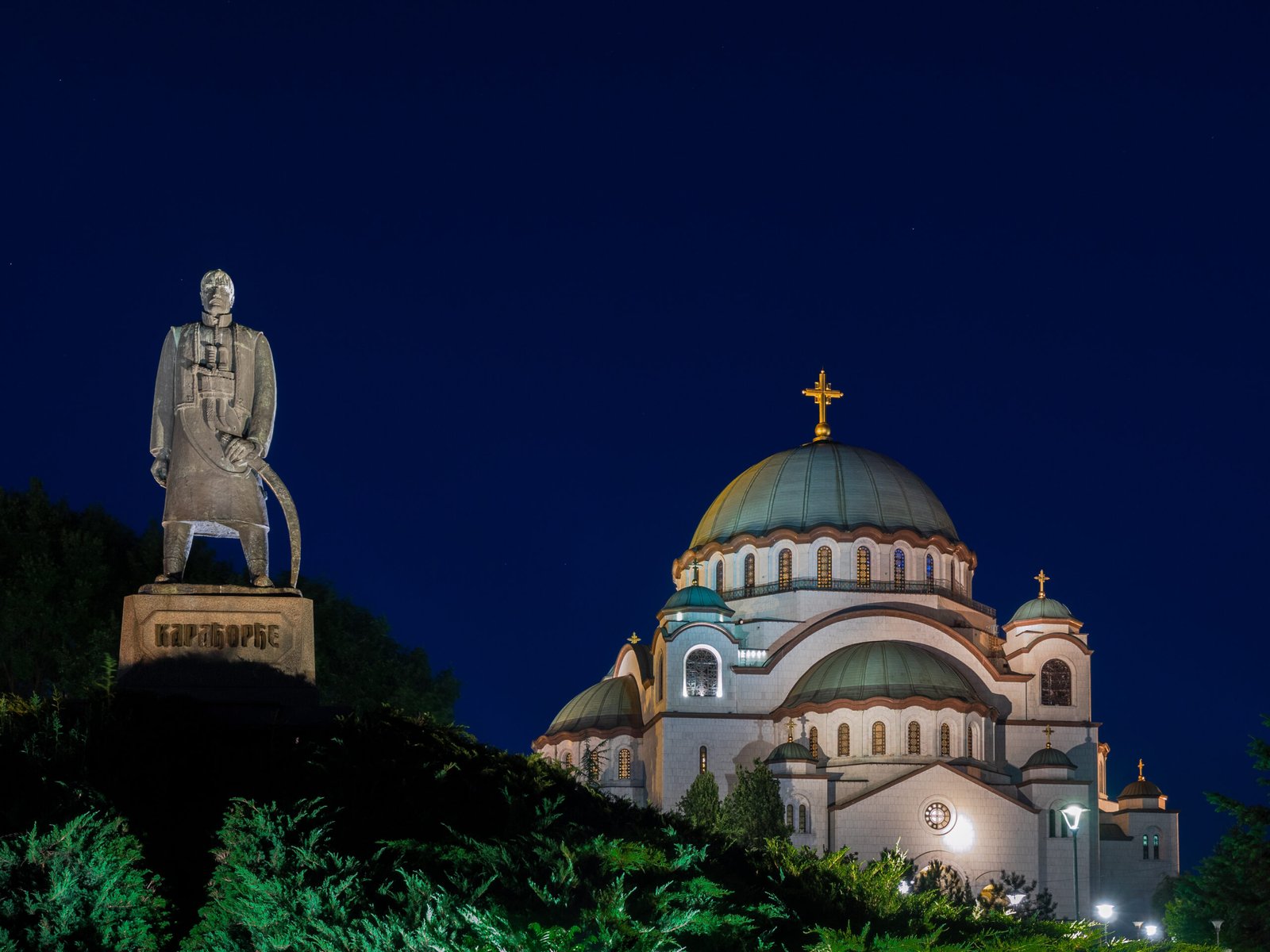
Photo: Petar Milošević, CC BY-SA 4.0, via Wikimedia Commons — the Church of Saint Sava in Belgrade, one of the largest Orthodox churches in the world.