
Quick answer: Getting around Albania, North Macedonia, and Kosovo means switching transport modes at each border: Albania runs on informal furgon minibuses plus a few fixed-schedule coaches, North Macedonia has a thin but usable train network alongside buses, and Kosovo relies almost entirely on buses and shared taxis. None of the three link up by rail across borders — every international leg is by road. Below is what actually works in each country, including a correction on a claim you’ll see repeated on other sites: there is no train to Ohrid, despite what a few outdated guides still say.
Contents
Getting Around Albania: Furgons and Coaches
Albania’s backbone is the furgon: a shared minibus, usually a Mercedes Sprinter, that leaves an informal gathering point once it’s full rather than on a timetable. Furgon “stations” cluster near markets or main squares rather than a purpose-built bus terminal — in Tirana, for instance, buses heading north gather near Zone e Kombinatit and other points that shift periodically, so it’s worth asking your guesthouse the evening before rather than trusting an old blog post’s directions. Fares are cash-only in lek and cheap: Tirana–Berat runs roughly €4-5, Tirana–Sarandë €12-15. Most long-distance furgons depart in the morning between 06:00 and 10:00, and mountain routes to Theth or Valbona are best pre-arranged through your accommodation rather than caught on spec. A smaller number of routes, mostly to Sarandë, Vlorë, and the Tirana–Pristina international line, run on fixed schedules bookable online.
Getting Around North Macedonia: Trains and Buses
North Macedonia has a small, slow, but genuinely useful train network out of Skopje, running to Kumanovo, to Veles and on to Gevgelija near the Greek border, and to Bitola via Prilep. Fares are cheap and worth it on the routes that exist. What doesn’t exist: a train to Ohrid. A narrow-gauge line once ran from Skopje toward Ohrid via Kičevo, but it was closed and dismantled back in 1966 — you’ll still see the occasional outdated guide claim otherwise, but Ohrid today is reached by road only, either directly from Skopje (~3h20m by bus) or via a Bitola stopover if you want to combine the train with a bus onward. For everywhere else, intercity buses fill the gaps the rail network leaves, departing from Skopje’s main bus station on regular, bookable schedules.
Getting Around Kosovo: Buses and Shared Taxis
Kosovo has no passenger rail service for travelers to speak of, so buses handle everything: frequent, reasonably comfortable coaches connect Pristina with Prizren, Peja, and Gjakova, typically running every 30-60 minutes on the busier routes and departing from Pristina’s main bus station just south of the center. Shared taxis (running a similar model to Albania’s furgons, minus the total lack of schedule) fill in on routes with thinner bus service, especially toward smaller towns near Rugova Canyon. Within Pristina itself, city buses are cheap but a taxi or rideshare is usually more practical for short hops given how compact the center is.
Crossing Borders by Bus
All three international legs on the classic loop run by road coach, not rail or minibus:
| Route | Duration | Booking |
|---|---|---|
| Tirana → Pristina | ~4 hours | Gjirafa Travel, Balkanviator, or station counter |
| Pristina → Skopje | ~2 hours | Gjirafa Travel or station counter |
| Skopje → Ohrid | ~3h20m | Station counter (limited online booking) |
| Ohrid → Tirana | ~2h45m | Gjirafa Travel or station counter |
See our full Balkans overland route guide for the border-crossing details (including the one real complication in the region: Kosovo–Serbia entry order).
Renting a Car Across the Three Countries
A rental car is the most flexible way to link all three countries, and one-way rentals (pick up in Tirana, drop off in Skopje or Pristina) are commonly available for an added cross-border fee. Confirm explicitly that your rental agreement and insurance cover Kosovo — a handful of insurers based in North Macedonia and Serbia still exclude it due to the non-recognition dispute, even when they happily cover Albania. Roads on the main routes (Tirana–Pristina, Pristina–Skopje, Skopje–Ohrid) are modern dual carriageways; roads off the main loop, especially toward the Albanian Alps, are narrower and slower than GPS travel-time estimates suggest.
Staying Connected: SIM Cards
Each country needs its own SIM — none of the three share a regional roaming plan. In Kosovo, Vala’s tourist SIM is the cheapest reliable option at around €3 for 3GB of data, 50 minutes, and 15 days of validity, sold at shops throughout the country and at Pristina airport (Vala is only sometimes available at the airport counter April–September; IPKO is there year-round and similarly priced). Albania’s Vodafone and ONE, and North Macedonia’s A1 and Telekom, are equally cheap and sold at airports and city kiosks with just a passport — expect to spend €3-10 per country for a data-focused tourist SIM.
FAQ
Is there a train from Skopje to Ohrid?
No. The old narrow-gauge line was dismantled in 1966 and never rebuilt; Ohrid is bus-only today.
Do I need to book furgons in Albania in advance?
Generally no, except for mountain routes like Theth and Valbona, which should be arranged through your accommodation the day before.
Can I use one SIM card across all three countries?
No — buy a fresh, cheap prepaid SIM in each country rather than relying on roaming, which isn’t bundled between them the way it is inside the EU.
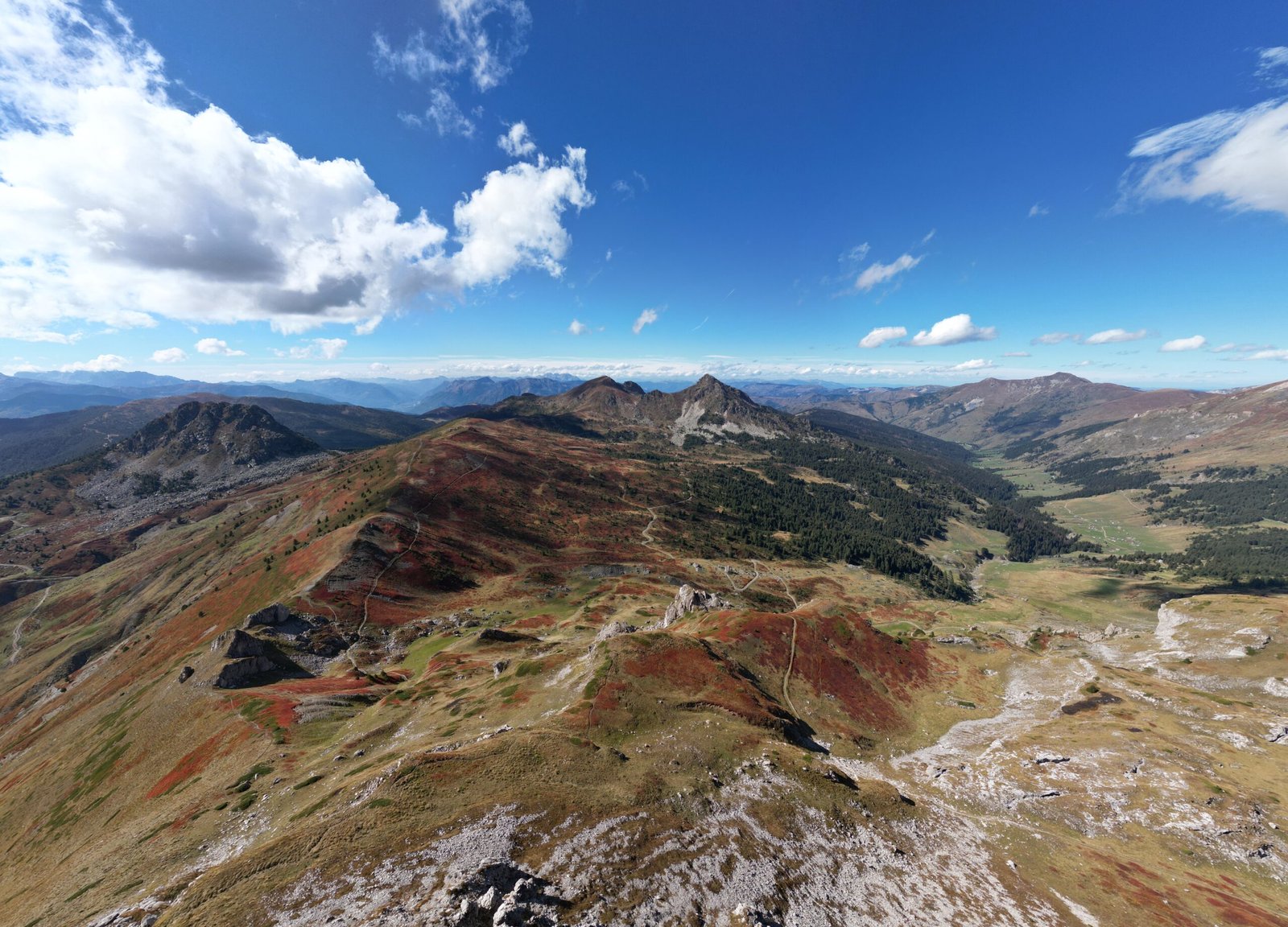
Photo: SUHEJLO, CC BY 4.0, via Wikimedia Commons — the Accursed Mountains straddling the Albania–Montenegro–Kosovo border region.