
Quick answer: Georgia (the country) remains one of the most generous visa-free destinations on earth — US and UK citizens can stay up to 365 days without a visa. But since 1 January 2026, every visitor is legally required to carry health and accident insurance covering at least 30,000 GEL (about $11,000), for the entire length of their stay. This is a genuinely new rule that most English-language guides still don’t mention. Beyond that: a new expressway has cut Tbilisi–Kutaisi driving time substantially, and several museum and park entrance fees rose in early 2026.
Table of contents
Visa: still 365 days, but read the insurance rule
Georgia’s visa-free allowance for US citizens is up to 365 days, confirmed by the US State Department’s Georgia country page. UK citizens get the same: up to a year, visa-free, per the UK Foreign Office. Overstaying triggers a fine, so it’s worth actually tracking your entry date rather than assuming a full year is casual. A passport with at least one blank page is expected at entry, and border officers retain full discretion to deny entry regardless of nationality.
If you’re carrying more than 30,000 GEL (about $11,100) in cash, in any currency, it must be declared at both entry and exit.
The mandatory insurance rule, in full
This is the single most important change for 2026, and it’s still missing from a lot of travel content: as of 1 January 2026, every tourist entering Georgia must carry health and accident insurance with minimum coverage of 30,000 GEL, valid for the entire period of your stay including your arrival and departure dates. The policy can be issued by a Georgian or foreign insurer, and can be presented in physical or electronic form, in Georgian or English.
Exemptions apply to diplomatic and official passport holders, accredited international-organization staff and their families, people covered by specific international treaties, and international commercial drivers. Ordinary tourists don’t qualify for any of these exemptions. Most standard travel insurance policies sold in the US and UK already meet or exceed this coverage threshold, so in practice this mainly means: don’t travel to Georgia without travel insurance, and keep proof of it accessible, ideally as a PDF on your phone as well as printed.
Money and costs
The currency is the Georgian Lari (GEL). Several fees rose in early 2026 that are worth knowing before you budget: the Georgian National Museum’s entry fee increased to 40 GEL, and protected-area entrance fees — including at Prometheus Cave — rose across the board from March 2026, with Prometheus Cave now also at 40 GEL. If you’ve read an older guide quoting lower figures, treat those as outdated.
Getting around: what actually changed
The Rikoti Expressway was completed on 30 December 2025, and it meaningfully shortens the drive between Tbilisi and Kutaisi (the gateway to western Georgia and Svaneti) to roughly 2.5–3 hours. A new 8.3km tunnel on the Tbilisi–Batumi railway also opened in December 2025, shaving about 30 minutes off that route. If you’re planning a west-Georgia loop, these two changes make it noticeably easier than it was even a year ago.
Air connectivity is also expanding: Etihad launched Tbilisi–Abu Dhabi service in March 2026, and Tbilisi International Airport has a $150 million expansion underway that will grow the terminal by roughly 50%. None of this affects a typical trip directly, but it’s a signal the country is investing heavily in tourism infrastructure right now.
When to go
Spring (mid-April to early June) and fall (mid-September to early November) are the sweet spots for cultural touring and lower-elevation hiking, though unexpected snowfall in Georgia’s high mountain regions like Kazbegi is possible even in May or October — pack for it. Summer (mid-June to mid-September) is when the high mountains — Svaneti, Kazbegi, and technical routes on Mount Kazbek — are most reliably accessible, though lowland heat can exceed 40°C. Winter brings skiing at Gudauri and Bakuriani, but mountain roads to Kazbegi and into Russia close periodically — sometimes for half a day, occasionally for four or five days at a stretch — so build slack into any winter itinerary that depends on those routes.
Where to go: the regions
Georgia packs an unusual amount of variety into a small country — Black Sea coast, high Caucasus peaks, and a serious wine region are all a few hours apart. We’ve written detailed, dated guides to each:
- Tbilisi Guide — the capital, Old Town, and the sulfur baths
- Batumi Guide — the Black Sea coast, and what’s gone since 2024
- Kazbegi (Stepantsminda) Guide — Gergeti Trinity Church and Mount Kazbek
- Svaneti (Mestia) Guide — medieval stone towers and Ushguli
- Kakheti Wine Region Guide — 8,000 years of qvevri winemaking
Planning a wider Caucasus trip? See our Georgia/Armenia/Azerbaijan visa comparison and Caucasus overland route guide, which covers what’s actually open between the three countries right now.
FAQ
Do US and UK citizens need a visa for Georgia?
No — both get up to 365 days visa-free. But since 1 January 2026, everyone must carry qualifying travel insurance (minimum 30,000 GEL coverage) for their whole stay.
Is Georgia expensive?
Still inexpensive by US/UK standards overall, though several museum and national park fees rose in early 2026 — check current prices rather than older guides.
Can I combine Georgia with Armenia or Azerbaijan?
Yes — see our Caucasus overland guide for what border crossings are actually open and what isn’t.
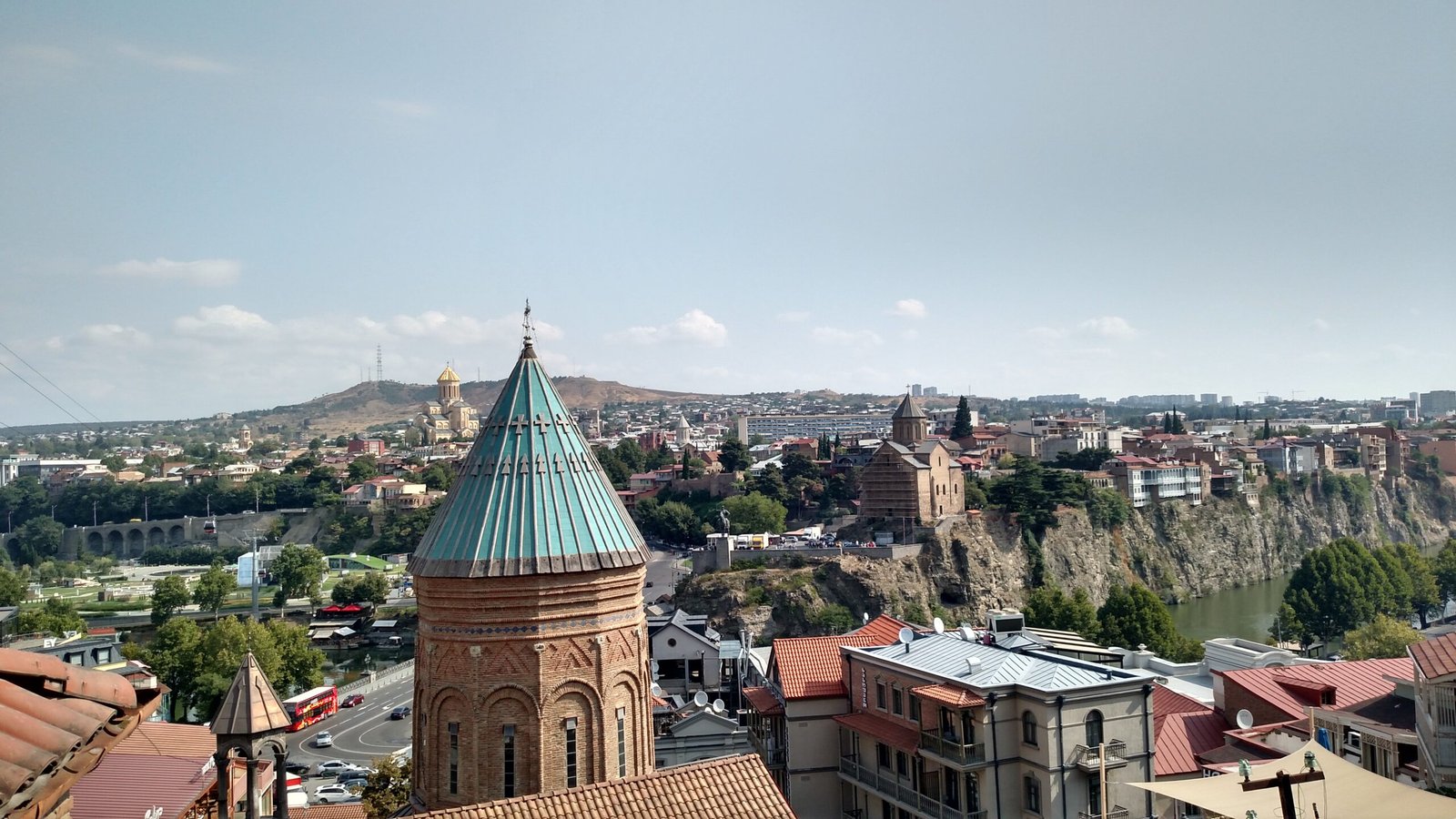
Photo: Nodar Ambartsumov, CC BY-SA 4.0, via Wikimedia Commons.